
Life is the set of processes and experiences that produce self-organising, responsive systems and conscious experience; spiritually it is the unfolding of meaning, purpose and connection that shapes wellbeing and inner direction. This definition bridges biological functioning with spiritual purpose to answer “life what is life” directly.
Understanding the Fundamental Question: What Is Life?
Answer: Life is both a biological phenomenon—organisms that metabolise, grow, reproduce and respond to stimuli—and a lived, conscious process that spiritual traditions describe as meaning, purpose and relational energy shaping wellbeing.
Life (first use): in biology, a set of organized processes that maintain an organism’s structure and enable reproduction and adaptation; in spiritual usage, an ongoing expression of meaning and connected awareness.

This answer combines two registers. Scientifically, life is defined by observable characteristics such as metabolism and reproduction; spiritually, life is described as a field of meaning and relational energy that supports purpose and wellbeing. Clear distinctions help: one is descriptive and testable, the other is interpretive and value-oriented.
Term: metabolism — the chemical processes in an organism that convert energy and support growth and maintenance.
When someone asks “life what is life”, they usually want both a clear conceptual definition and a way to connect that definition to their sense of purpose. Below we expand scientific definitions briefly, then prioritise spiritual wellness frameworks to help you form a personally useful concept of life.
Transition: With a working definition in place, next we compare the scientific, philosophical and experiential criteria people use to identify and explain life.
Scientific and Philosophical Definitions of Life?
Answer: Scientifically, life is characterised by metabolism, growth, reproduction, homeostasis, response to stimuli and evolution; philosophically, definitions range from vitalism to mechanistic materialism and existentialist accounts that prioritise meaning and agency.
Consciousness (first use): a state of awareness and subjective experience, often used in philosophical and spiritual descriptions of life to differentiate mere biological functioning from lived experience.
According to recent scientific consensus, biologists typically list core characteristics rather than a single universal definition because boundary cases (viruses, prions, sterile organisms) complicate a strict binary. For accessible summaries of these criteria see Nature and authoritative overviews such as the Encyclopaedia of Life Sciences.
| Framework | Core claims | Strengths | Limitations |
|---|---|---|---|
| Biological (modern consensus) | Metabolism, growth, reproduction, homeostasis, response, evolution | Empirical, testable, useful for classification | Edge cases and definitions vary by context |
| Vitalism | Life requires a distinct vital force beyond chemistry | Captures sense of enlivening quality | Rejected by mainstream science; not empirically supported |
| Mechanistic materialism | Life emerges from complex physical and chemical interactions | Predictive, consistent with biology and chemistry | Can feel reductionist about meaning and experience |
| Existential/phenomenological | Life defined by subjective meaning, choice and being-in-the-world | Addresses lived experience and purpose | Subjective, varies across cultures and individuals |
Philosophers from Aristotle (who defined life in terms of soul and function) to modern existentialists like Sartre (who emphasised freedom and meaning) offer competing accounts. For a thorough philosophical treatment, see the Stanford Encyclopedia of Philosophy entry on “life” at plato.stanford.edu.
Comparative examples:
- Viruses: biologically active within hosts but lack independent metabolism, challenging firm biological boundaries.
- Plants: meet biological criteria yet raise questions about consciousness and subjective life in philosophical debates.
- Humans: satisfy biological criteria and exhibit high levels of consciousness, self-reflection and meaning-making.
Transition: Scientific and philosophical accounts establish frameworks; the next section explores how spiritual wellness reframes the question toward purpose, connection and vitality.
The Concept of Life from a Spiritual Wellness Perspective?
Answer: From a spiritual wellness perspective, life is the unfolding of inner purpose, relational connection and conscious presence; it is experienced as an energetic or soulful movement that supports growth, compassion and alignment with deeper values.
Spiritual frameworks emphasise qualities that matter for wellbeing: meaning, interconnectedness, moral orientation and practices that cultivate presence. These understandings are not empirical claims about cellular metabolism but interpretive models that shape how people live and evaluate life quality.

Examples of spiritual descriptions across traditions:
- Hindu/Bhakti traditions: life as Atman (soul) expressing and learning through relationships and duty.
- Buddhist perspective: life as process (paticca-samuppada) of dependent arising, emphasising impermanence and liberation from suffering.
- Christian mysticism: life as participation in divine love and purpose, emphasising transformation and service.
Practical implications for spiritual wellness:
- Presence and mindful awareness reframe daily experiences as meaningful moments rather than mere events.
- Connecting to community, ritual and service creates a sense of life as relational energy rather than isolated existence.
- Discernment of values or vocation sustains purpose and reduces existential anxiety.
Deepening your concept of life often benefits from practices; see
daily spiritual practices and
how to be more spiritual offer direct tools to embody this concept.
Deep relational experiences—what some authors call
deep soul connections—often reshape someone’s sense of what life fundamentally is, moving from survival to service and meaning. For examples of practices that inform spiritual conceptions of life see
examples of spirituality and practices and read about
spiritual connection meaning.
Transition: Understanding spiritual framings helps map life to wellness outcomes; we next survey the best definitions across traditions to show the range available.
Exploring the Best Definitions of Life Across Various Traditions?
Answer: The “best” definition of life depends on purpose: biology serves scientific classification, philosophy addresses ontology, and spiritual/religious traditions emphasise meaning, relationship and transformation; each offers practical insights for living well.
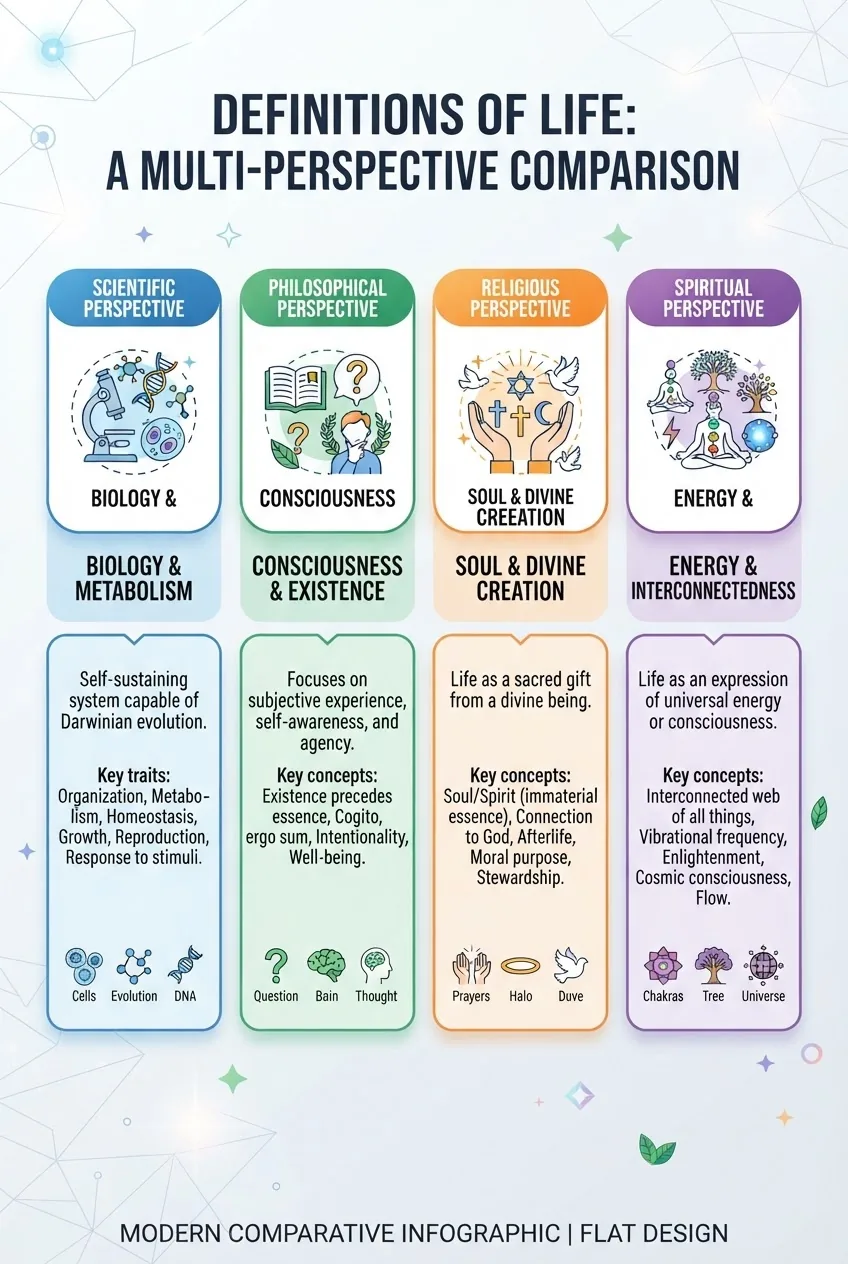
Below are concise, authoritative definitions from several traditions, presented to help you choose a working definition that supports spiritual wellness.
- Biological definition: Life is a set of self-sustaining chemical and physical processes—metabolism, growth, reproduction, homeostasis and evolution. Strength: empirical clarity. Limitation: excludes meaning.
- Aristotelian (teleological) definition: Life is a form with a purpose (entelechy); organisms actualize their potential. Useful for thinking about flourishing and function.
- Vitalist tradition: Life contains a non-physical vital principle. Historically influential but unsupported by modern experimental science.
- Mechanistic/materialist: Life emerges from complex interactions of matter and energy. Aligns with contemporary biology and neuroscience.
- Existential/phenomenological: Life is lived choice and meaning; existence precedes essence (Sartre). Useful for responsibility and purpose-focused work.
- Indigenous perspectives: Life often seen as relational — land, ancestors and community animate a person’s existence; values reciprocity and stewardship.
- Buddhist process view: Life as conditioned arising without an enduring self; emphasises impermanence and the possibility of liberation from suffering.
- Christian theological view: Life as participation in God’s creative love and a call to transformation toward compassion and service.
- Holistic spiritual definitions: Life as integrated body-mind-soul vitality where wellbeing arises from balance, presence and connection.
Choosing a “best definition” depends on what you need: scientific predictability, moral guidance, communal meaning, or practical wellbeing. A working recommendation for spiritual wellness is a composite: recognise biological facts while prioritising purpose, connection and conscious presence.
Transition: With options outlined, the next section shows how treating life as a journey integrates purpose and meaning practically.
Life as a Journey: How Does Purpose Integrate with Meaning?
Answer: Treating life as a journey reframes identity into a directional process where purpose and meaning are discovered, tested and refined through experience, practice and relationships; practical steps include values clarification, small experiments and service.
Frameworks that support the journey metaphor:
- Life path models: view life as stages with recurring themes, helpful for long-range focus — see resources on
finding your life path. - Purpose discovery: iterative process of testing interests, values and strengths — a core step is
finding your purpose. - Balance and meaning: purpose that clashes with daily life requires integration strategies; see
building meaning and balance in life.
Practical reflection points to integrate purpose and meaning:
- Clarify values: list 3 non-negotiables that shape daily choice.
- Set micro-goals: small experiments reveal whether a direction fits.
- Serve consistently: routine contribution tests sustainability of purpose.
- Reflect quarterly: reassess priorities and adjust course.
Transition: The clearer your concept of life as a journey, the more directly it can improve spiritual wellness; the following section connects definition to measurable wellbeing outcomes and practices.
How Understanding Life Enhances Spiritual Wellness and Well-being?
Answer: A clarified concept of life aligns values and behaviour, reduces existential anxiety, increases resilience and deepens presence; these effects are supported by spiritual-wellness research and consistent practice.
According to a 2024 industry report on spiritual wellbeing, many people report improved clarity and life satisfaction after intentionally clarifying their spiritual meaning and practices. Such findings are echoed in academic studies linking spiritual connection to mental health benefits; see a representative review at PubMed/NCBI.
Key wellbeing pathways:
- Meaning pathway: explicit definitions of life reduce indecision and provide a narrative that supports coping.
- Connection pathway: defined life as relational increases social support and belonging; see
spiritual needs and their importance. - Practice pathway: regular presence and ritual stabilise emotions and reinforce purpose—read more on
enhancing spiritual health and wellness and resources on
achieving inner peace.
Case example (concise): A mid-career professional reframed life from “career success” to “service and presence”; after six months of targeted spiritual practices and values alignment they reported reduced anxiety and clearer decisions—an outcome documented in workplace wellbeing studies linking purpose with reduced burnout.
Practical actions that follow from a clarified life concept:
- Create a one-sentence life statement that connects role to deeper values.
- Implement a 5–10 minute daily practice to cultivate presence (see
daily spiritual practices). - Use community and mentoring to test and refine purpose-driven decisions.
Transition: To make these approaches durable, use reflective exercises to articulate and iterate your personal concept of life; the next section provides guided steps and prompts.
Reflection and Practical Guidance: How Can I Define My Own Concept of Life?
Answer: Define your concept of life by combining values clarification, reflective exercises, trials of practice and community feedback; use journaling prompts, values inventories and micro-experiments to test and refine your definition.
Step-by-step walkthrough (practical exercise):
- Set intention (10 minutes): Quietly answer: “What matters if I had one year left?” Write one sentence.
- Clarify values (20 minutes): Use an inventory or follow the guidance to
discover your core life values. Rank top 5 and note conflicts. - Design micro-experiments (30 days): Choose two actions that align with your statement and test them for 30 days—track changes in mood, energy and clarity.
- Reflect and revise (weekly journals): Use prompts from the
asking deep life questions resource to refine language and direction. - Engage community: Share your current definition with two trusted people and invite feedback; iterate again.
Reflection prompts for immediate use (journaling):
- What three things make me feel most alive?
- Which relationships and activities expand my sense of purpose?
- When do I notice presence most easily?
- What small daily practice helps me return to clarity?
Tools and links to further practical resources: identify and act on goals with structured help—see
identify your values and goals, use
living your purpose, and for practical life balance ideas consult
building meaning and balance in life.
Note: Personal definition work is iterative. If you feel stuck, review the exercises above and consider seeking a trusted spiritual mentor or counsellor to help integrate insights into daily life.
Transition: Having defined your concept of life, the conclusion below summarises how that clarity supports continued spiritual growth and offers a call to action.
Conclusion: How Can Embracing a Clearer Concept of Life Support Spiritual Growth?
Answer: Embracing a clearer concept of life aligns behaviour with values, increases presence and supports resilience; integrating biological understanding with spiritual purpose produces a practical framework for ongoing wellbeing and meaning.
Key takeaways:
- Life can be defined in multiple complementary ways; choose a working definition that serves your wellbeing.
- Combine scientific knowledge (metabolism, reproduction, consciousness) with spiritual frameworks (purpose, connection) for balance.
- Use simple practices—daily presence, values clarification, service—to operationalise your concept of life.
Final CTA: Use the exercises here to write your one-sentence life concept, test it for 30 days with
daily spiritual practices, and revisit the resources linked above to deepen clarity and purpose. For foundational reading on the role of spirituality and purpose in wellbeing see the
importance of spirituality and purpose for wellbeing.