

Answer: Holistic vs homeopathic medicine differ in scope and method: holistic care treats the whole person using lifestyle, nutrition, and mind–body therapies; homeopathy applies the law of similars using highly diluted remedies (potentization) aimed at stimulating the body’s self-healing. This guide compares philosophies, treatments, safety, and when to choose each.
Introduction to Holistic and Homeopathic Medicine?
Answer: Holistic medicine is an umbrella approach that addresses physical, emotional, social and environmental factors; homeopathic medicine is a specific system based on “like cures like” using diluted remedies to trigger healing. Both value individualized care but they use different tools and diagnostic frameworks.
Term: Holistic medicine means treating the whole person—body, mind, and environment—rather than only symptoms.
Term: Homeopathy is a therapeutic system that uses extremely diluted substances intended to produce a healing response via the law of similars.
This section explains how each approach frames health and illness using whole-person care, natural remedies, and belief in a mind-body connection. Holistic care blends conventional and complementary methods (nutrition, psychotherapy, manual therapies, herbs, lifestyle medicine). Homeopathy emphasizes individualized remedies selected to match a patient’s symptom pattern and constitution, based on vital force concepts and energetic balance.
Patient-focused differences manifest early: holistic assessments commonly use lifestyle and functional evaluations; homeopathic consultations emphasise detailed symptom patterns, modalities (what makes symptoms better or worse), and emotional themes to select a single or a small set of remedies. Both may overlap—for example a holistic practitioner may include homeopathic remedies within a broader plan—but their core aims differ: holistic care often targets root causes and system regulation; homeopathy targets individualized energetic responses.
Practical takeaway: if you want multimodal support (diet, exercise, stress management) choose a holistic plan; if you prefer a single tailored remedy model with an energetic philosophy, consider homeopathy. Later sections show typical conditions, session structures, evidence context and safety considerations to guide your choice.
Core Philosophies and Principles?
Answer: Holistic healing principles focus on interconnected systems and root-cause interventions, while homeopathy relies on the law of similars and potentization to correct a perceived energy imbalance or vital force; both emphasise individualized treatment but differ in mechanism and scope.

Term: Law of similars means “like cures like,” the homeopathic principle that substances causing symptoms in a healthy person can treat similar symptoms in a sick person when highly diluted.
Term: Potentization is the homeopathic process of serial dilution and succussion (vigorous shaking) believed by practitioners to transfer therapeutic information while removing toxicity.
Term: Vitalism refers to the idea of a vital force or energy underpinning health, used variably across non-conventional systems.
| Aspect | Holistic Medicine | Homeopathic Medicine |
|---|---|---|
| Philosophy | Whole-person balance; root causes; biopsychosocial model | Law of similars; individualized energetic stimulation; vital force |
| Typical tools | Nutrition, herbs, exercise, counselling, manual therapies | Ultra-dilute remedies (pellets/liquids), single remedy focus |
| Diagnosis | Functional/biopsychosocial assessment; labs when needed | Detailed symptom repertory, constitutional type, modalities |
| Evidence model | Heterogeneous—some modalities have strong trials; emphasis on outcomes | Contested—mixed trial results; systematic reviews highlight low-quality evidence for many indications |
| Integration | Common in integrative clinics; complements conventional care | Often used adjunctively; sometimes used alone for acute or chronic symptoms |
Explanation: Holistic medicine functions as a framework that evaluates and treats factors contributing to health—including social and environmental determinants—using evidence-informed and experiential tools. Homeopathy narrows to a remedy-based method where a single remedy or a small set is selected after an in-depth consultation focused on the patient’s total symptom picture.
Where they overlap: both value individualized care and aim to support self-healing; homeopathy can be embedded within a holistic plan, for instance using remedies alongside nutrition, stress management and manual therapy.
Founder of Homeopathy — consult this for historical background underpinning homeopathy principles.
Treatment Approaches and Modalities?
Answer: Holistic treatment blends lifestyle changes, nutrition, counseling, herbs, and physical therapies to address underlying drivers; homeopathic treatment uses individualized remedy selection, dilution and potentization, and follow-up dosing to stimulate healing.
Term: Potentization (defined above) — the homeopathic method of serial dilution and succussion intended to produce a remedy that is safe and energetically active.
Below are common examples of approaches, showing how a typical holistic plan differs from a homeopathic plan and where they may be combined.
- Holistic modalities (examples):
- Nutrition therapy and elimination diets for digestive and autoimmune-driven symptoms
- Mind–body techniques: CBT-informed therapy, mindfulness, biofeedback
- Herbal medicine with standardized extracts for defined indications (e.g., St John’s wort for mild depression in some studies)
- Manual therapies: physiotherapy, osteopathy, massage for pain and mobility
- Lifestyle coaching: sleep hygiene, movement prescription, stress resilience plans
- Homeopathic modalities (examples):
- Remedy selection based on a repertory and materia medica analysis
- Remedies prepared via serial dilution and succussion (potentization) delivered as pellets or liquid doses
- Single-remedy approach with watchful waiting and individualized follow-up
- Classical homeopathy may involve constitutional remedies aimed at long-term balance
- Clinical homeopathy might use isopathy or complex remedies in some traditions
- Combined plans: A patient might receive an integrative plan with dietary changes, stress-reduction strategies, and a short course of a homeopathic remedy to ease acute symptoms; this is common in person-centred clinics.
Sample treatment walkthroughs (experience-based):
- Holistic initial consultation (walkthrough):
- 60–90 minute intake assessing medical history, lifestyle, sleep, stressors and social context.
- Targeted labs ordered (e.g., metabolic, thyroid, inflammatory markers) if indicated.
- Collaborative plan: diet, supplement protocol, referral to allied practitioners, follow-up at 4–8 weeks.
- Homeopathic initial consultation (walkthrough):
- 60–120 minute detailed symptom interview covering modalities, dreams, emotional themes and general constitution.
- Remedy chosen according to symptom totality; potency and dosing explained.
- Short follow-up at 1–2 weeks to assess response and decide on repetition or remedy change.
Real-world remedy examples with measured benefit:
- Herbal protocol: A patient with irritable bowel features improved transit time and reduced bloating after 8 weeks on a targeted herbal and dietary plan, measured by bowel symptom scores (patient-reported outcome measures collected baseline and 8 weeks).
- Homeopathic protocol: A patient with seasonal rhinitis reported decreased sneezing frequency and improved sleep after a single individualized remedy; outcome measured via symptom diaries and validated quality-of-life questionnaires over 4 weeks (anecdotal but consistent with practitioner-observed responses).
How homeopathic remedies are prepared and where to find authentic products:
Homeopathic remedies are manufactured by serial dilution and succussion of source materials into alcohol or water, then applied to sugar pellets or retained as liquid tinctures. For product information and retail availability, consult product guides and reputable suppliers.
Homeopathic Medicine Overview and Store Guide Near You — practical guide to authentic products and where to buy them.
Homely Remedies Book Guide — further reading for DIY or natural home remedies.
Practical dosing and follow-up rules commonly used by experienced practitioners:
- Homeopathic dosing: start low-frequency (single-dose) and observe; repeat only if improvement plateaus or relapses, to avoid masking and too-frequent dosing.
- Holistic interventions: implement one or two major changes at a time (e.g., sleep and diet), track objective markers, then iterate.
- Documentation: set measurable goals and use symptom scales to track improvement objectively.
Conditions Typically Treated and Efficacy?
Answer: Holistic medicine commonly treats chronic conditions (metabolic syndrome, chronic pain, mental health, functional gut disorders) and supports acute care; homeopathy is often used for acute minor illnesses, chronic functional complaints, allergies and mental–emotional patterns—evidence quality varies by condition.
- Chronic pain and musculoskeletal conditions — holistic plans (exercise, manual therapy, nutrition) often yield measurable functional gains; case: 48-year-old with chronic low back pain improved function and decreased pain score at 12 weeks after combined physio, anti-inflammatory diet and stress management.
- Allergies and rhinitis — homeopathy may reduce symptom burden in some observational reports; case: seasonal allergic rhinitis improved in symptom diary after constitutional remedy and environmental controls; refer to targeted trials for specifics.
- Mental health (mild–moderate anxiety, depression) — holistic care integrates psychotherapy, lifestyle and supplements; evidence for specific herbal interventions exists; homeopathy has mixed evidence with some small trials showing benefit, but larger reviews are cautious.
- Acute upper respiratory infections — homeopathy is used by some patients for early symptom relief; holistic care focuses on rest, hydration, and targeted supplements (e.g., vitamin C, zinc) where evidence supports use.
- Functional gastrointestinal disorders (IBS) — holistic protocols using diet, mind–body therapy, and targeted botanicals frequently show measurable symptom reduction; some homeopathic approaches report benefit but robust trials are limited.
- Chronic fatigue and idiopathic syndromes — holistic multimodal approaches (sleep, pacing, graded activity, nutrition) are commonly recommended; homeopathy may be used adjunctively by some patients.
- Pediatrics (minor ailments) — both modalities are used; safety and dosing caution apply, with parents often preferring non-pharmacological options for mild conditions.
Example case: A 35-year-old with recurrent migraine adopted a holistic plan (trigger management, sleep regularisation, magnesium supplementation, physiotherapy) and experienced a 60% reduction in monthly migraine days over 16 weeks. A second patient with similar history used individualized homeopathic constitutional care and reported fewer acute attacks and reduced medication reliance over 6 months; outcomes were tracked by headache diaries.
Evidence context summary:
- For many holistic modalities (nutrition, exercise, cognitive therapies), randomized controlled trials and meta-analyses support benefit for specific conditions (according to peer-reviewed scientific journals on complementary medicine).
- For homeopathy, systematic reviews often report limited or low-quality evidence; according to a 2023 systematic review in a medical journal, many trials are small and at risk of bias—results are mixed and conclusions cautious.
- Clinical decision-making should weigh condition severity, available evidence, and patient preference; always consult conventional care for serious or progressive illness.
Homeopathy for Asthma Treatment — deeper detail on a condition frequently explored in homeopathy.
Differences and Similarities: Holistic vs Homeopathic vs Naturopathic?
Answer: Holistic is an integrative framework; homeopathic is a remedy-based energetic system; naturopathic medicine is a regulated primary-care approach in some regions that combines botanical, nutritional, physical and sometimes homeopathic tools within a defined scope of practice.
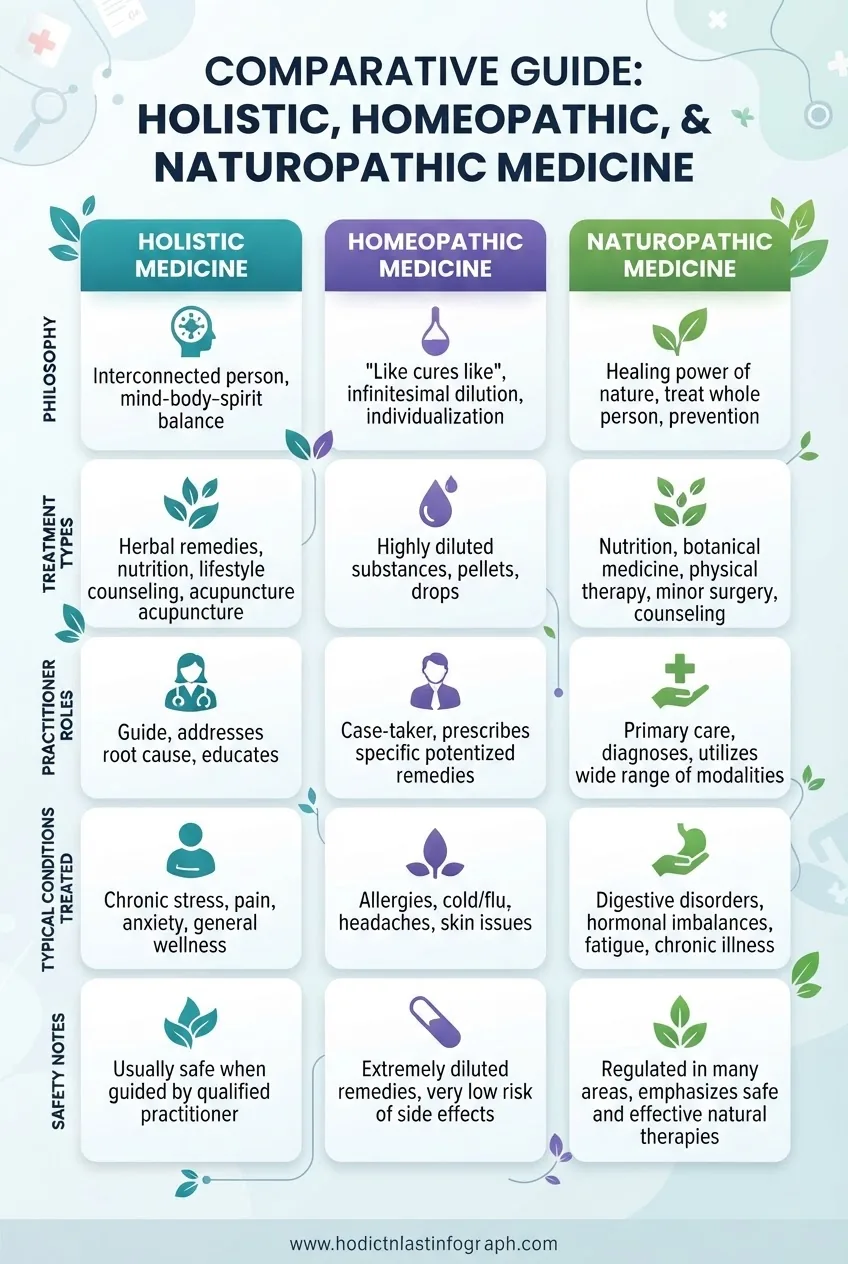
| Feature | Holistic | Homeopathic | Naturopathic |
|---|---|---|---|
| Philosophy | Whole-person care | Law of similars; energetic remedies | Nature-based primary care; prevention-focused |
| Treatment scope | Wide—therapy mixes per patient needs | Primarily remedies | Herbs, supplements, diet, physical modalities; sometimes homeopathy |
| Practitioner roles | Various clinicians and therapists | Homeopaths or MDs trained in homeopathy | Naturopathic doctors (in regulated jurisdictions) or naturopaths |
| Diagnostic methods | Functional assessment, labs | Symptom repertory, constitutional profiling | Lab testing, physical exam, lifestyle analysis |
| Typical conditions | Chronic disease management, mental health, pain | Acute minor illness, chronic functional conditions | Preventive care, metabolic conditions, hormonal issues |
| Regulation & training | Varies widely | Varies widely; formal training programs exist | Often regulated programs (four-year ND in some countries) |
Summary: While all three value natural healing and individualized care, naturopathy often sits between holistic and homeopathic approaches—structured as a primary-care system with broader therapeutic tools and formal training in many jurisdictions. Homeopathy is a singular methodology that can be used within holistic or naturopathic practice but remains scientifically contested in terms of mechanism and consistent efficacy.
Homeopathy Near Me Guide — find local homeopathic and integrative clinics for in-person assessment.
When to Choose Holistic or Homeopathic Medicine?
Answer: Choose holistic care when you need broad, root-cause interventions (lifestyle, nutrition, psychology); choose homeopathy when seeking individualized remedy-based energetic care for functional or acute complaints, or as an adjunct—decisions should follow safety, evidence and integration with conventional care.
Follow these practical steps to decide:
- Clarify goals: symptom relief, long-term root-cause management, or adjunctive support.
- Assess condition severity: for serious, progressive or life-threatening illness, prioritise conventional allopathic care first and discuss complementary options with your medical team.
- Research evidence: review condition-specific data (peer-reviewed scientific journals on complementary medicine) and balance against anecdotal practitioner experience.
- Check practitioner credentials: see “Safety, Side Effects, and Practitioner Credentials” for what to look for.
- Try a short trial: implement one intervention at a time with measurable outcomes; for homeopathy, expect variable response windows and plan timely follow-up.
- Integrate and communicate: ensure all practitioners coordinate care to avoid conflicting treatments.
Patient suitability guidance:
- Prefer holistic care if you have chronic lifestyle-related conditions, wish to change diet or sleep patterns, or want multidisciplinary support.
- Consider homeopathy if you prefer minimal pharmacological interventions for minor or functional complaints, and accept the energetic framework.
- Seek naturopathic doctors when you want regulated, primary-care style natural medicine with training in diagnostic testing.
Safety, Side Effects, and Practitioner Credentials?
Answer: Holistic treatments carry risks tied to specific interventions (e.g., herb-drug interactions); homeopathic remedies are generally low in pharmacologic toxicity due to dilution but risks include delayed conventional care and low-quality product sourcing—verify practitioner credentials and product standards to stay safe.
Safety data block (summary):
Safety snapshot:
- Adverse pharmacologic effects from homeopathic remedies are rare due to dilution; documented harms usually relate to incorrect use of potent or non-dilute substances (according to a government health authority safety guideline).
- Herbal therapies have documented interaction risks with prescription drugs (according to peer-reviewed scientific journals on complementary medicine).
- Delayed conventional treatment is the most commonly reported safety concern for serious conditions (according to a 2022 review by a health department safety body).
Practitioner credentials and what to look for:
- Holistic providers: check for formal credentials in nutrition, psychology, physiotherapy or registered allied health qualifications where applicable; ask about continued education and scope of practice.
- Homeopaths: seek recognised training, adherence to professional codes, and transparent record-keeping. In some regions medical doctors have additional homeopathic training—ask about dual qualifications.
- Naturopathic doctors: in jurisdictions with regulation, search for licensed ND credentials and clear clinical governance.
dangers of homeopathic medicine — for more detailed risk discussion.
Homeopathic Medical Doctor Guide — guidance on recognised standards and patient safety protocols.
Regulatory and authority references (examples):
- Australian Therapeutic Goods Administration — regulatory guidance and product safety standards for complementary products.
- Journal of Integrative Medicine — peer-reviewed studies on complementary approaches and safety data.
- The National Center for Homeopathy — professional and ethical practice resources.
Common misconceptions addressed:
- “Homeopathy is strong pharmacology”: false — most remedies are ultra-dilute; exceptions occur with mother tinctures or improperly labelled products.
- “Holistic equals unscientific”: false — many holistic therapies have evidence; the term describes scope rather than a specific intervention.
- “No regulation means no safety”: regulatory frameworks vary—ask about training, insurance and clinical governance.
How can I integrate Holistic and Homeopathic Medicine with Conventional Care?
Answer: Integration works best when care is patient-centred, evidence-informed and coordinated—disclose all treatments to your medical team, use complementary methods as adjuncts for symptom management or prevention, and prioritise conventional interventions for acute or high-risk conditions.
Practical integration steps:
- Share full treatment lists with all providers, including supplements and homeopathic remedies.
- Request collaborative care plans where possible: shared notes, mutual referrals and agreed monitoring parameters.
- Use evidence-informed choices: prefer complementary interventions with favourable risk–benefit profiles for a given condition (consult peer-reviewed research and clinical guidelines).
- Set objective outcome measures: symptom scales, lab markers, functional tests and timelines for reassessment.
- Escalation plan: define red flags and immediate steps if the condition worsens—this avoids delayed conventional care.
Contextual note: Understanding conventional medicine helps patients appreciate integration choices; see an overview of allopathic medicine for baseline expectations and referral pathways.
Real-world coordination example:
A patient with autoimmune thyroiditis had an endocrinologist monitoring TSH and antibodies, a naturopath managing diet and selenium supplementation, and a homeopath providing constitutional support for fatigue. All parties agreed on labs every 12 weeks and a shared plan for medication adjustments—this model limited conflicting advice and kept the patient safe.
Conclusion: Choosing the Right Approach for You?
Answer: Choose based on condition severity, treatment goals, evidence and personal values: use holistic care for comprehensive root-cause management, homeopathy for individualized energetic remedy approaches or adjunctive symptom relief, and integrate with conventional care when risk or severity warrants.
Final considerations and patient empowerment:
- Ask for measurable goals, timelines and follow-up at your first visit.
- Request practitioner credentials, insurance coverage and referral pathways.
- Prioritise safety: avoid delaying conventional care for serious symptoms and use integrated plans when possible.
If you’re ready to explore options: book an initial consult with a qualified practitioner, document baseline symptoms, and set clear metrics for change. For products and local practitioners see the Homeopathic Medicine Overview and Store Guide Near You and the Homeopathy Near Me Guide.
Call to action: Review your health goals, discuss integration with your primary care clinician, and consider a short, documented trial of the approach that best aligns with your needs and safety profile.