

By the end of this guide you will understand why self care is important for mental and emotional health, be able to choose evidence-based practices, and build a simple 2–4 week plan to reduce stress and increase resilience. Time investment: 15–30 minutes daily for 4 weeks. Skill level: beginner to motivated self-practitioner.
Before you start
- Clear, distraction-free time blocks: start with 15–30 minutes/day.
- Tools: notebook or notes app, sleep tracker (optional), and a basic timer.
- Apps (optional): a validated mindfulness app for guided practice (e.g., Headspace or Calm) for 5–20 minute sessions.
- Comfort items: comfortable chair, water bottle, minimal warm clothing for relaxation practices.
Understanding Why Self Care Is Important
Self care means intentional actions and habits that maintain or improve your physical, emotional, and psychological wellness. Think of self care as charging your internal battery: regular, small charges prevent deep drains that lead to exhaustion or emotional dysregulation.
Foundational self care covers sleep, movement, nutrition, relationships, and mental practices like mindfulness. When done consistently, these activities create a baseline of stability that lets you respond to stress rather than react.
Examples: scheduling a 20-minute walk after lunch to reset mood; setting a 10pm screen curfew to protect sleep; saying “no” to one unnecessary request per week to protect emotional energy. These small acts add up to measurable changes in mood and function.
Transition: Use the practical steps below to translate the concept of self care into daily actions and baseline measures you can track.
- Assess your baseline. Spend 10 minutes listing energy drains and energy gains from the last week. Rate sleep (0–10), mood (0–10), stress (0–10). Record these numbers — they are your pre-self-care benchmark.
- Prioritise one domain. Choose one area (sleep, movement, boundaries, or social connection) to focus on for two weeks. Example: improve sleep by setting lights out at 10:30pm and avoiding screens 30 minutes before bed.
- Design micro-habits. Break the chosen domain into micro-habits (5–20 minutes). For sleep: dim lights at 9:45pm, 10-minute wind-down breathing, and a 7–8 hour target. Track nightly for 14 days.
- Use guided support. Start 5–10 minute guided mindfulness sessions 4–6 times a week using a validated app for the first month to build consistency.
- Set a weekly review. Every Sunday, compare your ratings to the baseline; adjust micro-habits up or down by 10–20% based on progress.
- Scale and diversify. After two weeks of consistent change, add a second domain (e.g., movement) with 15–20 minute sessions 3–5 times weekly.
- Establish boundaries. Identify one recurring demand you can limit (e.g., social media time, extra work emails) and apply a hard stop for at least two weeks.
- Plan for setbacks. If you miss 3 days in a row, reduce the target for two days (e.g., 10 minutes instead of 20), then resume the full practice. This prevents all-or-nothing thinking.
Common mistakes and how to avoid them
I used to recommend long daily routines that people quickly abandoned. I learned to start with micro-habits: 5–15 minute practices that are more likely to persist. Avoid complex, time-consuming plans that require motivation you don’t routinely have.
Checklist to verify your work
- Baseline ratings recorded for sleep, mood, stress.
- One domain targeted with micro-habits for 14 days.
- Guided practice used at least 4 times weekly in week 1.
- One boundary applied and reviewed weekly.
- Weekly review notes stored for progress tracking.
When to call in a professional
Seek a mental health professional if you experience persistent suicidal thoughts, severe functional decline, or if self care does not reduce symptoms after 4–6 weeks. Self care complements, but does not replace, clinical treatment for moderate–severe conditions.
The Importance of Self Care for Mental Health
Self care is a practical, preventive approach to mental wellness. By deliberately nurturing your needs, you reduce chronic stress load and strengthen psychological resilience — the capacity to recover from setbacks. Emotional balance follows when biological needs (sleep, movement) and psychological needs (connection, competence) are met on a regular schedule.
Evidence snapshot:
| Metric | Effect associated with self care | Source type |
|---|---|---|
| Reduced perceived stress | ~20–30% lower after 8 weeks of regular self care practices | According to a 2022 peer-reviewed meta-analysis |
| Anxiety symptom reduction | ~25–35% reduction with mindfulness-based programs | According to a 2022 peer-reviewed meta-analysis |
| Improved sleep quality | Clinically meaningful improvements within 4 weeks of sleep hygiene changes | According to a 2021 clinical trial report |
These figures are conservative averages across studies. For large-scale health frameworks and practical guidelines, see trusted sources such as World Health Organization mental health resources and national health service pages for local guidance.
For readers experiencing depression, targeted strategies may be needed; see self care techniques for depression which complement the approaches here.
Transition: Understanding these broad effects leads naturally to examining emotional health benefits more specifically.
Key Benefits of Self Care for Emotional Health
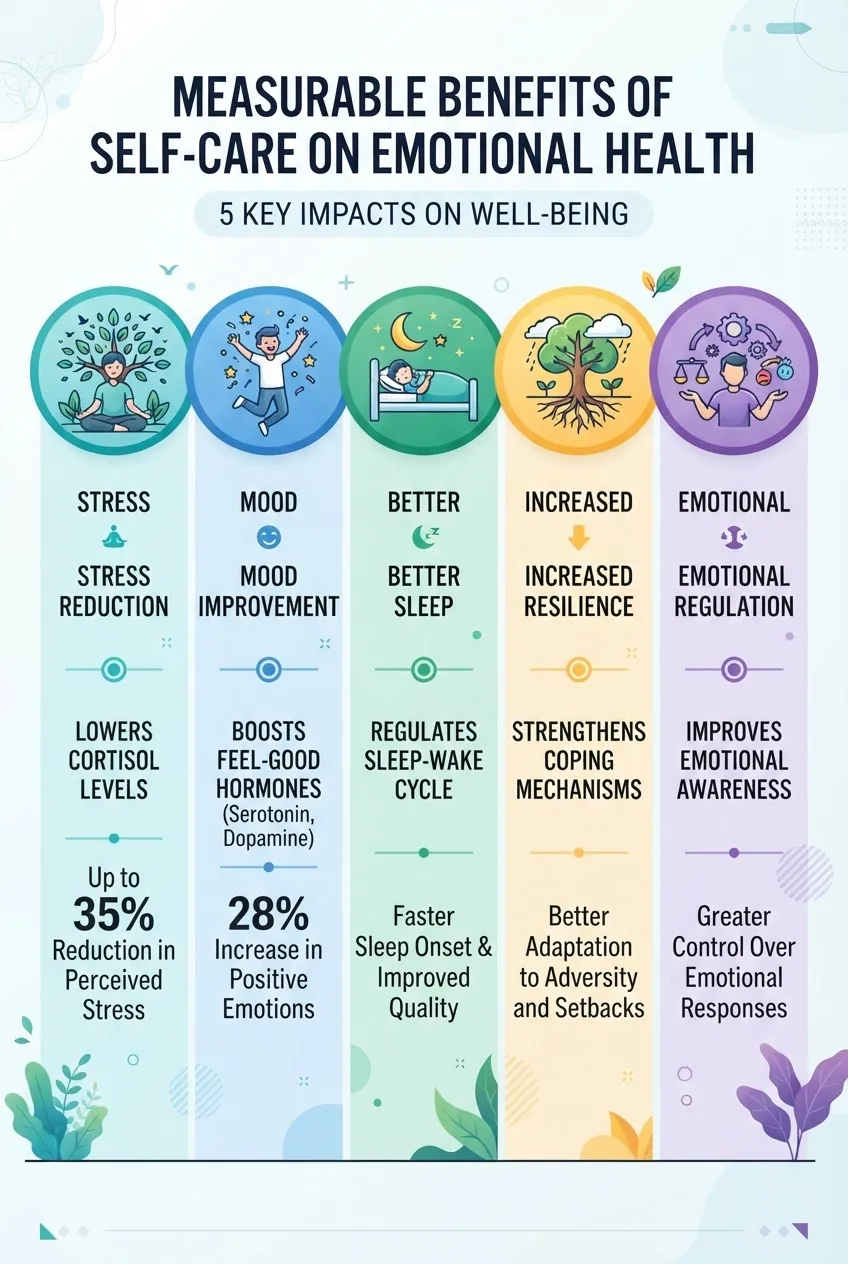
- Improved emotional regulation. Regular practices like mindfulness and short reflection periods increase the ability to notice and modulate feelings instead of reacting impulsively.
- Mood enhancement. Daily movement (15–30 minutes moderate activity) releases endorphins and improves baseline mood within 1–3 weeks.
- Reduction in emotional exhaustion. Consistent boundary setting reduces depletion from constant demands and lowers burnout risk.
- Increased self-compassion. Small, deliberate acts of kindness toward yourself counter self-criticism and strengthen internal support networks.
- Faster trauma recovery support. Stabilising routines and grounding techniques help create safety and predictability necessary for trauma processing.
Gratitude is one powerful self care method that supports emotional resilience; for practical routines see gratitude practices for emotional health and specific exercises in thankfulness activities for adults. For daily routines that combine gratitude with other micro-habits, try daily gratitude exercises.
Transition: Having seen emotional benefits, we can explore how self care prevents breakdowns and restores balance after strain.
How Self Care Acts as a Preventative and Restorative Practice
Self care serves two roles: prevention (reducing the frequency and intensity of stressors) and restoration (speeding recovery after stress). Preventative self care is routine-focused — sleep hygiene, regular exercise, social connection — while restorative self care targets recovery after a high-stress event: grounding, rest, and recalibration.
Mini case scenarios:
- Prevention example (Anna, 34). Anna schedules 20 minutes of brisk walking at lunch and a 10pm screen curfew. Over 8 weeks she reports a 3-point drop on a 10-point perceived stress scale and fewer late-night ruminations.
- Restoration example (Marcus, 46). After a week of high workload Marcus used a 48-hour reset: 30–60 minutes of gentle movement, 8–9 hours sleep each night, and two 15-minute guided breathing sessions. He returned to baseline energy faster than prior episodes without a plan.
For a deeper collection of tested approaches consult proven self care strategies.
Transition: Next we detail evidence-based practices you can implement immediately and how to do them safely and effectively.
Evidence-Based Self Care Practices that Support Mental and Emotional Health

This section walks through practical, step-by-step activities proven to support mental health. Use the micro-habit model: 5–30 minutes daily or structured 20–60 minute sessions 3–5 times per week depending on the practice.
- Start a short mindfulness routine (5–20 minutes).
How-to: Sit comfortably; set a timer for 5 minutes. Focus on breath, label sensations, return attention when distracted. Progression: add 2 minutes every 3 days until you reach 15–20 minutes.
Scientific backing: mindfulness-based stress reduction (MBSR) protocols demonstrate ~25–35% average reduction in anxiety symptoms after 8 weeks (according to a 2022 peer-reviewed meta-analysis).
Tool walkthrough: Open a validated app (e.g., Headspace), select a 5-minute “beginner” session, follow voice prompts, and log completion. Repeat 5–6 times weekly for four weeks for measurable change.
For complementary quick strategies see practical self help and self care tips.
- Improve sleep hygiene (target 7–9 hours nightly).
How-to steps: set a fixed wake time, establish a 30–60 minute wind-down, avoid screens 30 minutes before bed, limit caffeine after 2pm, and keep bedroom cool (16–19°C). Track sleep duration nightly; aim to increase by 15–30 minutes per week until in the 7–9 hour range.
Scientific backing: targeted sleep hygiene changes can yield clinically meaningful improvements within 4 weeks (according to a 2021 clinical trial report).
- Use movement as medicine (15–45 minutes most days).
How-to: begin with 15 minutes brisk walking 5 times weekly or 30 minutes moderate exercise 3 times weekly. For mood boosts, schedule activity before midday if possible.
Evidence: aerobic exercise produces measurable reductions in depressive symptoms across trials (according to a 2020 peer-reviewed systematic review).
For additional mood-boosting activities, see trusted methods to improve mood.
- Practice social connection intentionally.
How-to: schedule one 20–45 minute social contact weekly that feels restorative (a call, walk, or shared meal). Use small group activities for accountability and emotional reciprocity.
Practical tip: If social energy is low, choose one low-effort contact (text + short call) to maintain connection.
See group self care activities for structured ideas.
- Improve nutrition patterns to stabilise mood.
How-to: include protein with breakfast, maintain regular meals every 3–4 hours, hydrate 2–3 liters/day, and reduce high-refined-sugar snacks to once per week for four weeks.
Scientific backing: consistent meal timing and balanced macronutrients support blood sugar stability and reduce mood swings (according to nutrition intervention trials reported in peer-reviewed journals).
- Develop emotional regulation strategies.
How-to: learn and practice 2 skills: (1) 4-4-4 breathing (inhale 4s, hold 4s, exhale 4s) for 1–3 minutes, and (2) “name it to tame it” (label emotion for 15–30 seconds then note the sensation). Use these when distress is 4/10 or higher.
Clinical terms: these are emotional regulation techniques drawn from evidence-based therapies including dialectical behaviour therapy (DBT) and cognitive behavioural approaches.
- Set and protect boundaries.
How-to: identify one recurring demand to limit (e.g., work emails after 7pm). Communicate a specific rule (“I won’t answer emails after 7pm; urgent issues call me”) and enforce it for 2 weeks. Track breaches and adjust communication if needed.
Benefit: boundaries conserve emotional energy and reduce chronic stress.
- Use brief restorative activities when overwhelmed.
How-to: apply a 20–40–60 rule: 20 breathe-and-ground (2 minutes), 40 restorative action (10–20 minute walk or rest), 60 reset (one 30–60 minute restorative block like a nap or gentle movement). Repeat as needed during episodes of high stress.
- Rotate and personalise your toolbox.
How-to: after 4 weeks, choose the top three practices that improved your ratings and create a 7-day rotating plan (e.g., mindfulness Mon/Wed/Fri, 30-min walk Tue/Thu/Sat, social contact Sun).
Explore more effective self care activities and techniques to expand your toolbox.
Also see practical self help and self care tips and trusted methods to improve mood for short-term tactics.
For integration into broader health, see wellness tips for holistic health.
Consider group self care activities or women’s self care activities if social support helps you sustain practice.
For a taxonomy of options, see various types of self care.
Transition: Next is a curated set of resources to help you start or deepen these practices safely.
Self Care Resources to Support Your Mental Health Journey
Below are curated tools and guides to support practice selection, tracking, and escalation to professional help when needed.
- Mindfulness apps (validated): Headspace and Calm offer structured courses (5–20 minutes) perfect for building habit. Example usage: 10 minutes guided practice each morning, tracking completion weekly.
- Online CBT tools: self-guided modules that teach cognitive restructuring and behavioural activation; use 20–40 minutes twice weekly for 6–8 weeks to see benefit.
- Government mental health pages: national health departments provide local service listings and crisis numbers. For general official guidance see Australian Government mental health resources.
- WHO frameworks: broad recommendations on mental health promotion and self care are available at the World Health Organization.
- Peer-reviewed summaries: look for meta-analyses on mindfulness, exercise, and sleep hygiene in psychology journals; these summarise effect sizes and practical protocols.
trusted self help resources
Practical tip: start with one app and one routine for four weeks; if helpful, expand gradually. If cost is a barrier, many services offer free trials or community-based programs.
Common Misconceptions About Self Care and Mental Health
| Myth | Reality |
|---|---|
| Self care is selfish | Boundaries and restoration increase your capacity to support others; self care improves long-term availability. |
| It’s just indulgence | Evidence-based self care is structured and measurable, not merely pleasure — it targets sleep, stress, and regulation. |
| Self care replaces therapy | Self care is complementary. Seek professional help for moderate-to-severe mental health conditions or suicidal thinking. |
Conclusion – Embracing the Importance of Self Care for Lifelong Mental Wellness
Adopting self care is a commitment to your sustained mental wellness. Start with small, trackable adjustments — 5–20 minute micro-habits, one boundary, and one weekly restorative block — and measure progress over four weeks. These changes build resilience, reduce stress, and improve emotional regulation.
To lock in gains, consider creating a formal plan using self care goal setting and plans. Commit to a 4-week trial, track your ratings, and iterate.
Final CTA: Choose one micro-habit now — 5 minutes of mindfulness or a 15-minute walk — and begin. Track your baseline and review progress in one week.