

Ayurvedic body types—the three doshas Vata, Pitta and Kapha—describe your innate mind-body constitution; an ayurvedic body type test identifies dominant and mixed doshas so you can tailor lifestyle, routines and preventive health strategies to restore balance, reduce chronic symptoms and improve resilience.
Term: Dosha — fundamental bioenergetic forces in Ayurveda (Vata, Pitta, Kapha) that describe physical, mental and physiological tendencies.
Introduction to Ayurvedic Body Types
Answer: Ayurvedic body types are classifications of an individual’s prakriti (innate constitution) defined by combinations of the three doshas—Vata, Pitta and Kapha—and they explain predictable physical traits, mental patterns and health susceptibilities that inform personalised prevention and daily routines.
Term: Prakriti — your innate, stable constitution present from birth that reflects dominant dosha proportions.
Ayurveda is a traditional system of natural medicine whose basic principles appear in classical texts such as the Charaka Samhita and Sushruta Samhita; these sources set out that every person is born with a unique prakriti, a balanced or mixed ratio of the three elemental doshas (air/ether, fire/water, earth/water) that shape physiology and temperament. For deeper study of original sources, see Charaka Samhita translations.
Recognising your ayurvedic body type through a robust ayurvedic body type test helps you anticipate likely health patterns, choose an appropriate daily routine (dinacharya), and implement preventive measures rather than episodic fixes. For textbook context and recommended readings, consult our guide to Ayurveda foundational texts.
The Three Doshas: Vata, Pitta, and Kapha Explained
Answer: The three doshas—Vata (air/ether), Pitta (fire/water) and Kapha (earth/water)—each have identifiable elemental qualities, physical and mental traits, and common imbalance signs that determine how to tailor health strategies and daily routines.
Vata Dosha Characteristics
Answer: Vata is dominated by air and ether qualities—movement, creativity and variability—so Vata constitutions tend to be slim, energetic, and mentally agile but prone to irregular digestion, anxiety and dryness when out of balance.
Term: Vata — the dosha composed of air (Vayu) and ether (Akasha), linked to motion and nervous system activity.
- Typical physical traits: light frame, variable appetite, dry skin, cold hands and feet.
- Mental tendencies: quick thinking, creative, prone to worry or scattered attention.
- Common imbalances: insomnia, constipation, anxiety, joint pain, irregular digestion.
Vata governs movement in the body—nerve impulses, circulation, respiration, and elimination. When balanced, Vata brings flexibility, quickness and enthusiasm; when aggravated, it produces erratic or degenerative symptoms. Classical references in Charaka and modern practitioner observations align on Vata’s link to variability and dryness.
Vata dosha diet and lifestyle tips
Pitta Dosha Characteristics
Answer: Pitta is centred on fire and water—metabolism, digestion and clarity—so Pitta bodies are medium-built, warm, and focused, with strong digestion but a tendency to inflammation, irritability, and overheating when imbalanced.
Term: Pitta — the dosha composed of fire (Agni) and water, regulating digestion, metabolism and intelligence.
- Typical physical traits: medium build, strong appetite, warm body temperature, sharp appetite and digestion.
- Mental tendencies: decisive, focused, quick to learn, can be perfectionistic or irritable.
- Common imbalances: acid reflux, skin rashes, inflammatory conditions, anger and irritability.
Pitta’s fire element governs enzymatic and metabolic processes, mental acuity and body heat. Balanced Pitta supports clarity and effective digestion; excess Pitta increases inflammation, impatience, and skin or gastrointestinal symptoms. For applied Pitta recommendations, see the Pitta guide: Pitta dosha diet and health guide.
Kapha Dosha Characteristics
Answer: Kapha combines earth and water qualities—structure, lubrication, stability—so Kapha constitutions are sturdy, steady and calm, but can gain weight, experience congestion and become lethargic or depressed when imbalanced.
Term: Kapha — the dosha composed of earth (Prithvi) and water (Jala), providing structure, lubrication and momentum.
- Typical physical traits: larger or solid build, steady energy, smooth skin and strong stamina.
- Emotional traits: calm, loyal, patient, can resist change and become slow or heavy.
- Common imbalances: weight gain, fluid retention, congestion, sluggish digestion, depression.
Kapha anchors structure and stability; balanced Kapha confers endurance and emotional steadiness, while excess Kapha leads to stagnation, mucus-related disorders and low motivation. For deeper Kapha management, read Kapha dosha dietary and health tips.
Understanding Ayurvedic Body Type Tests (Dosha Tests)
Answer: Ayurvedic body type tests are structured self-assessment questionnaires and practitioner evaluations that measure long-term traits (prakriti) and current imbalances (vikriti) using observable physical signs, mental patterns and lifestyle markers to produce a scored dosha profile.
Term: Vikriti — the current state of imbalance in the doshas, which may differ from your innate prakriti due to diet, stress or environment.
Dosha tests have two complementary purposes: 1) to determine prakriti—the stable, birth-based constitution—and 2) to detect vikriti—temporary or chronic deviations from that baseline. A reliable test combines:
- self-reported trait questions (sleep, digestion, temperament),
- observable signs (skin, tongue, nails, pulse patterns),
- practitioner intake (pulse diagnosis, detailed history), and
- a scoring system that quantifies dominance and mixed types.
Methodologically, self-assessment quizzes are practical first steps; practitioner-led tests (including pulse reading or nadi pariksha) refine accuracy. For readers considering formal study, consult Ayurveda certification and training options to learn clinical testing methods and diagnostic standards.
Contemporary investigations compare practitioner-assigned prakriti with genetic and biochemical markers; for example, according to a 2023 peer-reviewed study, certain metabolic markers correlate with dominant doshas in population samples (see the study here).
Typical dosha test components and rationale:
- Trait inventory assesses long-term tendencies that define prakriti.
- Symptom inventory captures current vikriti signs (sleep, appetite, mood).
- Objective signs (tongue, pulse, skin) provide practitioner corroboration.
- Scoring weights combine frequency and intensity to identify dominance or mixed types.
Tests should always include a disclaimer: self-assessments support wellness decisions but do not replace medical diagnosis. For professional accreditation and standards, see the National Ayurvedic body: National Ayurvedic Medical Association.
How to Take the Ayurvedic Body Type and Dosha Test
Answer: Take the dosha test by answering a structured questionnaire honestly, scoring each response to calculate Vata, Pitta and Kapha totals, then interpret dominance, sub-dominance or mixed types and compare with physical signs and practitioner input.

Follow these step-by-step instructions and example questions to complete a practical ayurvedic body type test.
- Prepare: Choose a quiet time, use a printed or digital questionnaire, and be honest about lifelong patterns rather than recent fluctuations.
- Answer trait questions: Rate lifetime tendencies like body frame, sleep, appetite, memory and stress response on a 1–5 scale.
- Record current symptoms: Note recent changes in digestion, sleep, mood, skin and energy—these indicate vikriti.
- Observe objective signs: Check tongue coating, nail texture, skin moisture, eye clarity and pulse with a practitioner if available.
- Score and compare: Sum scores for Vata, Pitta and Kapha to see which dosha ranks highest, second and lowest.
- Interpret mixed types: If two doshas score similarly, you have a dual-dosha type (e.g., Vata-Pitta); balance approaches blend strategies from both profiles.
- Validate: Consult a qualified Ayurvedic practitioner for pulse diagnosis and clinical confirmation when possible.
Example questionnaire items (score 1–5 where 1=not at all, 5=very characteristic):
- Body frame: “Thin and light” (Vata trait) — score example: 5 for lifelong thinness.
- Digestion: “Strong appetite, quick digestion” (Pitta trait) — example score: 4.
- Energy: “Slow to start, steady stamina” (Kapha trait) — example score: 2.
- Mood: “Quick to worry or feel anxious” (Vata trait) — example score: 5.
Scoring guide (simple method):
- Add scores for Vata-related items = V total.
- Add scores for Pitta-related items = P total.
- Add scores for Kapha-related items = K total.
- Interpretation:
- Single-dosha dominant: one total at least 6–8 points higher than others.
- Dual-dosha: two totals within 2–5 points of each other and higher than the third.
- Tridoshic: all totals within 1–3 points (rare).
Example scoring interpretation: If V=42, P=28, K=22, primary dosha = Vata (prakriti likely Vata or Vata-dominant). If current symptoms (vikriti) show increased Pitta signs—e.g., inflammation—then bring Pitta-balancing practices into routine while preserving Vata-supportive measures.
To study practitioner-level diagnostics or formal testing curricula, review practitioner training and certification materials that teach nadi pariksha (pulse diagnosis), tongue analysis and clinical scoring standards.
Experience: A client case: after taking a self-assessment and confirming with a practitioner, Maya (35) discovered Vata-Pitta dominance; by stabilising sleep and reducing spicy evening meals she improved sleep, halved migraine days and reported better mood within 12 weeks under practitioner supervision.
Health Insights and Lifestyle Benefits of Knowing Your Dosha
Answer: Knowing your dosha lets you personalise daily routines, stress management, sleep, exercise and simple dietary choices that prevent imbalance effects—improving digestion, mood stability, energy and long-term disease prevention.
Recognising your dominant and secondary doshas clarifies why standard advice may or may not work for you; personalised strategies increase adherence and reduce trial-and-error. For targeted nutrition strategies linked to weight management, consult Ayurvedic diet tips for weight loss.
Practical lifestyle strategies by dosha (examples):
- Vata: prioritise regular meals, warm nourishing foods, gentle grounding exercise, consistent sleep schedule and moisturising skincare; calming breathing supports nervous-system regulation.
- Pitta: emphasise cooling foods, moderation with intense exercise, mindfulness for anger management, daytime routines that avoid overheating and anti-inflammatory sleep hygiene.
- Kapha: favour invigorating movement, lighter meals with stimulating spices, variety to avoid stagnation, morning routines that energise and social engagement to offset inertia.
Daily Ayurvedic routine (dinacharya) tailored to dosha supports prevention and recovery: morning tongue cleaning, appropriate exercise timing, mindful meals and evening wind-down. These practical rhythms reduce stress and metabolic strain—benefits observed both by traditional practitioners and in modern lifestyle medicine reviews (see peer-reviewed lifestyle medicine review).
Complementary therapies like massage, oil therapies and Shirodhara support nervous system balance. To explore local offerings, search for Ayurveda massage and shirodhara therapy.
Dosha knowledge also informs hair, skin and cosmetic care—see our recommendations for Ayurvedic hair care tips.
Common Dosha Imbalances and How to Address Them
Answer: Each dosha has characteristic imbalance symptoms; targeted lifestyle, dietary and herbal actions—plus detoxification or Panchakarma where appropriate—are used to restore balance and function.
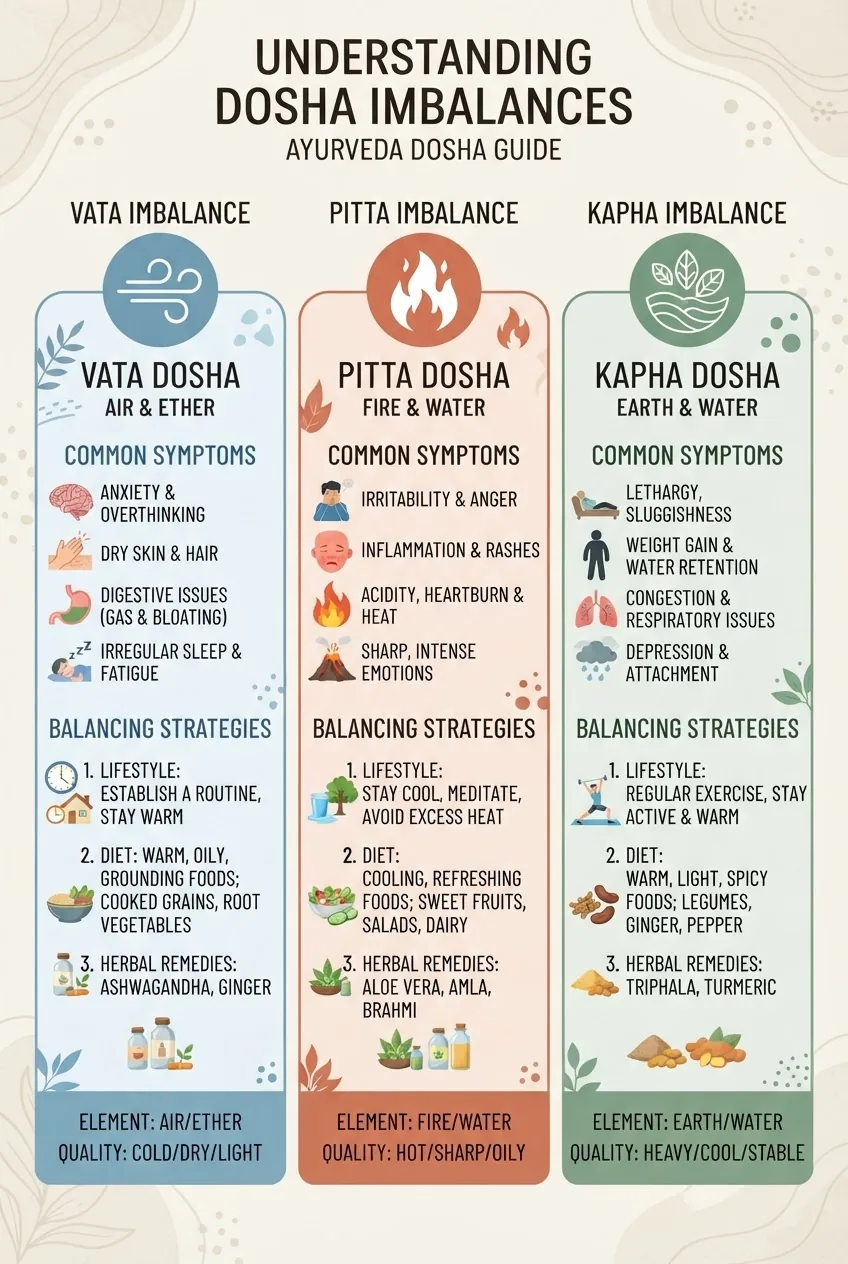
Below is a concise comparison table of common imbalances and practical first-response actions to try at home; for deeper clinical detox protocols, consider supervised Panchakarma detox treatments or curated retreat options: Panchakarma retreat options.
| Dosha | Common Imbalance Symptoms | Recommended Actions |
|---|---|---|
| Vata | Dry skin, anxiety, constipation, insomnia | Warm oil massage, regular warm meals, grounding yoga, ginger or ashwagandha under guidance |
| Pitta | Acidity, skin rashes, irritability, excess heat | Cooling foods, avoid spicy/alcohol, midday rest, aloe vera or neem-based support with practitioner input |
| Kapha | Stuffy nose, weight gain, sluggishness, fluid retention | Stimulating exercise, lighter foods, warming spices, triphala or licorice under supervision |
When imbalances persist or are severe—chronic inflammation, major mood changes, or systemic disease—seek an Ayurvedic practitioner or medical professional; for clinic locations and qualified teams, see resources on finding an Ayurvedic doctor near you.
Integrating Dosha Knowledge into Your Wellness Journey
Answer: Integrate dosha knowledge by combining self-assessment, daily routines, dosha-guided lifestyle changes and professional consultation to select herbal supplements, therapies and long-term strategies that support individualised health goals.
Start by re-taking your dosha test after 6–12 weeks of lifestyle changes to monitor vikriti shifts; data-informed adjustments yield better outcomes than one-off changes. Use practitioner insight for herbal selection, especially for complex conditions; review options at finding an Ayurveda center near you or consult certified professionals.
Ayurvedic supplements and herbal medicine
Practical integration steps:
- Confirm prakriti with an experienced practitioner to ground recommendations.
- Adopt a dinacharya that matches your dosha (timing of meals, sleep, exercise).
- Select herbs and formulas informed by dosha—use practitioner-prescribed blends not random supplements.
- Track outcomes for 8–12 weeks and adjust; if symptoms worsen, stop and consult a clinician.
For curated herbal guidance, our guide to Ayurvedic herbs and supplements and list of herbal formulas for dosha balance outline common single herbs and classical preparations; remember herbs interact with medications and require professional dosing.
If you want to study applied skills or pursue clinical roles, review Ayurveda certification and training options and clinical pathways in our practitioner training guide: practitioner training and certification.
Trust and safety note: Dosha tests are helpful for personalisation but are not substitutes for medical diagnosis; always inform your primary healthcare provider when starting herbal therapies or major lifestyle changes.
Conclusion — Key takeaways and next steps
Understanding your ayurvedic body types via a reliable ayurvedic body type test clarifies long-term predispositions (prakriti) and current imbalances (vikriti), enabling targeted lifestyle, routine and herbal decisions that improve digestion, mood, energy and chronic symptom management. Start with a structured self-assessment, validate with a practitioner, then implement incremental routines and monitored supplement choices.
Ready to act: take a structured questionnaire today, track changes for 8–12 weeks, and if you seek personalised care explore finding an Ayurveda center near you or consult our Ayurvedic supplements and herbal medicine guide to learn safe, dosha-informed choices.