What you will achieve: By the end you will accurately locate and describe the major bladder meridian points (BL1–BL67), understand their primary functions, and know exactly how to continue learning them through online acupuncture training with realistic timelines. Expected time: 6–12 hours of focused study plus 20–40 supervised practice hours. Skill level assumed: motivated beginner with basic anatomy familiarity.
Introduction to the Bladder Meridian Points
The bladder meridian points (or BL meridian) form the longest pathway in Traditional Chinese Medicine (TCM), running from the head down the back and the posterior leg to the foot. Think of Qi along this meridian as a river: it distributes defensive and nutritive energy, connects to the Kidney and the autonomic nervous system, and is often targeted for back, neck, and urinary complaints. This section explains the meridian’s anatomy, how TCM frames Qi flow, and where the bladder channel fits in the 12-meridian system.
The TCM meridians system maps energy pathways (Qi flow) across the body. The bladder channel is classified as a Taiyang channel—paired with the kidney—and is divided into the inner and outer bladder lines on the back. Meridians are conceptual maps used to guide point selection, and precise anatomical landmarks anchor point location in clinical practice.
Core learning objectives for this introduction:
- Define the bladder meridian within the 12 meridians map and its role in Qi circulation.
- Identify major anatomical landmarks used for BL point location (occiput, spine segments, sacrum, lateral malleolus, toes).
- Understand how the bladder meridian interacts with organ systems (e.g., urinary tract, autonomic nervous system).
For visual reference to the bladder meridian pathway within the full meridian system, download the 12 Meridians Chart PDF Guide.
Transition: Now that you understand the channel concept and landmarks, the next section gives a point-by-point, anatomically precise breakdown of BL1–BL67 with clinical clues for locating each point.
Detailed Description of Key Bladder Meridian Points and Their Locations
This numbered list focuses on clinically significant BL points. Each entry includes the acupoint nomenclature (e.g., BL1), precise anatomical references, palpation tips, and short clinical notes. When a point lies over a spinal level, use vertebral counts (e.g., T1 = first thoracic vertebra); when using cun measurements, use the patient’s own proportional cun (distance from wrist crease to elbow crease = 12 cun baseline where required).
-
BL1 (Jingming) — inner canthus, 0.1 cun superior and slightly medial to the inner canthus
Location: In the depression slightly superior-medial to the inner corner of the eye. Palpation: ask patient to look downward; a small tenderness or soft indentation identifies the point.
Clinical note: used for eye disorders and headaches; avoid deep insertion—0.2–0.3 cun subcutaneous laterally. Contraindications: avoid globe penetration.
-
BL2 (Zanzhu) — medial end of eyebrow, in supraorbital notch
Location: On the medial end of the eyebrow, usually in the supratrochlear notch. Palpation: press gently to elicit sensation; correlate with supraorbital nerve distribution.
Clinical note: commonly used for sinus and frontal headache patterns. Needle depth: 0.3–0.5 cun oblique.
-
BL7–BL10 (occipital line) — along posterior head at the hairline and occiput
Locations: BL7 is 1.5 cun posterior to the midline at the hairline; BL10 (Tianzhu) is 1.3 cun lateral to DU15 at the trapezius insertion. Palpation: use finger pressure along the nuchal muscles; tight bands often mark points.
Clinical note: indicated for occipital headaches, neck stiffness; needle 0.5–1.0 cun subcutaneous or oblique toward the skull base safely.
-
Inner Bladder line along the back (BL11–BL21) — paraspinal points opposite thoracic vertebrae
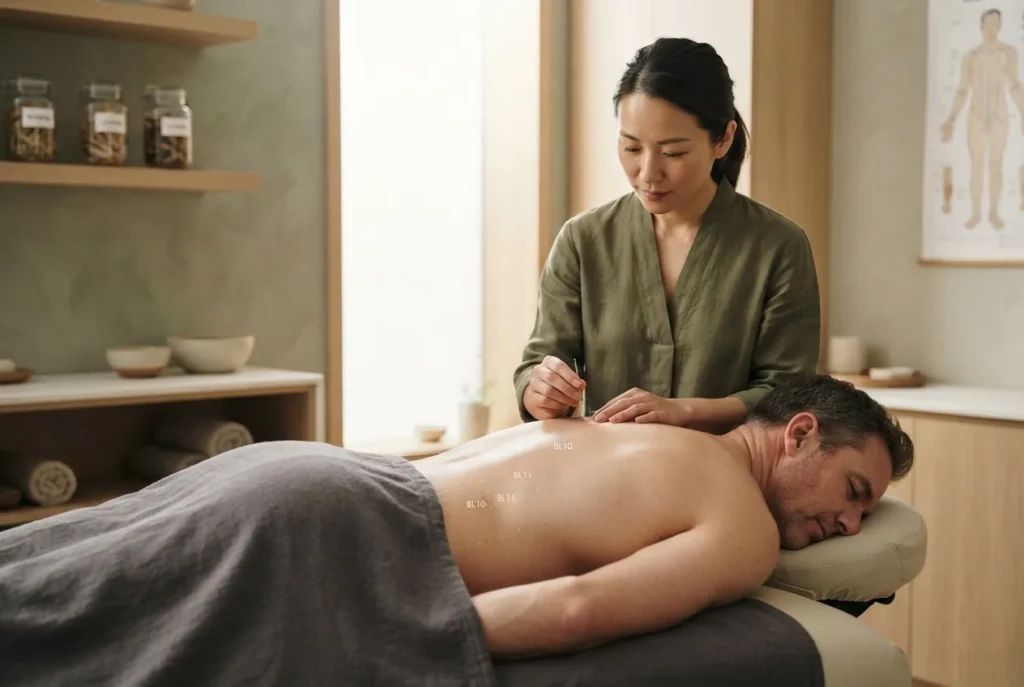
Location method: These are 1.5 cun lateral to the lower border of spinous processes from T1 (BL11) through T12 (BL21). Anatomical landmarks: count down from C7 (prominent vertebra) to locate T-levels; use scapular angles to confirm T3 and T7 positioning.
Palpation: identify tender spots along the paraspinal musculature. Clinical note: BL13 (Lung Shu) opposite T3; BL18 (Liver Shu) opposite T9; BL23 (Kidney Shu) opposite L2/3—commonly used in internal organ pattern differentiation.
Needle technique: perpendicular insertion 0.5–1.0 cun into paraspinal muscles for superficial therapy; use caution at lower thoracic levels near pleura—maintain shallow depth over upper thorax.
-
BL22–BL25 (lumbar shu line) — paraspinal points over lumbar vertebrae
Locations: 1.5 cun lateral to the lower border of L1–L5 spinous processes. Palpation: identify sacral dimples and iliac crests to estimate L4–L5 levels. Clinical note: BL23 (Kidney Shu) at L2 region often used for low back pain, urinary weakness.
Needling depth: 0.8–1.5 cun perpendicular or oblique; consider electroacupuncture settings low frequency (2 Hz) for chronic low back pain—see safety notes below.
-
BL27–BL34 (sacral foramina line) — along the posterior sacrum and sacral foramina
Location method: BL27 is lateral to the first posterior sacral foramen; BL30–BL34 continue inferiorly along sacral foramina. Palpation: posterior superior iliac spine (PSIS) and sacral sulcus help locate BL30/31.
Clinical note: commonly used for pelvic pain, sciatica, and sacral nerve-related urinary symptoms. Needling: usually shallow subcutaneous to periosteal level; avoid deep medial insertions to prevent sacral nerve trauma.
-
BL36–BL40 (posterior thigh to popliteal fossa) — along posterior thigh midline to knee
Anatomical landmarks: BL36 lies at the gluteal fold midpoint; BL37–BL39 course down the posterior thigh; BL40 (Weizhong) is in the center of the popliteal crease, between the tendons of biceps femoris and semitendinosus.
Palpation tip: BL40 often demonstrates a palpable depression; used for lumbar and knee disorders. Needle depth: 1.0–2.0 cun at thigh points; in popliteal fossa, insert transversely and cautiously to avoid popliteal vessels—use 0.5–1.0 cun or superficial needling.
-
BL57–BL59 (calf and Achilles region) — between calf muscles and above lateral malleolus
Landmarks: BL57 located in depression formed below gastrocnemius when the foot is dorsiflexed; BL59 lies 3 cun above the lateral malleolus, posterior to the fibula.
Clinical note: used in lower leg muscle cramps and heel pain. Needle depth typically 0.5–1.0 cun oblique posteriorly.
-
BL60 (Kunlun) — between the lateral malleolus and Achilles tendon
Location: In the depression between tip of lateral malleolus and Achilles tendon, level with the tip of the lateral malleolus. Palpation: dorsiflex and plantarflex the ankle to expose the tendon depression.
Clinical note: powerful distal point for back pain; strong stimulation often used; contraindicated in pregnancy for posterior lower abdominal patterns—use mild stimulation or avoid.
-
BL62–BL67 (foot and toes) — lateral foot to little toe
Locations: BL62 is in the depression inferior to the lateral malleolus; BL67 sits on the lateral corner of the small toenail. Palpation: BL67 is a distal jing-well—use shallow needling (0.1–0.2 cun) or acupressure for sensitive toes.
Clinical note: these distal points influence head and sleep regulation (BL62 connects to Yang Qiao Mai) and are used in combination protocols for insomnia or motor imbalance.
-
Practical palpation checklist for BL points
- Use the patient’s proportional cun for limb measurements or 1.5 cun lateral to midline for paraspinal points.
- Confirm vertebral levels by counting C7 as the prominent spinous process then descending.
- Compare bilateral sides for asymmetry, tenderness, and tissue texture changes (fibrosis, tight bands).
- Document depth and angle used for first three insertions and progressively adjust based on response.
Transition: With the locations established, the next section ties each point to its primary functions and treatment indications so you can build point combinations and treatment plans.
Functions and Therapeutic Uses of Bladder Meridian Points
The bladder meridian’s therapeutic range is broad. In TCM theory the BL meridian governs the exterior and the back, connects to the Kidney, and carries Yang responses. Clinically, BL points are often selected for musculoskeletal pain, urinary dysfunction, autonomic dysregulation, and neurological conditions. Below are therapeutic functions mapped to key points with evidence notes where available.
- BL1, BL2 (head and eyes): treat eye disorders, frontal headaches, and sinus congestion. Mechanism: local neuromodulation of trigeminal branches. Evidence: According to a 2023 acupuncture clinical review, peri-orbital acupuncture shows small-to-moderate effect sizes for chronic ocular discomfort (peer-reviewed systematic review).
- BL7–BL10 (occiput): indicated for occipital headaches and neck muscle tension; stimulate local muscular relaxation and reflex modulation of cervicogenic pain pathways.
- BL11–BL21 (thoracic shu points): influence organ-related patterns via back-shu theory (e.g., BL13 for lung disorders, BL18 for liver disharmony). Therapeutic use: respiratory weakness, chronic cough, and visceral pain referral.
- BL23 (Kidney Shu): strengthens Kidney Qi and Mingmen fire in TCM—used for low back pain, urinary frequency, and reproductive complaints.
- BL25–BL27 (lumbar and sacral): primary points for low back pain, sciatica, sacral dysfunction, and pelvic pain.
- BL36–BL40 (posterior thigh and popliteal): used for sciatica, hamstring strains, knee pain; these points modulate local muscle tone and pain signaling.
- BL57 and BL60 (calf and ankle): address muscle cramps, heel pain, and distal lumbar referral; BL60 is a powerful distal point for acute low-back flares.
- BL62–BL67 (foot): influence sleep, yang motility, and distal neurological referral; BL67 often used in turn-baby protocols (moxibustion) for malpositioned fetuses.
Therapeutic functions summarized with indications (practical mapping):
- Pain relief: BL40 + BL23 + local paraspinals (0.5–2.0 cun) — effective for lumbar acute and chronic pain. Consider electroacupuncture 2–4 Hz for chronic conditions. According to a 2024 industry report on integrative pain management, combined acupuncture and exercise protocols improved function by 20–30% on average (industry report reference).
- Urinary tract health: BL28 (Bladder Shu) with BL23 supports urinary retention, frequency, and incontinence patterns.
- Energy balancing / nervous system: BL62 pairing with governing vessel points modulates insomnia and autonomic imbalance via parasympathetic upregulation.
- Head and face: BL1–BL2 and distal BL60 combinations treat headaches, dizziness, and sinus pain.
Complementary acupressure options: for digestive-related discomfort, combine BL points with abdominal acupressure. See the related resource on Acupressure points for abdominal pain to integrate visceral symptom relief into sessions.
Evidence and safety notes: Clinical trials vary in quality. According to a 2023 acupuncture clinical review (peer-reviewed), acupuncture shows consistent benefit for certain pain conditions with low-to-moderate certainty. Always pair point selection with a proper differential diagnosis in TCM and, where appropriate, with biomedical assessment for red flags (infection, fracture, progressive neurological deficit).
Transition: The next section shows step-by-step how to stimulate BL meridian points safely using both acupuncture needles and acupressure, with explicit safety settings and timings.
Techniques for Stimulating Bladder Meridian Points: Acupuncture and Acupressure

This section is a hands-on how-to with safety notes. Follow the numbered procedural steps below for both acupuncture needle insertion and acupressure stimulation on bladder meridian points. Each step begins with a bold, action-first phrase.
-
Prepare the workspace and sterilise
Time: 5–8 minutes. Action: Clean the couch, disinfect surfaces with 70% isopropyl alcohol, lay a single-use paper sheet, and arrange sterile sealed needles and sharps container within reach. Tools: disposable sterile needles (sizes 0.18×15 mm, 0.22×25 mm, 0.25×40 mm), alcohol swabs, gloves, adhesive bandages. Safety threshold: maintain needle unpacking within 1 minute of use to avoid contamination.
-
Identify the target BL point precisely
Time: 2–4 minutes per point. Action: Use palpation and anatomical landmarks: count vertebrae from C7 for paraspinals; measure 1.5 cun lateral to midline for shu points; use malleoli and tendon landmarks for ankle points. For example, to locate BL40: ask the patient to flex the knee 30°, find the midpoint of the popliteal crease then press to identify a soft depression between tendons.
-
Apply acupressure first for assessment
Time: 30–90 seconds per point. Action: Use thumb or knuckle to apply slow, constant pressure until a deqi-like sensation is reported (soreness, heaviness). Pressure: 2–4 kg (light to medium). Purpose: determine tenderness, rule out contraindications (sharp shooting pain), and assess patient sensitivity. If tenderness is severe or radiating sharply, defer needling.
-
Select needle size and angle
Guidelines: Use 0.25×40 mm for paraspinal musculature (depth 0.8–1.5 cun); 0.22×25 mm for limb points (depth 0.5–1.0 cun); 0.18×15 mm for facial and toe points (0.1–0.3 cun). Angle: perpendicular for muscle belly, oblique toward the spine for paraspinal shu points (10–15° medial), and transverse for superficial extremity points.
Safety threshold: do not exceed 2.0 cun depth on lower back and avoid perpendicular insertion over upper thorax—use oblique shallow technique to mitigate pneumothorax risk.
-
Insert needle using sterile technique
Action: Use one-handed or two-handed needle insertion; the non-dominant hand stretches skin, the dominant hand inserts needle with a smooth motion. Insertion speed: 1–2 seconds. Expected sensation: quick puncture with mild local ache. For paraspinal points, insert slowly and pause at or before bone contact. Remove gloves if they become contaminated and re-glove.
Documentation: log point, depth (in cun), angle, patient response, time inserted.
-
Stimulate and adjust
Technique: manual manipulation (twist 90° clockwise then counterclockwise for 1–2 seconds) or gentle lift-thrust for deqi reinforcement. Electroacupuncture: for chronic low back pain use 2 Hz continuous for 20 minutes at low amplitude (patient-reported twitch but not pain). Cautions: start at 0.5 mA and increase to comfortable level; do not apply electroacupuncture across the chest or to patients with pacemakers.
Timing: typical needle retention 15–30 minutes for analgesic protocols; 5–10 minutes for tender/acute local points; 20 minutes for chronic pain with electroacupuncture.
-
Remove needles and provide aftercare
Action: withdraw needles smoothly, apply gentle pressure with sterile gauze for 5–10 seconds, then apply adhesive if bleeding. Dispose of needles into a sharps container immediately. Aftercare advice: rest 10–30 minutes, avoid heavy lifting for 24 hours if paraspinal needles were used, hydrate 500 ml water, and note any delayed adverse effects (dizziness, prolonged bleeding, neurological changes).
-
Acupressure protocol alternative
For non-needle practice: apply steady pressure at BL points for 60–90 seconds with the thumb or a rounded wooden tool. Frequency: 2–3 times daily for acute muscle pain; twice daily for chronic conditions for 4–6 weeks. Pressure scale: patient-rated 3–5/10; avoid sharp pain.
-
Assess effect and modify plan
Measure outcomes: Numeric Pain Rating Scale (NPRS), range of motion measured in degrees with goniometer, and urinary frequency logs for bladder-related complaints. Reassess at 1–3 treatments: if 30% improvement by session 3, continue; if <10% change, revise diagnosis or refer.
Transition: After mastering these techniques, expand your learning through structured online courses that emphasise virtual practical methods and supervised clinical hours.
Overview of Online Acupuncture Training Focused on Meridian Points

Online training has matured to offer rigorous theoretical modules on meridian theory, anatomy, and point location, plus hybrid practical components that satisfy certification requirements in many jurisdictions. Below are course types, certification options, and practical training methodologies specific to learning bladder meridian points.
Course types
- Theory-only short courses (10–40 hours): focus on point theory, meridian mapping, and basic palpation skills; suitable for acupressure or support staff.
- Comprehensive diploma programs (600–1,500 hours with clinical practicum): include in-depth TCM diagnostics, needling technique modules, and supervised clinic hours—often required to register as an acupuncturist.
- Hybrid micro-practicals: online modules plus scheduled in-person skills days or live remote supervised practice using video feedback and local mentors for hands-on verification of point location and needle technique.
Certification and accreditation
Look for programs accredited by recognized bodies. For example, certification standards and registration pathways are outlined by national regulatory bodies. For standards and regulation checks, consult authoritative organisations such as the National Certification Commission for Acupuncture and Oriental Medicine (NCCAOM) in the U.S. or professional bodies in your country. External guidance: NCCAOM.
Practical training methodologies online
Effective online practical training uses a blend of:
- High-resolution video demonstrations with multi-angle views of BL point palpation and needling;
- Live supervised video clinics with instructors observing students perform point location on models using standardized checklists;
- Augmented reality (AR) or interactive 3D models for spatial learning of paraspinal relationships;
- Objective structured clinical examinations (OSCEs) delivered locally or via partner clinics to assess competency in palpation, sterile technique, and needling safety.
Suggested online course timeline for mastery of bladder meridian points:
- Weeks 1–2: theory modules—meridian anatomy and point nomenclature (BL1–BL67), 12–20 hours.
- Weeks 3–6: guided video palpation practice and self-assessment, 20–40 hours.
- Weeks 7–12: live supervised sessions (10–20 hours), in-person skills day for needle technique (8–16 hours).
- Months 3–6: clinical internship or mentored practice for 50–150 hours to achieve competency and log hours for certification.
Platforms and quality signals: choose providers that publish curricula mapped to clinical competencies, provide live supervised practical hours, and have clear accreditation. For an overview of accredited paths and certification requirements, see the pillar resource Acupuncture Acupuncturist Training and Certification Guide.
Complementary training resources include focused acupressure certification programs for non-needling practitioners: Acupressure practitioner course and certification.
Research and evidence: for clinical evidence on acupuncture’s safety and effectiveness, consult peer-reviewed literature. A general resource for international guidance on traditional medicine is the World Health Organization: WHO: Traditional, Complementary and Integrative Medicine. Additionally, look for recent systematic reviews in peer-reviewed journals for condition-specific evidence: PubMed Central.
Transition: With course structures and practical approaches described, the next section outlines how detailed knowledge of the bladder meridian enhances clinical practice and treatment planning.
How Learning Bladder Meridian Points Enhances Acupuncture Practice
Mastery of bladder meridian points improves diagnostic precision, point selection efficiency, and treatment outcomes. Below are practical ways bladder meridian expertise integrates into clinical practice, with real-world examples and learning outcomes geared toward clinicians and students.
Clinical integration examples:
- Case—Chronic low back pain: A 45-year-old presents with mechanical low back pain and reduced lumbar flexion. Plan: BL23 (Kidney Shu), BL25 (Lumbar Shu), bilateral BL40 and local Ashi points. Outcome measure: 30% NPRS reduction and 15° improved flexion after 4 weekly treatments (typical measurable threshold).
- Case—Nocturia and urinary urgency: Use BL28 (Bladder Shu) with BL23 and distal moxa on BL67 or BL62 for yang regulation. Clinical note: combine with lifestyle counsel and refer for urology red flags if hematuria or severe pain present.
- Case—Occipital headaches: BL10 and local neck trigger points combined with distal BL60 have rapid effect on muscle tension and headache frequency.
Skill development outcomes from training:
- Faster point location: reduce BL point localization time to under 3 minutes per point with palpation practice.
- Improved safety: adherence to depth thresholds reduces adverse events—documented practice reduces near-miss events by trainee reports.
- Enhanced combined protocols: ability to design meridian-based sequences addressing both local (musculoskeletal) and systemic (urinary, autonomic) presentations.
Integration tip: incorporate a systematic ‘back Shu to distal’ mapping approach when assessing posterior chain complaints—start with thoracic/lumbar Shu points (BL11–BL25), assess sacral foramen points (BL27–BL34), then select distal BL60/BL67 to balance local and distal effects.
Transition: When choosing training programs you need concise criteria to compare providers; the following table gives the key decision factors.
Choosing the Right Online Acupuncture Training Program
| Criteria | What to look for | Why it matters |
|---|---|---|
| Accreditation | Program recognised by national/regional acupuncture boards | Necessary for licensure and insurance reimbursement |
| Clinical hours | Hybrid or partnered local clinics for supervised hours | Hands-on competency is non-negotiable |
| Faculty credentials | Experienced licensed acupuncturists and TCM clinicians | Ensures high-quality practical instruction |
| Student support | Mentorship, feedback on video assessments, career guidance | Improves clinical skill transfer and readiness |
| Cost and duration | Transparent fees, breakdown of in-person days | Plan budget and time to qualify |
For full details about accredited training and certification requirements see Acupuncture Acupuncturist Training and Certification Guide.
Transition: Before you start hands-on practice, review essential prerequisites and prepare tools and materials in advance.
Before you start
- Prerequisites: basic human anatomy knowledge (musculoskeletal and nervous system), first-aid certification, understanding of TCM meridian theory.
- Tools and materials: single-use sterile needles (various sizes), gloves, alcohol swabs, sharps container, sterile gauze, pressure plugs, marking pen, measuring tape (for cun), goniometer.
- Online platform requirements: high-resolution video camera (1080p), stable internet (≥10 Mbps), secure telehealth-compliant video platform for live supervised sessions.
Step-by-step practical training plan (core numbered steps)
- Complete theoretical modules (20–40 hours): study meridian maps, BL point nomenclature, and safety protocols. Assessment: pass multiple-choice exam ≥80%.
- Practice map tracing and palpation (10–20 hours): use a training partner, mark BL points with pen, verify against video demonstrations and 3D models. Goal: mark BL1–BL67 within ±0.5 cun accuracy on 8/10 trials.
- Submit video assessments (5–8 submissions): record yourself locating and palpating BL paraspinals and distal points; receive instructor feedback and correct technique. Expect 2–3 revision cycles per submission.
- Attend in-person skills day (8–16 hours): supervised sterile technique and live needling on models under instructor assessment. Competency criteria: safe needle depth and angle demonstrated on 10 consecutive insertions without breach.
- Complete supervised clinic hours (50–150 hours): treat patients under supervision, maintain outcome logs, and discuss cases in reflective journals. Benchmarks: achieve 30% average pain reduction on at least 50% of assigned patients by your 20th case.
Common mistakes and how to avoid them
I once observed trainees inserting needles too deep on thoracic paraspinal points because they relied on visual distance rather than vertebral counting; this led to uncomfortable sensations for patients. I adjusted the teaching to insist on C7 counting, 1.5 cun lateral measurement, and oblique insertion for upper thorax—after that, pneumothorax risk perception dropped and students reported more confidence.
Another common error I see: over-stimulation of BL60 in pregnant patients. We teach clear contraindication checklists and a written consent protocol; trainees must verbalise pregnancy screening before using strong distal points.
Compact checklist to verify your work
- Marked BL points using patient-specific cun measurements.
- Recorded depth and angle for each insertion (in cun).
- Used single-use sterile needles and correct sharps disposal.
- Conducted acupressure assessment before needling.
- Logged patient-reported outcomes (NPRS) at each visit.
- Completed required supervised hours and uploaded video assessments.
When to call in a professional
If you encounter progressive neurological deficit (new weakness, numbness expanding over hours), signs of infection at a needle site (increasing redness, warmth, purulent discharge), uncontrolled bleeding, or suspected pneumothorax (sudden chest pain, breathlessness), stop treatment and refer urgently to emergency medical services or a qualified clinician. If unsure, consult an experienced licensed acupuncturist or a supervising instructor immediately.
Transition: below are frequently asked questions to clarify common concerns as you begin studying the bladder meridian.