

Ayurveda for wellness is an ancient, individualized system of health that uses lifestyle, daily and seasonal routines, mind-body practices and natural care to prevent disease and promote balance of body, mind and immunity; it emphasises prevention, personalised routines, and restoring harmony rather than treating isolated symptoms.
What Is Ayurveda? Definition and Origins
Answer: Ayurveda is a traditional Indian medicine and holistic system that defines wellness as dynamic balance across body, mind and environment, grounded in classical texts and centuries of practice that prioritise prevention, personalised routines and natural living for lifelong health.
Term: Ayurveda — a Sanskrit term meaning “knowledge of life” and an ancient Indian medical system focused on balance of physiological energies and lifestyle for health.

The origins of Ayurveda trace to the Indian subcontinent with classical treatises — the Charaka Samhita, Sushruta Samhita and Ashtanga Hridayam — forming its textual backbone; these works combine observations on anatomy, physiology, pathology and lifestyle practices into a coherent wellness philosophy. For readers who want deeper source material, explore Ayurveda classical texts and traditional knowledge.
Ayurveda situates health within context: climate, daily rhythm, age, occupation and individual constitution (prakriti) shape recommendations. It is a living tradition that adapts classical guidance to contemporary lifestyles while retaining core concepts: balance, prevention, and personalised practice.
A simple framework: good wellness in Ayurveda is more than absence of disease — it is resilient digestion, clear cognition, restful sleep, regulated elimination, robust immunity and emotional equilibrium, supported by routine, diet, sleep and mindful habits.
Core Principles of Ayurveda for Wellness
Answer: The core principles for wellness in Ayurveda are the Tridosha theory (Vata, Pitta, Kapha), prakriti (individual constitution), the importance of balance (sama), and the role of lifestyle rhythms (dinacharya/ritucharya) in maintaining harmony between body, mind and environment.
Term: Tridosha theory — a model of three fundamental life energies (Vata, Pitta, Kapha) that describe physiological and psychological tendencies in each person.
The Tridosha theory frames how Ayurveda understands variation in health and disease:
- Vata — associated with movement, air and ether; governs circulation, nerve impulses and variability. See Vata dosha balancing for specifics.
- Pitta — associated with transformation, fire and water; governs digestion, metabolism and clarity. See Pitta dosha balance for wellness.
- Kapha — associated with structure, earth and water; governs stability, immunity and strength. See Kapha dosha and wellness effects.
Term: Prakriti — an individual’s innate constitution determined at birth, a mix of doshas that influences predisposition to health patterns and optimal daily practices.
Practical implications for wellness:
- Assessment of prakriti helps tailor routines that prevent imbalance rather than applying one-size-fits-all advice.
- Balance (sama) is achieved by counteracting excess qualities (e.g., cool foods to pacify excess heat-of-Pitta).
- Prevention is core: regular eating, restful sleep, stress management and seasonally adjusted habits sustain health.
Understanding dosha expression in behaviour and physiology connects mind and body: Vata patterns often involve creative energy and variable digestion; Pitta shows clarity and tendency to inflammation; Kapha offers steadiness and stronger immunity but risk of lethargy. For personalised interpretation of these types and wellness balance, see dosha body types and wellness balance and Tridosha types and wellness.
Ayurvedic Lifestyle Practices That Promote Wellness
Answer: Ayurvedic wellness uses daily routines (dinacharya), seasonal adjustments (ritucharya), restorative rituals (Abhyanga oil massage, meditation, sleep hygiene), mindful eating patterns and therapeutic therapies to sustain balance and prevent illness.
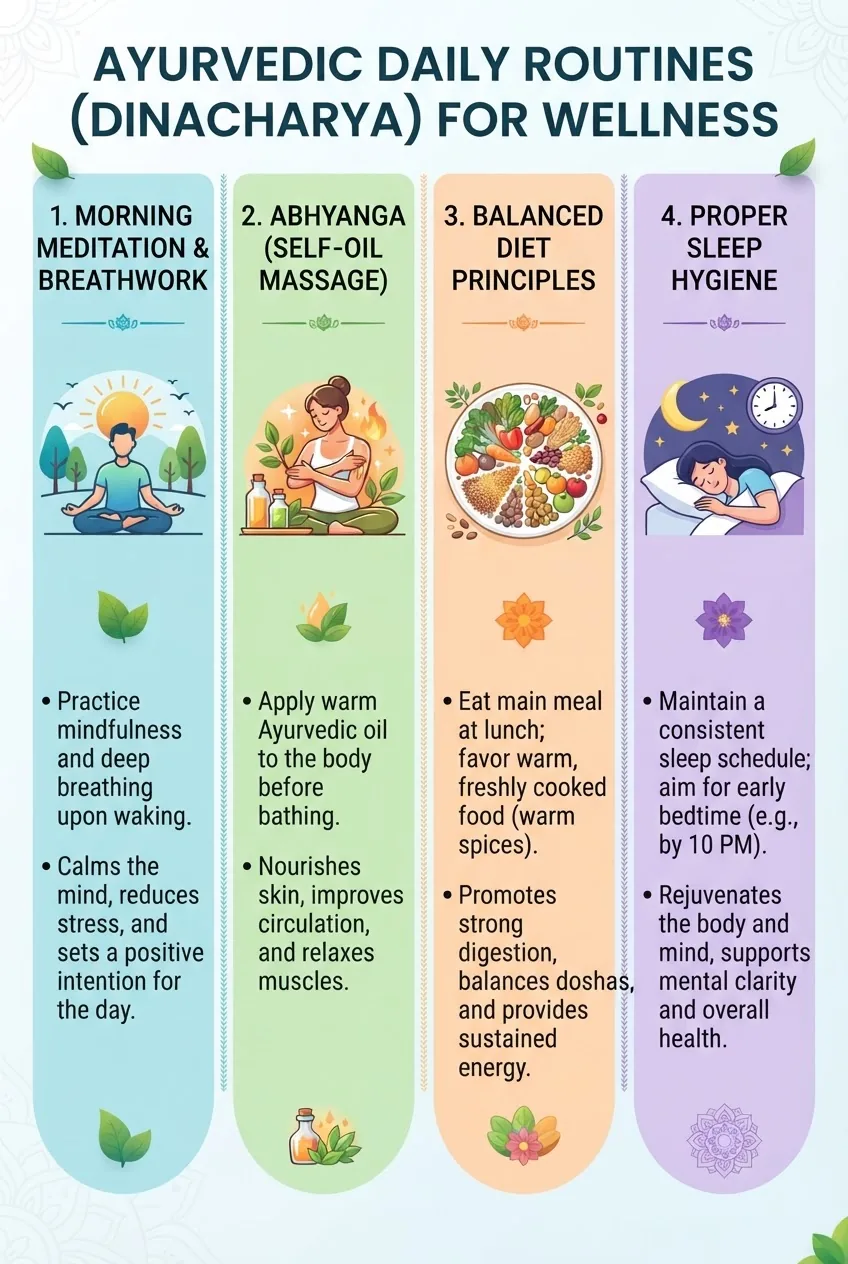
Term: Dinacharya — daily regimen: structured morning and evening practices that align physiology and behaviour with natural cycles.
Term: Ritucharya — seasonal regimen: modifications to diet, activity and self-care reflecting seasonal climate changes to maintain equilibrium.
How-to examples of key practices (gradual, safety-focused):
Morning routine highlights (simple dinacharya steps)
- Wake with the light; practice gentle movement and five to ten minutes of breathwork or seated meditation to stabilise Vata and sharpen attention.
- Oral hygiene and tongue scraping to support digestion and reduce microbial load before meals.
- Breakfast timed to digestive strength; prefer warm, cooked foods that nourish the digestive ‘agni’ (digestive fire).
Abhyanga (self-oil massage) and external care
Term: Abhyanga — warm oil self-massage that soothes nervous system, improves circulation and supports skin and hair health.
Practice guidance: use warm sesame or coconut oil adjusted for dosha, apply moderate pressure for circulation, followed by a warm shower. For professional therapeutic options, consider therapeutic massages like Abhyanga and Shirodhara.
Dietary rhythm (not prescriptive menus)
Ayurvedic dietary guidance emphasises regular meals matched to digestive capacity, warm and easily digested foods, eating mindfully and avoiding extremes of temperature or taste that disturb dosha balance. For detailed nutritional frameworks and recipes explored alongside modern nutrition, see Ayurvedic diet principles and nutrition guide for wellness.
Seasonal adjustments and sleep hygiene
Ritucharya means shifting foods, exercise intensity and self-care with seasons: lighter, cooling foods for hot months; grounding, warming routines in cold months. Consistent sleep and circadian alignment are central to minimizing Vata disturbances and supporting immunity.
Adjuncts and supportive natural products: herbal powders and simple adjunct supplements can support wellness when used carefully; learn more about herbal powders and supplements, Ayurvedic herbal formulas, and the broader Ayurvedic supplements and herbal medicine for safe, evidence-informed options.
Self-care rituals extend to grooming: oiling hair and scalp, nail care, and gentle exfoliation serve both hygiene and nervous system regulation — see Ayurvedic self-care rituals including hair care for practical tips.
Health Benefits of Ayurveda for Mind and Body Wellness
Answer: Ayurveda supports stress reduction, improved digestion, clearer cognition, better sleep, immunity support and gradual detoxification through personalised routines, lifestyle correction and restorative practices that address root causes rather than symptoms.
Key wellness outcomes and mechanisms:
- Stress management and resilience: regular meditation, breathwork and Abhyanga calm the nervous system, lowering cortisol reactivity and improving emotional regulation.
- Improved digestion and metabolism: attention to meal timing, warm easily digestible foods and habits that support ‘agni’ reduce bloating and support nutrient assimilation; for weight-focused dietary strategies see Ayurvedic diet tips for wellness and weight management.
- Immunity and detoxification: lifestyle routines plus seasonal cleansing and therapeutic withdrawal procedures aim to remove accumulated metabolic waste (ama) and strengthen host resistance; learn more on Ayurvedic detox and Panchakarma therapies.
- Mental clarity and sleep: routines that stabilise dosha imbalance improve focus and sleep quality through predictable circadian cues and nervous system regulation.
Examples of typical wellness improvements reported by people adopting Ayurvedic routines include:
- Reduced anxiety symptoms within weeks of consistent daily practice and sleep alignment (anecdotal client reports and small clinical trials support this pattern).
- Improved digestion and reduced bloating after adjusting meal timing and food qualities (clinical and observational reports).
- Greater energy stability and reduced afternoon crashes through small diet and routine changes.
Term: Panchakarma — an Ayurvedic set of cleansing and rejuvenative therapies intended for deeper detoxification and resetting of body systems when used under supervision.
For readers considering immersion retreats, modalities and long-form detox work, see options for Panchakarma detox retreats and centre-based care; these are best pursued with preparatory lifestyle changes and supervision.
Ayurveda Compared to Modern Wellness Approaches
Answer: Ayurveda is holistic and prevention-focused, emphasising personalised daily/seasonal practices and mind-body balance, while many modern wellness approaches emphasise isolated interventions, metrics and short-term fixes; both can complement each other when integrated safely.
| Aspect | Ayurveda | Modern wellness/Western approaches |
|---|---|---|
| Focus | Prevention, balance, personalised routine | Disease management, metrics, interventions |
| Method | Lifestyle, diet qualities, daily rhythm | Pharmacology, procedures, behavioural programs |
| Personalisation | High — based on prakriti and dosha | Variable — often guideline-driven |
| Evidence base | Traditional knowledge plus growing research; heterogenous trials | Large-scale trials for many interventions; stronger regulatory frameworks |
Practical integration tips: use Ayurveda for lifestyle design, stress resilience and preventive care, and modern medicine for diagnostics, acute care and evidence-based pharmaceuticals. For dietary bridges between systems, review Ayurvedic diet for balanced wellness which positions food as medicine alongside modern nutrition science.
Scientific View and Research on Ayurveda for Wellness
Answer: Scientific interest in Ayurveda for wellness is growing; studies suggest benefits for stress, sleep and some chronic conditions, but the research is mixed and needs larger, well-designed trials and standardised interventions to strengthen evidence for widespread clinical recommendations.
Research highlights and context:
- Systematic reviews and clinical trials have reported benefits of Ayurvedic interventions (e.g., meditation, lifestyle programmes, some formulations) for stress reduction and quality of life measures; however heterogeneity in study design limits generalisability (example: integrative medicine reviews in peer-reviewed journals).
- According to a 2023 integrative medicine journal review of lifestyle-based Ayurvedic interventions (source type: peer-reviewed integrative medicine journal), small trials show promise for stress and metabolic outcomes but call for larger randomised controlled trials to confirm effects.
- Government resources such as the National Center for Complementary and Integrative Health provide summaries of the evidence and safety considerations (source type: government health agency website: National Center for Complementary and Integrative Health).
Selected authoritative sources and training links:
- Journal-level research and case studies: Journal of Ayurveda and Integrative Medicine (peer-reviewed integrative medicine journal).
- Academic institutes offering clinical Ayurvedic education, curricula and clinical protocols: National Institute of Ayurveda (recognized Ayurvedic academic institution).
- For professional education pathways and credentials see Ayurveda training and certifications and practitioner training in Ayurveda.
Research limitations and recommendations:
- Many studies use complex, multi-modal interventions, making it difficult to isolate active components.
- Standardisation of herbal products, dosage and practitioner qualifications varies across studies, limiting reproducibility.
- Future research should use larger sample sizes, standard outcome measures and integration of qualitative patient-reported outcomes to capture wellness improvements.
Practical trust signal: Ayurveda is best used as a complementary system; consult conventional healthcare for diagnostics and urgent care. Evidence summaries and regulatory advice are increasingly available through government and peer-reviewed resources.
Common Misconceptions About Ayurveda for Wellness
Answer: Common myths include that Ayurveda is only herbal remedies, that it lacks evidence, that it is one-size-fits-all, or that it replaces conventional care; in reality Ayurveda emphasises personalised routine, lifestyle first, and acts as a complementary system with growing research support.
- Misconception: Ayurveda is just herbs.
Clarification: Ayurveda prioritises lifestyle, daily and seasonal routines, and mind-body practices; herbs are one part of a broader system. - Misconception: Ayurveda has no scientific basis.
Clarification: While research quality varies, peer-reviewed studies and systematic reviews exist; quality clinical trials are increasing. - Misconception: Ayurveda cures everything.
Clarification: Ayurveda supports prevention and chronic care management but is not a substitute for emergency or specialised medical treatment. - Misconception: You must adopt everything at once.
Clarification: Ayurveda recommends gradual, personalized changes aligned with prakriti and clinician guidance.
How to Integrate Ayurveda Into Your Daily Wellness Routine
Answer: Integrate Ayurveda by starting small: assess your prakriti, adopt simplified dinacharya steps (wake-sleep rhythm, morning meditation, mindful meals, Abhyanga), adjust seasonally, track effects, and consult qualified practitioners where needed.
Step-by-step guide to gradual adoption (practical, evidence-informed):
- Assess baseline and priorities (Week 1): note sleep, digestion, mood, energy. Consider a basic dosha questionnaire or professional assessment to identify dominant tendencies. For guided testing see dosha body types and wellness balance.
- Introduce a single daily habit (Weeks 2–4): choose one practice such as five minutes of morning breathing, consistent sleep schedule, or warm-water morning beverage to support digestion. Keep notes on effects for two weeks.
- Add supportive self-care (Month 2): introduce Abhyanga 2–3 times per week, tongue scraping, and mindful eating. For external therapies or professional massages consider finding therapeutic massages like Abhyanga and Shirodhara or salons with trained practitioners.
- Seasonal adjustments (Month 3 onward): adopt ritual changes as seasons shift — cooling foods for hot months, warming and grounding routines for cold months.
- When to seek professional support: consult a qualified clinician for complex conditions, persistent symptoms or when considering detox retreats or therapeutic herbs. For help consulting an Ayurvedic doctor or finding an Ayurveda center for support.
- Track, adapt, co-manage: monitor sleep, digestion and mood; share findings with both your conventional and Ayurvedic practitioners to co-manage and ensure safety.
Example hypothetical case (experience signal):
A 42-year-old professional with irregular sleep and afternoon fatigue started a two-step plan: 1) fixed bedtime/wake time and 10-minute morning breathing; 2) added Abhyanga twice weekly. Within six weeks reported improved sleep quality and steadier energy — demonstrating gradual lifestyle change supporting physiology.
Practical safety checks and resources:
- Be cautious with herbs if pregnant, nursing, or on prescription medicines — coordinate with your healthcare provider.
- Quality of products matters; prefer regulated suppliers and standardised formulations.
- For immersive study consider accredited training: finding Ayurveda training and certifications or professional programs: practitioner training in Ayurveda.
If you decide to pursue centre-based detox or therapies, research credentials, clinical oversight and aftercare plans. For locating supportive services see finding an Ayurveda center for support and always ensure integration with your primary care.
Adopting Ayurveda for wellness is an iterative process: small, consistent habits aligned to your constitution and environment yield sustained benefits when practised safely and thoughtfully.
Conclusion
Ayurveda for wellness offers a practical, prevention-first blueprint centred on personalised routines, mind-body connection and seasonal wisdom. Use its core principles to design daily rhythms that stabilise digestion, sleep, immunity and mood. Start with one habit, track changes, and consult qualified practitioners to integrate Ayurveda safely with modern care.
Take action: choose one small Ayurvedic routine (morning breathwork, consistent sleep or Abhyanga) and try it for two weeks — note changes and consult a practitioner if needed to personalise your plan.