
A herbalist doctor is a clinically trained practitioner who assesses patients and prescribes plant-based therapies using herbal pharmacology and clinical herbalism; becoming one typically requires accredited coursework or apprenticeship, supervised clinical practicum, and meeting regional certification or licensure requirements where applicable.
What Is a Herbalist Doctor? Roles and Titles Explained
Answer: A herbalist doctor practices botanical medicine to prevent, manage or support health conditions; titles vary by training, scope and regulation—examples include medical herbalist, herbal therapist, herbal practitioner and herb medicine doctor.
Herbalist doctor: a clinician trained principally in herbal medicine who applies botanical science, therapeutic formulation and patient assessment in clinical practice.
Roles span community herbalists offering traditional remedies, clinical herbalists working in integrative clinics, and academically credentialed medical herbalists who coordinate care with conventional providers. Distinctions hinge on education, legal recognition and whether the practitioner can prescribe pharmaceuticals.
Common titles and practical implications:
- Medical herbalist — often indicates formal training in botanical pharmacology and clinical case management; may work in regulated settings.
- Herbal therapist — focused on symptom relief, therapeutic preparations and client education; training may be shorter or competency-based.
- Herbal practitioner / herb specialist — broad label covering community and clinical practitioners with varying training levels.
- Herb medicine doctor — used by some clinicians with advanced herbal and medical training; usage depends on regional naming rules.
Choosing a title should be informed by legal scope, ethics and client expectations; when in doubt, check local regulation and professional body membership.
herbalist definition and study of herbalism
Overview of Herbalist Doctor Training Paths
Answer: Training paths include formal degree programs in medical herbalism or naturopathy, shorter diploma/certificate courses, and traditional apprenticeships; many combine classroom theory with supervised clinical practicum and self-directed herb study.
Primary training routes (numbered for clarity):
- University or college degree programs — 3–4 year bachelor degrees or graduate diplomas in herbal medicine, botanical therapeutics or naturopathy with integrated clinical practice.
- Accredited diploma and certificate programs — 6–36 month courses focused on herbal science, formulation and clinic skills; suitable for entry or upskilling.
- Apprenticeship / mentorships — hands-on multi-year training under an experienced herbalist, often combined with coursework to fill scientific gaps.
- Short courses and continuing education — modular workshops on materia medica, safety, formulation or specialty areas (e.g., pediatrics, oncology support).
- Hybrid programs — online theoretical modules plus in-person intensives and local clinical internships.
Trade-offs between paths:
- Degrees offer broad scientific training and professional recognition but take longer and cost more.
- Diplomas and certificates are faster and practical but may lack the depth required by some regulators.
- Apprenticeships excel at practical skills and context but vary widely in standardisation and documented competency.
Example student pathways (illustrative):
Case A: A graduate completes a 3-year Bachelor of Herbal Medicine, a 300-hour clinical practicum, passes a professional board exam and joins the national herbalists’ association to meet regional registration standards.
Complementary study areas commonly included: pharmacognosy, herbal pharmacology, clinical diagnosis, nutrition, ethics and business skills for private practice.
To deepen formulation knowledge, students often consult practical guides such as the botanical dietary supplements and their benefits, and programs emphasising integrative care refer learners to integrative health and herbal supplements guide.
Practical on-site options and accessibility:
- Search local options via certified herbalist training classes near me.
- For distance learning, see online herbalist schools and certification courses.
Transition: The chosen training route determines specific certification steps and regulatory implications discussed next.
Certification and Qualification Requirements by Region
Answer: Certification and licensure for herbalist doctors vary widely: some countries require formal registration and protected titles, others regulate herbal products but not practitioners; always verify national health authority and professional board guidance before practice.
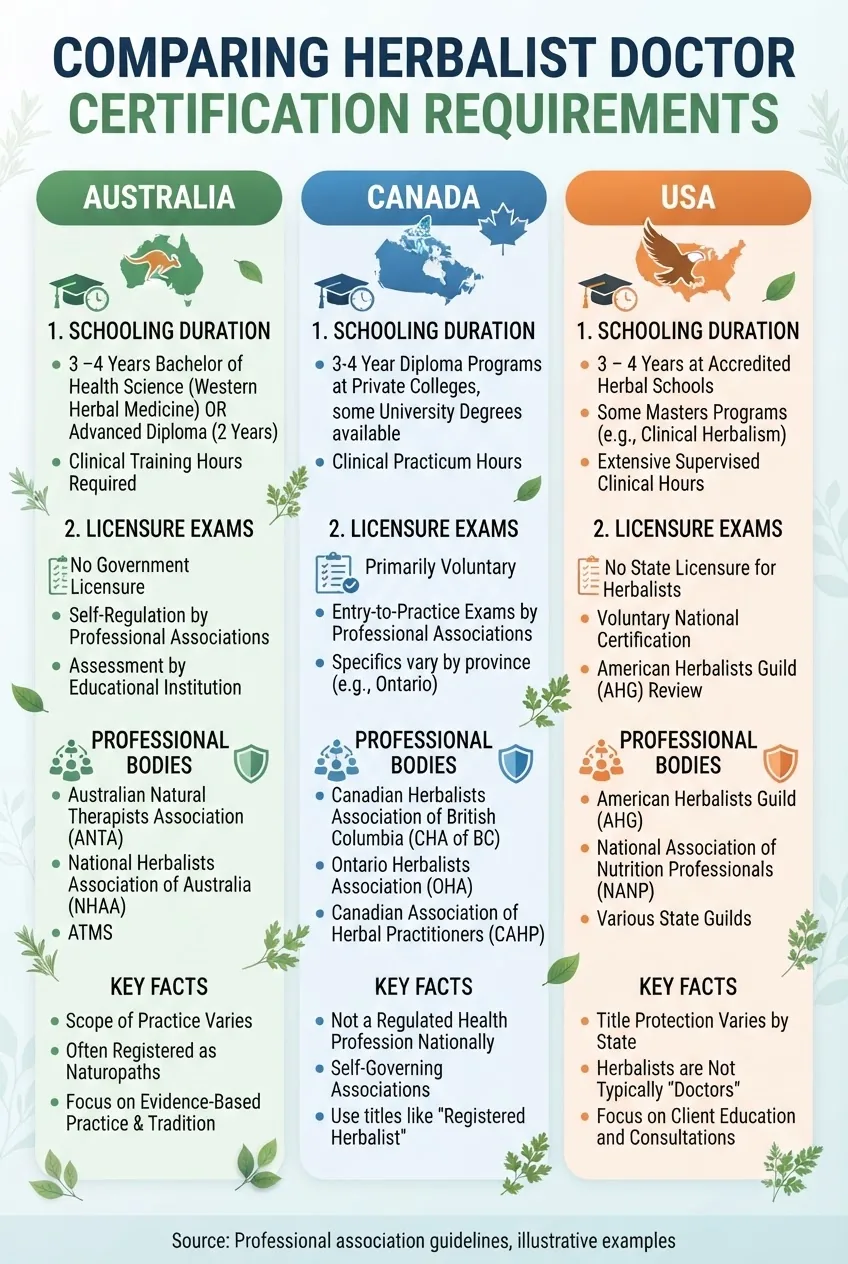
Key country comparisons (summary table):
| Region | Education & Duration | Regulation & Professional Bodies |
|---|---|---|
| Australia | Diploma to degree (1–4 years), plus clinical hours | No national protected title for herbalist; professional associations and voluntary registration available. |
| Canada | Varies by province: diploma/certificate to degree pathways; naturopathic programs are regulated in some provinces. | Provincial regulation for naturopaths in parts of Canada; herbalists may seek credentialing through associations. |
| United States | Certificate to master-level programs (1–4 years); clinical internships are common. | No federal licensure for herbalists; voluntary certification (e.g., AHG mentorship) and state rules for naturopathic doctors vary. |
Regional nuances and recommended checks:
- In Australia, check national herbalist associations and course accreditation with local educational regulators.
- In Canada, provincial rules for naturopathy affect prescribing scope; review Canada naturopathy and herbalist certification requirements for province-specific steps.
- In the USA, verify state boards for naturopathic doctors and professional membership options through bodies such as the American Herbalists Guild.
Licensure vs. certification:
- Licensure is legal recognition by government that can confer title protection or prescribing rights; availability depends on jurisdiction.
- Certification is credentialing by a professional body indicating competency; often required by employers or insurance panels but not a legal license.
Useful external regulatory and professional resources:
- FDA guidance on dietary supplements — regulatory context for herbal products in the USA.
- American Herbalists Guild (AHG) — professional development and mentorship frameworks.
- National Institute of Medical Herbalists (NIMH) — UK professional standards and registrant expectations.
Credential examples and pathway links:
- naturopathic doctors prescription rights — helps clarify differences in medication scope.
- medical herbalism training and certification — detailed certification options.
- naturopathic doctor clinics near me — alternative career comparisons and local practice models.
Transition: With regional rules understood, the next section breaks down the curriculum and competencies you will study.
Curriculum Components and Core Competencies of Herbalist Training
Answer: Core curriculum blends herbal science (pharmacognosy, phytochemistry), clinical herbalism and diagnostics, formulation and compounding, safety and interactions, plus ethics, business skills and supervised clinical hours to develop practitioner competence.
Pharmacognosy: the study of medicinal natural products and their biological properties, including identification and extraction of active constituents.
Core curriculum areas (sectioned):
Foundational Sciences
Courses cover human anatomy, physiology, biochemistry and pathophysiology to ensure safe clinical decision-making; herbalists must understand organ-system disorders and standard medical diagnostics.
Herbal Science and Materia Medica
Includes in-depth study of plant monographs, phytochemistry, traditional uses and evidence synthesis. Students learn to evaluate clinical trials, systematic reviews and ethnobotanical data when building treatment plans.
top medicinal herbs and their health benefits are typically taught alongside safety profiles and dosage ranges.
Clinical Herbalism and Therapeutics
Clinical herbalism: applied practice of assessing a patient, formulating plant-based interventions, monitoring outcomes and integrating with other care. Training focuses on case-taking, treatment planning and follow-up.
Students practice evidence-based herbal therapy techniques and develop familiarity with natural symptom remedies and herbal therapy techniques for common presentations.
Herbal Pharmacology and Safety
Courses teach pharmacokinetics/pharmacodynamics of plant constituents, herb–drug interactions and contraindications. Programs often require competency in using interaction resources and reporting adverse events.
herbal drug interaction guidelines are integrated into clinical training for safety.
Formulation, Compounding and Pharmaceutics
Students learn to prepare tinctures, decoctions, capsules and topical formulations, including dose calculation, extraction methods and quality assurance.
capsule herbal supplements and formulation skills are taught for standardised dosing and commercial practice.
Diagnostics, Clinical Reasoning and Referral
Training emphasises red-flag identification, appropriate referral to conventional care, and interprofessional communication. Students learn to read basic labs and interpret results relevant to herbal interventions.
Professional Practice and Ethics
Business skills, record-keeping, informed consent, scope of practice and regulatory compliance are mandatory modules to establish safe, ethical clinics.
botany and herbalism training for herbalists complements pharmacognosy by teaching plant identification, cultivation and sustainable sourcing.
Terminology and definitions taught early help students avoid confusion; for example, herbal preparation definitions and herbal meaning clarify distinctions between tinctures, extracts and isolates.
Hands-on lab modules and compounding practicums often reference practical skills guides such as capsule herbal supplements and formulation skills.
Transition: After classroom learning, practical experience cements clinical competence—covered next.
Practical Experience: Apprenticeships, Internships, and Clinical Training
Answer: Practical training is achieved through supervised clinical practicums, internships and apprenticeships where trainees log client encounters, refine formulation skills and receive mentor feedback; duration and supervision ratios vary by program.
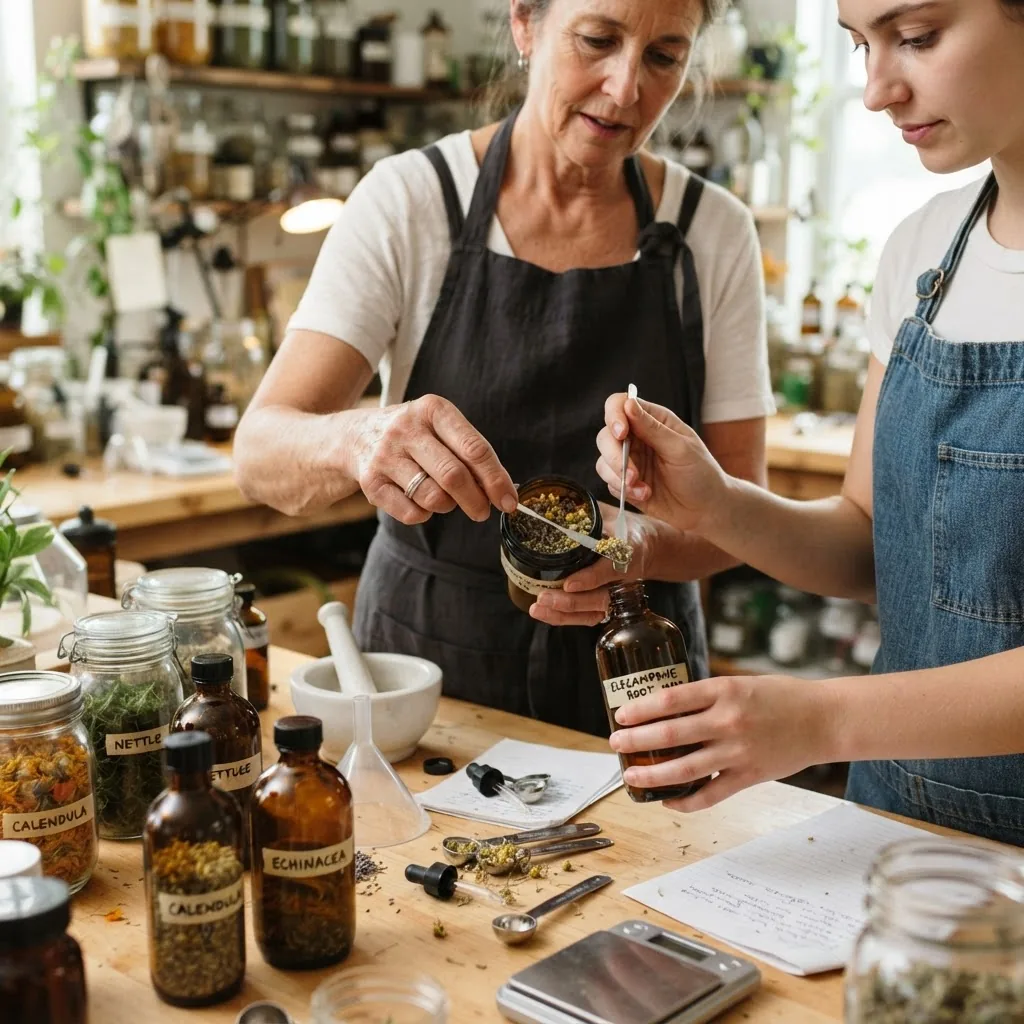
How to structure practical experience (step-by-step):
- Enroll in a program with required clinical hours or secure an apprenticeship placement with a qualified herbalist.
- Complete supervised clinic shifts — typically 200–1000 hours depending on credentialing body; log cases with mentor signatures.
- Progressive responsibility — begin with observation, then co-consulting, then independent consults under review.
- Skills assessment — formative and summative assessments: case presentations, observed structured clinical examinations (OSCE-like) and written competence tests.
- Document portfolio — maintain case records, reflective learning notes and a formulation log for certification review.
Examples of practicum requirements (illustrative):
- University herbal medicine degree: 300+ supervised clinical hours with graded casework.
- Diploma program: 150–300 hours plus community clinics and peer practice.
- Apprenticeship: 1–3 years of mentor-led clinical exposure with competency sign-off.
Essential practicum competencies:
- Comprehensive case-taking and medical history synthesis.
- Risk assessment and referral decision-making.
- Safe formulation and dose calculation across preparations.
- Monitoring outcomes and managing adverse effects.
Practical toolkits and courses to support early practice:
- herbalist starter kit for remedy making — baseline tools for apprentices and students.
- herbal potions making and home remedies course — structured hands-on workshops.
- making herbal remedies course for creating natural herbal medicines for advanced compounding.
Mentorship best practices:
- Choose mentors with documented training and professional association membership.
- Agree on learning objectives, supervision frequency and feedback mechanisms in writing.
- Use objective assessment tools and case audits to track competency progression.
Transition: Once qualified, continuing education and specialization expand practice options.
Continuing Education and Specializations for Herbal Doctors
Answer: Certified herbalist doctors maintain competence through continuing education (CE) hours, specialty certifications and advanced clinical courses in areas like oncology support, pediatrics or traditional systems such as Traditional Chinese Medicine (TCM).
Continuing education pathways and examples:
- Required CE hours for maintenance of professional body membership (varies by association).
- Advanced diplomas in clinical herbalism, botanical pharmacology or integrative oncology.
- Short intensives and workshops: herbal gynecology, pediatrics, geriatrics, sports medicine.
- Cross-training in complementary systems: traditional Chinese herbal medicine courses.
- Certification in herbal manufacturing, GMP, or quality assurance for industry roles.
Specialization checklist for clinicians:
- Complete focused coursework and supervised clinical hours in the specialty.
- Build a documented case series demonstrating outcomes in the specialty area.
- Seek recognition from specialty interest groups or professional boards.
Other continuing supports:
- Peer case review groups and supervision for complex cases.
- Subscriptions to primary botanical journals and evidence databases.
- Attendance at conferences and workshops to maintain networking and skills.
Transition: With education and specialization in place, career possibilities and recognition follow.
Career Opportunities and Professional Recognition for Certified Herbalist Doctors
Answer: Certified herbalist doctors can work in private clinics, integrative hospitals, product development, research and education; recognition depends on credentials, association membership and jurisdictional regulation which affects access to insurance and collaborative practice.
Common career paths with examples and data points:
- Private practice: Solo or group clinics providing consultations, formulations and follow-up care; income varies by location and client base.
- Integrative clinics and hospitals: Collaborative roles alongside MDs and NDs in multidisciplinary teams.
- Industry and product development: Formulation, quality control and regulatory affairs in botanical supplement companies.
- Research and academia: Teaching herbal medicine, conducting clinical trials and publishing case series.
- Public health and community programs: Education and preventive care initiatives using botanical approaches.
Professional recognition considerations:
- Membership in professional bodies (e.g., AHG or NIMH) signals adherence to standards and helps with peer referral networks.
- Insurance reimbursement and third-party recognition depend on state/provincial rules and whether insurers accept herbal consult codes.
- Credential portability is limited—expect to validate qualifications when moving between jurisdictions.
Specialization example—oncology support:
Herbalists may develop competency in supportive care for cancer patients by completing targeted training and supervised placements; readers can explore natural cancer treatments and adenocarcinoma herbal remedies for an example of a specialty area where herbalists contribute supportive therapies.
Insurance and clinical access:
Coverage varies widely; check resources such as insurance coverage for natural medicine practitioners to understand possible reimbursement paths and documentation needs.
Alternative career entry points:
- Join integrative clinics—search local listings or use naturopathic doctor clinics near me as an example route for collaborative hiring.
- Pursue industry roles in formulation, regulatory affairs or quality assurance.
Transition: Below are final practical considerations, costs and timelines for planning your training.
Practical considerations: duration, cost and next steps
Answer: Becoming a herbalist doctor can take 1–4+ years depending on the pathway; expect costs from a few thousand for certificates to tens of thousands for degree programs, plus living costs and supplies—budget for supervised clinical hours and continuing education.
Typical timelines:
- Certificate/diploma: 6–24 months
- Bachelor degree: 3–4 years
- Apprenticeship combined with coursework: 2–5 years
Approximate cost ranges (illustrative):
- Certificate/diploma: AUD 2,000–15,000 depending on provider and delivery mode.
- University degree: AUD 15,000–60,000+ depending on domestic/international status and institution.
- Apprenticeship: variable; may include mentor fees or reduced earnings during supervised practice.
Next steps checklist:
- Decide on apprenticeship vs accredited program based on career goals.
- Check regional regulation and association requirements.
- Plan finances and time for clinical hours and CE.
- Create a portfolio and seek supervised placements early.
Useful internal resources for practical planning:
- herbal supplements guide with benefits and natural medicine uses — helpful for formulation learning.
- organic herbal supplements guide for natural health products — for industry career planning.
Final note on safety and scope: Herbal practice complements conventional care; always prioritise client safety, use interaction checks and refer to conventional providers when needed.
Conclusion: Where to begin and the professional promise of herbalist doctors
Becoming a herbalist doctor requires combining rigorous study in herbal science, supervised clinical experience and navigating regional certification; choose a pathway that balances scientific training with practical mentorship, join a recognised professional body, and commit to ongoing education to build a safe, respected practice. Ready to start? Identify accredited programs, request syllabi and schedule a clinic observation to see the work firsthand.