

What causes mental illness is best understood as a combination of biological, psychological and social risk factors that interact across time; most disorders arise from genetic predisposition plus neurobiological differences and life experiences such as trauma, chronic stress, substance use and social disadvantage that together alter brain and behaviour.
Understanding What Causes Mental Illness
Answer: Mental illness is caused by a network of interlocking factors — genetic vulnerability, neurochemical and brain function variations, psychological patterns, hormones and environmental stresses — rather than a single source. The biopsychosocial interplay explains why risk varies across individuals and lifespans.
Genetic predisposition: a heritable increase in likelihood of developing a disorder based on family history and specific gene variants.
Neurochemical imbalance: differences in brain signalling chemicals (neurotransmitters) that affect mood, cognition, and behaviour.
Environmental influences: external conditions such as chronic stress, trauma, poverty and social isolation that modify risk across time.
This section summarizes core domains and links readers to deeper resources on physiological impacts and statistics. For population-level context, WHO report and national epidemiology studies show rising lifetime prevalence for common disorders, indicating multiple, interacting causes (According to a 2023 WHO report).
physiological effects of poor mental health
Below are the immediate categories to watch: biological (genes, brain, hormones), psychological (early learning, cognitive styles, resilience), and social/environmental (stressors, social determinants, substance exposure). Later sections elaborate each and show how they combine like pieces of a complex puzzle.
Transition: The next section examines genetic and biological risk factors in depth, including the research methods that reveal their roles.
Genetic and Biological Risk Factors for Mental Illness
Answer: Genetics, brain structure and function, neurochemistry, hormonal systems and epigenetic mechanisms create biological vulnerability; these factors are measurable with methods like GWAS, neuroimaging and endocrine assays and interact with environment to change risk.
Genetic predisposition: a tendency toward developing a disorder passed through family lines via many gene variants rather than a single gene.
Genome-wide association studies (GWAS) scan millions of genetic variants across thousands of people to identify alleles associated with disorders such as schizophrenia, bipolar disorder and depression (According to a 2022 meta-analysis published in peer-reviewed journals). GWAS findings show that risk is polygenic — many small-effect variants combine to raise vulnerability rather than one deterministic gene.
Neurochemical imbalance: common shorthand for altered neurotransmitter systems (e.g., serotonin, dopamine, GABA, glutamate) that influence mood, reward processing and anxiety. Laboratory assays and PET or MR spectroscopy can measure some neurotransmitter system variations, though clinical diagnosis does not rely solely on these measures.
- Example: Dopamine dysregulation is linked to psychosis in schizophrenia (neuroscience studies using PET imaging).
- Example: Serotonergic differences are associated with depressive disorders and response to SSRI medications (clinical trials and meta-analyses).
Brain structure and function: neuroimaging (MRI, fMRI) reveals structural and connectivity differences in areas such as the prefrontal cortex, amygdala and hippocampus that correlate with mood and anxiety disorders. These are risk markers, not absolute causes; many people with similar imaging findings do not develop clinical disorders.
Hormonal influences: endocrine systems (cortisol, thyroid hormones, sex steroids) shape stress response and mood regulation. Chronic HPA-axis activation (high cortisol) is associated with depressive symptoms and memory changes (According to a 2021 systematic review in psychiatric endocrinology journals).
Epigenetics: changes in gene expression caused by environmental inputs (e.g., methylation) — epigenetic marks do not change DNA sequence but can switch genes on or off, linking life experiences to biological risk (According to recent epigenetics research published in peer-reviewed journals).
Case example: A person with a family history of depression (polygenic risk) who experiences early-life neglect may show epigenetic changes and altered hippocampal volume on MRI; combined, these biological markers increase the probability of a depressive disorder occurring after later life stressors.
Screening and assessment: clinicians use family history interviews, validated genetic risk scores in research settings, neurocognitive testing and, when indicated, endocrine screening to build a biological risk profile. Functional assessments look at sleep, appetite, cognition and stress reactivity to integrate biological signals into care planning.
Research methods and evidence standards:
- GWAS identify statistical associations across populations; they indicate correlation and polygenic risk (According to multiple GWAS consortia reports).
- Neuroimaging provides structural and functional correlates but requires replication and longitudinal designs to suggest causal pathways (According to neuroimaging methodological reviews).
- Epigenetic studies link exposures (trauma, smoking) to methylation changes; prospective cohort studies provide stronger causal inference than cross-sectional designs.
Practical biological considerations: medical causes such as thyroid dysfunction, vitamin deficiencies, or medication side effects can mimic or worsen psychiatric symptoms; routine medical screening is often recommended when symptoms first present. Collaboration between primary care, psychiatry and neurology improves detection of treatable biological contributors.
Transition: Biological vulnerability sets a foundation, but environmental and social risk factors frequently precipitate or amplify mental illness — the next section explores those influences.
Environmental and Social Risk Factors That Affect Mental Health
Answer: Environmental stressors — including trauma, chronic stress, social determinants like poverty and discrimination, and substance abuse — elevate the risk for mental health disorders by changing stress systems, behaviour and access to care.
Environmental stressors: external pressures such as chronic work stress, overcrowding, noise, pollution, and unstable housing that increase physiological stress responses and reduce coping resources.

Chronic stress from job insecurity, caregiving strain, or long-term financial hardship increases allostatic load — the wear-and-tear on body systems — which is linked to depression, anxiety and cognitive problems (According to a 2020 public health cohort study). Social determinants like low income, limited education and housing instability both increase exposure to stressors and reduce access to early care.
Traumatic experiences: single-incident trauma (assault, accident) and repeated trauma (childhood abuse, domestic violence) are strong predictors of PTSD, depression and substance misuse. Trauma alters brain circuits for fear and memory (hippocampus/amygdala) and can produce long-term epigenetic marks (According to longitudinal trauma research in peer-reviewed journals).
Substance abuse: alcohol, cannabis and other psychoactive substances can precipitate or exacerbate mental illness through neurochemical effects, withdrawal sequelae and social consequences. Substance use is frequently both a risk factor and a coping mechanism that complicates diagnosis and treatment.
Hidden or unrecognized stress matters: many people carry physiological stress without obvious signs. Screening questions and validated tools can reveal these hidden burdens.
Social isolation, discrimination, and lack of community support are consistent predictors of poor outcomes. Public health data indicate that neighborhoods with fewer services and higher crime rates show higher rates of mental health diagnoses (According to a 2022 population health study published in an epidemiology journal).
Case study: An adult living with low income, exposure to neighborhood violence and early childhood neglect may develop anxiety and depression following a job loss; lack of social support and substance use can deepen symptoms, illustrating cumulative environmental risk.
Prevention and systems-level solutions: reducing poverty, improving access to stable housing, offering trauma-informed schools and workplaces, and regulating access to addictive substances lower population-level risk. Early identification programs in primary care can catch environmental contributors before they escalate.
Transition: Alongside biological and environmental drivers, psychological factors—how people think, cope and find meaning—shape resilience or vulnerability; the next section details these processes.
Psychological Factors and Their Role in Mental Illness
Answer: Psychological factors such as coping styles, early childhood experiences, cognitive patterns, emotional regulation and meaning-making determine how individuals respond to stress and mediate whether biological vulnerabilities manifest as mental disorders.
Psychological resilience: the capacity to adapt to adversity, maintain equilibrium and recover from stress; resilience is shaped by relationships, skills and learned coping strategies.
Early childhood experiences—secure attachment, predictable care or, conversely, neglect—shape stress regulation systems and cognitive schemas that influence risk across life. Evidence-based psychological frameworks like cognitive-behavioural models explain how maladaptive thought patterns (e.g., catastrophising, black-and-white thinking) can maintain depressive and anxiety disorders (According to cognitive therapy trials and meta-analyses).
Psychological processes can buffer or amplify biological and environmental forces. For example:
- Effective coping and problem-solving reduce the impact of job stress on mood.
- Strong social support accelerates recovery after trauma and reduces recurrence risk.
- Maladaptive avoidance increases the chance that anxiety disorders become chronic.
Therapeutic frameworks and evidence:
- Cognitive Behavioral Therapy (CBT) targets distorted thinking and behavioural patterns and has strong evidence for depression and anxiety (According to clinical trial meta-analyses).
- Resilience-building interventions (skills training, social support, mindfulness) show measurable reduction in symptom development in at-risk groups (According to randomized preventive trials).
Practical psychological screening includes validated questionnaires (PHQ-9, GAD-7), trauma histories, and functional assessments. Interventions often aim to strengthen emotion regulation, improve cognitive flexibility, and reconnect people with meaningful roles — all of which lower the probability that risk factors progress to a diagnosable disorder.
Transition: With biological, environmental and psychological drivers in view, we next consider why mental health disorders are rarely due to a single cause and how the complexity matters for diagnosis and care.
The Myth of a Single Cause: Why Mental Health Disorders Are Usually Due to Multiple Risk Factors
Answer: Mental health disorders are usually multifactorial; the biopsychosocial model explains that many interacting risk factors — genetic, neurobiological, psychological and social — combine differently in each person, so a single-cause explanation is rarely accurate.
Term: biopsychosocial model — an integrative framework that explains health outcomes as the product of biological, psychological and social interactions.
Clinical evidence and epidemiology demonstrate that single-cause models fail to explain the variability in who becomes ill. Diagnostic frameworks such as DSM-5 describe disorders by symptom clusters and functional impact, not by a single etiological agent; see mental health disorder definitions for diagnostic context.
mental health disorder definitions
Comparison: single-cause versus multifactorial models
| Model | Key features | Clinical implication |
|---|---|---|
| Single-cause | One dominant factor explains disorder | Simpler interventions but often insufficient |
| Multifactorial (biopsychosocial) | Multiple interacting biological, psychological and social factors | Tailored, multi-modal assessment and treatment |
Examples of interaction:
- Genetic predisposition + childhood trauma → higher risk of depression than either factor alone.
- Substance abuse + economic instability → increased likelihood of psychosis relapse.
- High resilience + biological risk → reduced chance of transition to illness under stress.
Why multifactorial thinking matters for care:
- Assessment must be comprehensive — medical, psychosocial, functional.
- Treatment should be multi-modal — psychotherapies, medication when indicated, social support and lifestyle changes.
- Prevention targets population-level determinants as well as individual resilience-building.
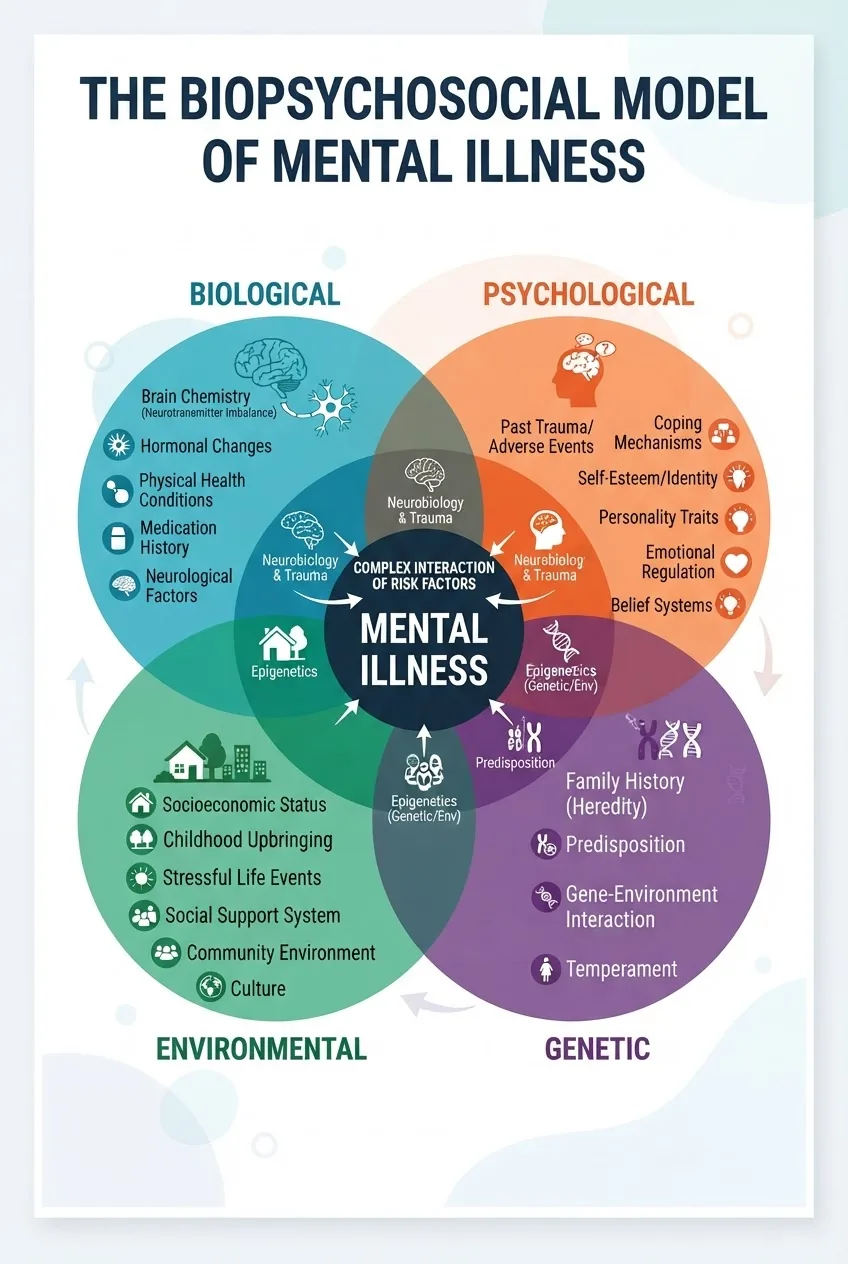
Transition: Risk factors accumulate and change over time; the next section explains cumulative and temporal dynamics and what they mean for prevention and early intervention.
How Risk Factors Affect Mental Health Over Time
Answer: Risk factors have cumulative and dynamic effects: repeated or prolonged exposure increases probability of disorder, while timely intervention, lifestyle changes and resilience-building can reduce risk and alter trajectories.
- Accumulation: repeated stressors (financial instability, caregiving strain) produce additive physiological burden (allostatic load) that increases vulnerability (According to longitudinal cohort studies).
- Timing: early-life adversity has outsized effects because it coincides with brain development and stress-system calibration; later-life exposures also matter but operate on different substrates.
- Interaction: risk factors interact multiplicatively — e.g., genetic risk plus trauma often yields a higher-than-additive risk.
- Latency and trigger: some risk factors create latent vulnerability that requires a precipitating event (e.g., substance use, acute loss) to manifest as symptoms.
- Reversibility and prevention: interventions (therapy, social support, medication, lifestyle changes) can reduce symptom severity and lower recurrence risk; early intervention shortens duration and improves outcomes (According to randomized clinical trials and public health evaluations).
Examples:
- Case A: A teenager with genetic vulnerability who receives early family support and CBT after a stressful event may avoid progression to a full disorder.
- Case B: An adult with untreated chronic stress and increasing alcohol use may experience gradual worsening of depression over years, illustrating cumulative risk.
Practical guidance for timeline-sensitive care:
- Screen early in high-risk settings (schools, primary care) to detect subthreshold symptoms.
- Implement brief interventions for episodic stress and substance misuse to prevent escalation.
- Prioritise continuity of care after traumatic experiences to reduce long-term impact.
Transition: With mechanisms and timelines explained, the final major section offers practical steps individuals and systems can use to reduce risk and support recovery.
Summary and Practical Considerations for Maintaining Mental Health
Answer: Maintain mental health by addressing modifiable risk factors: build psychological resilience, reduce environmental stress where possible, seek early assessment for biological contributors, minimise substance misuse, and access evidence-based treatments when needed.
Key practical tips:
- Regular screening: use simple tools (PHQ-9, GAD-7) in primary care or workplace programs to identify early symptoms.
- Lifestyle changes: prioritize sleep, physical activity, balanced nutrition and reduced substance use to lower physiological risk (According to public health intervention studies).
- Social supports: strengthen community ties and reach out to reduce isolation; social prescribing can connect people to services that address determinants.
- Therapeutic care: psychotherapies such as CBT, trauma-focused therapy, and family interventions are effective for many conditions; medications may correct neurochemical contributors when clinically indicated.
- Prevention policies: advocate for safer neighborhoods, stable housing, and equitable access to mental health services to reduce population-level risk.
benefits of good mental health
treatment options for mental illness
Case examples of effective change:
- Documented program: workplace stress reduction combined with organizational changes reduced sick days and modestly lowered depressive symptoms over 12 months (According to a 2021 occupational health evaluation).
- Individual change: a patient with mild depressive symptoms who increased exercise, reduced alcohol, and began CBT showed symptom remission within three months (Clinical case report in a peer-reviewed psychotherapy journal).
Screening walk-through (simple method clinicians use):
- Brief intake: collect family history, medical history, current stressors and substance use.
- Use validated questionnaires (PHQ-9, GAD-7, AUDIT) to quantify symptom burden.
- Order baseline labs/endocrine tests if medical contributors suspected (thyroid, B12, liver function).
- Refer to specialist care (psychiatry, psychology) for persistent or severe symptoms and consider collaborative care models.
Trust and uncertainty: scientific understanding evolves — while genetics and neurobiology give strong clues, research continually refines the weight and mechanisms of each risk factor (According to ongoing research in neuroscience and epidemiology). Personalized assessment remains essential because individual risk profiles vary.
Final takeaways: Mental health results from multiple interacting causes; prevention and treatment work best when they address biological, psychological and social domains together. For practical support, seek early assessment and multi-modal care when needed.
Call to action: If you notice persistent changes in mood, cognition or functioning, contact a healthcare provider or mental health service for screening and tailored support — early steps change outcomes.