

Holistic approach to mental health: a comprehensive care model that treats psychological symptoms alongside physical, social and spiritual factors to restore emotional balance and long-term wellbeing through integrated therapies, lifestyle changes, and patient-centred supports.
Holistic approach to mental health prioritises integrated care for mind, body and spirit, combining evidence-based psychotherapy, lifestyle and nutritional strategies, mindfulness, and supportive networks to reduce symptoms, improve resilience and support recovery. It works alongside conventional medicine to create personalized, whole-person treatment plans focused on sustainable emotional balance and wellbeing.
Holistic approach to mental health: definition above explains the concept; next we clarify related terminology used throughout this guide.

Introduction to the Holistic Approach to Mental Health?
Answer: The holistic approach to mental health treats mental disorders within the broader context of physical health, lifestyle, relationships and spiritual needs to restore functional wellbeing, not just reduce symptoms.
Term: Mind-body-spirit connection: the concept that mental health is influenced by physical health, emotional patterns and spiritual meaning, and that interventions addressing all three domains produce better outcomes.
A holistic approach reframes mental health from isolated symptoms to an interdependent network of factors that shape cognition, mood and behaviour. Clinicians assess diet, sleep, social support, trauma history, medical comorbidity and personal meaning; they then design composite plans that may include psychotherapy, medication when needed, exercise prescriptions, nutritional adjustments, mindfulness training and spiritual supports.
This article explains core principles, common modalities, evidence, practical exercises, access pathways and emerging trends so readers can evaluate how integrated care fits their needs. For foundational terminology and philosophy, see the definition of the holistic view.
Core Principles of Holistic Mental Health Treatment?
Answer: Holistic mental health treatment is governed by five interlocking principles—mind-body connection, emotional balance, patient-centred care, integrative therapies and natural healing—that guide assessment and personalised care plans.
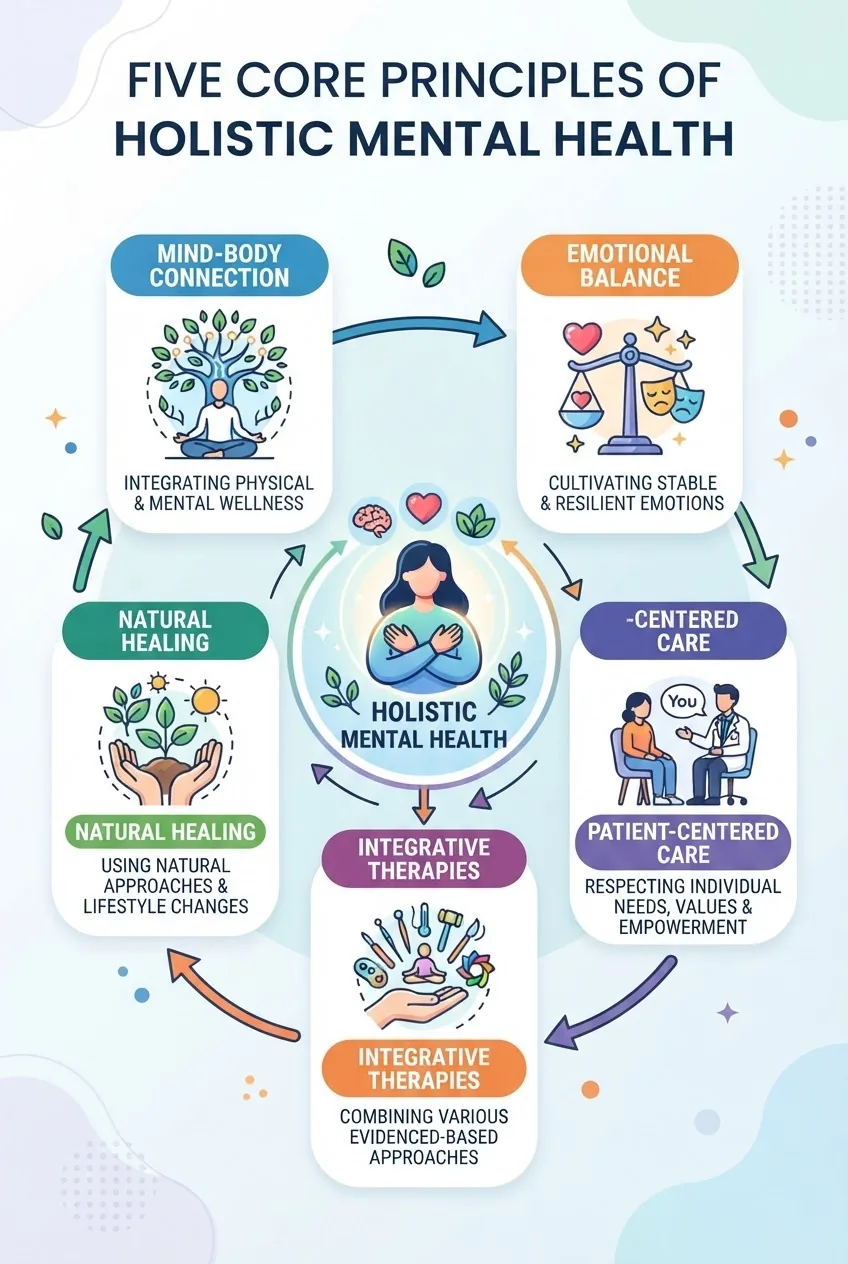
- Mind-body connection: recognise physical health influences mood and cognition. Clinicians screen for sleep problems, inflammatory conditions and medication side effects; interventions include exercise prescriptions and sleep hygiene. Evidence: According to a 2023 systematic review in integrative medicine literature, exercise and sleep interventions produced small-to-moderate reductions in depressive symptoms for many adults.
- Emotional balance: target regulation skills—emotion identification, distress tolerance and grounding techniques—often taught via therapies such as DBT (dialectical behaviour therapy) and adapted CBT. These approaches build resilience and reduce reactive cycles that maintain anxiety or low mood.
- Patient-centred care: collaborative planning that respects patient preferences, cultural context and goals; treatment sequencing is negotiated rather than imposed. This aligns with models of shared decision-making shown to increase adherence. For frameworks connecting mental health to broader wellness, review holistic well-being models.
- Integrative therapies: combine conventional modalities (medication, psychotherapy) with complementary practices (mindfulness, nutritional therapy, manual therapies). This integrative care model coordinates providers across disciplines, improving communication and outcomes in many studies.
- Natural healing and lifestyle support: emphasise modifiable factors—diet, exercise, sunlight, social connection and purposeful activity—that support neuroplasticity and stress regulation. Clinical teams include nutritionists, health coaches and movement therapists to operationalise lifestyle change.
These principles operate in combination: assessment yields a personalised plan that sequences interventions, monitors outcomes and adjusts intensity. For a deeper practice-level breakdown of therapies used across holistic care, consult our guide to holistic healing methods and modalities.
Common Modalities in Holistic Mental Health Care?
Answer: Common modalities include holistic counseling, nutritional and lifestyle interventions, spiritual and mindfulness-based practices, and complementary natural remedies, each tailored to the individual and often combined for maximum effect.
Holistic Counseling Services and Mental Health Counseling
Answer: Holistic counseling blends evidence-based psychotherapies with assessments of physical health, lifestyle and spiritual needs to create integrative psychotherapy plans focused on durable emotional balance.
Term: Holistic counseling services: counselling approaches that intentionally integrate psychological, physiological and social assessments to inform therapy goals and techniques.
A holistic counselor may use CBT techniques to address distorted thinking while concurrently exploring sleep, nutrition and relationship patterns that perpetuate distress. Session structure often includes a 90–120 minute intake covering medical history, current symptoms, lifestyle, substance use, and personal meaning, followed by weekly or fortnightly sessions with embedded homework on sleep, exercise and mindfulness.
Examples:
- Supportive psychotherapy with lifestyle coaching: a client with moderate depression receives weekly therapy for cognitive restructuring and a graded exercise plan co-developed with a health coach; results include improved mood and daily functioning.
- Trauma-informed integrative counseling: combines EMDR (eye movement desensitisation and reprocessing) or somatic experiencing with breathing exercises, nutritional assessment and social support mapping to reduce reactivity and improve regulation.
- Collaborative care model: counselors coordinate with primary care to adjust medications, monitor labs and align psychotherapy goals with medical management.
Clinical evidence supports combined psychotherapy and lifestyle interventions for many conditions; National Institute of Mental Health resources emphasise integrated care pathways for serious mood disorders. For additional therapy program detail, see holistic therapy techniques and programs.
Nutritional and Lifestyle Interventions
Answer: Nutritional and lifestyle interventions target inflammation, neurotransmitter precursors and circadian rhythms to support mental health; they are personalised and monitored for safety and efficacy.
Term: Holistic nutrition: a dietary approach that considers whole foods, micronutrient status and gut health as contributors to emotional and cognitive functioning.
Key components:
- Dietary patterns rich in whole foods, omega-3 fatty acids, fiber and fermented foods to support gut microbiome and reduce inflammation.
- Regular physical activity tailored to ability—exercise prescriptions often mirror medication effect sizes for mild-to-moderate depression when sustained.
- Sleep optimization: fixed sleep-wake routines, reduced nighttime screens and behavioural strategies to restore circadian rhythm.
- Substance moderation: nicotine, alcohol and recreational drugs are assessed and addressed due to their impact on mood and anxiety.
Clinical workflow example: baseline labs (vitamin D, B12, thyroid function, inflammatory markers), a nutrition review, and a 12-week lifestyle coaching program with measurable goals (sleep hours, weekly exercise minutes, Mediterranean-style diet adherence). For professional training or certification resources that support clinical nutrition integration, review holistic nutrition certification and counseling.
Spiritual and Mindfulness-Based Practices
Answer: Spiritual supports and mindfulness-based practices reduce stress physiology, enhance attention regulation, and provide meaning-making frameworks that complement psychotherapeutic work.
Term: Mindfulness meditation: a practice that cultivates nonjudgmental present-moment awareness to reduce rumination, autonomic arousal and reactivity.

Common interventions include mindfulness-based stress reduction (MBSR), mindfulness-based cognitive therapy (MBCT), guided imagery, breathwork and spiritual counseling. These practices operate on stress reduction mechanisms—lowered cortisol, improved heart-rate variability—and on cognitive mechanisms—reduced rumination and improved attentional control.
Walk-through exercise (5-minute grounding):
- Breathe: sit quietly, inhale for four counts, exhale for six, repeat for six breaths.
- Scan: move attention slowly from toes to head, naming sensations without judgment.
- Anchor: pick an anchor word (e.g., “steady”) and return to it when the mind wanders.
- Close: take three slow breaths and set one intention for the next hour.
Empirical note: According to a 2022 meta-analysis in a peer-reviewed integrative medicine journal, MBCT reduced relapse risk for recurrent depression compared with usual care. Spiritual counseling—non-denominational or faith-based—supports values clarification and meaning, often improving engagement in care where spiritual distress is present.
Complementary Natural Remedies and Supplements
Answer: Some natural remedies and supplements—selected for evidence and safety—can support mood, anxiety and sleep, but require clinical oversight for interactions and contraindications.
Term: Natural remedies: herbal preparations, nutraceuticals and non-pharmaceutical interventions used to complement conventional care.
Common options and evidence summary:
- Omega-3 (EPA/DHA): modest evidence for depressive symptom reduction, especially EPA-dominant formulas; monitor blood thinning effects in people on anticoagulants.
- St. John’s Wort: evidence for mild-to-moderate depression but significant interactions with many medications; safe use requires clinician review.
- Magnesium: may support sleep and mild anxiety when deficient; dosing should account for renal function.
- Lavender oil (oral or topical): some evidence for anxiety symptom relief; generally low-risk but check for allergies.
Cautionary notes: Always consult prescribers before starting supplements: herbal agents can interact with antidepressants, oral contraceptives and anticoagulants. Laboratories and baseline screening (liver, kidney) are prudent for prolonged supplement use.
For balanced analyses of natural approaches and safety, consult peer-reviewed summaries and official position statements; for example, research digests on integrative medicine are indexed at PubMed.
What are the Benefits and Challenges of Holistic Mental Health Care?
Answer: Benefits include comprehensive recovery, improved functioning and patient engagement; challenges include evidence variability, coordination demands and payment/coverage barriers.
| Benefits | Challenges |
|---|---|
| Addresses root contributors (sleep, nutrition, environment) so improvements are often sustainable and reduce relapse risk. | Heterogeneous evidence base: while some interventions are well-supported, others lack large RCTs, creating mixed guidance for clinicians. |
| Improves patient engagement by aligning treatment with values, culture and preferences; supports autonomy. | Requires multidisciplinary coordination—time-intensive and sometimes costly; insurance coverage varies by jurisdiction and provider type. |
| Reduces polypharmacy risks by using non-pharmacologic strategies when appropriate. | Risk of unregulated supplements and conflict with medical treatments; safety oversight needed. |
| Works well in chronic conditions where lifestyle factors are prominent (e.g., chronic stress, insomnia). | Outcome measurement can be complex: multiple domains (symptoms, function, biometric markers) require harmonised tracking. |
Empirical context: According to a 2024 industry report, integrated mental health programs reported higher patient satisfaction and modest improvements in functioning metrics compared with traditional single-discipline services. For a broader review of health advantages across systems, consult our analysis of the benefits of holistic medicine and official position statements.
Patient wellness orientation is central to holistic care; for a focused discussion of this principle and organisational rationale, see patient wellness focus in holistic care.
How Can I Access Holistic Mental Health Support and Services?
Answer: Accessing holistic mental health care involves structured steps: clarify needs, map local and online resources, verify credentials and coverage, assemble a collaborative team, and start with a coordinated intake plan.
- Clarify your priorities: symptom reduction, lifestyle change, spiritual support, or combined care. This guides provider selection and financing.
- Map services: search multidisciplinary clinics, community mental health centres, telehealth platforms and certified coaches. For assistance with insurance and locating providers, see our guide to finding alternative holistic practitioners.
- Check credentials and roles: differentiate licensed mental health clinicians, registered dietitians, accredited health coaches and spiritual counsellors. Consider certified coaches for lifestyle change support; resources on certification are at holistic health coach certification and finding a holistic wellness coach.
- Verify coverage and costs: ask insurers about coverage for counselling, allied health, integrative programs and supplements; some services may be reimbursable with referrals.
- Start with coordinated intake: ask for integrated assessment, baseline measures (mood scales, sleep logs, labs) and a written care pathway with milestones and review dates.
- Use support networks: peer groups, family education and community resources reduce isolation and improve adherence to holistic plans; consider referral to clinics listed in holistic mental health treatment centers for intensive programs.
Practical tip: request a short trial phase to evaluate coordination and measurable progress (4–12 weeks), then adjust the team composition. For sourcing credential information on nutrition professionals, see holistic nutrition certification and counseling.
How Do Holistic Approaches Integrate with Conventional Mental Health Care?
Answer: Integration occurs via collaborative care where multidisciplinary teams coordinate medication management, psychotherapy and complementary interventions through shared care plans, communication protocols and outcome tracking.
Integrated mental health care means primary clinicians and specialists agree on goals and responsibilities. For example, a psychiatrist manages medication adjustments while a holistic counselor provides CBT and a nutritionist addresses micronutrient deficits; a health coach supports lifestyle adherence and a primary care physician monitors labs.
Clinical integration workflow (sample patient pathway):
- Week 0 — Intake: unified assessment (psychometric scales, medical review, lifestyle inventory) and initial care plan created.
- Weeks 1–6 — Stabilisation: commence evidence-based psychotherapy, start safe supplements if indicated, implement sleep and activity plans; psychiatry evaluates need for medication within 2–4 weeks.
- Weeks 7–12 — Intensification and monitoring: adjust interventions based on objective measures and patient feedback; add mindfulness programs or group therapy as needed.
- Quarterly review: comprehensive outcomes review includes symptom scores, functioning, biometrics and patient-reported wellness to adapt the long-term maintenance plan.
Anonymized case example: a 34-year-old with recurrent depression improved PHQ-9 scores from 16 to 6 over 14 weeks after combined CBT, omega-3 supplementation, graded exercise and sleep restructuring, coordinated across three providers with weekly case reviews. This illustrates collaborative gains and necessity of measured coordination.
For integration frameworks and definition of integrative care, see external resources like integrated care definitions and institutional guidance from agencies such as NIMH.
What are Future Trends in Holistic Mental Health Treatment and Care?
Answer: Future trends include digital integration of holistic services, precision lifestyle medicine, expanded evidence from large pragmatic trials, and system-level reimbursement models supporting multidisciplinary care.
Digital platforms now combine teletherapy, app-based mindfulness, sleep tracking and remote nutrition coaching into coordinated care plans; According to a 2024 industry report, investment in digital integrative mental health solutions grew substantially in the prior two years, supporting remote access to holistic services.
Other trends:
- Precision lifestyle medicine: using biomarkers (inflammation, gut microbiome profiles) to tailor nutritional and supplement recommendations.
- Large-scale pragmatic trials: efforts to produce higher-quality evidence for combined modalities (e.g., mind-body plus medication) are underway in academic centres.
- Reimbursement and integration: policy shifts toward value-based care may increase coverage for coordinated holistic programs that reduce downstream costs.
Research and authoritative guidance are expanding: access indexed studies through PubMed and keep an eye on position statements from recognised associations like the American Holistic Health Association and government agencies for evolving recommendations.
Conclusion and Key Takeaways on Holistic Mental Health?
Answer: Holistic mental health treats the whole person—combining psychotherapy, medicine, lifestyle, nutrition and spiritual supports—to improve resilience, functioning and long-term wellbeing while requiring multidisciplinary coordination and careful safety monitoring.
Key takeaways:
- Holistic care emphasises personalised, patient-centred plans addressing biological, psychological and social factors.
- Evidence supports many components—psychotherapy, exercise, sleep optimization and select supplements—while some complementary modalities need stronger trials.
- Integration with conventional care and clinical oversight are essential to ensure safety and maximise benefit.
- Start with a coordinated intake, measurable goals and short trial phases to evaluate fit and progress.
If you’re considering holistic mental health care, request an integrated assessment from a multidisciplinary clinic or a coordinated team and discuss options with your medical provider to build a safe, evidence-aligned plan that addresses your mind, body and spirit.