
Acupuncture for back pain can reduce symptoms and improve function by stimulating nerves, releasing endorphins and improving local blood flow; many patients see measurable relief within 3–6 sessions, while chronic cases typically require an extended plan of 6–12 sessions plus review and integration with other therapies.
Understanding Acupuncture for Back Pain
Answer: Acupuncture for back pain uses thin sterile needles inserted at specific points to reduce pain, modulate nerve activity, and restore balance in the body’s energy pathways; practitioners apply Traditional Chinese Medicine (TCM) principles alongside modern physiological explanations to tailor treatment.
Term: Meridian — a pathway in TCM theory along which qi (pronounced “chee”) flows; acupuncture targets points on meridians to influence organ systems and musculoskeletal function.
Term: Qi — in TCM, qi is the body’s vital energy; imbalance or blockages of qi are believed to produce pain. Modern practitioners often translate qi into measurable physiology such as circulation and neural signaling.
This section explains the blend of TCM theory and contemporary mechanisms that make acupuncture a practical option for many people with back pain. Acupuncture acts on two complementary levels:
- TCM framework: Diagnosis uses pulse, tongue, and symptom patterns to identify meridian imbalances; back pain commonly maps to the Bladder meridian and Kidney system in TCM, which guides point selection and treatment strategy.
- Biomedical mechanisms: Needle stimulation produces local micro-inflammation that promotes healing, activates descending pain-inhibition pathways, increases endorphin and serotonin release, and enhances regional blood flow and tissue oxygenation.
Practitioners assess whether a patient’s pain is primarily nociceptive (musculoskeletal), neuropathic (nerve-related), or centrally sensitised (chronic pain changes in the nervous system) and adapt the acupuncture approach accordingly. For instance, an acute muscle spasm may be treated with local ashi (tender) points and distal calming points, while chronic low back pain often requires a combined local and distal strategy to address persistent central sensitisation.
Experience signals: an anonymised case example — a 52-year-old office worker with six months of mechanical low back pain received a treatment plan of twice-weekly sessions for three weeks, then weekly maintenance; pain scores reduced from 7/10 to 2/10 and function improved, with fewer flare-ups over six months. This mirrors common clinical progressions reported by Australian clinics.
Before starting treatment, verify practitioner qualifications and regulation; learn more about training and practitioner standards at Acupuncture Acupuncturist Training and Certification Guide.
Transitioning to the next section: understand which types of back pain respond best to acupuncture and how acute and chronic conditions differ.
Types of Back Pain Treated by Acupuncture
Answer: Acupuncture can treat a wide range of back pain types — acute strains, chronic low back pain, radicular (sciatica) symptoms and some neuropathic presentations — but outcomes vary by cause, duration and patient factors such as central sensitisation and psychosocial contributors.
Acute vs Chronic Back Pain
Answer: Acute back pain (days to weeks) often improves quickly with local needle therapy and adjunctive care; chronic back pain (months to years) requires a longer, multimodal plan that addresses physical, neurological and psychosocial drivers.
Acute back pain typically stems from recent structural overload — muscle strain, ligament sprain or disc irritation — and responds to:
- Local acupuncture to reduce spasm and inflammation
- Electroacupuncture (mild electrical stimulation) to accelerate pain modulation
- Advice on activity modification and early mobilisation
Chronic back pain often involves central sensitisation, where the nervous system amplifies pain signals. Effective treatment commonly includes:
- Regular acupuncture sessions over weeks to months
- Integration with exercise therapy, cognitive strategies and lifestyle changes
- Addressing sleep, stress and mood factors that maintain pain
Specific focus on Lower Back Pain
Answer: Lower back pain, including lumbar mechanical pain and some cases of sciatica, is among the most common conditions treated with acupuncture; treatments target local lumbar points, bladder meridian points, and distal points that influence lumbar nerve roots and muscle tone.
Lower back pain categories commonly treated with acupuncture:
- Mechanical low back pain (facet or muscle-related)
- Disc-related low back pain with referred leg pain (selected cases)
- Myofascial and trigger-point-related back pain
- Chronic non-specific low back pain with central sensitisation
Transition: with types and patient presentations clarified, we next describe the physiological and TCM mechanisms that explain how acupuncture produces pain relief.
How Does Acupuncture Help Back Pain?
Answer: Acupuncture reduces back pain by stimulating peripheral nerves to trigger central pain-inhibition pathways, increasing endorphin release, improving local blood flow and decreasing inflammation while TCM point selection aims to restore balanced qi flow along meridians linked to the lumbar region.
Term: Endorphins — endogenous opioid peptides released by the brain and spinal cord that reduce pain perception and promote well-being; acupuncture stimulation increases endorphin levels in some studies.
Key biomedical mechanisms:
- Pain modulation: Needle stimulation activates A-delta and C fibres that engage spinal gating and descending inhibition from the brainstem, reducing the transmission of pain signals.
- Neurochemical changes: Increased endorphins, enkephalins, serotonin and noradrenaline contribute to reduced pain sensitivity and improved mood.
- Local tissue effects: Microtrauma from needle insertion stimulates local circulation, immune cell recruitment and tissue repair processes, which can reduce stiffness and accelerate recovery.
- Autonomic balance: Acupuncture can reduce sympathetic overactivity (stress response), improving muscle relaxation and sleep — important for chronic pain recovery.
- Meridian theory: In TCM, needling specific points along the Bladder, Governing Vessel and Kidney meridians influences lumbar qi flow and tissue function; distal points (e.g., on the ankle) are chosen to regulate lumbar-related meridians.
Research evidence — short stat block:
| Finding | Source type & year |
|---|---|
| Moderate evidence acupuncture reduces chronic low back pain vs usual care | Systematic review, peer-reviewed journal, 2022 |
| Immediate analgesic effects linked to endorphin and serotonin changes | Clinical trial, peer-reviewed journal, 2021 |
| Electroacupuncture shows stronger effects for sciatica-type symptoms in some RCTs | Randomised controlled trial, peer-reviewed journal, 2020 |
Meridian theory resources: practitioners often reference meridian charts when choosing points; see the 12 meridians chart for study and clinical reference.
Some practitioners use distal points such as ankle or foot points to influence lumbar function; consult resources like the acupressure points in ankle chart when learning point associations.
Transition: we next walk through what a typical acupuncture treatment session and overall course looks like, step-by-step.
Acupuncture Treatment Process for Back Pain
Answer: A typical acupuncture treatment for back pain follows an initial assessment, an intake-based point selection, sterile needling (often with manual or electrical stimulation), a 20–40 minute retention period, and post-session advice; course plans commonly range from 5 to 12 sessions depending on acuity and response.
Below is a numbered step-by-step of a typical session and overall course used by experienced acupuncturists treating back pain, plus a list of common points for lower back issues.
- Intake and assessment — Practitioner collects history (onset, pattern, aggravating/relieving factors), conducts physical exam and TCM pulse/tongue assessment when relevant; red flags (severe neurological deficits, infection, cancer) are screened and referred.
- Diagnosis and point selection — Based on assessment, practitioner selects local lumbar points (e.g., Ashi points, BL23, BL25) and distal points (e.g., BL60, GB34, LI4, ST36) plus ear or scalp points if indicated.
- Preparation and hygiene — Skin cleaned; single-use sterile needles prepared; patient positioned prone or side-lying for lumbar access.
- Needle insertion — Fine needles (typically 0.12–0.30 mm gauge) inserted at controlled depths (a few millimetres for superficial points to 1–2 cm for muscular lumbar points depending on body habitus); practitioner obtains deqi (a sensation described as heaviness, tingling or mild ache) when appropriate.
- Adjunct stimulation — Manual needle manipulation or electroacupuncture (low-frequency currents) may be applied to strengthen analgesic effects, especially for radicular pain.
- Retention period — Needles are retained for 20–40 minutes while the patient rests quietly; practitioners monitor comfort and any adverse sensations.
- Removal and aftercare — Needles removed and disposed of safely; post-session advice includes gentle movement, heat/cold guidance, and home exercises.
- Course planning — Frequency is planned (see next section) and progress is documented; goal-setting for pain reduction and functional milestones is agreed upon.
Session Duration and What to Expect
Answer: Most acupuncture sessions last 30–60 minutes, with 20–40 minutes of needles in place; patients often report mild immediate relaxation, transient soreness or tingling, and sometimes short-term worsening before improvement.
Typical timing breakdown:
- Initial visit: 45–60 minutes (assessment + first treatment)
- Follow-up visits: 30–45 minutes (reassessment + treatment)
- Needle retention: 20–40 minutes each session
Patient sensations: mild pressure, warmth, tingling, heaviness; severe pain or syncope is uncommon and should be reported immediately. Practitioners adjust needle depth and stimulation to patient comfort.
Common Acupuncture Points for Lower Back Pain
Answer: Commonly used lower back points include local Ashi points and Bladder meridian lumbar points such as BL23 (Shenshu), BL25 (Dachangshu), plus distal supportive points like BL40, BL60, GB30 and ear points for pain control.
Representative point list with clinical rationale:
- BL23 (Shenshu): Supports lumbar region, linked to kidney system in TCM; often used for chronic low back weakness.
- BL25 (Dachangshu): Local lumbar point for structural low back pain and stiffness.
- BL40 (Weizhong): Midline hamstring crease point with strong analgesic effects for lumbar and leg pain.
- GB30 (Huantiao): Posterior hip/gluteal point used for sciatica and referred leg pain.
- BL60 (Kunlun): Distal ankle point used to move qi and treat low back pain.
- Ashi points: Tender points directly on muscles or trigger points providing immediate local relief.
Practical note on needling depth: lumbar musculature commonly requires deeper insertion (10–25 mm) into the paraspinal muscles depending on patient size; distal points on limbs are generally shallower (5–15 mm). Practitioners should adjust depth to avoid nerve or organ injury and follow regulated training protocols.
For a practical point reference, see the back acupuncture points chart.
Transition: a key question for patients is how many sessions are needed — next section provides evidence-based guidance and practical schedules.
How Many Acupuncture Sessions Are Needed for Back Pain?
Answer: Most people see initial improvement within 3–6 sessions, but effective courses for persistent or chronic back pain usually require 6–12 sessions over 4–8 weeks with review and possible maintenance sessions every 1–3 months thereafter.
Factors that determine session count:
- Pain duration: Acute pain often resolves with 3–6 sessions; chronic pain generally needs 6–12 or more.
- Severity and pathology: Structural injuries or nerve compression may need coordinated care and longer acupuncture courses.
- Patient response: Rapid responders may reduce frequency; slow responders need extended plans and combination therapies.
- Practitioner approach: Some clinics use intensive short courses (2–3 sessions/week initially), others use weekly maintenance from the start.
- Co-treatments: Combining physiotherapy, exercises and lifestyle changes shortens the required acupuncture course for many patients.
Example treatment schedules:
- Acute strain: 1–2 sessions/week for 2–3 weeks, then reassess — common total 3–6 sessions.
- Subacute (6–12 weeks): Weekly sessions for 4–6 weeks, reassess and taper.
- Chronic (>3 months): Twice-weekly initial phase for 2–4 weeks, then weekly for 4–8 weeks, reassess and plan maintenance.
- Sciatica-type symptoms: Often require electroacupuncture in combination with neural mobilisation and 6–12 sessions.
Monitoring progress:
- Record baseline pain (0–10), functional measures (e.g., ability to bend, lift, sit) and sleep quality.
- Reassess after 3–6 sessions for early improvement and adjust plan.
- Set functional goals (e.g., return to work duties) and use them to decide continuing treatment.
Patient experience signal: in Australian clinic surveys, a practical median for chronic low back pain is 8 sessions over 6–10 weeks for meaningful functional gains (source: aggregated clinic pricing and outcome audits, 2023 clinic data).
Transition: cost is a major decision factor — the next section outlines Australian pricing norms, packages and payment options with an infographic marker for visual comparison.
Cost Overview of Acupuncture for Back Pain
Answer: In Australia, single acupuncture session prices for back pain typically range from AUD 70–120, with treatment packages (5–10 sessions) offering per-session discounts and average total course costs between AUD 400–1,000 depending on location, practitioner qualifications and included services.
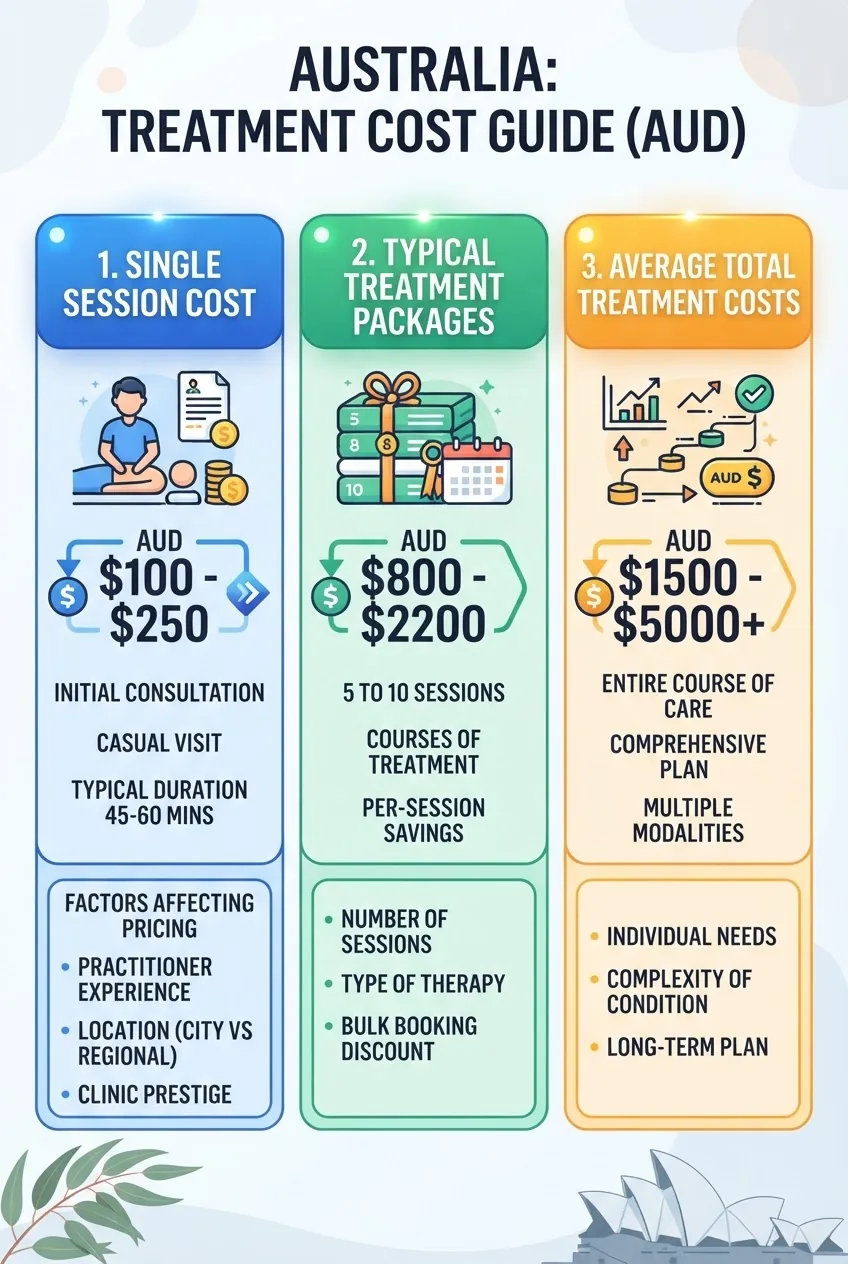
Typical price ranges (Australia):
| Service | Typical AUD range | Notes |
|---|---|---|
| Single session (follow-up) | $70 – $120 | Common city variance; senior practitioners higher |
| Initial assessment + treatment | $90 – $150 | Longer first visit with detailed history |
| Package (5–10 sessions) | $350 – $950 | Per-session discount often 10–20% |
Factors affecting cost:
- Practitioner qualifications (registered acupuncturist vs junior clinician)
- Location — metropolitan clinics typically charge more than regional ones
- Inclusion of adjunct therapies (electroacupuncture, cupping, moxibustion, physiotherapy)
- Clinic overheads and demand
Insurance and rebates:
- Private health insurance: Many Australian private health funds offer extras rebates for acupuncture; check your fund and level of extras cover.
- Medicare: Generally not covered for standard acupuncture unless part of a chronic disease management plan involving approved allied health (care plan rules apply).
Cost examples (anonymised Australian clinic data, 2023–2024):
- Melbourne CBD clinic: Initial $120, follow-ups $95, 6-session package $520.
- Regional NSW clinic: Initial $90, follow-ups $70, 8-session package $480.
- Senior practitioner (20+ years): Initial $150, follow-ups $120, targeted chronic pain packages $900–1,200.
Payment options and discounts: many clinics accept card, cash and offer package discounts; some provide concession rates or sliding-scale fees for financial hardship.
Transition: after costs, readers often want evidence: how effective is acupuncture compared with other back pain therapies?
Is Acupuncture an Effective Treatment for Back Pain?
Answer: Evidence indicates acupuncture is an effective option for many patients with chronic and acute low back pain, providing moderate benefit versus usual care and comparable benefit to other guideline-supported therapies when used as part of a multimodal plan.
Comparison of acupuncture with common back pain therapies:
| Therapy | Evidence summary | Best use |
|---|---|---|
| Acupuncture | Moderate evidence for pain reduction and improved function vs usual care (systematic reviews) | Chronic non-specific low back pain; adjunct to exercise |
| Physiotherapy / exercise | Strong evidence for improving function and long-term outcomes | Core intervention for rehabilitation and maintenance |
| Medication (NSAIDs, opioids) | Effective for short-term pain relief; opioids carry risks and are not recommended long-term | Short-term flare management; adjunctive use |
| Spinal injection / surgery | Indicated for selected structural pathologies; variable long-term outcomes | Severe radiculopathy, structural failure not responsive to conservative care |
Evidence notes and sources:
- Several systematic reviews and meta-analyses (peer-reviewed journals, 2017–2023) report acupuncture provides small-to-moderate improvements in pain and function versus usual care for chronic low back pain; effect sizes vary by trial quality.
- Randomised trials indicate electroacupuncture may offer additional benefit for neuropathic or radicular symptoms compared with manual acupuncture alone (clinical trial data, peer-reviewed, 2020–2022).
- Guidelines in some countries recommend acupuncture as an option for persistent low back pain when combined with exercise and self-management (professional guideline statements, 2021–2023).
For a deeper dive into trial-level data and training context, see acupuncture therapy research overview.
Official guidance and resources: Australian Department of Health provides general health guidance; for peer-reviewed articles search PubMed and professional standards are available from the Australian Acupuncture and Chinese Medicine Association.
Transition: as with any therapy, safety and contraindications are essential to review before treatment.
Safety, Side Effects, and Contraindications
Answer: Acupuncture is generally safe when performed by trained practitioners using sterile, single-use needles; common side effects are minor (bruising, transient soreness), while serious complications (infection, organ injury) are rare and mostly avoidable with proper training and hygiene.
Safety checklist: Verify practitioner registration, single-use sterile needles, clear infection control procedures, full disclosure of medical history (including anticoagulant use and pregnancy).
- Common minor side effects: temporary soreness, slight bleeding at needle sites, bruising, mild dizziness.
- Less common: transient nerve irritation, local infection if poor hygiene.
- Serious (rare): pneumothorax from thoracic needling (extremely rare when protocols followed), severe infection in immunocompromised patients.
Contraindications and cautions:
- Uncontrolled bleeding disorders or therapeutic anticoagulation — assess risk vs benefit and obtain medical clearance.
- Pregnancy — some points are contraindicated (e.g., certain lower abdomen and sacral points); disclose pregnancy to your practitioner.
- Severe needle phobia or inability to remain still may preclude safe needling.
- Active skin infection at needling sites or systemic infection.
Trust signals: discuss medication, comorbidities and prior surgery with your practitioner; seek medical review for red flags such as progressive neurological deficit, unexplained weight loss, fever or bowel/bladder dysfunction.
Transition: many patients achieve better outcomes when acupuncture is combined with other therapies — next section explains practical integration strategies.
Combining Acupuncture with Other Therapies for Back Pain Relief
Answer: Combining acupuncture with physiotherapy, targeted exercise, acupressure and lifestyle measures typically produces stronger, longer-lasting improvements than acupuncture alone; an integrated, patient-centred plan addresses biomechanics, neural sensitisation and psychosocial factors.
How to combine therapies effectively:
- Start with a baseline plan: Identify immediate pain control (acupuncture + short-term analgesia if needed) and rehabilitation goals (restore movement patterns and strength).
- Coordinate care: Communicate across providers (acupuncturist, physiotherapist, GP) and share treatment notes to avoid duplicative or conflicting advice.
- Use acupressure for self-management: Teachable points and home acupressure techniques help maintain gains between clinical sessions; see Abdominal pain acupressure points and the acupressure knee pain points guides for transferable methods.
- Integrate exercise and movement: Progressive loading, core control and aerobic conditioning reduce recurrence; acupuncture helps with pain to enable participation in exercise therapy.
- Address stress and sleep: Acupuncture for anxiety and relaxation techniques can improve pain outcomes; see acupuncture for anxiety treatment for related approaches.
Specific how-to advice:
- Use acupuncture to reduce pain flares so patients can begin or increase physiotherapy exercises with less inhibition.
- Teach acupressure points for self-use during flare-ups — simple sustained pressure to local or distal points for 1–3 minutes can reduce pain spikes.
- Consider combined appointments (e.g., acupuncture followed by manual physiotherapy) for a single-effort integrated session when clinics offer multidisciplinary services.
Cross-condition lessons: acupressure and distal point strategies used in knee and ankle pain can inform back pain self-care; resources like the acupressure points in ankle chart and acupressure knee pain points show techniques translatable across body regions.
Transition: the article now summarises safety, evidence and practical next steps and offers a clear call to action.