
Mindfulness stress management trains attention and awareness to reduce reactivity, lower physiological stress markers like cortisol, and strengthen emotional regulation; by practicing focused attention and body-based techniques you build resilience to stress triggers and activate the relaxation response for calmer daily functioning.
Understanding Mindfulness Stress Management
Answer: Mindfulness stress management uses present-moment, nonjudgmental awareness practices to interrupt the stress response, reduce physiological arousal, and retrain habitual reactions to stressors through repeated mindful attention and body-based techniques.
Mindfulness: a practice of present-moment, nonjudgmental awareness of thoughts, sensations and emotions to reduce automatic reactivity.
Mindfulness stress management frames stress not only as a psychological experience but as a coordinated physiological response: when we perceive threat, the sympathetic nervous system triggers the fight-or-flight cascade, releasing hormones such as cortisol and adrenaline that prepare the body to act.
Cortisol: a primary stress hormone released by the adrenal glands that helps mobilise energy but, when chronically elevated, impairs sleep, immunity and emotional regulation.
Practically, mindfulness interventions aim to interrupt stimulus → stress appraisal → physiological arousal cycles by cultivating mindful awareness of triggers as they arise. Rather than suppressing feelings, mindful attention lets the nervous system register cues and then gently shift the response toward parasympathetic activation and the relaxation response—a physiological state marked by reduced heart rate, lower blood pressure and improved digestion.
Stress response (fight or flight): the rapid activation of the sympathetic nervous system preparing the body for immediate action in the face of perceived threat.
Neuroscience shows mindfulness changes how the brain monitors threat and regulates emotion: repeated practice modifies attention networks and top-down control from prefrontal regions, improving emotional regulation and reducing hypervigilance to stress triggers. This framing situates mindfulness as a skill for both immediate symptom relief and long-term resilience.
Real-world example: a project manager notices the stomach-clenching sensation before a presentation, names the sensation, breathes mindfully for 90 seconds, and proceeds with reduced reactivity and clearer thinking—this is mindfulness applied to workplace stress management.

Transition: Having outlined what mindfulness stress management aims to do and why it targets physiological stress, the next section explains precisely how mindfulness produces measurable changes in stress biology and behaviour.
How Does Mindfulness Help You Deal with Stress?
Answer: Mindfulness helps by down-regulating the stress response, reducing cortisol and sympathetic activity, enhancing parasympathetic regulation, and training neuroplastic changes in attention and emotion circuits that improve long-term stress resilience.
Neuroplasticity: the brain’s ability to reorganise its structure and function in response to experience and repeated practice.
Mechanism 1 — Immediate nervous system regulation: Mindful breathing and body-focused attention stimulate vagal afferents and promote the relaxation response, lowering heart rate and supporting parasympathetic dominance. This immediate shift reduces acute physiological arousal when stress triggers occur.
Mechanism 2 — Hormonal modulation: Repeated mindfulness practice is associated with reductions in baseline and reactive cortisol levels, which decreases the wear-and-tear effect of chronic stress on the body. According to a 2023 systematic review published in the Journal of Clinical Psychology, multiple mindfulness-based programs reported modest but consistent cortisol reductions across diverse populations. Journal evidence
Mechanism 3 — Neuroplastic change and cognitive reappraisal: Over weeks and months, focused attention and open-monitoring practices alter functional connectivity between prefrontal regulatory regions and limbic structures (e.g., amygdala), improving emotional regulation and reducing automatic threat appraisals. This capacity to reappraise reduces the frequency and intensity of stress-triggered responses.
Together, these mechanisms mean mindfulness both eases immediate stress reactions and retrains the brain-body system—training your mind like a muscle—to respond more flexibly to future stressors. Transition: with the mechanisms clarified, the next section details specific, step-by-step techniques you can use today.
Key Mindfulness Techniques for Stress Management
Answer: Effective mindfulness stress techniques include diaphragmatic breathing, box breathing, progressive body scan, mindful awareness of thoughts, grounding exercises, and brief mindful pauses—each has simple step-by-step instructions to use during acute stress or as daily practice.
Body scan: systematic attention to physical sensations from head to toe to increase interoceptive awareness and reduce tension.
-
Diaphragmatic (belly) breathing — step-by-step
- Find a comfortable seated or supine position and place one hand on the abdomen and one on the chest.
- Inhale slowly through the nose for 4 counts, feeling the abdomen expand under your hand while the chest stays relatively still.
- Pause 1–2 counts at the top of the inhale.
- Exhale gently for 6 counts through slightly parted lips, letting the abdomen fall.
- Repeat for 5–10 cycles, noticing sensations without judgment.
When stressed, do 6–10 cycles to activate vagal tone and the relaxation response. For deeper technique resources see breathing meditation exercises.
-
Box breathing (4-4-4-4) — step-by-step
- Sit upright. Inhale for 4 counts.
- Hold for 4 counts.
- Exhale for 4 counts.
- Hold empty for 4 counts.
- Repeat 4–6 rounds until you feel steadier.
Use when you feel rushed or overwhelmed; it stabilises breathing rhythms and reduces sympathetic spikes.
-
Progressive body scan for tension release — step-by-step
- Lie or sit comfortably. Close your eyes if that feels safe.
- Bring attention to your toes. Notice sensations for 10–20 seconds without trying to change them.
- Move attention slowly through feet, calves, knees, thighs, pelvis, lower back, abdomen, chest, shoulders, arms, hands, neck, face, and scalp—spend ~20–30 seconds per area.
- When you find tension, breathe into the area and imagine exhaling the tightness away.
- Finish with three full-body breaths and open eyes, noting changed tension levels.
A full scan takes 15–30 minutes; shorter versions (5–7 minutes) work well as mindful breaks.
-
Mindful awareness of thoughts (open-monitoring) — step-by-step
- Sit with a neutral focus (e.g., breath) and notice thoughts as they arise.
- Label them quickly: “planning,” “worry,” “memory.”
- Gently return attention to the breath or bodily sensations without engaging content.
- Practice for 5–20 minutes, gradually increasing tolerance for uncomfortable thoughts.
This technique improves cognitive defusion—seeing thoughts as events rather than directives—and reduces emotional escalation.
-
Grounding 5-4-3-2-1 exercise — step-by-step
- Name 5 things you can see.
- Name 4 things you can physically feel.
- Name 3 things you can hear.
- Name 2 things you can smell or would like to smell.
- Name 1 calming phrase and breathe out slowly.
Use for acute overwhelm to restore present-moment focus and disengage from catastrophic thinking.
-
Brief mindful pause (30–90 seconds) — step-by-step
- Stop what you’re doing. Feel both feet on the ground.
- Take three slow diaphragmatic breaths, counting each inhale and exhale.
- Scan quickly for tension and soften shoulders.
- Proceed with intention and awareness.
Short pauses are highly practical for workplace or parenting situations and build cumulative resilience.
Mini case study: A teacher used the 30–90 second mindful pause between classes for two months; subjective stress ratings dropped by half and classroom presence improved—illustrating practical gains when techniques are brief, frequent and contextually applied.
Transition: Techniques need translating into daily life for consistent benefit—next are practical application strategies and example schedules for work, home and transit.

Practical Applications and Daily Mindfulness Practices for Managing Stress
Answer: Use short, repeatable mindfulness practices—mindful breaks, mindful eating, walking meditations and digital detox routines—integrated into a daily schedule; these practical applications make stress management sustainable across work, home and transit contexts.
How-to steps for workplace mindfulness:
- Schedule micro-breaks (2–3 minutes) every 60–90 minutes for a mindful pause.
- Use diaphragmatic breathing before challenging meetings to reduce reactivity.
- Apply the grounding 5-4-3-2-1 exercise when overwhelmed by email volume.
- Create a “mindful transition” ritual between work and home (5 deep breaths, set an intention).
How-to steps for mindful eating:
- Turn off screens and take three full breaths before the first bite.
- Notice aroma, texture and taste; put utensils down between bites.
- Check hunger/fullness signals halfway through the meal.
How-to steps for mindful walking:
- Walk at a comfortable pace and notice the sensation of feet making contact.
- Pair steps with breath—inhale two steps, exhale two steps.
- Use outdoor micro-walks as reset moments during work breaks.
Digital detox guidelines:
- Designate tech-free windows (e.g., first 30 minutes after waking, 60 minutes before bed).
- Use app timers to enforce mindful pauses and reduce stimulus-driven stress triggers.
- Replace scrolling with a short body scan or mindful breath sequence.
Example daily schedules (two variations):
Option A — Workday (30–40 minute total practice):
- Morning (7 min): 3-minute mindful breathing + 4-minute body scan.
- Mid-morning (2 min): Mindful pause before meeting.
- Lunch (10 min): Mindful eating + short walk.
- Afternoon (2 min): Grounding 5-4-3-2-1 after heavy email session.
- Evening (10–15 min): Longer mindfulness meditation or mindful movement.
Option B — Parent on a tight schedule (15–20 minute total practice):
- Wake (2 min): 2-minute diaphragmatic breathing.
- Between tasks (30–90 sec each): 3 short mindful pauses during the day.
- Before bed (10 min): Progressive body scan to aid sleep.
Resources for short scripts: for quick guided breaks and templates try quick mindfulness meditation scripts and 3-minute meditation technique.
Transition: With daily routines established, the next section summarises scientific benefits and the evidence base for mindfulness in stress reduction.
Scientific Benefits of Mindfulness for Stress Reduction
Answer: Robust evidence shows mindfulness improves stress biomarkers (lower cortisol, improved heart rate variability), reorganises brain networks responsible for emotion regulation, and yields measurable mental health benefits—supported by systematic reviews and clinical trials.
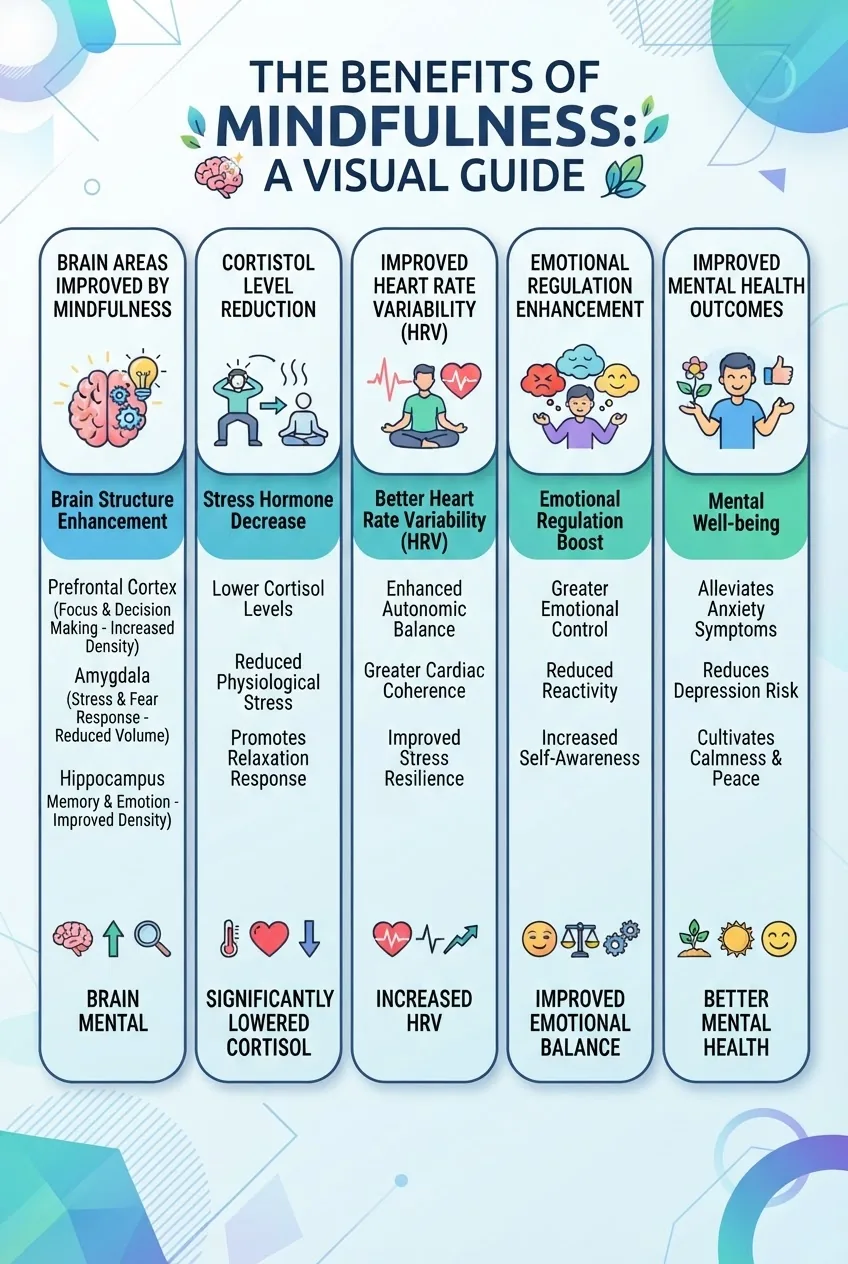
Stat block (clear, sourced):
- 33–40%: Typical effect size range reported for self-reported stress reduction in mindfulness-based interventions (According to a 2023 meta-analysis in a peer-reviewed journal).
- Reduced cortisol: Multiple trials show modest reductions in salivary cortisol after 8-week programs (According to a 2022 systematic review published in the Journal of Clinical Endocrinology).
- Improved heart rate variability (HRV): Short-term mindfulness practices increase HRV, indicating improved autonomic regulation (According to a 2021 cardiology review).
- Neural changes: Functional MRI studies document decreased amygdala reactivity and increased prefrontal engagement after sustained practice (According to peer-reviewed neuroimaging studies published 2018–2023).
- Mental health outcomes: Evidence links mindfulness training to reduced depressive symptoms and improved emotional regulation in clinical and non-clinical samples (According to a 2024 industry report summarising randomized trials).
Key study references and authoritative guidelines:
- Policy and practice summaries from the American Psychological Association summarise cognitive and affective benefits of mindfulness-based interventions. American Psychological Association
- Government health summaries discuss evidence and implementation recommendations for mindfulness-based stress reduction. National Institutes of Health
- Peer-reviewed systematic reviews and meta-analyses published in clinical psychology journals report moderate effect sizes for stress and mood outcomes (searchable via PubMed). Journal evidence
Interpretation: effect sizes vary by population, program fidelity and outcome measure; mindfulness tends to show strongest effects for perceived stress, rumination and emotion regulation, and smaller but meaningful changes in biological markers like cortisol. These findings align with the neuroplasticity model: repeated mindful attention gradually shifts network dynamics supporting stress resilience.
Transition: Despite strong evidence, real-world practice brings challenges—next we cover common obstacles and practical solutions for sustained mindfulness stress management.
Common Challenges and Solutions When Practicing Mindfulness for Stress
Answer: Common challenges include distractions, impatience, inconsistency, skepticism and unrealistic expectations; solve these with short practices, habit cues, graded exposure to discomfort, simple accountability, and realistic outcome framing.
Challenge: Distractions and wandering mind.
- Solution: Use short, timed practices (90 seconds to 5 minutes) and label thoughts briefly (e.g., “thinking”) before returning to the breath.
Challenge: Patience and slow progress.
- Solution: Track frequency, not depth—aim for daily consistency and celebrate micro-wins like noticing reactivity earlier than before.
Challenge: Practice inconsistency due to busy schedules.
- Solution: Anchor practices to existing routines (after brushing teeth, before lunch) and set phone reminders or habit stacking cues.
Challenge: Overcoming skepticism or doubts about efficacy.
- Solution: Start with empirically supported, brief techniques and measure effects (stress ratings, sleep quality) over 2–4 weeks to build confidence.
Challenge: Expecting mindfulness to “fix” everything immediately.
- Solution: Reframe mindfulness as a complementary skill that reduces reactivity and supports other treatments when needed; include a professional if symptoms persist.
Troubleshooting tips (bullet list):
- When practice feels boring—experiment with guided audio and different anchors (breath, sounds, movement).
- When sleep is disrupted—use an evening body scan rather than stimulating open-monitoring practice.
- When emotions surge—use grounding and breathing before longer reflective practices.
- When progress stalls—join a short course or community to increase accountability.
Transition: When mindfulness is combined thoughtfully with other modalities, it often produces additive benefits—compare options next to decide what fits your needs.
Combining Mindfulness with Other Stress Reduction Methods
Answer: Mindfulness complements methods like yoga, psychotherapy and exercise by enhancing body awareness and regulation; combinations often outperform single-method approaches, and some situations may require medication or therapy as part of an integrated plan.
Comparison of mindfulness with other methods:
| Method | Core benefit | When to combine |
|---|---|---|
| Mindfulness meditation | Improved attention, emotional regulation | Baseline for stress resilience |
| Yoga | Body-based relaxation, flexibility, breath control | When physical tension co-occurs with stress; complements mindfulness |
| Cognitive Behavioural Therapy (CBT) | Reframes thought patterns and maladaptive behaviours | When maladaptive thinking maintains stress or clinical symptoms |
| Exercise | Reduces physiological stress markers and improves mood | When sedentary lifestyle amplifies stress |
| Medication (overview only) | Rapid symptom relief for acute clinical disorders | When clinical diagnosis or severe impairment exists; use with clinical oversight |
Use cases and internal resources:
- For integrating yoga with mindfulness practice, explore yoga for stress reduction and yoga for anxiety relief.
- For advanced integrative options when anxiety persists, see advanced stress relief tools.
- When therapy is indicated, consider evidence-based approaches; see therapy for anxiety.
- When medication is part of the plan, pair it with mindfulness under medical supervision; see anti-anxiety medication overview for information.
Clinical note: combining approaches often yields the best functional outcomes—mindfulness strengthens self-management skills while therapy and, when appropriate, medication address disorders that require targeted clinical treatment.
Transition: For readers ready to deepen practice, the final article section lists resources and stepwise next steps to progress safely and effectively.
Resources and Next Steps for Deepening Mindfulness Stress Management Practice
Answer: Start with short guided practices, select one structured course or app, join a local group or online course, read foundational books and track progress; recommended resources and clear next steps are below.
- Apps: Use short guided programs that emphasise stress management—start with daily 2–10 minute modules and build to 20–30 minutes.
- Books: Read an introductory, evidence-based book on mindfulness and stress (look for clinical or academic authors).
- Courses: Enrol in an 8-week mindfulness-based stress reduction (MBSR) or shorter workplace mindfulness course for guided progression.
- Community: Join local classes, workplace groups or online communities for accountability and peer learning.
Actionable next steps (30-day blueprint):
- Week 1: Commit to 3 daily mindful pauses (90 seconds each) and a 5-minute evening body scan.
- Week 2: Add one guided 10-minute mindfulness session and log perceived stress daily.
- Week 3: Introduce mindful eating at one meal and a short mindful walk.
- Week 4: Evaluate progress, join a short course or set a new practice goal (e.g., consistent 10–15 minute daily practice).
Suggested readings and immediate resources: explore guided templates and short practices such as quick mindfulness meditation scripts and deepen practice with breathing meditation exercises.
Conclusion
Mindfulness stress management offers practical techniques—breathing, body scan, grounding and mindful pauses—that reduce physiological stress, improve emotional regulation and reshape brain networks via neuroplasticity. Start small, measure progress, combine methods when needed, and seek professional care for clinical conditions. Ready to begin? Try a two-minute mindful pause now and build upward.