
Best online health coach certification program — By the end of this guide you will be able to compare top online health coach certification programs, pick the right holistic track, estimate cost and timeline, and start enrollment; realistically this takes 2–8 weeks of research plus 3–12 months of course time, and assumes beginner to intermediate familiarity with wellness concepts.
What Is a Health Coach Certification and Why Get Certified Online?
A health coach certification is a formal credential that documents training in behaviour-change techniques, client-centred coaching and foundational health knowledge (nutrition basics, lifestyle medicine, motivational interviewing). Choosing an online certification lets you study remotely, balance work and family, and access programs with national accreditation standards.
Online certification value: credentials help clients and employers trust your skill set—accreditation from recognised bodies (for example, the National Board for Health & Wellness Coaching) acts like a quality badge. Online delivery expands access to specialized holistic curricula and peer communities, while offering recorded lectures, synchronous practice labs, and digital assessment methods.
Scope and career opportunities: certified health coaches work in private practice, corporate wellness, clinics, integrative medical teams, or digital health platforms. According to a 2024 industry report, demand for lifestyle and preventive health services is growing in employer-sponsored wellness and primary care partnerships (source type: industry report).
Online certification benefits include lower travel cost, flexible pacing (self-paced or cohort-based), and access to international faculty and supervised practice. Limitations include less in-person practice hours (unless the program offers local practicum options) and variability in recognition across regions.
Transition: Next, learn exactly what criteria to use when selecting the best program for your goals.
Criteria to Choose the Best Online Health Coach Certification Program
- Accreditation standards — Check whether the program is NBHWC-approved or aligned with NBHWC standards. Accreditation matters for employer recognition and exam eligibility. NBHWC approval typically requires specified practicum hours and curriculum elements.
- Curriculum depth and scope — Confirm core modules: coaching skills (motivational interviewing, active listening), behaviour-change models (TRIAD, stages of change), nutrition fundamentals, lifestyle medicine, ethics, and business-building. Look for integrative wellness modules if you want a holistic track.
- Clinical practicum and supervised coaching hours — Programs that provide 60+ supervised coaching hours and mentor observation increase competence. Verify how many observed sessions are included and whether recorded reviews count.
- Program length and timeline — Typical online programs range from 3 months (intensive) to 12 months (comprehensive). Shorter programs often omit practicum or business modules; plan your timeline according to your availability.
- Certification exam and eligibility — Confirm whether program graduates are eligible to sit for board or industry certification exams (for example NBHWC exam). Some programs prepare you directly for external exams; others award a certificate of completion only.
- Cost factors and transparent pricing — Compare tuition, exam fees, materials, required textbooks, practicum supervision fees, and recertification costs. Watch for payment plans and scholarships.
- Student support and community — Look for mentor access, cohort peer groups, live Q&A, career services (job boards, practicum placement), and active alumni communities that provide referral pipelines.
- Faculty credentials — Assess instructor backgrounds: clinical experience, NBHWC certification, academic degrees in nutrition, integrative medicine, behavioural psychology, or public health.
- Delivery format and tech — Confirm synchronous vs asynchronous balance, platform usability, recording policies, and whether assessments use real client recordings or simulated clients.
- Continuing education and recertification — Check recertification intervals (typically every 2–3 years), CE requirements, and whether the provider offers CE credits and alumni discounts.
Each item above usually matters differently depending on your goal — clinical integration, private practice, corporate wellness, or specialty (e.g., holistic nutrition). Next we compare the leading online programs using these criteria.
Top Rated Online Health Coach Certification Programs Compared
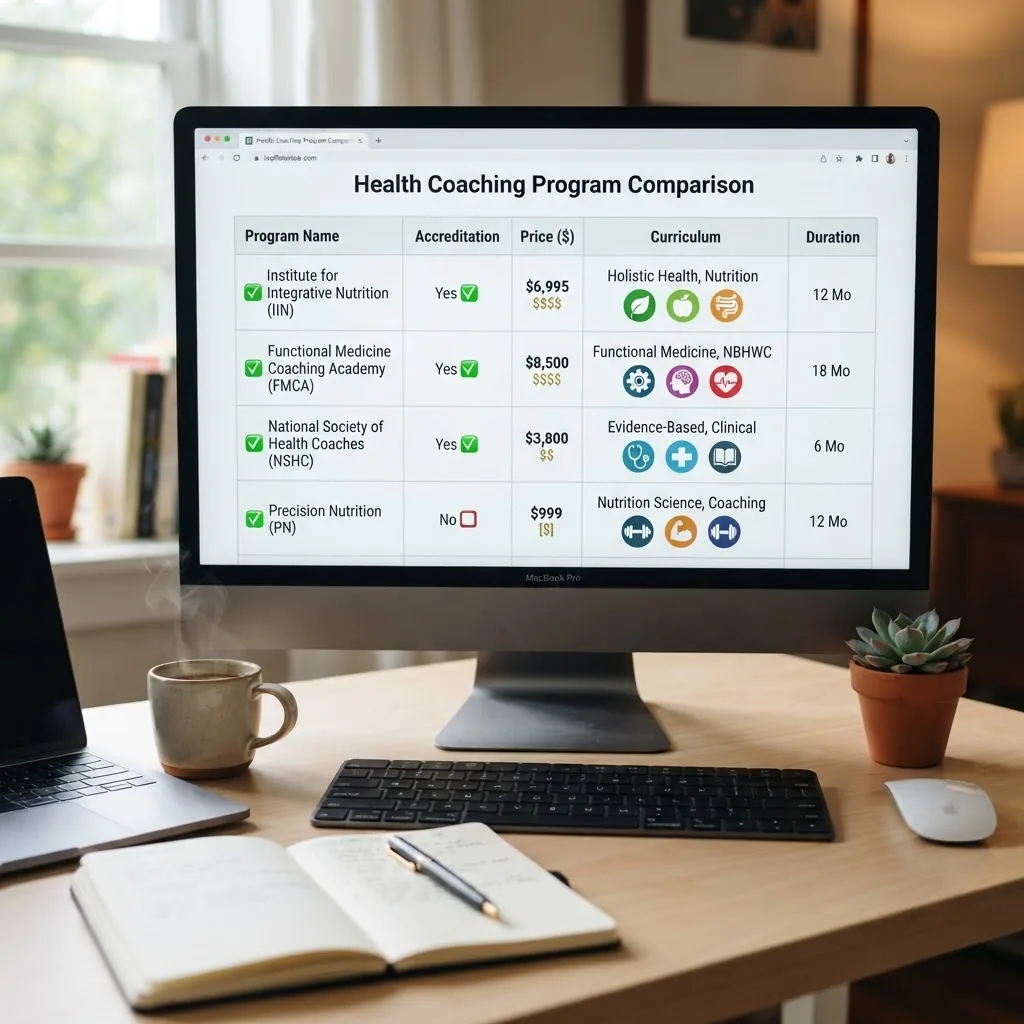
Below is a side-by-side comparison of top-rated online health coach certification programs (illustrative pros/cons based on public program literature and industry reporting). Costs are shown as typical ranges in 2025 USD or program-listed local currency, with notes on accreditation and curriculum highlights.
| Program | Accreditation / Recognition | Core curriculum highlights | Length | Typical cost (USD) |
|---|---|---|---|---|
| Functional Medicine Coaching Academy (FMCA) | NBHWC-aligned pathways; widely respected | Functional medicine foundations, integrative assessment, 1:1 practicum | 9–12 months | $5,500–$7,500 |
| Wellcoaches Professional Coach Training | NBHWC-approvable curriculum; coach certification | Coaching techniques, behaviour change, basic nutrition | 6–9 months | $2,500–$4,000 |
| Health Coach Institute (HCI) | Certificate of completion; pathways to NBHWC via additional requirements | Business setup, habit-based coaching, holistic nutrition | 6 months (fast track) | $2,200–$4,200 |
| Institute for Integrative Nutrition (IIN) | Certificate program; not NBHWC-accredited but widely known | Holistic nutrition, lifestyle coaching, business training | 6–12 months | $3,000–$6,000 |
| Duke Integrative Medicine Health Coach Training | University-based program; CE credits available | Clinical integration, health behaviour change, team-based care | 6–9 months | $3,500–$6,500 |
| Wellness-focused University/College Certificate Programs | Varies by school; some have continuing education recognition | Public health basics, program evaluation, clinical placements (varies) | 3–12 months | $1,200–$8,000 |
Summary of differences: FMCA and university-based programs emphasise clinical integration and are costlier but provide strong practicum and NBHWC alignment. IIN and HCI offer accessible holistic tracks and stronger business-building content. Wellcoaches is coaching-skills focused and aligns well with corporate roles.
Specializations: if you want a nutrition specialization within a holistic framework, consider a program that includes dedicated nutrition modules or a combined nutrition certification.
holistic nutrition certification
Transition: After weighing program features, many prospective coaches want to understand how holistic certification differs and why it matters for client outcomes.
Understanding Holistic Health Coach Certification and Its Unique Benefits
Holistic health coaching integrates mind-body-spirit principles with lifestyle medicine and behaviour-change methods. A holistic certification trains coaches to assess diet, sleep, stress, environment, relationships and spiritual factors, and to weave modalities (mindfulness, breathwork, basic energy awareness) into coaching plans.
Definition and integrative approaches: Holistic coaching emphasises systems thinking — seeing clients as whole people whose symptoms reflect multiple interacting domains. For a technical grounding, many programs reference wellness models (e.g., biopsychosocial and integrative wellness models) to structure intake and goal setting.
Examples of modality integration: a coach might combine nutritional guidance, sleep hygiene, breathwork sessions, and guided journaling to address chronic fatigue. More specialized tracks include spiritual coaching techniques and Ayurvedic lensing, but scope depends on the program and regional practice rules.
Differences vs standard coaching: Holistic certification emphasises multiple wellness domains and may include modules on spiritual care, energy practices, and complementary therapies; standard health coaching often focuses on behaviour-change and biomedical lifestyle interventions without spiritual or alternative modality training.
Transition: If you want to become certified online, follow these hands-on steps — the core of this guide.
How to Become a Certified Health Coach Online – Step-by-Step Guide
What you will have achieved at the end of these steps: selected a program, enrolled, completed coursework, logged supervised practice hours, passed necessary exams if applicable, and launched a basic client acquisition plan. Expect to invest 100–600 hours total depending on program rigor.
Before you start:
- Prerequisites: reliable internet, laptop with webcam, headset, a private space for practice coaching, basic literacy in nutrition and behaviour change (recommended).
- Tools and materials: digital notebook (Notion/OneNote), video recording tool (Zoom or platform-provided), payment plan or savings for tuition, 3–5 practice clients for supervised hours.
- Time commitment: plan 6–12 hours/week for a 6-month cohort; reduce or increase based on program self-paced options.
- Define your target outcome and niche. Decide whether you aim to work in corporate wellness, private practice, integrative clinics, or online group coaching. Quantify it: aim for 10–20 initial clients and 2 referral partners within 6 months.
- Shortlist 3–5 programs using selection criteria. Use the criteria earlier (accreditation, curriculum, practicum hours, cost). Create a spreadsheet and score each program on a 1–5 scale for accreditation alignment, practicum hours, cost transparency, community support, and business training.
- Confirm exam eligibility and accreditation path. If NBHWC recognition is a priority, ensure the program makes graduates eligible for the NBHWC exam or provides an NBHWC-aligned curriculum. Visit the NBHWC site for standards and approved program lists.
- Calculate total cost with hidden fees. Add tuition, exam fees (e.g., NBHWC exam fees if applicable), mandatory books (estimate $100–$300), supervision fees (often $200–$1,000), and recertification bundles. Compare payment-plan interest rates and scholarship options.
- Check practicum logistics and supervisee matching. Confirm how many supervised hours are included (target 60+ observed coaching hours for clinical readiness), whether the school provides client matching, and if sessions can be remote.
- Assess student support and community features. Look for weekly mentor hours, cohort peer calls, live practice labs, and a moderated alumni forum. Prioritise programs that provide placement or job-search assistance if you plan clinical integration.
- Review faculty bios and sample coursework. Read instructor CVs: aim for at least two instructors with clinical or doctoral-level backgrounds and at least one with NBHWC credentialing. Request sample lesson videos and a syllabus that lists required learning outcomes and assessments.
- Enroll and set a study plan. Block time in calendar: 3–5 hours/day on class days, 6–12 hours/week otherwise. Use timeboxing: 90-minute focused study blocks, 10-minute break, and weekly practice coaching sessions (minimum two 60-minute sessions/week).
- Complete coursework and log supervised hours. Keep a practicum log: date, client initials, session length, learning objective, supervisor feedback. Aim to complete at least 60 supervised hours and 100 total coaching hours for strong readiness.
- Prepare for and take the certification exam if required. Use practice exams, flashcards, and recorded mock coaching assessments. Schedule the exam after completing ≥80% of coursework and practicum hours. Allow 4–6 weeks of focused revision.
- Launch your coaching practice with measurable goals. Build a simple website or listing, create a 3-month marketing plan (content calendar, 2 weekly posts, 1 webinar/month), price services (example: 6-session starter package $350–$700) and track conversion rates.
- Pursue continuing education and build referral partnerships. After certification, plan 20–40 hours/year of continuing education. Develop referral agreements with local clinicians, nutritionists, and holistic centres.
Practical timeline examples: a focused path (intensive) — 3–6 months with 15–20 hours/week; a balanced path — 6–9 months with 6–12 hours/week; a part-time path — 9–12+ months with 3–6 hours/week.
Case example: Claire’s path (real-practice style)
Claire, 34, completed a 9-month NBHWC-aligned online program while working part-time. She logged 75 supervised hours, completed a capstone case study, and used the school’s marketing templates to secure her first 12 clients within 10 weeks of graduation. Claire now works with a hybrid model: 60% private clients, 40% corporate contract coaching.
Transition: Below are common mistakes I’ve seen learners make and how to avoid them.
Common mistakes and how to avoid them
I once recommended a program to a peer who later found out the practicum hours wouldn’t count toward NBHWC eligibility — we should have verified exam pathways first. Verify accreditation alignment and practicum counting before enrolling.
- Choosing on price alone — I observed students lose time in programs lacking practicum or assessment rigor. Always score programs for practicum and accreditation first.
- Underestimating supervised hours — I’ve seen learners scramble to find practice clients late in the course. Start client recruitment early; aim to recruit 3 practice clients in month one.
- Skipping business training — several graduates could coach well but lacked referral or pricing strategies. Prioritise programs with business modules or add a short business course.
- Not checking regional recognition — a colleague completed a non-accredited program that wasn’t recognised by healthcare employers in their region. Confirm employer or clinic acceptance if integration is your goal.
Holistic Health Coach Certification Cost Breakdown and Financing Options
Typical cost components: tuition (largest component), exam fees, practicum supervision fees, required readings, software or platform fees, recertification costs, and optional business startup costs (website, branding). Costs vary: according to a 2024 industry report, typical comprehensive programs range $2,000–$8,000 (source type: industry report).
Example breakdown (mid-range program):
- Tuition: $3,500
- Exam/credentialing fee: $300–$800
- Supervision/mentor fee: $250–$800
- Books/resources: $100–$300
- Recertification (every 2–3 years): $150–$600
- Business launch costs (optional): $300–$1,200
Financing tips:
- Ask programs about payment plans (example: 6 monthly payments at 0–6% APR) or early-bird discounts.
- Search for scholarships or bursaries targeted at healthcare workers or career changers — some schools offer need-based aid.
- Consider employer tuition reimbursement for corporate wellness roles; negotiate pre-hire tuition support if you have a service agreement.
- Estimate return on investment: If your average client pays $75/session and you convert 10 clients at 6 sessions each, revenue = $4,500 in months 3–6 post-launch.
Transition: Understanding cost is vital; so is knowing what career outcomes you can expect after certification.
Career Outcomes: What to Expect After Certification and How to Succeed
Career pathways after certification include private practice, corporate wellness, integrative clinics, digital health companies, and community health programs. Salary and income vary by location, experience, and business model.
According to a 2024 industry report, entry-level coaches working independently often earn $25–$45 per hour in base sessions, growing to $75–$200 per hour as experience and niche authority increase (source type: industry report). Government workforce data for related roles (health educators, wellness program specialists) shows median wages ranging widely by region; consult national data for precise local estimates.
For role data, see US Bureau of Labor Statistics: Health Educators.
Real-world examples and tips:
- Private practice: Start with a 6-session package at $395; aim to convert 20% of free discovery calls to clients. Track client retention and outcomes using a simple CRM or spreadsheet.
- Corporate wellness: Position towards measurable outcomes (employee engagement, reduced sick days). Use case studies showing client ROI to pitch HR; seek short pilot contracts (8–12 weeks).
- Clinic-based work: Partner with integrative doctors or allied health clinics and offer a referral split or hourly contracting.
- Digital products: Create group programs and workshops to scale beyond 1:1 work; group pricing example — $297 for a 6-week cohort.
alternative practitioners options with insurance
mental health coaching opportunities
holistic healing center opportunities
Continuing education and recertification: plan 20–40 hours/year of CE. Many programs offer alumni discounts for CE and networking; staying current supports referrals and clinical integration.
Transition: A few remaining common questions are answered below.
FAQs About the Best Online Health Coach Certification Programs
Below are compact, actionable answers to common queries about programs, timelines, costs and accreditation.