

Holistic therapy combines psychological care, mind–body practices, energy-based and natural modalities into coordinated treatment programs that target physical, emotional and social factors. It delivers individualised sessions, modules and lifestyle supports to restore balance, reduce symptoms and build resilience by treating the whole person, not only isolated complaints.
What does holistic therapy mean and how is it defined?
Answer: Holistic therapy means an integrative, whole-person approach to health that intentionally combines psychological, physiological, energetic and lifestyle interventions into a coordinated plan to support long-term wellness, not merely symptom suppression.
Term: Holistic therapy — an approach that treats the whole person (physical, mental, emotional, social, spiritual) using combined modalities rather than single isolated treatments.
Holistic therapy definition focuses on integration: practitioners consider diet, sleep, relationships, stress regulation, movement and belief systems alongside traditional counseling or medical care. Unlike strictly biomedical treatment models, a holistic therapeutic plan may include meditation, movement practices, talk therapy, nutritional guidance, energy work, and herbal or natural healing therapy to create synergy.
To clarify language used across this article, see a short glossary when concepts first appear and expanded definitions embedded in each section. For broader conceptual framing you can read a
holistic view with examples.
Transition: With a working definition established, we next review the core principles that guide a holistic therapeutic approach and why they matter.
What are the core principles of the holistic therapy approach?
Answer: The holistic therapy approach is guided by a set of core principles—person-centred care, systems thinking, integration, prevention and empowerment—that shape assessment, goal-setting and treatment program design.
- Whole-person assessment: Evaluate physical, psychological, social and environmental factors rather than focusing only on a symptom or diagnosis. This is foundational to any holistic therapeutic program.
- Integrated modalities: Combine evidence-based talk therapies, mind‑body practices, and natural or energy-based interventions to create synergies that amplify outcomes.
- Individualisation: Tailor interventions to the person’s biology, culture, preferences and readiness; similar symptoms may require different modality mixes for different people.
- Preventive and lifestyle focus: Emphasise sleep, nutrition, movement, stress management and social supports to reduce relapse and build resilience.
- Collaborative care: Coordinate with medical providers, specialists and community resources when conditions require conventional interventions alongside holistic methods.
- Empowerment and education: Use teaching and self-management strategies so clients actively participate in their healing rather than passively receiving treatments.
- Safety and evidence awareness: Choose modalities with demonstrated benefit for the target condition, monitor for interactions or contraindications, and adapt when new evidence appears.
- Outcome tracking: Use symptom measures, functional goals and patient-reported outcomes to adjust program structure over time.
These principles explain the importance of holistic therapy in practice: they ensure care is person-centered, coordinated and adaptable. For further exploration of wellness models that underpin this thinking see the deeper discussion of a
holistic approach to well being, and the patient-centered framing in
holistic care focuses on patient wellness.
Transition: Understanding the principles helps choose which techniques to include; the next section explains common holistic therapy techniques and real examples.
What are common holistic therapy techniques and examples?
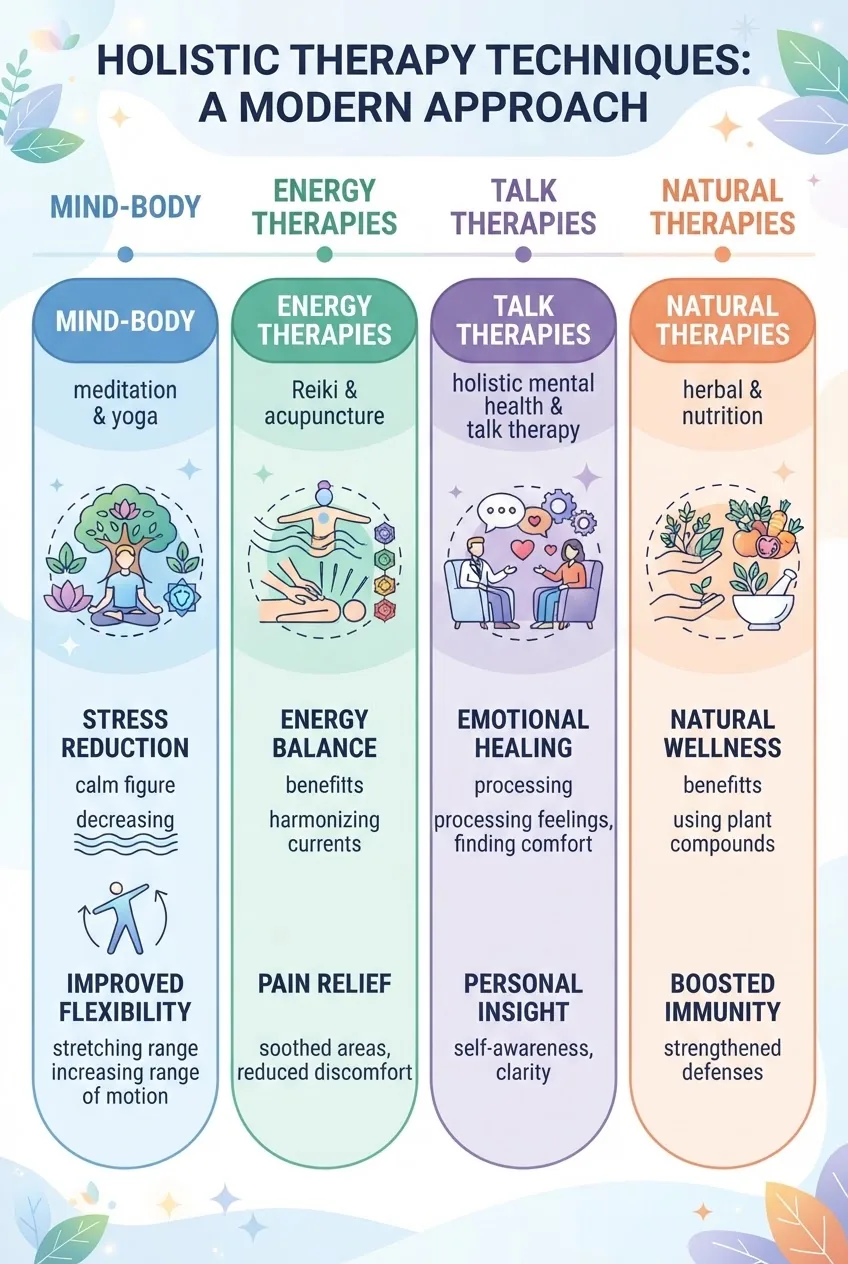
Answer: Common holistic therapy techniques group into mind‑body practices, energy-based therapies, talk and mental-health therapies, and natural/herbal interventions; clinicians mix these into protocols tailored to client needs.

Below are representative techniques, short descriptions of how they work, and practical examples of how they are combined within programs. For extended modality guides see the
holistic healing methods guide.
Mind-Body Techniques (e.g. meditation, yoga, breathwork)
What they are: Mind‑body techniques target the interaction between mental states and physical systems to reduce stress, downregulate sympathetic arousal and support neuroplastic change.
Term: Meditation — practices that train attention and emotion regulation through focused awareness or open monitoring.
- Meditation (mindfulness, loving‑kindness): Reduces rumination and improves emotion regulation; mechanism includes improved prefrontal control and reduced amygdala reactivity (supported by neuroimaging literature).
- Yoga and somatic movement: Combines gentle movement, breath and mindfulness to restore interoception, flexibility and stress resilience.
- Breathwork (controlled breathing, diaphragmatic): Alters autonomic balance to lower physiological arousal and support emotion regulation.
Examples of combination: A typical 6‑week program for generalized anxiety might include weekly cognitive-behavioural sessions, twice-weekly yoga classes, and daily 10‑minute guided mindfulness practices with symptom tracking.
Energy-Based Therapies (e.g. Reiki, acupuncture)
What they are: Energy-based therapies aim to influence subtle physiological or biofield processes to restore balance and reduce pain or distress.
Term: Energy healing — umbrella term for practices (Reiki, therapeutic touch, biofield work) that propose modulation of a body’s energetic field to support healing.
- Acupuncture: Needle-based stimulation at anatomical points to modulate nervous system activity, pain pathways and local circulation; supported by a body of clinical studies for pain and nausea.
- Reiki and therapeutic touch: Hands-on or near-body practices that focus attention and intention to promote relaxation and subjective wellbeing; research shows benefit for anxiety and pain in some controlled trials (research quality varies).
- Craniosacral and biofield therapies: Gentle-touch approaches claimed to influence autonomic function and tissue tension; used to complement other treatments.
Examples of combination: Clients with chronic pain often receive acupuncture for nociceptive modulation, integrated with physiotherapy and mindfulness-based pain coping skills within a three-month plan to reduce medication reliance and restore functional activities.
Talk and Mental Health Therapies (e.g. holistic mental health therapy, holistic talk therapy)
What they are: Talk therapies within a holistic model embed psychological work into a broader lifestyle and somatic plan to treat mental health in context.
Term: Holistic talk therapy — psychotherapy that explores cognitive, emotional and systemic factors while coordinating with diet, sleep, movement and mind‑body practices.
- Cognitive-behavioural therapy (CBT) integrated with mindfulness: Targets thinking patterns and builds present-moment skills to reduce anxiety and depression scores.
- Acceptance and Commitment Therapy (ACT): Focuses on values, committed action and psychological flexibility, often paired with body-based exercises.
- Trauma-informed somatic psychotherapy: Combines talk therapy with body-focused interventions to process trauma stored in the nervous system.
For targeted mental-health frameworks, see a deeper review of the
holistic approach to mental health.
Natural and Herbal Therapies
What they are: Natural healing therapy modalities include herbal supplements, nutritional protocols and lifestyle prescriptions that aim to correct deficiencies, reduce inflammation and support recovery.
Term: Natural healing therapy — non-pharmaceutical interventions such as botanicals, targeted nutrition, and supplements used to support physiological balance.
- Herbal medicine: Standardised botanicals (e.g., St. John’s wort for mild‑moderate depression in some studies) with dosing and safety monitoring.
- Nutritional interventions: Anti-inflammatory diets, micronutrient repletion and omega‑3 supplementation used to support mood and cognition.
- Supplement protocols: Vitamin D, B vitamins, probiotics and adaptogens used selectively with laboratory guidance.
Example: An integrated fatigue program might combine iron and vitamin D correction, anti-inflammatory dietary coaching, guided yoga and CBT for sleep, coordinated across 12 weeks to restore energy and functioning.
Nutrition appears across many interventions; for training and credential context related to nutrition practice see
holistic nutrition certification and counseling.
Transition: With a clear sense of techniques, the next section explains how therapists structure treatment programs that combine these methods into effective courses of care.
How are holistic therapy treatment programs structured and implemented?
Answer: Holistic therapy treatment programs are structured as phased, measurable modules—assessment, stabilization, skill-building, deeper therapeutic work, and maintenance—blending modalities according to goals and safety considerations.
Designing or understanding a holistic therapeutic program follows clear steps that ensure safety, coordination and measurable progress. Below is a practical how‑to walkthrough clinicians use and a sample program template you can recognise in clinics.
- Comprehensive intake and screening (Week 0): Collect medical history, medication list, symptom measures, lifestyle inventory, social supports and client goals; screen for red flags requiring urgent medical care.
- Collaborative goal-setting and plan co-design (Week 1): Co-create measurable goals (sleep hours, activity level, PHQ/GAD scores) and choose an initial modality mix—e.g., weekly psychotherapy + twice weekly yoga + herbal review.
- Stabilisation and safety (Weeks 1–3): Prioritise sleep, hydration, basic nutrition, crisis management, and short-term symptom relief (breathwork, grounding). This reduces acute distress so deeper work can proceed safely.
- Skill-building and habit formation (Weeks 3–10): Teach mindfulness, coping skills, movement routines and dietary changes with structured homework and tracking to foster neuroplastic change and behaviour change.
- Deeper therapeutic processing (Weeks 6–14): Undertake trauma processing, cognitive restructuring, or somatic therapies once stability is established; add adjuncts such as acupuncture if indicated.
- Reintegration and relapse prevention (Weeks 12–20): Consolidate gains, plan for setbacks, connect to community supports, and taper session frequency while maintaining check-ins and outcome monitoring.
- Maintenance and follow-up: Offer booster sessions, peer groups, or ongoing coaching to sustain gains; use patient-reported outcomes at 3, 6 and 12 months to measure durability.
Step-by-step walkthrough of a single session (typical 60 minutes):
- Opening check-in and symptom rating (5–10 minutes).
- Short somatic or breath-based centering exercise (5–10 minutes).
- Targeted therapeutic intervention (talk therapy, movement cueing, acupuncture) (30 minutes).
- Collaborative skill assignment and brief psychoeducation (10 minutes).
- Closing recap and remote-support plan (home practice, follow-up) (5 minutes).
Program comparison table: typical formats, duration, cost ranges and best-fit uses.
| Program Type | Typical Duration | Common Components | Best-fit Uses |
|---|---|---|---|
| Short-term integrative course | 6–8 weeks | CBT+mindfulness+nutrition check | Mild–moderate anxiety, sleep problems |
| Chronic condition rehabilitation | 3–6 months | Physio, acupuncture, diet, psychotherapy | Chronic pain, post-viral fatigue |
| Wellness maintenance | Ongoing (monthly) | Coaching, group mindfulness, check-ins | Stress management, lifestyle support |
Case study (hypothetical): A 42‑year-old with chronic low back pain and insomnia enters a 16‑week program: initial medical clearance and pain screening, 8 acupuncture sessions for pain modulation, weekly physiotherapy, biweekly CBT for pain coping, daily prescribed mobility routines and a 12‑week nutrition plan to reduce inflammatory markers. Outcome measures track pain intensity, sleep quality and work attendance quarterly.
Practitioner insight: “We sequence stabilisation before deep trauma work and use objective measures so both client and clinician can see progress; modalities are added cautiously to avoid overwhelming the system.”
Transition: Knowing program structure, the next section outlines the biological, psychological and social mechanisms by which holistic therapy produces change.
How does holistic therapy work — what are the mechanisms and is it effective?
Answer: Holistic therapy works through overlapping mechanisms—autonomic regulation, neuroplasticity, behavioural change, immune modulation and psycho-social support—producing additive and sometimes synergistic effects that improve function and wellbeing.
Mechanisms explained succinctly:
- Autonomic regulation: Mind‑body practices and breathwork shift the autonomic nervous system from sympathetic dominance to parasympathetic balance, lowering stress hormones and inflammatory signalling.
- Neuroplasticity: Repeated practice (mindfulness, CBT) strengthens prefrontal circuits and reduces maladaptive networks—this biological rewiring underlies long-term symptom reduction.
- Behavioural activation and habit change: Lifestyle interventions (sleep, nutrition, movement) reduce physiological vulnerability and create behavioural momentum toward health.
- Pain and sensory gating: Techniques like acupuncture and somatic therapies modulate nociceptive pathways and alter central sensitisation processes.
- Psycho-social buffering: Therapeutic alliance, group supports and education increase self-efficacy and social resources that predict better outcomes.
- Immune and endocrine effects: Stress reduction and nutrition can lower pro-inflammatory cytokines and improve endocrine balance, supporting recovery in chronic conditions.
Evidence context and authority: Integrated reviews show benefit for specific conditions when holistic components are matched to needs. For example, mind‑body interventions reducing anxiety and depression are supported by peer-reviewed systematic reviews (peer-reviewed journal). The NIH National Center for Complementary and Integrative Health provides overviews of commonly researched modalities and safety considerations (government health agency).
Representative authoritative resources:
- National Center for Complementary and Integrative Health — overview of modalities and evidence (government health agency).
- Mind‑body therapies review (PMC) — peer-reviewed synthesis of mechanisms and outcomes (peer-reviewed journal).
- Australian Health Practitioner Regulation Agency — regulatory context for integrated care and practitioner scopes (national regulator).
Measured effectiveness depends on indication and program fidelity. For chronic pain, multimodal programs that combine physical therapy, psychological therapy and sleep/ nutrition interventions consistently outperform single‑modality approaches in randomized trials (peer-reviewed journal, 2022–2024 reviews). According to a 2023 integrative health study (peer-reviewed journal), programs that included both mind‑body and lifestyle interventions showed larger functional gains than those without lifestyle focus.
Limitations and contraindications: Not every modality suits every person. Herbal therapeutics can interact with prescription drugs; some energy therapies lack high‑quality evidence; serious medical conditions require primary medical treatment first. Always coordinate with medical providers for complex or unstable conditions.
Transition: Next we summarise the measurable benefits and likely outcomes patients can expect from well-designed holistic therapy programs.
What are the benefits and outcomes of holistic therapy?
Answer: Holistic therapy benefits include improved mental health symptoms, reduced pain, better sleep, enhanced functioning and increased self-efficacy when programs are tailored, coordinated and evidence-informed.
- Mental health benefits: Reduced anxiety and depressive symptoms through combined CBT, mindfulness and lifestyle change.
- Physical health benefits: Lower chronic pain scores, improved mobility and better sleep from multimodal regimens (exercise, acupuncture, sleep hygiene).
- Emotional resilience: Greater stress tolerance and emotion regulation via regular practice of breathwork and mindfulness.
- Functional outcomes: Improved daily function, return-to-work rates and activity tolerance from coordinated rehabilitation programs.
- Reduced medication reliance: In some studies, integrative programs reduce the need for chronic opioid and sedative use by offering alternative pain and sleep strategies.
- Patient-centred outcomes: Increased sense of agency, improved quality of life and stronger self-care routines.
For a deeper look into epidemiological and clinical advantages see the referenced synthesis of the
benefits of holistic medicine.
Transition: Finally, learn how to select services and find qualified holistic therapists to deliver safe, coordinated care.
How do I choose holistic therapy services and find qualified therapists?
Answer: Choose holistic therapy services by verifying practitioner qualifications, treatment transparency, outcome measurement, safety protocols and coordination with your medical care; ask for written plans, session structure and evidence basis for chosen modalities.
Practical tips and considerations:
- Check credentials and scopes of practice; therapists should disclose training and limits of practice and provide clear invoicing and referrals when medical oversight is needed.
- Ask about program structure, measurement tools and expected timelines; reputable services share sample treatment plans and outcomes metrics.
- Confirm safety procedures for herbal supplements and potential drug interactions; request medication reviews if natural therapies are proposed.
- Prioritise services that collaborate with primary care or specialists when medical conditions are present.
- Read patient reviews and request a short consultation to assess therapeutic fit and rapport.
If you need assistance locating practitioners who accept insurance, review guidance on
finding alternative practitioners with insurance. For those considering training as a therapist or coach, see programs such as
online health coach certification programs and local
holistic wellness coach training.
Transition: Below are concise FAQs addressing common immediate questions about holistic therapy choice, combination with medical care and verification of quality.
Disclaimer: Holistic therapies are complementary and not always a substitute for medical treatment; consult your medical provider for serious or acute health conditions. Always disclose all therapies and supplements to your care team.