By the end of this hands-on guide you will have a tested, practical routine to calm your mind using breathing, progressive muscle relaxation, guided visualization and calming thoughts; it takes 10–30 minutes per session and assumes beginner-to-intermediate skill.
This guide gives step-by-step procedures, physiological explanations, and real-world examples so you can put techniques into practice immediately.
Before you start
- Quiet space or earphones, low-distraction environment (5–20 minutes available).
- Flat surface or firm chair and a yoga mat or cushion for seated work.
- Stopwatch or phone timer with silent vibrate; comfortable clothing.
- Journal or notes (optional) to track practice and triggers.
- Medical clearance if you have major cardiovascular, respiratory, or psychiatric conditions.
Understanding How to Calm Your Mind
Calming the mind means intentionally reducing cognitive and physiological arousal so thinking becomes clearer and emotional reactivity drops. You will learn how the brain and autonomic nervous system interact to create stress, and how targeted practices trigger the relaxation response — the body’s shift from sympathetic (fight-or-flight) activity to parasympathetic (rest-and-digest) regulation.
Acute stress raises heart rate, shortens breath, and narrows attention via the amygdala and hypothalamic-pituitary-adrenal axis; calming exercises interrupt that loop and restore heart-rate variability and prefrontal cortex regulation, improving decision-making and mental clarity.
A basic physiological mechanism: slow diaphragmatic breathing stimulates the vagus nerve and baroreceptors, which increases parasympathetic tone; progressive muscle relaxation lowers peripheral muscle tension and signals safety to the brain; guided imagery redirects attention and reduces threat-focused thinking.
According to a 2024 industry report on workplace wellbeing, employees who practice at least three relaxation sessions per week report measurable drops in perceived stress and improved concentration (source type: industry report). Peer-reviewed research supports similar effects of mindfulness and relaxation training on anxiety and physiological markers (published study).
Before moving to steps, keep in mind: techniques vary by intensity and context. Some are instant—good for acute spikes of nervousness—while others build resilience over weeks.
Transitioning from understanding to doing, the next section gives precise procedural steps you can use right now.
Key Relaxation Techniques to Calm Your Mind
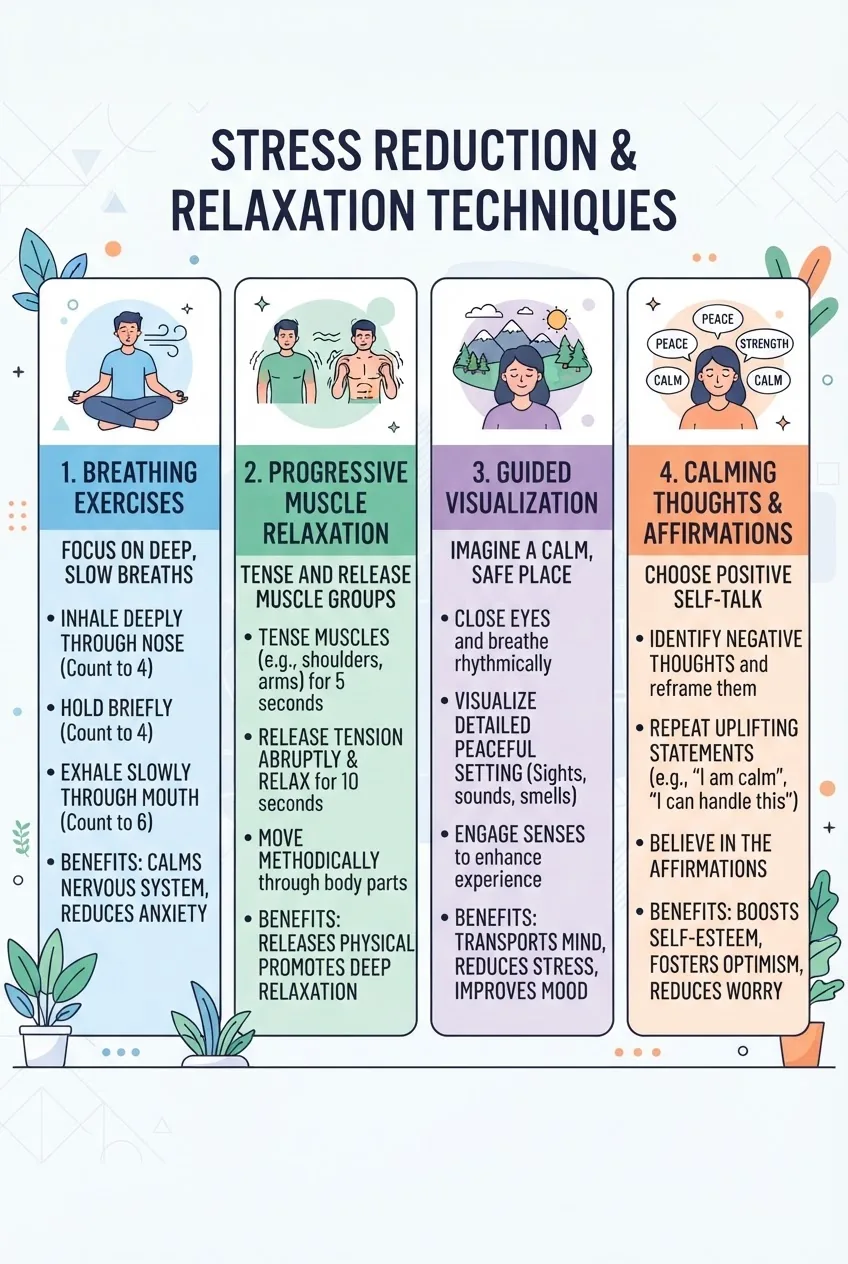
Below are the core methods you can apply immediately: breathing patterns, progressive muscle relaxation, guided visualization, and calming thoughts. Each method contains exact timings, body positions, cues, and practice notes so you can reproduce the effect reliably.
-
Breathing Exercises for Instant Calm
Goal: Drop heart rate and mental chatter within 60–120 seconds.
How to do diaphragmatic breathing (10 breaths; 2–3 minutes) — a precise sequence:
- Sit or lie with support. Spine neutral, shoulders soft, hands on abdomen.
- Inhale through the nose for 4 counts, feeling the belly expand—use diaphragmatic breathing (diaphragmatic breathing means engaging the diaphragm to draw air deep into the lungs).
- Pause 1–2 counts.
- Exhale through the mouth for 6 counts, gently contracting abdominal muscles so the exhale is longer than the inhale.
- Repeat 10 cycles. After 10 cycles check your pulse and perceived stress (0–10); you should see a 1–3 point drop within 2–5 minutes.
Box breathing (use for high-anxiety situations; 4 rounds — 4s/4s/4s/4s): Inhale 4 seconds, hold 4 seconds, exhale 4 seconds, hold 4 seconds. Repeat 4 times. Use seated posture; avoid breath retention if you feel lightheaded.
4-6-8 calming pattern (for sleep or immediate downshift): Inhale 4, hold 6, exhale 8. 6 rounds. This engages the vagal brake effectively.
Examples: If your heart races before a meeting, do 6 diaphragmatic breaths (4 in, 6 out) seated under a desk lamp for 90 seconds. If panic rises on a commute, try 4 rounds of box breathing, checking that shoulders stay relaxed.
Further reading: breathing meditation exercises
-
Progressive Muscle Relaxation
Goal: Systematically release muscular tension to signal safety and lower physiological arousal (10–20 minutes).
Set-up: Lie on your back on a firm surface or sit with feet flat. Timer set for 12–18 minutes.
Step-by-step procedure (12 minutes protocol):
- Start at your feet. Tense the toes and feet for 5–7 seconds (push toes down, flex feet), then release for 20 seconds and notice the contrast.
- Move to calves. Tense calves by pointing toes up and tightening for 5–7 seconds, release and observe warmth and heaviness for 20 seconds.
- Knees and thighs. Squeeze thigh muscles for 5–7 seconds, release 20 seconds.
- Pelvis and abdomen. Tense glutes and lower abdomen for 5–7 seconds, release 20 seconds.
- Chest and back. Breathe in and tense chest/back for 5–7 seconds, release with long exhale for 20 seconds.
- Hands and arms. Make fists and tense forearms/biceps for 5–7 seconds, release 20 seconds.
- Shoulders and neck. Raise shoulders toward ears then release; do not strain neck—keep it gentle—hold 3–5 seconds, release 20 seconds.
- Face and jaw. Clench jaw and squeeze facial muscles for 3–5 seconds, release and allow face to relax completely for 20–30 seconds.
- Full-body scan. Mentally scan for remaining tension; take three diaphragmatic breaths to close.
Practice frequency: daily for the first two weeks (10–20 min) then 3–4× weekly to maintain reduced baseline tension. Evidence shows progressive muscle relaxation reduces muscle tension and anxiety symptoms in clinical trials (source type: peer-reviewed journal) (study).
Caution: skip forceful tensing if you have recent muscle injury. Modify intensity to comfortable limits and pause if pain occurs.
Supplement: muscle relaxation meditation resources provide scripts to follow if you prefer guided audio.
-
Guided Visualization and Imagery
Goal: Redirect attention to calming scenes to lower threat-focused processing and induce a relaxation response (6–15 minutes).
How to practice (10 minutes):
- Position and anchor. Sit or lie comfortably; take 2 slow diaphragmatic breaths to settle attention.
- Choose a detailed scene. Pick a safe, calming scene you can imagine (e.g., shoreline, shady garden, warm room). The more sensory detail the better: temperature, textures, smells, sounds.
- Engage the senses. Spend 2 minutes describing silently: “I hear soft waves, the sand warms my feet, the air smells of salt.” Keep verbs in present tense.
- Include a safe-action anchor. Add a simple action like dipping toes, sipping tea, or pushing a hand through grass—this makes the imagery feel embodied and reduces dissociation risk.
- Return with grounding breaths. After 6–10 minutes, deepen breathing, wiggle fingers and toes, open eyes slowly and note shifts in temperature and tension.
Benefits: Visualization reduces rumination and increases positive affect; it can be used before sleep, public speaking or to disrupt worry loops. For more variations, see the visualization relaxation techniques.
-
Calming Thoughts and Affirmations
Goal: Reframe intrusive thoughts and anchor attention to gentle, stabilising statements that reduce escalation of anxiety.
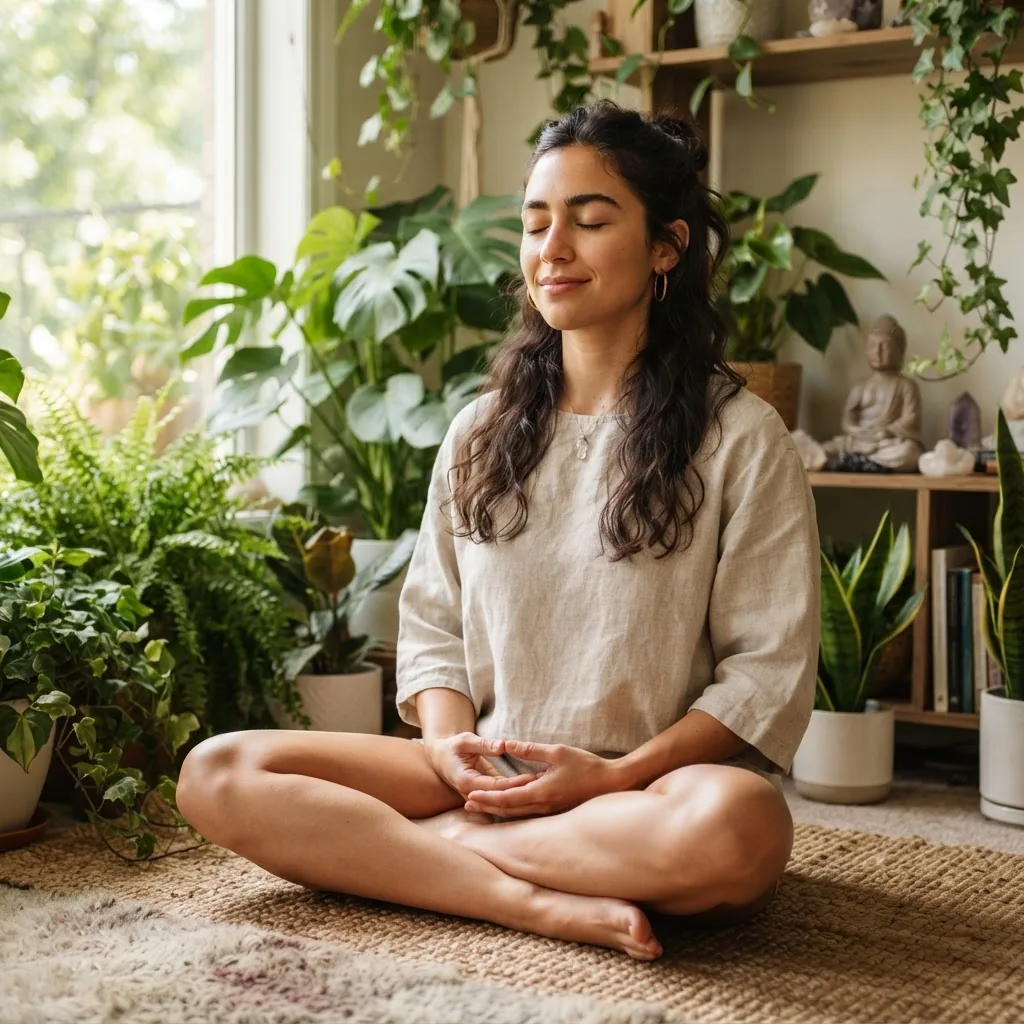
How to use calming thoughts (3–6 minutes):
- Notice the thought. Name it briefly: “There’s a future-worry.”
- Label its quality. Is it a prediction, a memory, a judgment? Labeling defuses urgency.
- Replace with a short affirmation. Use 6–10 words max: e.g., “I am safe for this moment,” “Breath carries me back,” or “This thought is passing like a cloud.”
- Repeat slowly with breath. Say the affirmation on the exhale for 5 repetitions, focusing on bodily sensation more than the words.
Examples of calming thoughts: “I can handle this one step at a time,” “My body knows how to return to calm,” “This sensation will ebb in minutes.” These are cognitive calming strategies—short, concrete, and tied to breath.
Practice: write 8–10 personal affirmations and rehearse them during low-stress moments, then use them when stress appears. For scripts, consult free guided meditation scripts.
Transition: once you can follow each procedure, the next section shows how to combine these practices with mindfulness and cognitive strategies to consolidate long-term mental calm.
Incorporating Mindfulness and Cognitive Strategies
Integrating mindfulness with cognitive calming amplifies benefits. Mindfulness here means non-judgmental present-moment awareness: noticing thoughts and sensations without needing to act on them. This develops emotional regulation and mental clarity over weeks.
Practical weekly plan (12-week template):
- Weeks 1–2: Daily 10–15 minute breathing + calming thought practice (5 min breathing, 5–10 min affirmations/progressive muscle relaxation).
- Weeks 3–6: Add two guided visualizations per week and one 20-minute progressive muscle relaxation session.
- Weeks 7–12: Combine techniques into a 20–30 minute daily routine and record changes in a brief weekly log.
Examples of cognitive strategies to use alongside practice:
- Thought records (5 minutes): After a stressful episode, write the triggering thought, evidence, alternative calm thought, and a 0–10 rating before and after the technique. This makes progress visible.
- Implementation intentions: Create if-then plans: “If my chest tightens at work, then I will do 6 diaphragmatic breaths and a 20-second grounding.”
- Grounding anchors: Use sensory anchors (5-4-3-2-1) to reorient when dissociation or panic begins.
Research and clinical frameworks: mindfulness-based stress reduction (MBSR) and cognitive-behavioural approaches both leverage awareness plus cognitive reframing to decrease worry and rumination (source type: peer-reviewed journal). For structured short practices, see 3-minute meditation techniques and grounding meditation practice.
mindfulness exercises for anxiety
Quick options for busy days: use quick guided meditation scripts and practice a single calming affirmation each time you stand from your desk.
For deeper technique diversity, study effective meditation techniques and guided classes at online guided meditation classes.
Transition: now that you know the techniques and how to integrate them, the next section explains when and how to apply them effectively across real-world scenarios and escalating stress levels.
When and How to Use These Techniques Effectively
Timing matters. Use quick breathing and calming thoughts for acute spikes (under 5 minutes). Use progressive muscle relaxation or a full guided visualization for sustained stress (10–30 minutes). Build a morning or evening routine for baseline reduction in anxiety and better sleep.
Scenario-based instructions:
- Before a stressful meeting: 4 diaphragmatic breaths (90 seconds) + one calming affirmation. This reduces cognitive narrowing and improves composure.
- During workplace panic: Sit, do box breathing for 4 rounds, then a 60-second grounding exercise (5-4-3-2-1). If symptoms persist, take a 10-minute break with a short guided visualization.
- Nighttime rumination: Progressive muscle relaxation (12 min) followed by a 6–8 minute visualization of a familiar calm place to ease sleep onset.
- Recurring intrusive thoughts: Use labeling + replacing with a 3–7 word calming thought repeated on the exhale for 8 breaths; log the episode to observe patterns.
Practice consistency: aim for 15 minutes daily or 5× weekly to produce measurable baseline changes in mood and reactivity over 6–8 weeks. According to a 2023 report by a mental health institute, consistent mindfulness and relaxation training reduced self-reported anxiety scores by a clinically meaningful margin for many participants (source type: mental health institute report).
When to step up care:
- If panic attacks, self-harm thoughts, persistent insomnia, or functional impairment occur, seek professional assistance. professional counseling for anxiety
- If techniques feel insufficient for severe physiological symptoms, consult your GP to discuss evidence-based medical options, including medications. advanced stress relief tools
- Use online guided courses for structured practice if you need schedule-based support: online guided meditation classes.
For somatic chest pain tied to anxiety, combine immediate breathing strategies with medical evaluation: see chest pain anxiety relief.
Transition: beyond sessions, lifestyle and daily practices sustain calm—see additional tips next.
Additional Tips for Sustained Mental Calm and Stress Management
Small habits compound. The list below pairs lifestyle choices with short practices to maintain a calmer baseline.
- Sleep hygiene: 7–9 hours, regular bedtime, screen off 30 minutes pre-sleep, use progressive muscle relaxation to wind down.
- Digital detox: Two 60-minute blocks each day with no screens; use those blocks for a 10–20 minute practice.
- Regular exercise: 30 minutes moderate activity 3–5 times weekly; combine with breathwork post-exercise to re-center.
- Balanced nutrition: Regular meals, reduce stimulants (caffeine after 2 pm), stay hydrated—blood sugar dips amplify anxiety.
- Social connection: Weekly check-ins with a friend or support group reduce isolation and rumination.
Complementary resources: try a 30-day yoga challenge and explore yoga benefits for anxiety and yoga for strength and calm to add movement-based resilience.
For medication information when considering pharmacological options, review understanding anti-anxiety medications.
Student- and workplace-specific guides: student stress reduction techniques and stress management at work.
Summary and Next Steps for Mind Calmness
You now have replicable, evidence-informed techniques: breathing sequences for instant downshifts, progressive muscle relaxation for body-based release, guided visualization to redirect attention, and concise calming thoughts to reframe intrusive thinking. Practice 10–30 minutes daily for 6–8 weeks to notice durable change.
Action plan: pick two techniques (one breathing + one body or imagery method), schedule them daily for two weeks, track pre/post stress scores, then expand your routine. If symptoms are severe or persistent, combine these practices with professional support.
Hands-On Steps
Follow this ordered routine to build a session (total 12–25 minutes):
- Settle into posture (1 minute): Sit upright or lie supine. Check environment: temperature comfortable, phone on silent. Timer 12–25 minutes depending on chosen package.
- Do a breathing primer (2–3 minutes): Use diaphragmatic breathing: 4 in, 6 out × 6 cycles. Count silently.
- Apply the main technique (6–15 minutes): Choose one — progressive muscle relaxation (12 min full scan), guided visualization (6–10 min), or extended breathing (10–15 min box or 4-6-8 patterns).
- Add calming thoughts (3 minutes): Label intrusive thoughts and repeat a chosen affirmation on exhale for 8 breaths.
- Ground and close (1–2 minutes): Wiggle fingers/toes, take three slow diaphragmatic breaths, open eyes slowly and note two bodily changes.
Common mistakes and how to avoid them
I often saw people try to force relaxation quickly; tension fights back when you rush. I learned to slow the tempo and accept brief discomfort—techniques work better when performed calmly, not frantically.
I also saw excessive breath-holding during box breathing; that caused lightheadedness. I now advise shorter holds (4 seconds) and to stop if dizzy.
Finally, people expect immediate elimination of worry. I found logging small wins (2-point stress drop) is more useful than chasing zero anxiety.
Checklist — verify your session
| Item | Pass/Fail |
|---|---|
| Environment quiet and comfortable | ____ |
| Used timed breathing (4/6/8 or box) | ____ |
| Completed progressive muscle sequence or guided imagery | ____ |
| Recorded pre/post stress rating | ____ |
| No breath-holding or pain | ____ |
When to call in a professional
If you experience panic attacks more than weekly, thoughts of harming yourself, disruption to daily functioning, or physical symptoms that could be medical (chest pain, fainting), seek medical or mental-health support immediately. For therapy options see professional counseling for anxiety and for advanced tools see advanced stress relief tools.
Final encouragement: start with two simple practices—three minutes of breathing plus one calming thought—and build from there. You’re training a mental capacity; consistency compounds into real calm.