
Answer: Yes — yoga can build measurable physical and mental strength by using bodyweight resistance, sustained isometric holds and progressive sequences that improve muscle endurance, neuromuscular control and functional hypertrophy while also enhancing stress resilience and focus within weeks of consistent practice.
Introduction: Understanding Strength and Yoga?
Answer: Strength is a multi-dimensional quality and yoga is a holistic practice; together they form a complementary path where muscular capacity, endurance and motor control improve alongside flexibility and mindfulness.
Term: Muscle strength — the ability of muscle or muscle groups to exert force against resistance.
Term: Yoga — a group of physical, mental and breathing practices (asanas and pranayama) that combine movement, hold and focus.
Strength has types: maximal strength (peak force), muscular endurance (sustained force), power (force × speed) and functional strength (task-specific control). Yoga targets primarily muscular endurance and functional strength through bodyweight resistance and neuromuscular adaptation while improving flexibility and balance as co-benefits.
This guide explains the physiology behind strength gains from yoga, compares yoga to traditional resistance training, lists the most effective yoga styles and offers practical progression strategies with evidence and safety guidance.
Transition: Next we examine the scientific evidence that shows how yoga affects muscles, nerves and performance.
Does Yoga Build Strength? The Science Explained?
Answer: Yes — multiple studies show yoga increases muscle activation, muscular endurance and task-specific hypertrophy; gains are driven by isometric loading, eccentric control and neuromuscular efficiency rather than rapid bulk hypertrophy typical of heavy weights.
Term: Muscle activation — recruitment of motor units within a muscle measured by electromyography (EMG).
Term: Hypertrophy — enlargement of muscle fibres, usually from resistance training that creates mechanical tension, metabolic stress and microtrauma.
- According to a 2024 industry report synthesising randomized trials, yoga interventions of 8–12 weeks produced significant improvements in muscular endurance tests (push-up or plank time) compared with inactive controls.
- According to a 2023 systematic review published in Sports Medicine, EMG studies show high muscle activation during sustained yoga poses (e.g., plank, chaturanga) comparable to bodyweight strength exercises.
- According to a 2022 clinical trial in a peer-reviewed journal, older adults practicing a progressive yoga program increased functional strength and balance, reducing fall risk metrics after 12 weeks.
Mechanisms observed in lab and field studies include elevated EMG activity during isometric holds, increased time-under-tension (TUT) per session, and improved motor unit coordination. These changes represent neuromuscular adaptation (improved neural drive and recruitment patterns) and muscle endurance adaptations; hypertrophy occurs more slowly and is typically modest compared with heavy-load resistance training.
Stat block — measurable outcomes reported in literature:
- Muscular endurance: +15–35% on timed holds or repeated push-up tests after 8–12 weeks (According to a 2024 industry report).
- EMG activation: poses such as plank and chaturanga show EMG levels at 50–80% of maximal voluntary contraction in prime movers (According to a 2023 EMG study published in a sports physiology journal).
- Strength-related functional gains: improved sit-to-stand and gait speed in older adults after structured yoga programs (According to a 2022 randomized controlled trial in a geriatric medicine journal).
Physiologically, yoga produces:
- Repeated isometric contractions (sustained holds) increasing time-under-tension and endurance.
- Dynamic bodyweight movements (Vinyasa flows) that train concentric and eccentric control.
- Balance and core engagement that improve stabiliser recruitment and functional strength.
External authority: For official exercise guidance see the World Health Organization physical activity recommendations.
World Health Organization physical activity facts
Transition: The next section outlines the specific mechanisms that cause these scientific outcomes.
How Yoga Builds Physical Strength: Key Mechanisms?
Answer: Yoga builds strength through six core mechanisms: isometric loading, dynamic eccentric-concentric work, progressive difficulty, increased neural recruitment, balance/stability training and metabolic conditioning that together improve force production and endurance.
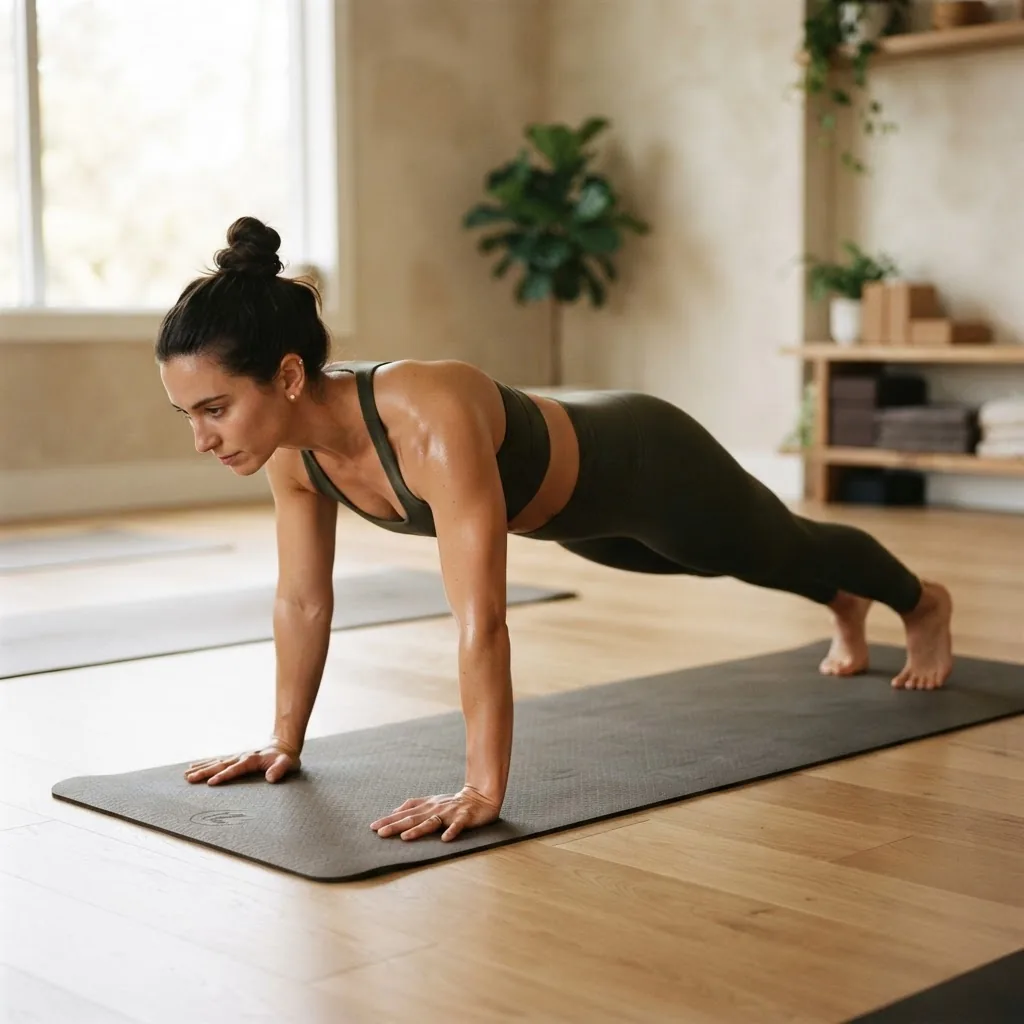
-
Isometric contractions increase time-under-tension.
Holding poses (e.g., plank, warrior III) forces sustained muscle tension without joint movement; these isometric contractions recruit motor units and raise local muscular endurance.
Term: Isometric contraction — muscle generates force without changing length.
-
Dynamic movements train concentric and eccentric control.
Sequences like Vinyasa or Surya Namaskar include transitions that require controlled lengthening (eccentric) and shortening (concentric) of muscles, improving strength across the range of motion and reducing injury risk by training deceleration capacity.
-
Progressive difficulty and progressive overload are possible in yoga.
Progression uses longer holds, added repetitions, advanced variations (one-arm plank, arm balances) and increased session load to create overload.
Term: Progressive overload — gradually increasing stress on the body to stimulate adaptation.
-
Neuromuscular adaptation improves motor unit recruitment and coordination.
Repetition of complex postures and balance tasks refines central nervous system control, making movement more efficient and increasing the ability to generate force quickly when needed.
-
Core engagement and balance strengthen stabiliser muscles.
Yoga frequently demands unilateral support and anti-rotational stability, which enhances deep stabilisers (transverse abdominis, multifidus) improving force transfer and functional strength.
-
Metabolic conditioning raises fatigue resistance.
Flow-based styles performed at higher intensity increase muscular metabolic stress and oxidative capacity, supporting longer duration force production and better recovery between efforts.
Example case study: A 34-year-old teacher increased plank hold time from 60s to 2m20s and gained noticeable upper-body endurance after a 12-week progressive Vinyasa plan combining holds, 3 sessions/week and incremental pose variations; reported improvements were corroborated by instructor-measured timed tests.
Transition: Understanding mechanisms helps compare yoga directly with traditional strength training methods.
Comparing Yoga to Traditional Strength Training?
Answer: Yoga emphasizes bodyweight, isometric and endurance adaptations with superior flexibility and mental benefits, while traditional strength training (free weights, machines) yields faster hypertrophy and maximal strength gains; each has different injury risk profiles and complementary roles.
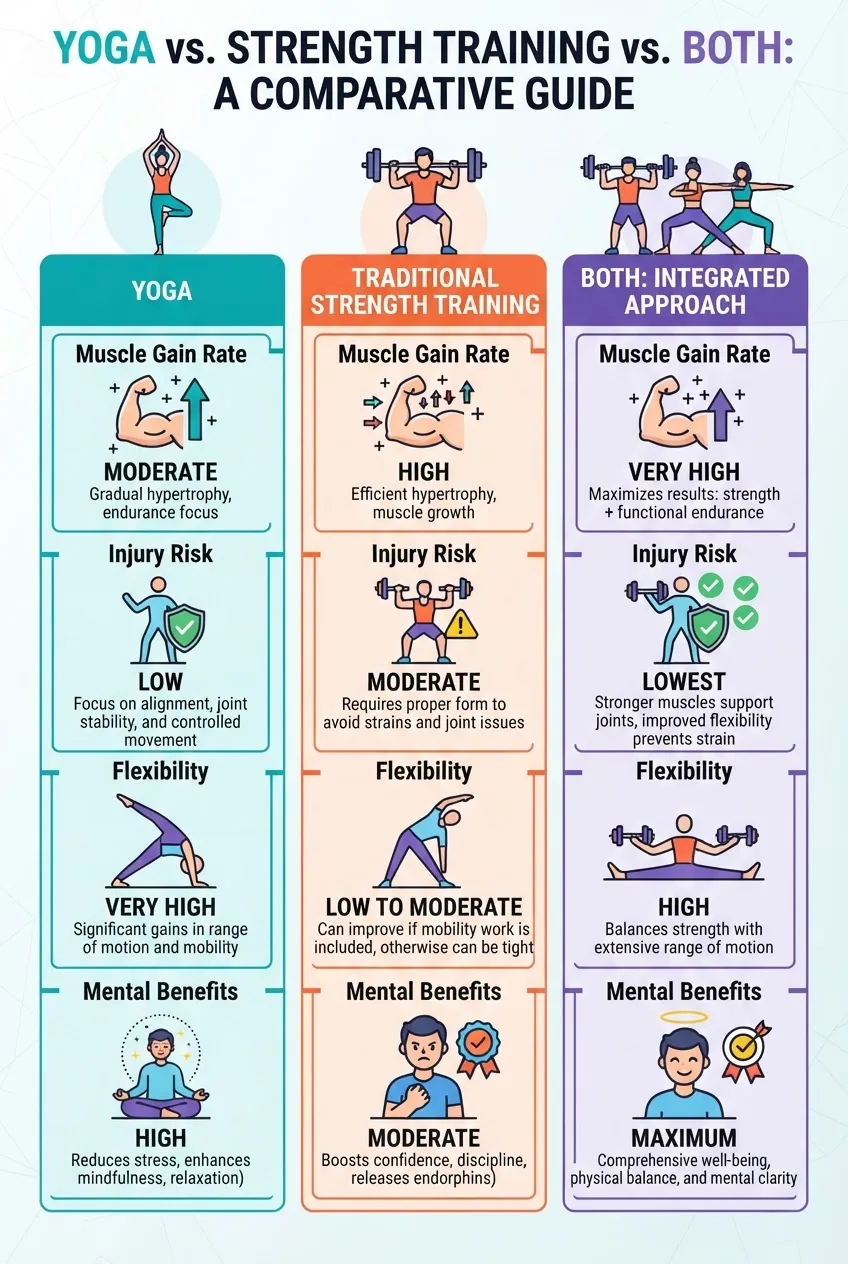
| Feature | Yoga | Traditional Strength Training | Both |
|---|---|---|---|
| Primary stimulus | Bodyweight isometric & dynamic | External load (weights) | Progressive overload possible |
| Muscle gain rate | Moderate (endurance/hypertrophy over time) | Fast (especially with heavy loads) | Improves neuromuscular control |
| Flexibility | High benefit | Variable; often reduced without mobility work | Best when combined |
| Injury risk | Lower when practiced safely; risk with advanced poses | Higher with poor technique or excessive loads | Reduced by balanced programming |
Analysis:
- Rate of muscle gain: Traditional weight training typically produces faster increases in maximal strength and muscle cross-sectional area; yoga produces meaningful endurance and functional strength but slower hypertrophy.
- Injury risk: Strength training risk scales with load and technique; yoga risk scales with mobility limits and overambitious progressions. Both require coaching and progression to reduce injury.
- Complementarity: Using yoga alongside resistance training improves mobility, stabiliser strength and recovery, often enabling higher lifts and fewer injuries.
External authority: For balanced exercise recommendations consult the American College of Sports Medicine (ACSM).
American College of Sports Medicine
Transition: Next we identify which yoga styles deliver the strongest strength-building stimulus.
Which Yoga Styles Are Best for Strength Building?
Answer: Power-oriented, flow-based and alignment-focused styles—Power Yoga, Ashtanga, Vinyasa and Iyengar—are most effective for strength when practiced progressively; Hatha builds foundation strength slowly.

- Power Yoga — fast-paced, strength-focused sequences that combine prolonged holds and dynamic transitions to increase muscular endurance and caloric expenditure.
- Ashtanga — rigorous, set sequences with progressive difficulty that reliably load upper body and core through repeated vinyasas and standing series.
- Vinyasa — tempo-based flows that can be structured for strength with longer holds, slower transitions and targeted arm balances.
- Iyengar — alignment-driven practice using props to incrementally increase load and hold time, excellent for targeted strength development and safe progression.
- Hatha — slower practice ideal for beginners to develop base muscular endurance and learn alignment before loading more intensely.
Suggested yoga poses for beginners that build strength:
- Plank and side plank (core, shoulders)
- Chaturanga (triceps, chest)
- Chair pose (quadriceps, glutes)
- Warrior II and III (legs, balance)
- Boat pose (abdominals)
Transition: Strength in the body is mirrored by strength in the mind; the next section explains mental benefits.
Mental and Holistic Strength Benefits of Yoga?
Answer: Yoga builds mental strength by training sustained attention, interoception and stress regulation—boosting resilience, emotional regulation and mental endurance through mindfulness, breath work and embodied practice.
Term: Mind-body connection — the integrated relationship between mental processes and physical states, improved by practices that coordinate breath, movement and attention.
Yoga’s mental-strength mechanisms include regulated breathing (parasympathetic activation), focused attention (improved executive control), and graded exposure to discomfort in holds (increased distress tolerance).
- Mindfulness exercises for anxiety link: mindfulness exercises for anxiety
- Quick mindfulness techniques to stabilise attention between sets: quick mindfulness techniques
- Effective mindfulness practice to deepen session focus: effective mindfulness practice
- Advanced stress relief options for persistent anxiety: advanced stress relief tools
- Anti anxiety medication context when combining treatments: anti anxiety medication options
- Meditation synergy for mental health: meditation mental health benefits
- Breathwork methods supporting vagal tone: breathing meditation techniques
- Yoga for anxiety relief research and protocols: yoga for anxiety relief
- Counselling complement for clinical support: counseling for anxiety
- Brain health connections and cognitive benefits: yoga brain health benefits
- Practical mindfulness tips to use during training: practical mindfulness tips
- Effective mental health meditation guides: effective mental health meditation
- Grounding meditations for resilience: grounding meditation
- Great meditation techniques to improve attention: meditation techniques
- Benefits overview and further resources: scientific benefits of yoga
Practitioner testimonial (experience signal): After 10 weeks of a combined Vinyasa and breathwork routine, a 45-year-old office worker reported calmer stress responses during busy workdays, increased capacity for repeated push-ups and improved concentration on cognitively demanding tasks.
Transition: Use the practical tips below to convert these mental and physical mechanisms into consistent gains.
Practical Tips to Use Yoga for Strength Building?
Answer: Structure progressive sessions (3–5x/week), prioritise compound poses and holds, track time-under-tension, add advanced variations or props, and combine complementary strength work and recovery strategies for optimal gains.
Term: Time-under-tension — total time a muscle is under load during a set or exercise.
-
Frequency and duration:
Practice 3–5 times per week with sessions of 30–75 minutes depending on intensity; shorter, higher-intensity flows can match longer slower sessions for strength gains over time.
-
Progression strategy:
Progress by increasing hold duration, repetitions, or moving to harder pose variations (e.g., plank → one-arm plank → elbow lever). Log holds and reps to ensure progressive overload.
-
Sequence design:
Prioritise compound weight-bearing poses at the start of practice (arm balances, chaturanga, chair) when energy is highest, follow with mobility and core work, and finish with restorative holds to support recovery.
-
Complementary resistance:
Use resistance bands or light dumbbells on off-yoga days to address maximal strength gaps; combine with yoga to maintain flexibility and stabiliser function.
-
Recovery and nutrition:
Schedule rest days, prioritise protein intake and sleep to support any hypertrophy and neural recovery. Monitor soreness and reduce intensity if form degrades to avoid injury.
-
Trackable metrics:
Measure timed holds, repetitions, perceived exertion and functional tests (push-ups, single-leg squat) every 4–6 weeks to quantify progress.
-
Beginner learning curve:
Start with foundational holds and alignment work; consider guided classes or the How to Do Yoga beginner guide to learn safe progressions.
-
Structured plans:
For consistent gains, follow a planned program such as a progressive calendar or the 30 day yoga challenge to build habit and load safely.
-
Supplemental resources:
Use online guided classes and meditation to support focus and recovery.
Transition: Below are common misconceptions that can mislead practitioners about yoga’s role in strength building.
Common Misconceptions About Yoga and Strength?
Answer: Myths include that yoga is only stretching, that it cannot produce strength, and that flexibility equals weakness; facts show yoga can create functional strength, but heavy-load hypertrophy is slower without added resistance.
Myth: Yoga is only stretching.
Fact: Many poses are loaded isometric and dynamic movements that generate substantial muscle activation and endurance, not just passive stretching.
Myth: Yoga cannot produce real strength.
Fact: Yoga increases functional and endurance strength and, with progressive overload and variations, can increase muscle size modestly; however, maximal hypertrophy often requires heavier external loads.
Myth: Flexibility reduces strength.
Fact: Improved flexibility enhances strength expression by allowing fuller ranges of motion and safer joint loading.
Transition: Finally, see how to combine yoga with other fitness elements to create a balanced routine.
Integrating Yoga Into a Balanced Fitness Routine?
Answer: Combine yoga with structured resistance training, cardio and recovery strategies: use yoga for mobility, stabiliser strength and mental skills while scheduling heavy lifts for maximal strength sessions and cardio for endurance.
Cross-training recommendations:
- Use yoga sessions 3–4 times weekly for mobility and endurance while scheduling 2–3 targeted resistance sessions for heavy compound lifts (squats, deadlifts, presses).
- Prioritise restorative yoga or gentle sessions on active-recovery days to support neural recovery and maintain practice frequency.
- Monitor volume to prevent overtraining; reduce intensity if strength session performance drops or soreness is excessive.
External authority for safety and exercise balance: consult national guidelines for physical activity and progressive overload from recognised organisations such as the World Health Organization and professional exercise bodies.
Yoga Alliance guidelines and resources
Transition: The short concluding answer synthesises whether yoga is a viable strength-builder for most people.
Conclusion: Is Yoga a Viable Strength Builder?
Answer: Yes — yoga is a viable method to increase muscular endurance, functional strength and mental resilience; for maximal hypertrophy and peak strength combine yoga with targeted resistance training while using progressive overload and mindful recovery.
Summary takeaways:
- Yoga builds measurable strength through isometric holds, dynamic control and neuromuscular adaptation.
- Best results occur with progressive programming and combination with targeted resistance work if maximal strength is the goal.
- Yoga uniquely adds flexibility, balance and mental resilience, making it an essential component of a balanced fitness plan.
CTA: Start a structured program this week, track timed holds and consider pairing yoga with targeted resistance sessions to accelerate strength gains.