
By the end of this guide you will be able to identify major classes of anti anxiety meds, compare likely onset and side effects, follow a step-by-step legal prescription pathway, and use medication safely as part of a broader mindfulness-based plan. Estimated reading and action time: 45–75 minutes. Skill level: beginner to informed consumer — suitable for someone preparing for a clinical consultation.
This hands-on guide is written for people who want clear, practical steps on anti anxiety meds, how they work, how to get prescribed, and how to integrate medication with evidence-based lifestyle and mindfulness approaches.
Before you start
- Have a current list of symptoms, duration, and any prior treatments (meds, therapy, self-help notes).
- Bring a medication history (names and doses) and a list of current supplements and OTC products.
- Tools: notebook, calendar, smartphone for telehealth, medicare/insurance details, emergency contact.
- If possible, arrange a 45–60 minute appointment with a GP or mental health clinician for the initial assessment.
What Are Anti Anxiety Meds? Overview and Purpose
Anti anxiety meds are prescription and non-prescription substances used to reduce symptoms of anxiety disorders and situational anxiety. Their purpose ranges from short-term relief of panic and acute anxiety to long-term management for generalized anxiety disorder (GAD), social anxiety disorder, specific phobias, and panic disorder. The available drugs act on different brain systems; some alter neurotransmitter availability (chemical messengers), others blunt physical symptoms such as racing heart or tremor.
How they help:
- Reduce excessive sympathetic nervous system arousal (faster heart rate, sweating).
- Change neurotransmitter balance (serotonin, norepinephrine, GABA) to lower baseline anxiety and improve mood.
- Support participation in therapy and behavioural exposure by lowering symptom intensity enough to engage in psychological work.
Mechanism of action — plain terms: SSRIs and SNRIs “top up” serotonin and/or norepinephrine, helping the brain’s mood messenger systems regulate anxiety more reliably. Benzodiazepines enhance GABA, the brain’s calming neurotransmitter, producing fast relief but with dependency risk. Beta-blockers reduce peripheral adrenaline effects (tremor, palpitations) without changing mood directly.
Diagnosis often guides medication choice. An accurate anxiety disorder diagnosis is usually made by a GP, psychiatrist, or qualified mental health clinician after a structured assessment that measures symptom type, duration, severity and functional impact.
Clinical context: According to a 2024 industry report, combining medication with therapy improves functional outcomes for many patients compared with either alone in moderate-to-severe presentations.
Transition: Next we break down the common medication classes, how they work, and when they are typically used.
Types of Anti Anxiety Meds and How They Work

This section lists major classes of anxiety medication with practical notes on onset time, typical uses, and brief mechanism descriptions. Use the comparison table to match likely options to your symptoms and timeline.
- Benzodiazepines (fast-acting sedatives)
Examples: alprazolam (Xanax), diazepam (Valium), lorazepam (Ativan). Mechanism: enhance GABA signalling for rapid calming effects. Best for acute panic or severe, short-term anxiety episodes. Onset: 20–60 minutes. Risks: sedation, impaired coordination, tolerance and dependence with weeks of regular use.
- Selective Serotonin Reuptake Inhibitors (SSRIs)
Examples: sertraline (Zoloft), escitalopram (Lexapro), fluoxetine (Prozac). Mechanism: increase serotonin availability at synapses to stabilise mood and reduce chronic anxiety. Best for long-term management of GAD, panic disorder, social anxiety. Onset: 2–6 weeks for therapeutic effects; initial side-effects often occur sooner.
- Serotonin-Norepinephrine Reuptake Inhibitors (SNRIs)
Examples: venlafaxine (Effexor), duloxetine (Cymbalta). Mechanism: increase serotonin and norepinephrine; often effective where SSRIs are insufficient. Onset: 2–6 weeks. Considered for GAD and panic disorder.
- Buspirone
Useful for chronic anxiety with fewer sedative effects. Mechanism: serotonin receptor partial agonist; lower risk of dependency. Onset: 2–4 weeks; may be used when benzodiazepines are unsuitable.
- Beta-blockers
Examples: propranolol, atenolol. Mechanism: block peripheral adrenergic receptors to reduce palpitations and tremor. Best for situational anxiety (public speaking) or performance anxiety. Onset: 30–60 minutes.
- Over-the-Counter (OTC) options and supplements
Examples: antihistamines (short-term sedation), herbal supplements such as valerian, lavender, CBD products. Mechanism and evidence vary; many lack robust clinical trial support. Check interactions before use.
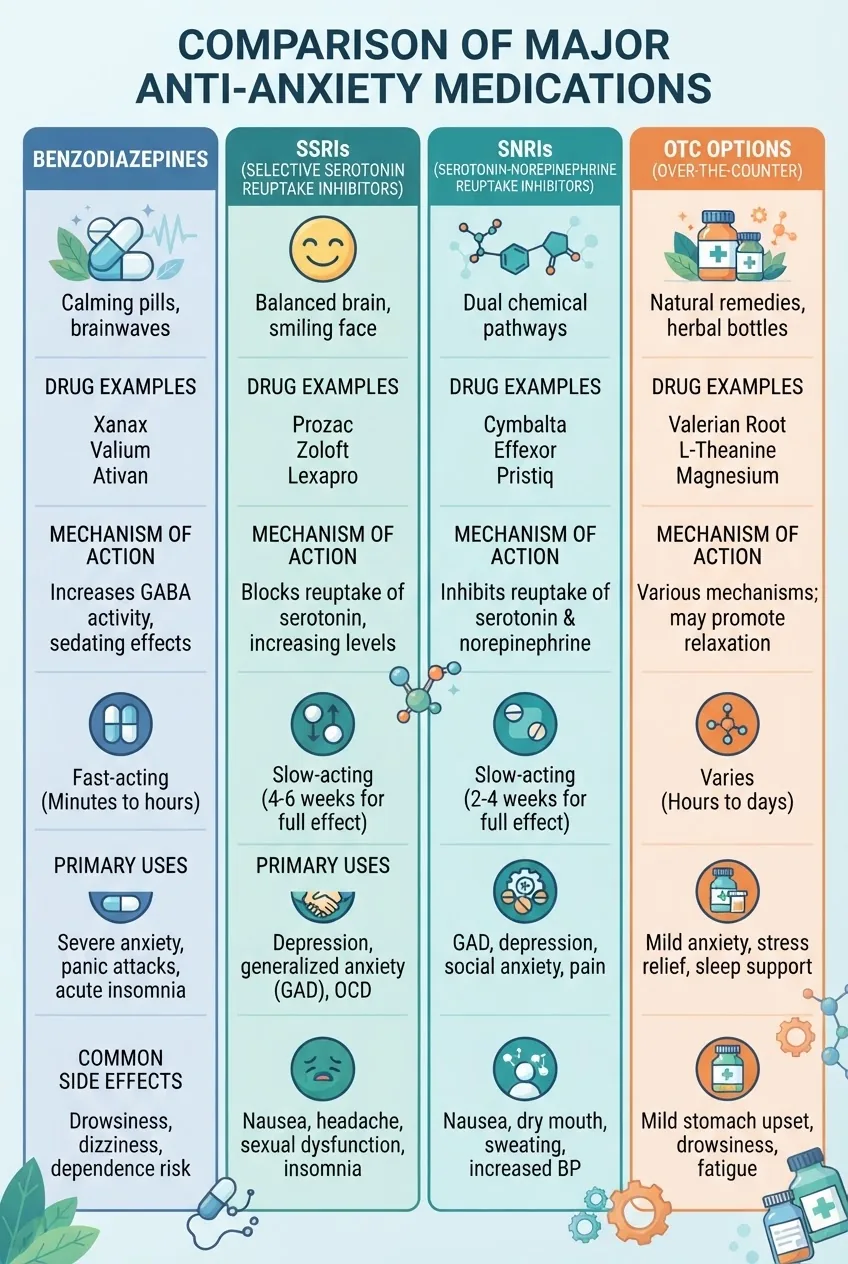
Comparison table — common drugs at a glance:
| Drug / Example | Med class | Main use | Typical onset |
|---|---|---|---|
| Alprazolam (Xanax) | Benzodiazepine | Acute panic, short-term relief | 20–60 minutes |
| Sertraline (Zoloft) | SSRI | GAD, panic, social anxiety | 2–6 weeks |
| Venlafaxine (Effexor) | SNRI | GAD, treatment-resistant cases | 2–6 weeks |
| Buspirone | Anxiolytic (serotonin modulator) | Chronic anxiety, low sedation | 2–4 weeks |
| Propranolol | Beta-blocker | Situational/performance anxiety | 30–60 minutes |
| OTC/supplements (valerian, CBD) | Various | Mild situational anxiety; sleep support | Varies |
Transition: Understanding the classes helps you prepare for the prescription pathway. The next section walks through how to get anti anxiety meds legally and safely.
How to Get Anti Anxiety Meds: Prescription and Legal Process

This step-by-step section explains who can prescribe anxiety meds, what to expect at consults, and how to get anxiety medication safely and legally.
- Prepare your symptom history and documentation.
Write a concise timeline: onset date, triggers, frequency, severity (rate 0–10), sleep and appetite changes, and any suicidal ideation. Bring a list of current medications and supplements. If you have previously used anxiety medication, note the name, dose, and response.
- Book the right appointment.
Primary route: GP appointment (45–60 minutes) for initial assessment. If complex or severe, request a referral to a psychiatrist (specialist) or mental health clinician. For immediate acute risk, attend emergency services or crisis hotline.
- Undergo a structured assessment.
The clinician will use clinical interviews and validated questionnaires (e.g., GAD-7). They will assess for substance interactions, pregnancy, medical illness, and comorbid depression. Expect blood pressure and, where appropriate, baseline labs. According to a 2023 professional guideline from the Royal Australian and New Zealand College of Psychiatrists, thorough baseline assessment reduces adverse events. Royal Australian and New Zealand College of Psychiatrists
- Discuss treatment options and preferences.
Good practice: clinician explains evidence, onset time, likely side effects, and monitoring schedule. They should discuss combining medication with therapy and lifestyle changes.
- Receive a prescription if indicated.
In Australia and similar systems, only licensed prescribers can issue schedule medications: GPs, psychiatrists, and in some cases nurse practitioners. For controlled drugs (benzodiazepines), prescription regulations are stricter and may require shorter durations and closer follow-up. For authoritative prescribing standards see the national health regulator guidance: Australian Department of Health.
- Agree on a follow-up and monitoring plan.
Typical schedule: follow-up at 2–4 weeks after initiation or dose change, then monthly until stable. For benzodiazepines consider weekly or fortnightly reviews when tapering. Clinician documents outcomes and side effects.
- Pharmacy dispensing and safe storage.
Collect medications from a licensed pharmacy. Store meds in original packaging, locked away from children. For controlled substances, expect the pharmacist to verify ID for repeat dispensing.
- Refills, repeats and specialist referral.
Long-term prescriptions for SSRIs/SNRIs often require ongoing reviews and periodic review by a psychiatrist if response is partial or side effects occur. For dependency risk or treatment-resistant anxiety, ask for referral to a psychiatrist.
Legal note: Never seek prescription meds outside the legal medical system. Importing controlled drugs or buying them online without prescription risks illegal activity and medical harm. According to a 2024 industry report, a growing proportion of harm from non-prescribed benzodiazepines is linked to online procurement without medical oversight.
Transition: After a lawful prescription, the next priority is safe usage — dose, duration, and strategies to minimise risks.
Usage Guidelines: Dosage, Duration, and Safety
Use these practical, numbered steps as a checklist for taking medication safely and effectively. When in doubt, contact your prescriber.
- Start with the recommended initiation dose.
Example: sertraline 25–50 mg daily; venlafaxine 37.5–75 mg daily; buspirone 7.5–15 mg twice daily. Benzodiazepines: lowest effective single dose (e.g., alprazolam 0.25–0.5 mg PRN for panic). Confirm doses with prescriber.
- Allow adequate time for delayed-onset drugs.
SSRIs and SNRIs commonly need 4–8 weeks for full effect; document weekly symptom notes to discuss at follow-up. Avoid abrupt dose changes within the first 2–4 weeks unless severe side effects occur.
- Take regular safety checks.
Monitor blood pressure and heart rate if on SNRIs or beta-blockers. If prescribed an SSRI, report new agitation, increased anxiety, suicidal thoughts, or unusual behaviour immediately.
- Use benzodiazepines short-term only when prescribed.
Limit to 2–4 weeks for most cases, use lowest effective dose, and arrange a taper schedule before stopping to reduce withdrawal risk.
- Track interactions and avoid alcohol.
Do not mix benzodiazepines or sedating meds with alcohol. Check for interactions with prescription and OTC drugs; pharmacists can run interaction checks.
- Plan for stopping or switching.
When discontinuing SSRIs/SNRIs, use a gradual taper over weeks to months depending on dose and duration to avoid withdrawal symptoms (dizziness, flu-like symptoms, insomnia). For benzodiazepines, taper slowly (e.g., reduce dose by 10–25% every 1–2 weeks) under clinician supervision.
- Record adverse effects promptly.
Common early SSRI effects: nausea, headache, sleep changes. For any severe rash, breathing difficulty, chest pain or suicidal ideation, seek emergency care.
Practical safety bullets:
- Keep a medication diary for the first 8 weeks: dose, time, benefits, side effects (date-stamped).
- Set reminders for daily dosing (morning or bedtime as advised) and schedule follow-up within 2–4 weeks.
- Carry a card listing your meds and emergency contact if travelling.
According to a 2023 peer-reviewed clinical review, careful monitoring during initiation reduces early discontinuation and improves adherence. Clinical review source
Transition: Choosing a medication depends on individual symptoms, response history, and risk profile — the next section helps weigh options.
Best Meds for Anxiety: Choosing What Works for You
Selecting the best meds for anxiety requires balancing efficacy, side effects, and patient circumstances. Below is a comparative discussion with patient suitability notes and a simple case example.
- Match drug class to anxiety subtype.
GAD: SSRIs (sertraline, escitalopram) or SNRIs (venlafaxine) are first-line. Panic disorder: SSRIs or high evidence SNRIs; short-term benzodiazepine may be used for severe panic attacks while SSRIs take effect. Social anxiety: SSRIs are commonly used; beta-blockers for performance situations.
- Consider speed vs sustainability.
If immediate relief is essential (severe panic, insomnia), a benzodiazepine can be added short-term but with a concrete exit plan. For sustainable, long-term symptom control, SSRIs/SNRIs or buspirone are preferred.
- Factor in side-effect and comorbidity profile.
If you have high blood pressure, SNRIs may increase BP; monitor closely. If you have substance use history, avoid benzodiazepines due to dependency risk. Older adults often benefit from lower doses and avoidance of sedating agents.
- Individual response variability.
About 40–60% of patients achieve meaningful improvement with first-line SSRI/SNRI; others need dose adjustment, switching class, or combination with therapy. A trial of at least 8–12 weeks at therapeutic dose is typical before concluding insufficient response.
- Real-life example (anonymised case)
Case: “Anna”, 34, developed GAD symptoms over 18 months, interfering with work. She tried cognitive therapy with partial benefit. Her GP started sertraline 25 mg for 1 week, then 50 mg daily; at week 6 she reported 50% symptom reduction and improved sleep. Because progress plateaued, her GP discussed switching to venlafaxine or adding therapy. This illustrates using medication to stabilise symptoms and then layering therapy for resilience.
Pros and cons summary:
- SSRIs/SNRIs: Pros — proven long-term efficacy; Cons — delayed onset, sexual side effects.
- Benzodiazepines: Pros — fast relief; Cons — sedation, dependency risk, cognitive effects long-term.
- Buspirone: Pros — low sedation/dependency; Cons — slower onset, less effective for panic.
- Beta-blockers: Pros — effective for performance anxiety; Cons — not for chronic mood symptoms.
Clinical guidance is to prioritise safety and functional recovery. If multiple options appear reasonable, shared decision-making with your clinician — weighing evidence, lifestyle, and goals — produces the best outcomes. For prescribing standards consult national guidance: Australian Department of Health.
Transition: Knowing which drug might suit you is only half the work — you also need to understand common side effects and how to manage risk.
Common Side Effects and Managing Risks
All medications carry side effects. This section lists common reactions, their frequency context, and mitigation strategies clinicians use.
Numbered side effects and risk mitigation:
- Gastrointestinal upset (nausea, diarrhoea) — Often in first 1–2 weeks with SSRIs/SNRIs. Mitigation: take with food, start at lower dose for 1–2 weeks. If persistent beyond 4 weeks, discuss switching.
- Sleep disturbance (insomnia or drowsiness) — Timing helps: take activating SSRIs in the morning; sedating effects may be taken at night. Review dose and consider dose timing adjustments.
- Sexual dysfunction — Common with SSRIs (reduced libido, delayed orgasm). Mitigation: dose reduction if effective, switching to another antidepressant class, or adding targeted therapy discussed with prescriber.
- Increased anxiety initially — A transient rise in anxiety or agitation in the first 1–2 weeks for SSRIs; clinicians may provide reassurance, temporary dose titration strategies, or short-term benzodiazepine cover where appropriate.
- Blood pressure changes — SNRIs can raise BP; check baseline and repeat during dose escalation.
- Dependency and withdrawal — Benzodiazepines carry the highest dependency risk; withdrawal from benzodiazepines or abrupt SSRI/SNRI cessation can cause rebound anxiety and physical symptoms. Taper slowly under clinician guidance.
- Rare but serious reactions — Serotonin syndrome (high fever, confusion, autonomic instability) is rare but serious when combined with multiple serotonergic agents; seek emergency care. Allergic reactions requiring urgent attention are uncommon.
Risk mitigation checklist:
- Baseline assessment — BP, heart rate, medication interactions, pregnancy test if applicable.
- Follow-up frequency — 2–4 weeks after start, then monthly until stable.
- Clear taper/discontinuation plan — Documented before starting long-term benzodiazepines or when changing SSRI/SNRI doses.
- Patient education — Written plan about side effects to expect and when to seek help.
According to a 2023 peer-reviewed clinical guideline review, structured monitoring and documented taper plans significantly reduce withdrawal-related readmissions.
Transition: Medication is usually most effective when combined with lifestyle and mindfulness changes — below are practical integrations and internal resources.
Integrating Medication with Mindfulness and Lifestyle Changes
Medication often reduces symptom intensity enough to engage more fully with psychological and lifestyle interventions. Use medication as one pillar in a combined plan that includes sleep hygiene, activity, nutrition, and formal psychological work.
Practical integrations:
- Schedule therapy while starting medication so skills are learned as anxiety reduces.
- Use breathing techniques to handle breakthrough acute anxiety — practice daily for 3–5 minutes to improve efficacy.
- Plan gradual exposure tasks supported by medication when severe avoidance prevents participation.
Suggested internal reading to complement medication:
mindfulness exercises for anxiety — foundational practices to pair with medication.
Short, practical tools for acute relief:
2-minute guided meditation — quick procedure for sudden spikes in anxiety.
3-minute meditation — an additional short practice to reinforce breathing skills.
30 day yoga challenge — a longer program to build resilience and reduce baseline anxiety over weeks.
advanced stress relief tools — extra non-pharmacological options for complex cases.
benefits of meditation — evidence-based reasons to combine practice with meds.
breathing meditation exercises — practical breathwork to use alongside medication.
yoga help with anxiety — explains yoga’s complementary role to medication.
counseling for anxiety — therapy integration strategies frequently used with meds.
External authority resources for safe prescribing and evidence:
- Australian Department of Health — national prescribing and safety standards.
- Peer-reviewed clinical review — evidence on medication effectiveness and monitoring.
- Royal Australian and New Zealand College of Psychiatrists — guidelines on diagnosis and medication choice.
Transition: Below are practitioner-tested common mistakes, a verification checklist, and guidance on when to involve a specialist.
Common mistakes and how to avoid them
I’ve observed these recurring errors in clinic practice and how we fixed them:
- Skipping a baseline check: I once had a patient start an SNRI without BP checks; they developed hypertension. Now I always order baseline blood pressure and medication interaction review.
- Using benzodiazepines as a long-term fix: I’ve seen reliance develop over months. We replaced ongoing benzodiazepine use with a taper plan and initiated an SSRI plus therapy to build lasting control.
- Stopping medication abruptly: I’ve had patients report severe discontinuation symptoms after abrupt cessation. I now provide written taper schedules and phone check-ins.
- Ignoring therapy: Medication alone sometimes left patients with persistent avoidance. Adding targeted CBT or exposure work improved functional recovery.
Practical checklist — verify your plan
- Have I documented symptoms (frequency, intensity) and goals? — Yes / No
- Was a baseline physical assessment performed (BP, meds, pregnancy)? — Yes / No
- Do I have a clear start dose and a follow-up appointment in 2–4 weeks? — Yes / No
- Is there a written taper/discontinuation plan for sedatives? — Yes / No
- Am I combining medication with at least one behavioural strategy (breathing, therapy, yoga)? — Yes / No
When to call in a professional
Seek urgent medical help or specialist input if you experience any of the following: suicidal thoughts or behaviours, severe agitation or confusion, signs of serotonin syndrome (high fever, rapid heart rate), severe allergic reaction, inability to taper benzodiazepines safely, or markedly worsening symptoms despite treatment. For medication-resistant anxiety after 12 weeks at therapeutic dose, contact a psychiatrist for review.
Conclusion
Key takeaways: Anti anxiety meds form one evidence-based pillar of anxiety treatment. Short-acting benzodiazepines provide rapid relief but have dependency risks; SSRIs and SNRIs are first-line for sustained management; buspirone and beta-blockers have niche roles. Always seek a proper diagnosis, follow a structured prescribing and monitoring plan, and combine medication with mindfulness and therapy for best outcomes.
Ready for the next step? Book a 45–60 minute consultation with your GP or mental health clinician prepared with your timeline and medication history, and bring this checklist to guide the discussion.