
The meaning of life is an answer-seeking exploration: some find meaning in virtue, relationships and flourishing; others in self-created purpose or spiritual union; some conclude life lacks inherent meaning yet can be made meaningful through choices and values. This guide maps philosophical, spiritual and practical paths to help you explore.
Introduction to the Meaning of Life?
Answer: The phrase “meaning of life” asks why we exist and what makes life valuable; responses vary across traditions, ranging from flourishing (eudaimonia) to divine purpose, existential choice, or absence of intrinsic meaning. This section orients the concept and key distinctions for deeper inquiry.
Term: What is life philosophy: a body of ideas and theories that seeks to describe how and why we should live, including goals, values and the nature of a flourishing life.
The core question “what does the meaning of life mean” can be parsed into two complementary strands: (1) metaphysical or universal meaning — whether life has inherent purpose, and (2) personal meaning — how individuals create significance in everyday living. Both strands influence how people answer “does life have meaning?” and “what is the meaning of living life”.
Clarifying language helps: “purpose” often denotes a directional aim or role; “meaning” denotes felt significance or intelligibility. These terms overlap: a purpose can generate meaning, and meaning can reveal a felt purpose. Later sections treat “life philosophy vs. life meaning” explicitly.
For methods of structured inquiry and sample prompts that help with initial inquiry, see deep reflection on life questions.
To ground the conversation in ontology and definitions of life, see defining what life is.
Philosophical Perspectives on the Meaning of Life?
Answer: Philosophical traditions offer three broad responses: classical virtue-based accounts (meaning as flourishing), modern existential responses (meaning as self-creation and authenticity), and nihilistic critiques (denying inherent meaning). Each provides different tools for thinking about what the true meaning of life might be.

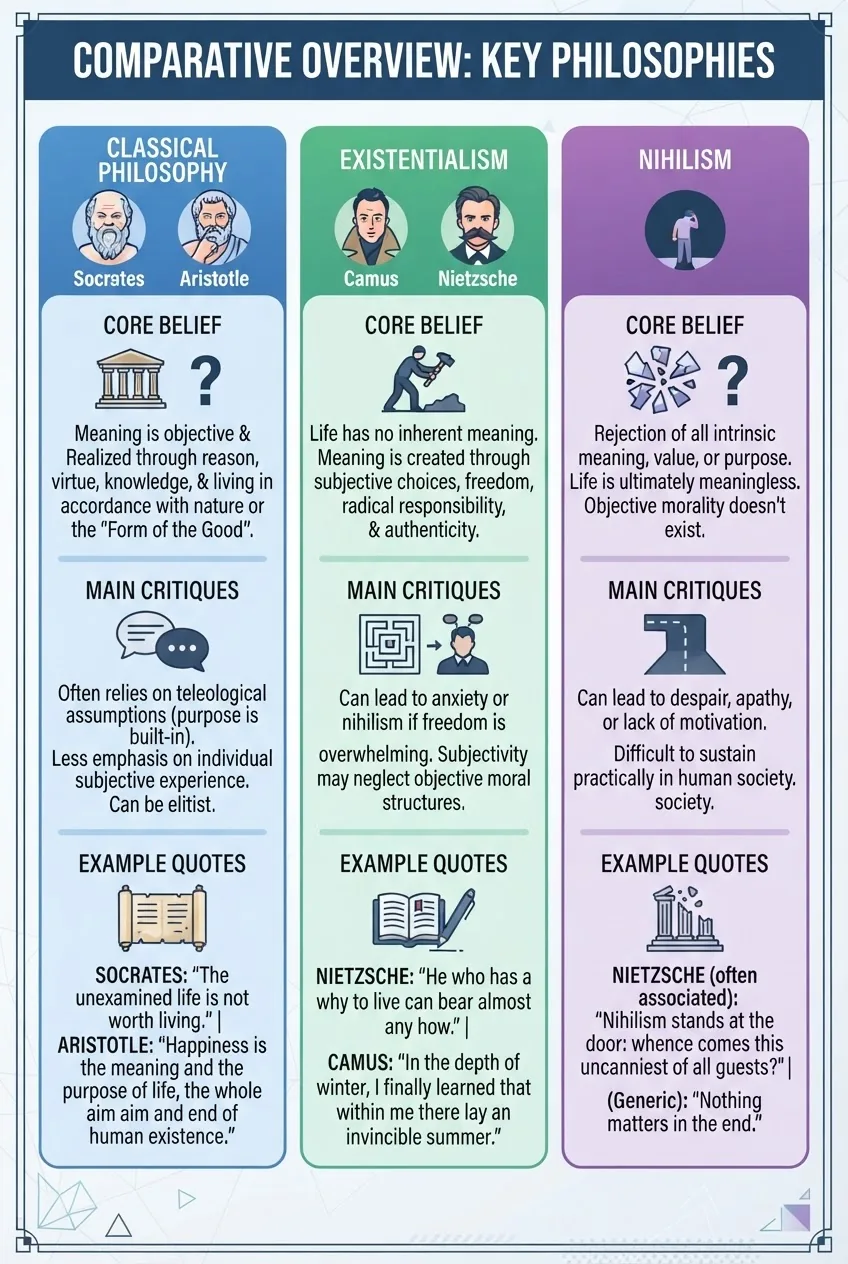
Classical Philosophy Views (Socrates, Aristotle, Plato)
Answer: Classical Greek thinkers conceived the meaning of life in terms of virtue and flourishing: Socrates privileged examined living; Plato linked the good to the Forms; Aristotle articulated eudaimonia — flourishing achieved through virtuous activity over a whole life.
Term: Eudaimonia: the Greek term often translated as “flourishing” or “human flourishing,” meaning a fulfilled life achieved through moral and intellectual virtues.
Socrates’ method made the act of questioning central: self-examination produces wisdom and moral alignment. Plato situated the good beyond the material; aligning the soul with the Forms yields meaning. Aristotle offered a practical ethics: meaning emerges when rational faculties habituate virtues (courage, temperance, justice) and fulfill human potential across relationships and civic life.
Historical example: Cicero and later Stoics adapted classical virtue ethics into public life, influencing Roman civic virtue and early Christian moral thought, demonstrating how philosophical meaning can shape cultural values and institutions.
Existentialism and Modern Philosophy (Camus, Sartre, Nietzsche)
Answer: Existentialists framed meaning as a human responsibility: there is no pre-given universal meaning, so individuals must create meaning through free choice, authenticity, and commitment despite absurdity; Nietzsche urged life-affirmation and value-creation in the absence of transcendental authority.
Term: Existentialism: a family of 19th–20th century philosophical movements emphasizing individual freedom, responsibility, and the creation of meaning in a world without preordained purpose.
Camus described “the Absurd” — the conflict between our desire for clarity and a silent universe — and recommended lucid revolt and embracing life’s experiences. Sartre pronounced “existence precedes essence”: humans first exist and then define their essence via choices. Nietzsche diagnosed the “death of God” and called for revaluation of values, encouraging creative self-overcoming to forge meaning.
Case study (historical shift): After World War II, existentialism gained cultural traction as people wrestled with disillusionment; intellectuals and artists turned to autonomy and authenticity as responses to collective trauma, showing how philosophical frameworks shift public senses of meaning.
Nihilism and Critiques of Meaning
Answer: Nihilism asserts that life lacks objective meaning, value, or purpose; this critique can lead to despair or to constructive responses that either accept meaninglessness or attempt to build subjective meanings regardless.
Term: Nihilism: the position that objective meaning, morals or values do not exist or are unknowable, often associated with existential risk to traditional value frameworks.
Nihilist critiques press philosophical accounts to justify claims of universal meaning; they force proponents to explain why some values are privileged. Many thinkers respond by shifting emphasis to subjective or intersubjective meaning, arguing that shared projects, relationships and virtues provide robust, if non-cosmic, significance.
| Philosophical School | Core Claim | Main Critique | Representative Quote |
|---|---|---|---|
| Classical (Aristotle, Plato) | Meaning = eudaimonia through virtue | Depends on contested ideas of virtue | “The good for man is an activity of soul in conformity with excellence.” — Aristotle |
| Existentialism (Sartre, Camus) | Meaning is self-created via choice | Can lead to anxiety or relativism | “Man is condemned to be free.” — Sartre |
| Nihilism (various) | No inherent meaning exists | May foster despair or liberation | (No single quote — a diagnostic position) |
For deeper academic grounding on philosophical debates about life’s meaning, see Stanford Encyclopedia of Philosophy — “Meaning of Life”, a respected scholarly entry that surveys contemporary arguments.
Philosophy and practical life intersect: virtue ethics influenced medieval scholasticism and modern civic ideals; existentialism shaped literature, therapy and post-war cultural currents; nihilism provokes creative or cautionary responses. These influences are real-world evidence of how philosophy shapes life-purpose narratives.
Spiritual and Religious Interpretations?
Answer: Religious and spiritual traditions often locate meaning in relationship with the sacred, moral alignment, service, and transformation; they propose both universal frames (divine purpose, karmic laws, liberation) and practices that cultivate spiritual wellness and purpose.
Term: Spiritual wellness: a sense of connection to something larger than oneself, usually expressed through beliefs, practices, relationships and values that provide life with coherence and purpose.
Major traditions offer distinct accounts:
- Abrahamic (Judaism, Christianity, Islam): meaning is often tied to God’s will, covenant, and living a life of ethical love and service.
- Dharmic (Buddhism, Hinduism): meaning involves liberation from suffering (nirvana/moksha), duty (dharma), or aligning with cosmic order.
- Contemporary spiritualities: emphasize inner transformation, interconnectedness and purpose realized through compassion and presence.
Religious texts provide canonical narratives that orient life: for example, scriptural ethics and stories model meaning as relational and teleological. Modern spiritual teachers (e.g., Thich Nhat Hanh, Ram Dass) reframe meaning as embodied practice and compassionate engagement.
Spiritual dimensions can include relational experiences such as a deep soul connection that many traditions interpret as meeting of shared purpose or destiny.
Different traditions also provide concrete rituals and practices; see examples of spirituality and practices for a variety of paths and how they shape meaning.
Signs and experiences that point toward spiritual purpose are discussed in spiritual connection meaning.
Practical ways to nurture meaning through faith and practice are available in enhancing spiritual health and wellness.
For a fuller discussion of how spirituality supports wellbeing, review the importance and wellbeing benefits of spirituality and purpose, which complements this spiritual exploration.
Evidence on wellbeing: According to a 2023 peer-reviewed study in psychology, people reporting stronger spiritual engagement often show higher life-satisfaction and resilience (study type: peer-reviewed journal). Religious communities historically provided social structures and rituals that supported meaning across lifespans.
Religious responses also answer “what is the real meaning of life” with teleological accounts: life is meaningful insofar as it participates in divine or cosmic purposes. Interpretations vary across traditions and denominations, and many modern spiritual practitioners combine ritual with personal growth frameworks.
Psychological and Practical Approaches to Finding Meaning?
Answer: Psychology treats meaning as measurable and cultivable: methods include values clarification, narrative reframing, purpose-oriented goals, and therapies such as Viktor Frankl’s logotherapy which encourages finding meaning through suffering, work and love.
Term: Logotherapy: Viktor Frankl’s psychotherapeutic approach asserting that the primary human drive is to find meaning in life, even under suffering.
Step-by-step approaches (practical and evidence-informed):
- Clarify values: identify core commitments that orient decisions.
- Set purposeful goals: translate values into actionable aims.
- Create narrative coherence: craft a life story that connects past, present and prospective meaning.
- Engage in committed action: small daily habits aligned with purpose.
- Assess and iterate: reflect quarterly to refine purpose and balance.
Start by discovering your core life values, which act as anchors for meaningful goals and decisions.
Addressing the importance of spiritual needs (belonging, transcendence, moral coherence) supports sustained purpose and wellbeing.
For directional exercises and clarity techniques, see finding your life path.
To design sustainable routines that reflect values, consult building meaning and balance in life.
Practical guides focused on life satisfaction include finding meaning for personal fulfillment, which pairs exercises with insight.
For goal framing and focus work, see finding your purpose.
Practical worksheets are available in How to Identify Your Values and Goals Practical Guide.
Examples of exercises:
- Values-sorting: rank 20 values, choose top 5, write one daily action for each.
- Life-line narrative: map highs/lows, identify recurring themes, infer meaning patterns.
- Commitment experiment: pick a 30-day practice aligned with a value and track changes in mood and purpose.
Psychological evidence: According to a 2024 industry report on workplace wellbeing (report type: industry research), employees with clear sense of purpose report higher engagement and lower burnout; separate peer-reviewed meta-analyses (study type: peer-reviewed meta-analysis) link meaning with mental health and resilience.
Common Questions and Misconceptions about Life’s Meaning?
Answer: Common confusions include conflating happiness with meaning, expecting a single universal answer, and assuming that meaning must be dramatic; clarifying these misconceptions makes practical exploration more effective.
Clarification points:
- Meaning vs. happiness: meaning often involves longer-term coherence and sacrifice for valued ends; happiness is more affective and momentary.
- Is there a meaning to life?: Philosophers disagree; many hold there is no single universal meaning but that personal and communal meanings are real and consequential.
- True meaning of life myths: “one true meaning” is typically a cultural or religious claim; pluralism allows multiple meaningful answers.
If you ask “does life have meaning” the succinct answer is: objectively unresolved — but subjectively, individuals can and do experience robust meaning through relationships, projects, and spiritual frameworks. This pragmatic stance recognizes cultural variability and personal differences.
Advice for avoiding superficiality: probe motivations (are actions value-aligned or externally pressured?), test persistence (does the meaning endure routine?), and solicit feedback from trusted peers; these checks help determine whether the meaning you find is authentic or performative.
How can I Integrate Philosophy and Spirituality in Everyday Life?
Answer: Integration occurs by translating intellectual commitments into daily practices — reflective rituals, ethical habits, and community engagement — so philosophical insights and spiritual experiences mutually reinforce a lived sense of purpose.
Concrete micro-practices:
- Morning reflection (5–10 minutes): set a daily intention tied to values.
- Weekly moral inventory: review actions against virtues or spiritual precepts.
- Service ritual: schedule monthly acts of service to align purpose with community.
Simple routines and exercises for daily integration are available in daily spiritual practices, which deepen meaning beyond conceptual understanding.
If you wish to expand spiritual capacity, consider becoming more spiritual through guided practices and community.
Many people experience integration as increased calm; resources on achieving inner peace show how reflection and discipline cultivate personal peace.
Example daily routine (practical walkthrough):
- Morning: two-minute gratitude, one intention linked to a core value.
- Midday: one mindful breathing break and an ethical check-in (ask: “Is this choice aligned with my value?”).
- Evening: brief reflection on successes, lessons, and connections — note one meaningful moment to reinforce narrative coherence.
Conclusion: Embracing Life’s Meaning on Your Own Terms?
Answer: There is no universally mandated answer; meaningful living combines insight from philosophy, resources from spiritual traditions, and practical psychological tools — the strongest approach is an integrated, iterative path that aligns values, actions and relationships.
Key takeaways:
- Philosophy supplies concepts and critiques; spirituality provides relational frameworks and practices; psychology offers measurable strategies for cultivating meaning.
- Test your sense of meaning through sustained action, community feedback, and reflective revision.
- Embrace plurality: diverse paths can be authentic and life-enhancing.
If you want guided steps, start with values clarification, a 30-day committed practice and gentle community accountability. For additional practical resources and courses, explore our related guides and begin a structured experiment to deepen purpose and fulfillment.