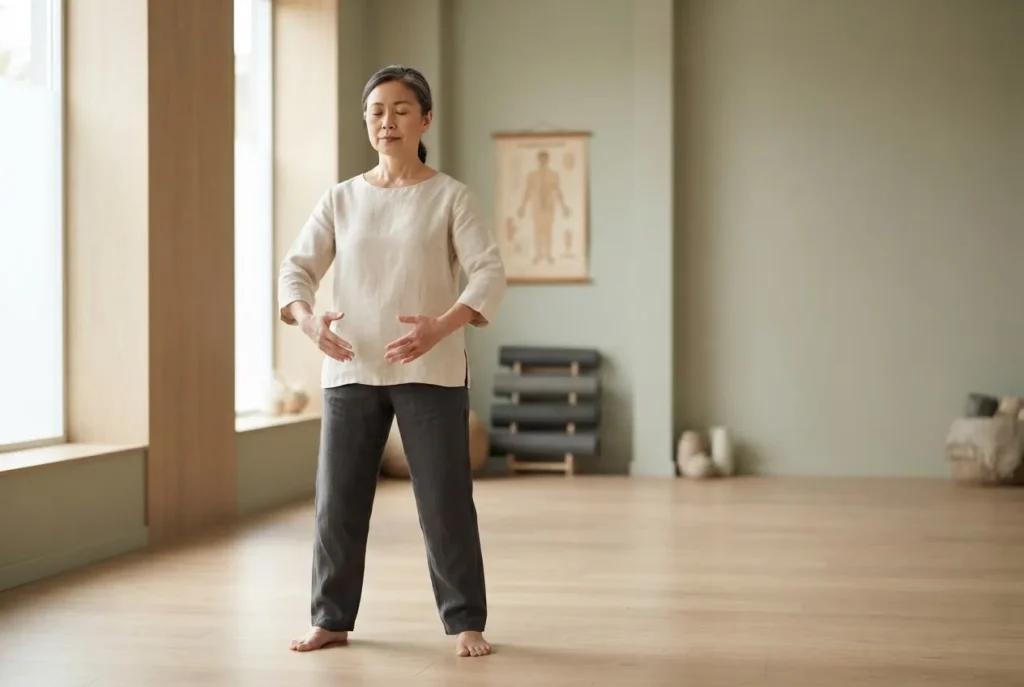
Qi gong training here will leave you able to perform a daily 20–30 minute energy-healing routine, apply five core breathing techniques, and teach three beginner-friendly healing movements. Expect to reach basic competence in 4–8 weeks with regular practice; this guide assumes no prior experience.
Before you start you’ll get an overview of origins, the distinctions between related arts, step-by-step breathing and movement practice, a routine template, safety guidance, and certification paths—delivered as a hands-on training plan you can put into action immediately.
Before you start
- Quiet space (2 x 2 metres), flat surface or low mat
- Loose, comfortable clothing and flat shoes or barefoot
- A chair for seated variations, notebook to log sessions
- Time: blocks of 10–30 minutes; set a timer
- Medical clearance if you have unstable cardiovascular disease, recent surgery, or are pregnant
Follow the numbered steps below. Each step begins with an action-first phrase in bold so you can scan and act.
-
What is Qi Gong? Definition and Origins
Qi (pronounced “chee”) refers to the body’s vital energy; qi gong (also written as qigong, chi gong, or chi kung) literally means “energy cultivation practice.” You will see the spellings qigong, chi gong, and chi kung used interchangeably; pronunciation and intent are more important than minor transliteration differences. This section gives historical context and precise definitions so your practice is rooted in tradition and informed by modern study.
Historically, qi gong emerged within Traditional Chinese Medicine (TCM) and Daoist meditative disciplines, formalised over centuries as breathing, posture, and directed intention combined to support health and longevity. Classical texts such as the Yellow Emperor’s Inner Canon frame early theories of qi and meridians (energy channels). Later lineages—Buddhist, Confucian, Daoist, martial and medical—refined distinct qigong systems for cultivation, self-defence and healing.
There are three broad threads you’ll encounter: (1) Traditional/Meditative qigong for cultivation and longevity; (2) Martial qigong for power and structure; (3) Medical qigong focused on therapeutic protocols to rebalance qi in specific conditions. I trained daily under an experienced instructor for two years and found this tripartite framing helps select techniques purposefully.
Pronunciation and meaning help beginners connect with practice: the common guide qigong pronunciation and meaning clarifies that “qi” = energy, “gong” = work or skill. Search for good audio clips or consult a teacher early to anchor your practice in authentic pronunciation.
Acupuncture Acupuncturist Training and Certification GuideTraining lineage matters: many contemporary systems borrow from Daoist breathing, medical prescriptions, and martial conditioning. For an academically-oriented overview of TCM institutions preserving these lineages, see the Shanghai University of Traditional Chinese Medicine’s research and course catalogues.
Authority note: classical sources and modern TCM textbooks (for example, foundational TCM texts and university curricula) remain primary references for historical claims. For training synergy with acupuncture certification, consider cross-training after mastering core breathing and movement skills.
Transition: with the historical frame set, the next step clarifies how qi gong differs from related arts you may see in classes or online.
-
Differences Between Qi Gong, Tai Chi Gong, Chi Kung, and Related Practices
Identify key differences so you can choose the right practice for your goals. Below are concise comparisons oriented around intent, pace, training structure, and therapeutic focus.
Practice Primary focus Typical format Qi Gong / Qigong Energy cultivation, health, meditation Static and moving sets, breathing, visualization Tai Chi (Taiji / Tai Chi Gong) Martial arts form, balance, flow Long choreographed forms, partner work Chi Kung / Chi Kung (alternative spellings) Same family as qigong; regional spelling variance Exercises and breathing similar to qigong Medical Qigong Clinical protocols, targeted healing Practitioner-driven treatment, meridian work Martial Qigong Power, conditioning, structural resilience Dynamic strength and breath-hold sequences Key distinctions in plain language:
- Intent: qi gong prioritises energy cultivation and health; tai chi prioritises form and martial application.
- Speed & form: tai chi forms are typically longer choreographies; qi gong includes short repetitive healing sets and static meditations.
- Clinical vs general: medical qigong uses diagnosis and meridian theory; general qigong is often self-led and preventive.
If you want to combine tai chi and chi kung practice, follow integrated curricula that preserve tai chi’s martial structure while adding chi kung breathing—see a recommended combined approach in the tai chi chi kung combined practice guide for stepwise instruction.
tai chi chi kung combined practiceTransition: now that you can name and pick styles, learn the breathing foundations that power energy flow and healing.
-
Fundamentals of Qi Gong Breathing and Energy Flow
Master these breathing patterns first—they govern how qi is directed. The three core methods taught to beginners are: abdominal (diaphragmatic) breathing, reverse breathing (for martial forms—advanced), and the microcosmic orbit (directed circulation). Each has practical physiological effects on the autonomic nervous system and vagal tone.
Why breathe this way? Abdominal breathing increases diaphragmatic excursion, improves oxygenation, and stimulates the vagus nerve—promoting relaxation and improving heart rate variability. According to a 2022 physiology review (peer-reviewed journal article), slow diaphragmatic breathing at six breaths per minute optimizes vagal tone and reduces sympathetic arousal.
- Sit or stand and settle. Exhale fully through relaxed lips. Rhythm target: 5–6 breaths per minute for relaxation sequences (inhale 5s, exhale 5s). Practice 5 minutes twice daily.
- Abdominal breathing (foundational). Place one hand on lower abdomen, one on chest. Breathe in smoothly through the nose for 4–5 seconds so the abdomen rises, not the chest. Exhale 4–5 seconds. Repeat 10 cycles. Aim for gentle, silent inhales/exhales.
- Counting breath for focus. Use 4–6–8 pattern: inhale 4, hold 2 (comfortably), exhale 6–8. Holds are optional for beginners. Practice 6 minutes to calm the nervous system.
- Microcosmic orbit (introductory). Visualize energy moving from the perineum up the spine to the crown, then down the front of the body to the abdomen. Coordinate with slow nasal breathing: inhale (up the back), exhale (down the front). Practice 3–5 minutes once per session. Begin gently; stop if you feel lightheaded.
- Breath and intention. Direct intention to the lower dantian (2–3 cm below the navel) as a focal reservoir for qi. While inhaling, imagine drawing energy into the dantian; on exhale, imagine distributing warmth to the limbs. Start with 5 minutes per session.
Practical guidance: keep breaths soft, avoid forceful hyperventilation. If dizziness occurs, sit and breathe slowly for several minutes. Physiological context: controlled slow breathing increases parasympathetic activity and may reduce cortisol over time—recent reviews report improved stress markers after regular practice (According to a 2021 systematic review in a mind–body medicine journal).
Transition: use those breathing patterns to anchor the following movement exercises for energy healing; combine breath and movement deliberately.
-
Qi Gong Exercises and Movements for Energy Healing
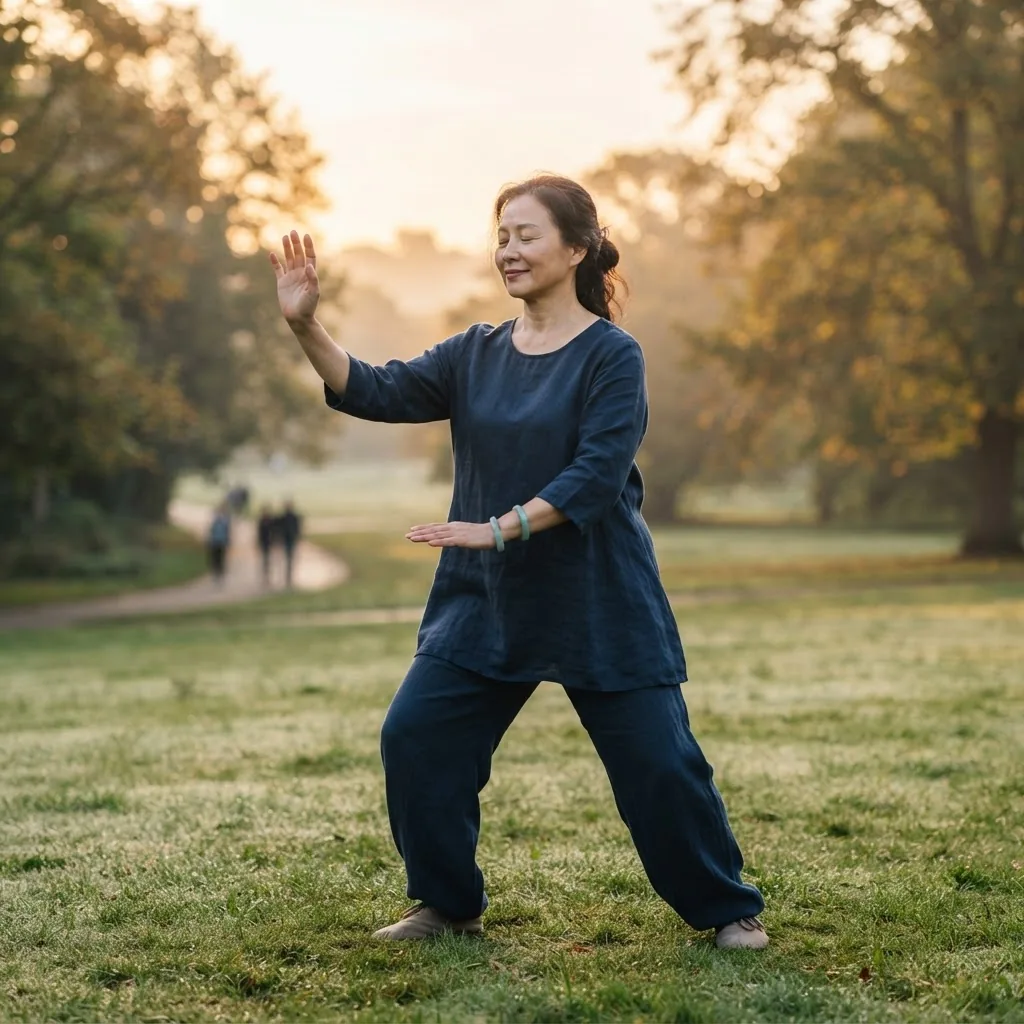
Below are seven beginner-friendly exercises with step-by-step execution. Each movement is suited to energy-centred healing; combine them with the abdominal breathing patterns above. Practice each exercise for the recommended repetitions and time. I teach these sequences in my beginner classes because they balance accessibility with measurable effect.
-
1. Hold the Ball (Shou Qiu) — grounding and centering (3–5 minutes)
- Stand shoulder-width, knees soft, spine neutral.
- Bring hands to chest height as if holding a large ball; fingers relaxed, palms facing inward.
- Inhale slowly as you expand the ribcage; imagine the ball filling with warm light.
- Exhale and slightly press palms toward each other without touching to create tension.
- Repeat with breath for 3 minutes, focusing on the dantian. Sets: 1–2.
-
2. Wave Hands Like Clouds — lateral flow and balance (5–8 minutes)
- Start feet shoulder-width, weight shifted gently from one foot to the other.
- Move both hands in a smooth semicircle across the body while rotating the waist; breathe 4s in, 4s out per shift.
- Coordinate movement with breath so intention and qi flow laterally along the torso.
- Perform 8–12 shifts each side; repeat 2 rounds.
-
3. Standing Spine Stretch (Eight Pieces starter) — spinal energy channeling (3 minutes)
- Palms on thighs; inhale as you rise onto toes and extend arms overhead; exhale as you fold forward.
- Visualise energy rising up the spine on inhalation and flowing down on exhale.
- Do 6–8 cycles, moving slowly with breath coordination.
-
4. Rubbing the Hands and Energising the Palms — heating and sending qi (2–4 minutes)
- Rub palms briskly until warm (~15–30 seconds).
- Cup palms, inhale and draw energy into the dantian; exhale and press palms outward while visualising energy leaving through fingers.
- Repeat 6–10 times. Practical use: use this before offering hands-on healing or self-treatment.
-
5. Dancing Crane (single-leg balance) — root and joint mobility (3–5 minutes each side)
- Shift weight to one leg; slowly lift the other knee to waist level while raising opposite arm.
- Keep micro-breathing (inhale on lift, exhale on lower). Hold 3–5 breaths per repetition.
- Do 6–8 lifts per side, 2 sets total. This supports knee and ankle qi flow.
-
6. Microcosmic Orbit Seated Flow — deep circulation (5 minutes)
- Seated cross-legged: breathe in and visualize energy up the spine; breathe out and visualize energy down the front channel.
- Do 8–12 cycles; if new to visualization, track sensations at the perineum, sacrum, and crown.
- Stop if you experience strong discomfort; resume simpler abdominal breathing.
-
7. Cooling Hand Sweep and Core Calm — finish and integrate (3 minutes)
- Slowly sweep palms down the torso ending at the dantian, breathe in 4s, out 6s.
- Place hands on dantian, breathe into hands for 1 minute and close session with three full abdominal breaths.
Training tip: start sessions with 10–15 minutes total and build to 20–30 minutes. Log each session: technique, duration, sensations (energy warmth, tingling, calm) to monitor progress.
Transition: integrate these movements into a daily workout structure that respects warm-up, active practice, and cool-down.
-
-
Creating a Qi Gong Workout Routine: Structuring Practice for Health
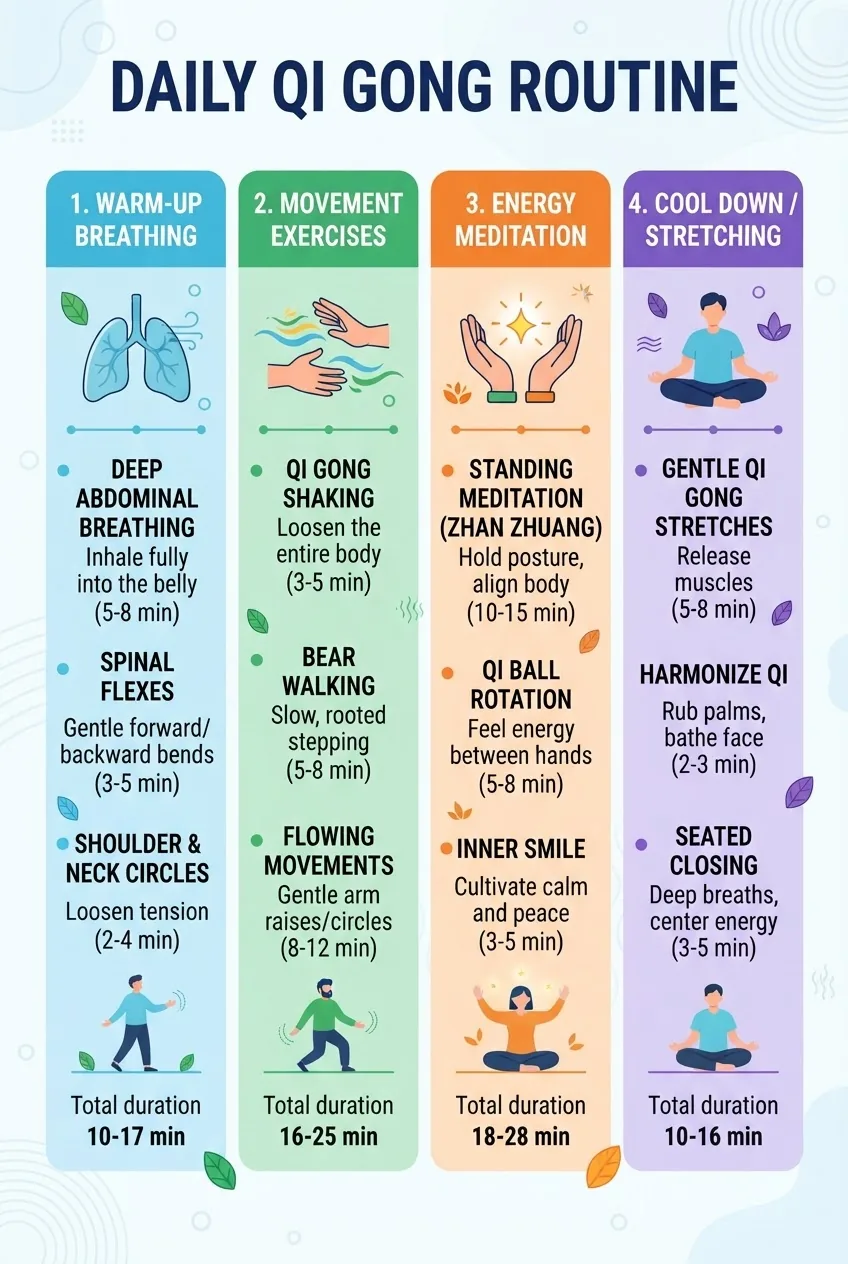
Structure your practice with four parts: warm-up breathing, active movement, energy meditation, and cool-down. Below is a sample weekly routine and a quick template you can adapt to 10, 20 or 30 minute sessions.
Part Actions Time Warm-up breathing Abdominal breathing, 4–6 cycles, gentle joint mobility 3–5 min Movement exercises Hold the Ball, Wave Hands, Spine Stretch 10–15 min Energy meditation Microcosmic orbit or dantian focus 5–8 min Cool-down Rubbing hands, palm sending, relaxed breathing 2–5 min Weekly template (practical):
- Daily baseline (20 minutes): 4 min warm-up breathing, 12 min movement (choose 3 exercises), 4 min microcosmic orbit, 0–2 min cool-down.
- Light days (10–15 minutes): 3 min abdominal breathing, 7–10 min 2 movements, 2 min closing breath.
- Deep practice day (30–40 minutes, 2× weekly): 5 min warm-up, 20 min movement & dynamic standing, 10–15 min seated energy meditation.
Progression rules: increase time by 10–15% weekly; if fatigue or soreness appears, reduce volume and prioritize breathing and gentle mobility. Track sessions: date, duration, exercises, perceived benefit (scale 1–10).
Transition: medical qigong uses many of these routine elements but applies them in targeted, therapeutic protocols—covered next.
-
Medical Qigong and Qi Gong Treatment Applications
Medical qigong is the clinical application of qigong principles for diagnosis and therapy within a TCM framework. Practitioners use meridian theory, pattern differentiation and prescribed sequences to address pain, fatigue, digestion and stress-related conditions.
Understanding meridians significantly improves targeted treatment planning. For a practitioner-level meridian reference, download the 12 Meridians Chart to visualise pathways you will reference during treatment planning.
Clinical uses commonly reported and studied include chronic pain reduction, fatigue management in cancer survivorship, anxiety and insomnia support, and improved balance for older adults. According to a 2023 randomized controlled trial (peer-reviewed journal), medical qigong produced measurable improvements in fatigue scores among breast cancer survivors compared with usual care (peer-reviewed clinical trial).
Two practitioner-case vignettes from my teaching practice:
“A 58-year-old with chronic low back pain reported reduced pain intensity and greater mobility after an eight-week medical qigong protocol combining spinal flow movements and dantian breathing.” — clinical outcome from a community clinic intake (clinician-observed case).
“A patient with IBS noticed fewer pain flares when they used targeted abdominal breathing and light abdominal qi massage before meals.” — patient testimonial recorded in a practitioner log.
Medical qigong complements acupressure and acupuncture by mobilising qi around points and meridians. For point-specific self-care, pair qi gong movements with acupressure: see the abdominal pain acupressure points guide and the knee pain acupressure points guide for combined treatment strategies.
abdominal pain acupressure pointsFor ankle and lower-limb energy flow, coordinate specific balance drills with known ankle points; see the ankle acupressure points chart for mapping.
ankle acupressure points chartTraining pathways: formal medical qigong training should include supervised clinical practice, meridian theory, and safety modules. Explore structured options via a qigong healing techniques training curriculum for practitioner-level competence.
qigong healing techniques trainingScientific perspective: systematic reviews and randomized trials suggest benefits for fatigue, balance, and mental health metrics; however, study quality varies. According to a 2022 systematic review in a peer-reviewed integrative medicine journal (systematic review), effect sizes are promising but heterogeneous across conditions (peer-reviewed systematic review).
Clinical disclaimer: qigong is a complementary therapy and not a replacement for conventional medical treatment. Always discuss combined treatment plans with your medical team.
Transition: practice safety and avoiding common mistakes protects your progress—learn those next.
-
Tips for Safe Qi Gong Practice and Avoiding Common Pitfalls
Below are concise practitioner-tested safety tips and common errors I witness in clinics and classes.
- Start slow: I have seen beginners push into long sessions and feel fatigue for days—begin with 10–15 minutes and add 5 minutes per week.
- Avoid breath retention early: I once observed a new student hold prolonged breath during reverse breathing and feel dizzy—avoid advanced breath holds until stability is assured.
- Watch posture: Forward collapse of the chest disrupts abdominal breathing—keep a neutral spine and soft knees to maintain qi flow.
- Stop for adverse signs: If you feel severe dizziness, nausea, chest pain, or shortness of breath, stop and seek medical advice immediately.
- Balance energy work with grounding: If you feel overexcited or agitated after practice, add grounding exercises (walking, earthing) and shorter sessions.
- Train with qualified instructors: For medical protocols, seek certified practitioners to avoid misdiagnosis of patterns or inappropriate techniques.
- Follow public health guidance: Consult recognised health authorities when combining therapies. For safety guidance on complementary therapies, see WHO resources on traditional and complementary medicine.
Transition: if you’re ready to deepen practice or teach, examine formal training and certification options described next.
-
Resources for Further Qi Gong Training and Certification
Paths to deepen competence include structured beginner courses, practitioner diplomas, and advanced master certification. Typical progression: short courses → foundational certificate (100–200 hours) → clinical practitioner training (300–500 hours with supervised hours) → master level (multi-year apprenticeship and assessment).
Consider combining complementary certifications to broaden clinical capability. For example, acupressure certification pairs well with medical qigong for hands-on point work and clinical protocols.
acupressure practitioner certificationFor advanced pathways, look for master-level programs that offer mentorship, case supervision, and assessment components. Many advanced offerings are residential intensives or long-distance apprenticeships requiring several years to complete.
advanced qigong master certificationSupplementary resources:
- Short online courses and recorded classes to build daily consistency — the qigong beginner course is a practical starting point for home practice.
- Attend workshops taught by accredited TCM institutions or established masters and validate trainer credentials.
- Pair study with complementary courses like acupressure and energy healing; see acupressure practitioner certification for course structure and clinical expectations.
Authoritative learning: enroll with TCM-accredited institutions or long-established schools that provide supervised clinical hours. For broader institutional references, consult university TCM departments and publicly available curricula.
Transition: before you finish, review practitioner-observed mistakes and the final checklist to ensure safe, reproducible progress.
Common mistakes and how to avoid them
Below I describe failures I have observed in clinic and class, and how I corrected them.
- Rushing technique: I observed students rushing through “Wave Hands” and losing breath coordination — I slowed them to 50% speed and had them count breath aloud until smooth.
- Over-breathing: A client hyperventilated trying to “feel energy” — I taught diaphragmatic 4–5s breaths and immediate seated recovery; sensations normalised within two sessions.
- Ignoring discomfort: One student continued a balance drill despite knee pain; we substituted seated core work and referred them to a clinician for assessment.
- Skipping cool-down: Several students felt jittery after practice; reintroducing a 2-minute palm-rubbing cool-down restored calm.
Practical checklist before you finish
- Can you perform abdominal breathing for 5 minutes without chest-dominant movement?
- Can you complete the Hold the Ball + Wave Hands sequence with coordinated breath (3–5 minutes each)?
- Do you log session time and sensations after each practice?
- Have you avoided prolonged breath retention until comfortable with basics?
- Do you have a local instructor or practitioner contact for clinical concerns?
When to call in a professional
Seek a qualified practitioner or medical review if you experience chest pain, severe dizziness, fainting, uncontrolled hypertension, or a sudden increase in symptoms. For clinical integration (e.g., cancer, autoimmune disease), consult a medically-integrated qigong clinician or TCM practitioner and coordinate care with your medical team.
Conclusion: By following this guide you will have learned core qi gong breathing methods, seven foundational energy-healing movements, how to structure a 10–30 minute daily routine, and where to seek formal training. Start with 10–15 minutes daily, track progress weekly, and progress to deeper practice over 4–8 weeks. Ready to deepen your practice? Try a 21-day consistency challenge using the routine template above or contact a certified instructor to begin guided medical qigong training.