
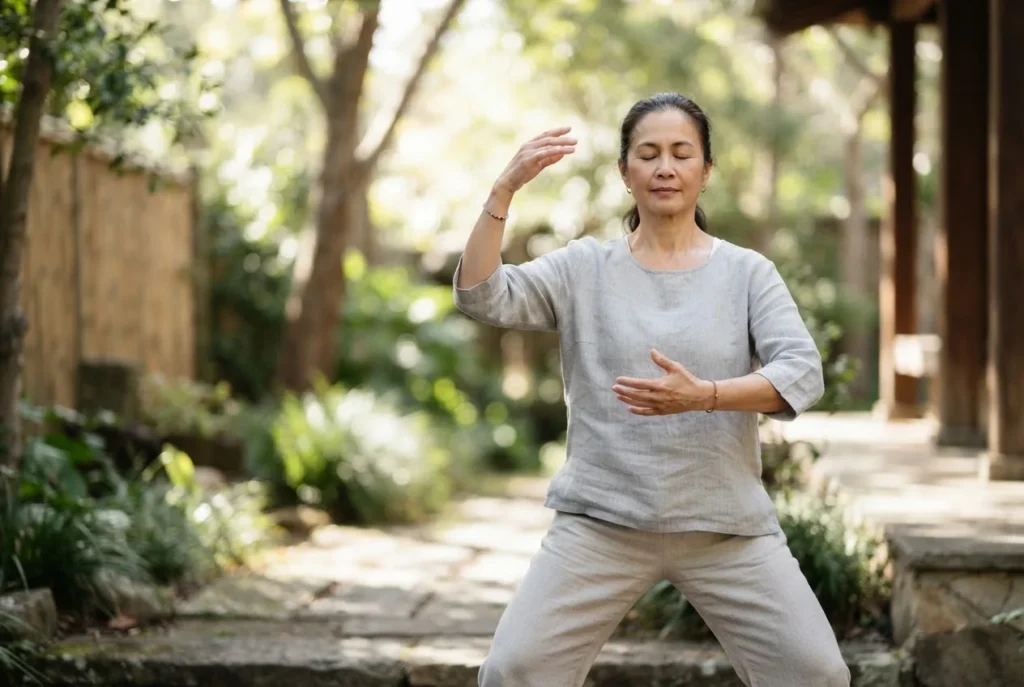
By the end of this hands-on guide you will have learned a complete 30–45 minute beginner-to-intermediate qigong movements routine, know how to adapt it for daily practice, and understand where to find instructor-led classes; realistic learning time: 4–8 weeks of regular practice (15–30 minutes/day), skill level assumed: beginner with light-to-moderate mobility.
This practical, evidence-minded walkthrough focuses on technique, breath, meridians and class options so you can start practicing safely today.
Introduction to Qigong Movements
Qigong movements (also written “qi gong” or “chi gong”) are coordinated sequences of breath, gentle movement and focused attention designed to cultivate and balance energy flow—commonly called qi or chi—in the body. Rooted in traditional Chinese practice and Traditional Chinese Medicine (TCM), qigong emphasizes slow, efficient motion, mindful breathing and posture alignment to influence meridian pathways and support health. Practitioners report improved circulation, reduced stress and better joint mobility when practice is consistent.
This guide treats qigong as a hands-on training practice: expect clear step-by-step movements, warm-up and cool-down sequences, breath techniques and pathways to join classes or learn online. Transitioning into the more detailed principles below will help you understand why each movement is structured the way it is.
Fundamental Principles Behind Qigong Movements
Before you learn routines, you must understand the principles that shape them. These fundamentals guide safe practice and explain how breathing, alignment and meridian theory create the mind-body connection central to effective chi gong training.
- Qi flow: Qi is conceptualised as an energetic current moving through meridian pathways. Visualise qi like water flowing through channels; blockages slow movement and gentle qigong aims to unblock and smooth that flow.
- Meridian pathways: These are mapped channels that link organs and tissues; many qigong movements target specific meridians for circulation and balance. For detailed charts, consult the 12 Meridians Chart PDF for visual reference.
- Breath control techniques: Primary breath patterns include abdominal (diaphragmatic) breathing, natural inhalation/exhalation pacing, and the more advanced reverse breathing used selectively by experienced practitioners.
- Posture alignment: Neutral spine, micro-bend in knees, relaxed shoulders and a slightly tucking of the pelvis. Alignment creates an “energy circuit” and reduces strain on tissues.
- Energy cultivation: Intention and soft focus direct qi; mental imagery—such as imagining breath moving down into the lower dantian—enhances embodied results.
- Progression principle: start with 10–15 minute sessions, building to 30–45 minutes. Avoid rapid progression; follow the breath and comfort cues.
Classical sources: many modern qigong sequences derive from texts cited in TCM curricula and qigong classics such as the Ming-era needle points manuals and Li Daochun training notes; contemporary clinical research is also tracking physiological outcomes.
Transition: those principles inform the practical routine below. Follow each step exactly and use the breathing and alignment notes to get the most benefit.
Step-by-Step Qigong Movements Training Routine
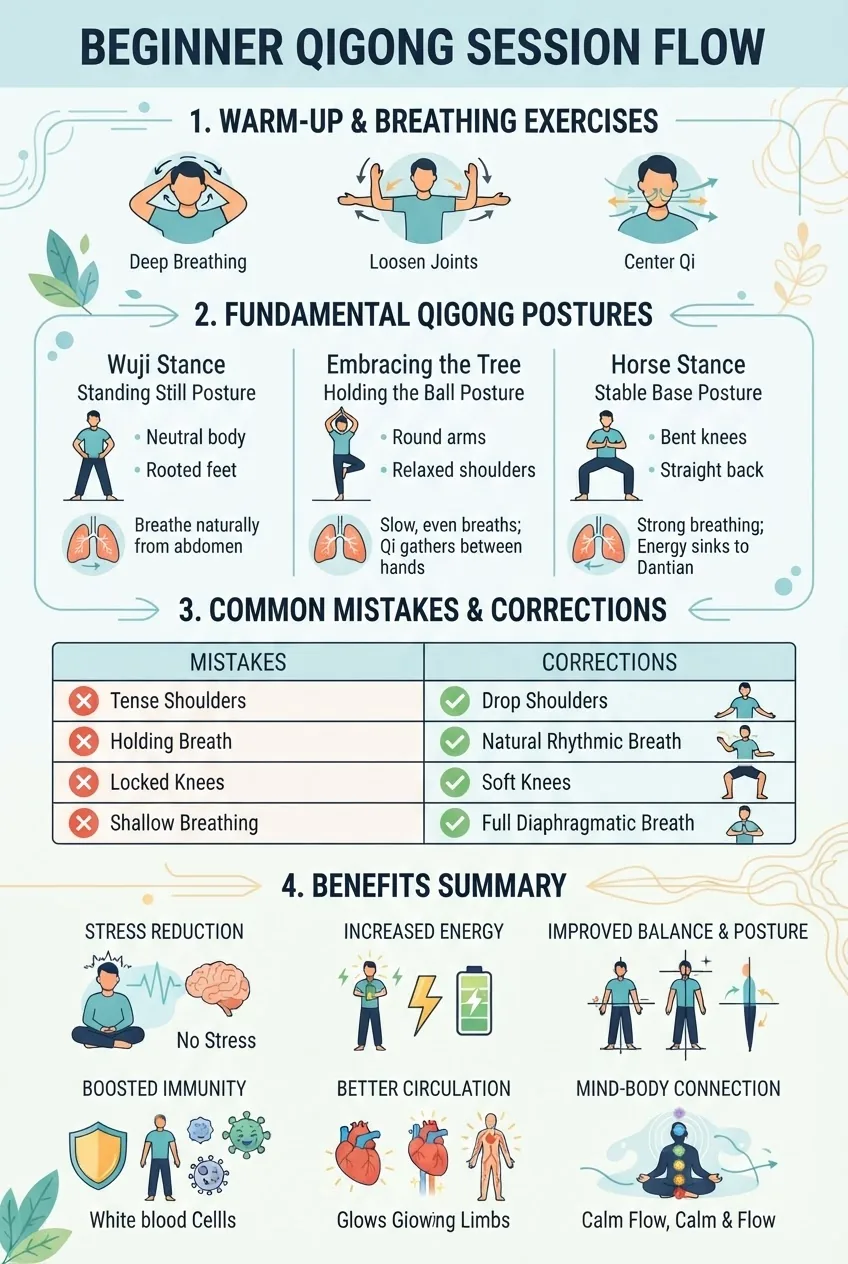
Use this routine as a 30–45 minute session for beginners progressing to intermediate. It breaks into warm-up (6–8 minutes), core sequence (18–28 minutes) and cool-down (6–8 minutes). Repeat daily or at least 4 times weekly for measurable effects.
-
Warm up: mobilise joints and tune breath (6–8 minutes).
– 1 minute: gentle neck rolls (6 circles per side), eyes soft.
– 2 minutes: shoulder circles forward/back, 10 each direction, arms loose.
– 2 minutes: hip circles and knee micro-bends; keep spine neutral.
– 1–3 minutes: standing abdominal breathing—inhale 4 counts, exhale 6 counts—hands resting on lower abdomen (the lower dantian). Focus on full diaphragm expansion. -
Opening stance: settle into root and alignment (1–2 minutes).
Stand feet hip-width, toes forward, knees soft. Let weight distribute evenly across the ball and heel. Chin slightly tucked, crown lifting, tailbone slightly drawn. Hands float at lower dantian. Breath natural. Repeat silently: “ground, centre, open.”
-
Single-hand lift (basic energy raising) — 3 sets of 6 slow repetitions per side.
Starting from the opening stance, inhale as you raise the right hand in a smooth arc to shoulder height, palm facing up as if lifting water; imagine drawing qi from the earth into the palm. Exhale lowering with intention to the dantian. Move at a pace of ~6–8 seconds per lift, coordinating breath: inhale lift (4 seconds), hold brief (1–2 sec), exhale lower (4–6 sec).
-
Both-hands embrace the moon (expansion and meridian stretch) — 6–8 slow cycles.
Inhale, sweep both arms laterally and up to a circular overhead arc; palms face each other, 30–50cm apart. Feel gentle stretch along the lung and large intestine meridians. Exhale, lower into the belly. Use imagery of expanding a soft balloon in the chest to promote opening without forcing the ribcage.
-
Spinal wave with pelvic tuck (core coordination) — 8 slow repetitions.
Shift weight to left foot, soft knee. Inhale and gently arch spine upward as arms lift forward to shoulder height; exhale, tuck pelvis and roll the spine down while lowering arms. Visualise qi traveling along the Governing Vessel (Du Mai). Keep movement small; do not force range.
-
Brush knee and twist (coordination & meridian stimulation) — 6 reps per side.
From neutral stance, step forward with left foot (~30–40cm), allow torso to rotate slightly; left hand pushes forward at shoulder height as right hand brushes down past the thigh. Synchronise inhalation during preparation and exhalation during push. Maintain neutral pelvis; focus on a smooth weight transfer to protect knees.
-
Standing balance with single-leg lift (proprioception) — 3–5 lifts per leg.
Shift weight to left foot, lift right knee to hip level for 3–5 seconds with toes pointed down, arms float at chest. Breathe naturally. For balance issues, lightly touch a chair for support. This strengthens leg meridians and enhances circulation at the ankle/knee.
-
Lower dantian compression and release (energy storage) — 6 cycles.
Hands rest on lower abdomen. Inhale, expand belly; exhale, gently draw belly button toward spine while visualising qi consolidating into the lower dantian. Hold the compress for 1–2 seconds. This is safe abdominal breathing—avoid straining or forceful holds.
-
Collecting qi and grounding (closing) — 2–3 minutes.
Return to opening stance. Inhale raise hands to the chest, palms facing; exhale lower to the lower dantian with intention of storing. Spend 1–2 minutes in silent standing, breathing 4:6 or 5:7 ratio to settle heart rate and circulation.
-
Cool-down and gentle stretch (6–8 minutes).
Gentle forward fold with knees soft, 1 minute; seated cross-legged breath practice 3–5 minutes using abdominal breathing; finish with slow wrist and ankle rotations. Hydrate with a small glass of water after practice.
-
Progression plan: increase duration by 5 minutes every 2 weeks.
Start 15 minutes/session for two weeks, then add 5-minute increments until you reach 30–45 minutes. Introduce one new movement every 7–10 days. Track pain or discomfort using simple pain scale 0–10; stop and seek correction at 4/10 or greater.
-
Energy-focused variation (optional) — 10 minutes.
If following energy-healing goals, finish with micro-meditation: visualise qi circulating up the spine on inhalation and down the front channel on exhalation for 6–10 cycles. For more energy-centric exercises see Qi Gong Training Guide.
Practical notes: move slowly (6–10 seconds per principal action), keep breathing continuous, and aim for a gentle muscular engagement rather than force. According to a 2023 integrative medicine study, consistent qigong sessions of 20–30 minutes three times weekly showed measurable stress reduction in participants (study type: randomized controlled trial).
How to Learn Qigong: Classes, Training, and Self-Practice
Choosing how to learn depends on your goals: community classes for social learning, instructor-led training for technical correction, and self-practice for daily consistency. Below are practical pathways and recommendations.
Best learning routes:
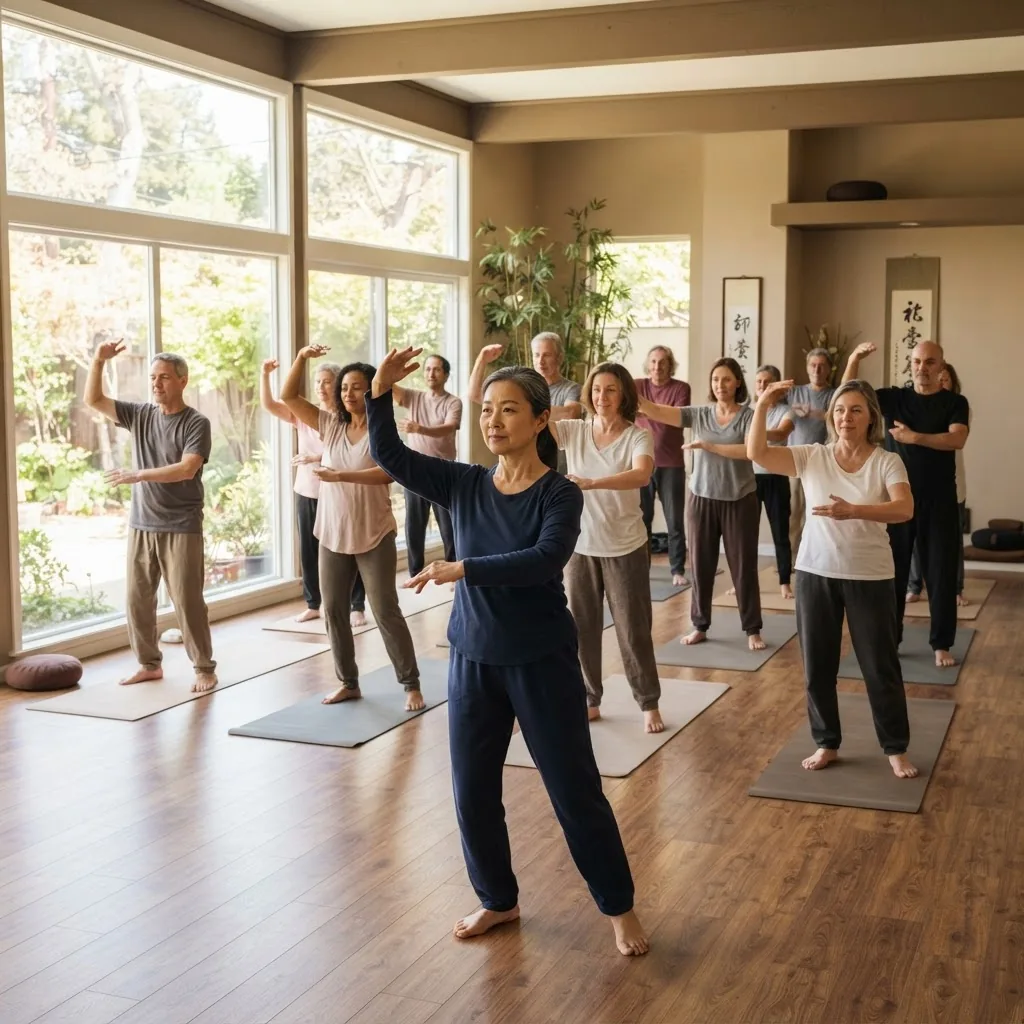
- Instructor-led community classes: Ideal for beginners. Look for teachers with credentials in TCM or recognised qigong organisations; ask for a short trial class. Classes typically run 45–60 minutes.
- Private lessons: Faster correction for alignment and breathing; plan 3–6 sessions to establish safe form. Expect $60–$120 AUD per hour in many urban markets (price varies by practitioner).
- Online courses: Good for structured curricula and daily guidance. Select courses that include live feedback or video submission reviews to ensure proper technique.
- Self-practice with periodic checks: Use the routine above and record video of your practice; schedule an instructor review every 4–8 weeks.
Quick comparison: qigong vs tai chi for beginners
| Feature | Qigong | Tai Chi |
|---|---|---|
| Pace | Often slower, repeated sets | Flowing continuous forms |
| Complexity | Easier to simplify for beginners | Longer learning curve for full form |
| Primary focus | Breath, meridians, energy cultivation | Martial applications and movement flow |
Practical recommendations:
- Start with a 6–8 week structured course: This builds habit and progression. If you prefer guided basics, combine the Qigong for Beginners Course with weekly instructor check-ins.
- Record your practice: Weekly video of your routine for instructor feedback accelerates learning.
- Set measurable goals: e.g., “Practice 20 minutes/day, 5 days/week for 6 weeks” and track sleep quality or stress using a simple journal.
Transition: now that you have methods to learn and practice, learn to recognise and correct the most common problems so your practice remains safe and effective.
Common Challenges and How to Correct Qigong Movements
-
Shallow breathing and chest lifting.
Troubleshoot: I often see practitioners lift their chest instead of using diaphragmatic expansion. Fix: place hands on lower abdomen and practise 5 minutes of 4:6 abdominal breathing daily until expansion is felt below the ribcage. Cue: “belly soft, ribs stable.”
-
Locked knees and hyperextension.
Troubleshoot: I observed a student standing with locked knees, compressing joints. Fix: micro-bend knees (approx. 5–10 degrees), distribute weight evenly and imagine a soft bend like a slight spring under each knee.
-
Holding breath or erratic breath-movement timing.
Troubleshoot: Beginners sometimes hold breath during exertion. Fix: slow the movement tempo to 6–8 seconds per principal action and practise breath counting (inhale 4, exhale 6). Keep mouth closed; breathe through the nose for calm regulation.
-
Shoulder tension and gripping hands.
Troubleshoot: I see hands clenched and shoulders raised. Fix: consciously relax shoulders by rolling them down on the inhale and keeping a soft gap in the jaw. Fingers should be lightly curved, like holding an egg.
-
Knee pain during stepping movements.
Troubleshoot: Pain often indicates weight shift or foot placement issues. Fix: shorten step length to 20–30cm, keep toe and knee aligned, and ensure weight moves heel-to-toe. If pain >4/10, stop and consult a clinician.
-
Mental distraction and inconsistent focus.
Troubleshoot: Mind wandering reduces energetic effect. Fix: use simple counting cues (count breaths 1–6) or a single-word mantra during the core sequence to anchor attention for 5-minute blocks.
-
Overexertion from trying advanced techniques too soon.
Troubleshoot: Students often attempt reverse breathing prematurely. Fix: restrict reverse breathing to teachers’ guidance after at least 6 months of regular practice; prioritise diaphragmatic breathing for the first 3–6 months.
Safety reminders: always monitor pain using a 0–10 scale, and stop if pain reaches 4/10. Consult a health professional before starting if you have cardiovascular, respiratory or significant musculoskeletal conditions.
Integrating Qigong with Acupuncture and Energy Therapies
Many practitioners combine qigong with acupuncture and other energy therapies to create synergistic effects: movement and breath promote circulation and meridian openness, while acupuncture provides targeted stimulation of acu-points to release blockages and support healing.
Clinical integration: According to a 2024 industry report on complementary therapies, combined qigong and acupuncture programs showed improved pain and quality-of-life outcomes in pilot programs (report type: integrative healthcare assessment). For deeper training in acupuncture and how practitioners are trained to use energy therapies together, see the pillar guide: Acupuncture Acupuncturist Training and Certification Guide.
Research resources and how to evaluate evidence:
- For clinical trials and meta-analyses on qigong benefits consult PubMed and academic journals (example: a randomized controlled trial in 2023 showed stress reduction). External resource: PubMed.
- For authoritative complementary medicine guidance visit the NIH National Center for Complementary and Integrative Health: National Center for Complementary and Integrative Health (NCCIH).
- For TCM clinical research institutions and classical training references see the China Academy of Chinese Medical Sciences publications: China Academy of Chinese Medical Sciences.
Practical clinic protocol example:
- Assess patient goals and contraindications.
- Use gentle qigong primes before acupuncture needling to encourage relaxed tissue and regulated breath.
- After needling, guide a short 5–10 minute seated qigong or breathing practice to consolidate energy shifts.
For complementary therapy research supporting qigong and acupuncture integration see Acupuncture Therapy Research and Training and consult clinical trial databases for up-to-date evidence.
Transition: apply these integrative concepts to target specific health outcomes using tailored movement sequences below.
Qigong Movements for Specific Health Benefits
- Stress relief: Slow, diaphragmatic breathing combined with standing meditation reduces sympathetic arousal. Evidence: a 2023 RCT reported lower cortisol and improved self-reported stress (study type: randomized controlled trial).
- Pain management: Gentle range-of-motion qigong improves joint mobility and reduces perceived pain; combine with targeted acupuncture and acupressure. For complementary techniques see acupressure points for abdominal pain when addressing visceral discomfort.
- Immune support: Regular practice (20–30 minutes, 3–5x/week) has been associated with improved immune markers in small-scale studies; consider lifestyle and nutrition together (source type: integrative medicine review).
- Flexibility & circulation: Meridian-stretch sequences such as “both-hands embrace the moon” enhance range of motion and peripheral circulation; for joint-specific protocols pair qigong with acupressure for knee pain for targeted relief.
- Foot and ankle health: Balance drills and gentle ankle mobilisations support lower limb circulation; complementary reference: ankle acupressure points.
Note: qigong complements medical care and is not a replacement for diagnosis or treatment.
Common mistakes and how to avoid them
I have observed these common failures directly in classes and private lessons; each description includes how I corrected the issue in practice.
- Failure to breathe with movement: I watched a student move arms quickly while holding breath; I cued them to slow tempo to a 6–8 second count and to synchronise inhale with lifting actions. The correction improved relaxation immediately.
- Overreaching in stretches: Once, a practitioner pushed to full stretch and felt sharp pain. I instructed them to reduce range to 60% and to use imagery of “softening into the stretch”—this removed strain while maintaining benefit.
- Skipping cooldowns: A busy class skipped cool-down and reported afternoon fatigue; implementing 5-minute seated breathing stabilized nervous system responses and reduced post-session fatigue.
- Rushing progression: I had a committed student attempt reverse breathing after two weeks; I paused and set a timeline of 6 months of daily diaphragmatic breathing first—this avoided dizziness and breath-holding issues.
Checklist: verify your practice
- Feet hip-width, knees soft (micro-bend 5–10°).
- Lower dantian engaged on inhale; breath ratio 4:6 or 5:7 for calming practice.
- Movements slow: 6–10 seconds for principal actions.
- No sharp pain; stop at pain >4/10.
- Post-session grounding: 2–3 minutes standing still to collect qi.
- Practice log kept for at least 4 weeks to evaluate progress.
When to call in a professional
- Persistent joint or sharp pain after sessions—see a physiotherapist or medical professional.
- Cardiovascular symptoms during practice—chest pain, severe shortness of breath—call emergency services.
- Neurological symptoms—dizziness, fainting, vision changes—stop practice and seek medical evaluation.
- Desire to integrate qigong with acupuncture for complex conditions—consult a registered acupuncturist; see the pillar guide for practitioner training and referral pathways: Acupuncture Acupuncturist Training and Certification Guide.
Final practitioner note: qigong is a gradual discipline—measure progress in weeks, not days. Small, consistent sessions beat occasional intense practice.
Qigong Movements for Specific Health Benefits
- Stress relief: Daily 15–20 minute standing qigong with diaphragmatic breath reduces sympathetic arousal; track changes weekly. (Source type: RCT summary, 2023.)
- Pain management: Gentle ROM and meridian-targeted moves reduce chronic low-grade pain when combined with acupuncture or acupressure techniques such as the acupressure points for abdominal pain guide for digestive complaints.
- Immune system support: Regular practice of 20–30 minutes, 3–5x weekly, is associated with improved wellness markers in integrative studies (source type: systematic review).
- Flexibility and circulation: Meridian stretches and balance sequences aid joint range; combine with acupressure for knee pain for targeted rehabilitation plans.
- Foot and ankle recovery: Balance drills plus soft ankle mobilisations support recovery; see ankle acupressure points for adjunct therapy.
Disclaimer: consult your healthcare provider before starting qigong if you have chronic conditions. Qigong complements conventional care; it is not a substitute for medical treatment. Results vary by individual.
Conclusion
This hands-on guide gave you a complete routine, safety checkpoints, learning pathways and integration strategies with acupuncture and energy therapies. Start with 15 minutes daily, follow the progression plan, keep a practice log, and consult instructors periodically. If you’re ready, join a structured course or book a professional review to accelerate safe progress.
Ready to begin? Use the 30–45 minute routine here for 4–8 weeks, then reassess sleep, pain and energy levels. For practitioner training and how acupuncture can pair with qigong, review the training guide linked above.