
Acupuncture acupuncturist training combines academic coursework in traditional Chinese medicine (TCM), supervised clinical hours and practical skills, and jurisdictional exams; most regions require a recognized qualification plus board or state registration. This guide gives step-by-step pathways, certification rules, practical skills development, safety, and career outlook for aspiring practitioners.
Introduction to Acupuncture and Acupuncturists
Question: What is acupuncture and what does an acupuncturist do? — Answer: Acupuncture is a regulated hands-on therapy that uses thin needles to stimulate points along energetic channels to restore balance; an acupuncturist is a trained clinician who assesses patients using TCM diagnostics, performs needling and adjunct therapies, and manages treatment plans.
Term: Acupuncture — a clinical practice from traditional Chinese medicine using sterile needles at specific points to influence physiological function and symptom patterns.
Term: Acupuncturist — a health practitioner trained and often licensed to diagnose according to TCM principles and deliver acupuncture and related therapies.
Acupuncture is embedded in eastern medicine and TCM systems that view health as the flow and balance of Qi (vital energy). Practitioners integrate pulse and tongue diagnosis, meridian theory and pattern differentiation to choose point prescriptions and adjunct modalities (moxa, cupping, auricular techniques).
Clinical settings vary from private clinics and integrative health centres to hospitals and research units; acupuncturists often collaborate with conventional clinicians for musculoskeletal pain, chronic conditions, and supportive care. The next section explains the foundational TCM concepts that underpin how acupuncturists are trained and how they reason clinically.
Core Concepts of Traditional Chinese Medicine Relevant to Acupuncture
Question: What core TCM concepts does acupuncture training teach? — Answer: Training covers meridians and acupoints, Qi and blood, yin-yang balance, zang-fu organ theory, pattern differentiation, and the Chinese apothecary for herbal integration; each concept frames diagnosis, point selection, and treatment sequencing.
Term: Qi — Qi is the TCM term for vital energy that flows through meridians and maintains physiological function.
Term: Meridian — a meridian is a pathway in TCM connecting acupoints and organs, used to map symptom patterns to treatment strategies.
Below are the key TCM terms and concise definitions students see early in programs:
- Yin–Yang: complementary opposites that must be balanced for health; imbalance informs treatment aim.
- Zang–Fu: organ system theory mapping physiological and emotional functions to organ patterns.
- Meridian channels: networks connecting points; knowledge of the 12 primary meridians is core to point selection.
- Pattern differentiation: identifying syndromes (e.g., Liver Qi stagnation) from signs and symptoms to guide therapy.
- Chinese apothecary: the herbal pharmacopeia used alongside acupuncture for many trained clinicians.
Traditional Chinese herbal drugs and the apothecary relationship are taught to varying extents depending on program scope: some programs integrate herbal formularies closely, while others leave herbal prescribing to specialist herbalists. For foundational study of meridians and organ theory, see tcm meaning and traditional medicine training.
Understanding these concepts prepares students to interpret clinical signs (pulse, tongue, symptom clusters) and to apply acupuncture safely. The next section distinguishes styles of acupuncture so you can match training to your intended scope of practice.
Types of Acupuncture and Their Specializations
Question: What types of acupuncture are taught and practised? — Answer: Training programs cover multiple modalities—TCM-style body acupuncture, auricular (ear) acupuncture, electroacupuncture, scalp acupuncture, dry needling variations in some jurisdictions, and adjuncts like moxibustion and cupping—each with specific indications and scope.
- TCM acupuncture: Classical meridian-based needling with pattern differentiation; the core of most accredited master’s programs.
- Auricular acupuncture: Focused work on ear points for addictions, pain and emergent settings; often a short certification specialty.
- Electroacupuncture: Low-voltage electrical stimulation applied to pairs of needles to modulate pain and neuromuscular function.
- Scalp acupuncture: Targeted cerebral and neurological indications using mapped scalp zones; used in stroke rehabilitation and neurology settings.
- Japanese-style acupuncture: Lighter needling, palpation-based point finding and often shorter needle retention times; emphasizes refinement and gentle technique.
- Five-element acupuncture: A constitutional approach focusing on elemental imbalances and fewer points per treatment, with a distinct diagnostic lens.
- Electrotherapies and advanced modalities: Cupping, gua sha, moxa (moxibustion), and adjunct point stimulation; training programs include practical modules for these.
- Complementary acupressure and reflex therapies: Non-needle options and charts such as the acupressure points in ankle chart and treatment guide for complementary care.
Many programs allow electives or specialisation pathways; when selecting a program confirm competence hours for the specific modalities you plan to practise. The next section evaluates evidence for benefits and common clinical indications.
Understanding Acupuncture Benefits and Efficacy
Question: Does acupuncture work and what can it help treat? — Answer: High-quality reviews show acupuncture is effective for several conditions—chronic low back pain, osteoarthritis knee pain, tension-type and chronic migraine prevention, and some postoperative or chemotherapy-related symptoms—while other indications have mixed evidence; benefit size varies by condition.
According to a 2023 systematic review indexed on PubMed, acupuncture demonstrated clinically significant effects for chronic musculoskeletal pain compared with sham controls in pooled trials, though effect sizes are moderate and heterogeneity exists across studies (source: peer-reviewed journal review, 2023).
Leading summaries from authoritative bodies report similar conclusions:
- According to a 2022 evidence summary from the U.S. National Center for Complementary and Integrative Health (NCCIH), acupuncture shows effectiveness for chronic pain and migraine prevention but evidence is variable for other conditions (NCCIH acupuncture overview).
- According to a 2021 Cochrane-style meta-analysis summary (peer-reviewed synthesis), acupuncture outperforms usual care for knee osteoarthritis for pain and function, with safety comparable to controls (source: peer-reviewed meta-analysis, 2021).
Clinical indications commonly supported by moderate-to-strong evidence include:
- Chronic low back pain and neck pain
- Osteoarthritis (especially knee)
- Chronic tension-type and migraine prevention
- Postoperative nausea, chemotherapy-related nausea
Complementary modalities and acupressure training can address other symptom patterns; see abdominal pain acupressure points for stomach relief and acupressure knee pain points training as related modalities that illustrate application breadth.
Statistically, patient-reported improvement rates vary: according to a 2024 industry report summarising clinical registries, around 60–70% of patients receiving a course of acupuncture for chronic musculoskeletal complaints report moderate improvement within 4–8 sessions (source: 2024 industry report).
Caveats and limitations of the research:
- Sham-controlled trials sometimes show smaller effect sizes, exposing non-specific needle effects and contextual factors.
- Heterogeneity in practitioner skill, dose (number of needles, session length), and point selection influences outcomes.
- Many trials lack long-term follow-up beyond 6–12 months.
For condition-specific practitioner resources, consider acupuncture for back pain treatment guide and acupuncture for joint pain therapy and treatment for applied protocols and patient expectations.
Transition: With evidence and indications clarified, the following section outlines what day‑to‑day practice looks like for a licensed acupuncturist.
The Acupuncturist Profession: Roles and Responsibilities
Question: What are the key roles and responsibilities of an acupuncturist? — Answer: Acupuncturists evaluate patients through TCM and biomedical histories, develop treatment plans using point prescriptions and adjuncts, deliver safe needling care, document outcomes, maintain infection control, and engage in interprofessional communication when required.
Typical work activities include:
- Comprehensive intake with medical and TCM pattern assessment
- Pain and functional assessment, measurement of outcomes
- Needle insertion, retention and adjunct therapies (moxa, cupping, electroacupuncture)
- Clinical record keeping, informed consent and safety screening
- Referral and collaboration with GPs, physiotherapists and specialists
- Practice management duties in private clinics (billing, scheduling)
- Continuing education and adherence to regulatory standards
Skills beyond technical needling are critical: communication, differential diagnosis integrating TCM and biomedical red flags, emergency response (e.g., fainting), and cultural competence when discussing expectations and herbal prescriptions.
Example case pathways: a patient with chronic knee pain may receive an initial TCM assessment, a conservative acupuncture protocol over 6–8 sessions, concurrent advice on movement and self-acupressure, and referral for imaging if biomedical red flags are present; this demonstrates the integration of clinical judgment, safety and scope of practice.
Transition: If you plan to enter the profession, the next section lays out clear training pathways and a step-by-step roadmap to certification.
Training Pathways for Aspiring Acupuncture Acupuncturists
Question: How do I train to become a certified acupuncturist and what steps are required? — Answer: Train by completing an accredited TCM/acupuncture diploma or master’s program, fulfil supervised clinical hours, pass required national/state exams, register with the local licensing authority, and pursue supervised mentoring and continuing education; timelines vary from 2–4 years full-time.
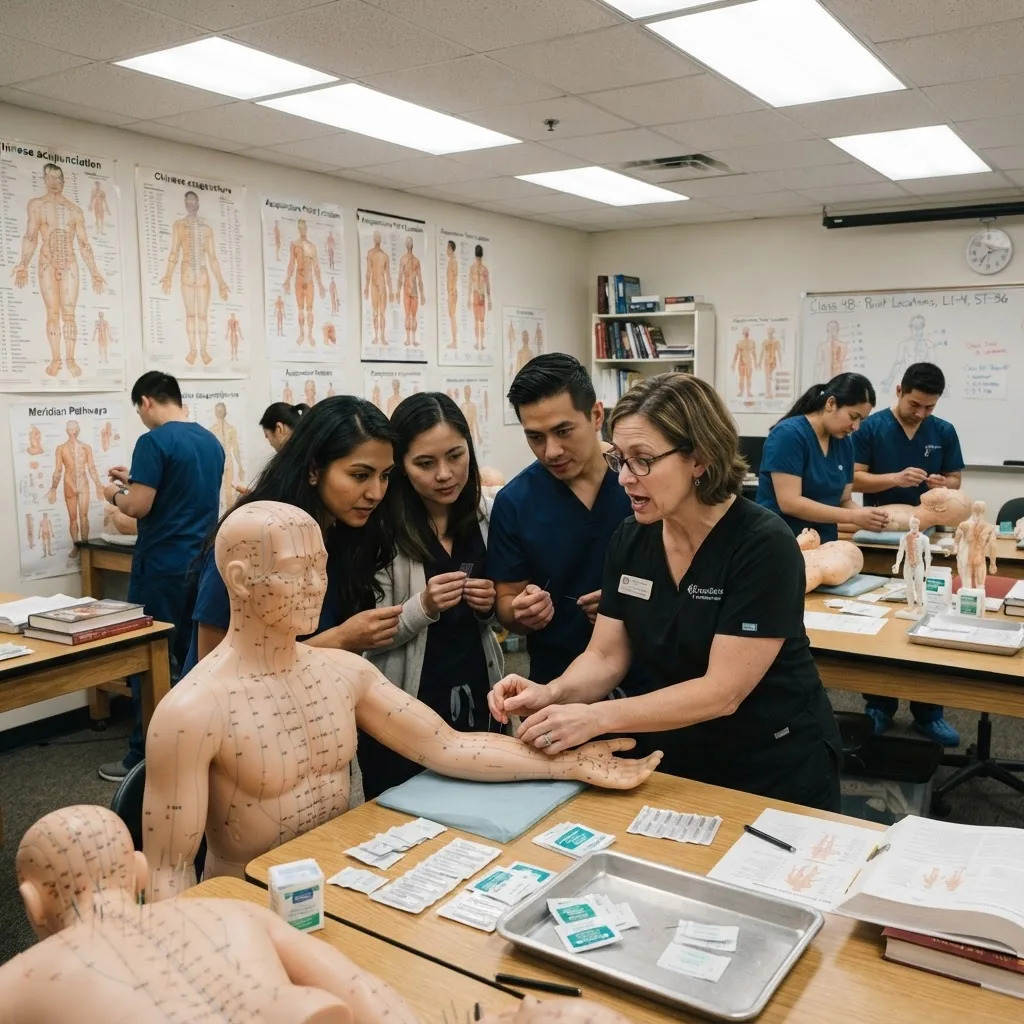
The following step-by-step guide outlines standard progression, practical milestones, and variations by jurisdiction. For a complementary route in non-needle touch therapies see acupressure practitioner course and certification.
-
Step 1 — Pre-requisites and preparatory learning
Many programs require prior tertiary study (health sciences, biology) or evidence of equivalent experience. Entry-level diplomas may accept high-school completion plus interview or bridging courses in anatomy and physiology.
-
Step 2 — Choose the right accredited program
Select a program that meets your jurisdiction’s education hours and clinical requirements; options include:
- Master’s degree (commonly 3–4 years full-time) — standard in many countries for full-scope TCM acupuncture practice
- Advanced diplomas (2–3 years) — available in some regions with clinical training components
- Short certificates/specialist courses — suitable for auricular or adjunct modalities but often do not qualify for full licensure
Confirm that the curriculum includes anatomy & physiology, TCM theory, clinical diagnosis, point location, needling techniques, sanitation and professional ethics.
-
Step 3 — Clinical practice hours and supervised placements
Accredited programs require supervised clinical hours—typically 500–1,000+ hours depending on level and jurisdiction. Supervised practice hones point location, needling technique, treatment sequencing and patient communication.
Experience signal: students routinely describe early clinical rotations focusing on intake, single-point protocols, then graduating to complex multi-point treatments under instructor review.
-
Step 4 — Assessment and competency exams
Programs use OSCEs (Objective Structured Clinical Examinations), written theory exams, and practical needling assessments. Competency frameworks evaluate safety, infection control, and clinical reasoning.
-
Step 5 — National or regional certification exams
After graduation many jurisdictions require passing a licensing exam (e.g., board exams such as NCCAOM in the U.S. or state registration processes in Australia); check local regulator requirements early in program selection.
-
Step 6 — Registration and scope setup
Register with your local licensing body, obtain professional indemnity insurance, set up clinical governance, and understand restrictions on herbal prescribing or collaborations with medical practitioners. Some regions limit acupuncturists to needling unless additionally trained in herbal medicine.
-
Step 7 — Early career development and mentorship
Many new practitioners join group practices or seek mentoring for complex case management and business skills. Early-career mentors accelerate clinical judgment and safe prescribing habits.
-
Step 8 — Continuing professional development (CPD)
Once licensed, maintain registration through structured CPD: seminars, supervised practice, research courses, and specialty certifications (e.g., sports acupuncture, fertility acupuncture).
-
Step 9 — Advanced pathways and research integration
Pursue postgraduate research, teaching roles or hospital-based fellowships to expand scope; for advanced study options see acupuncture therapy research and treatment training.
-
Step 10 — Complementary certifications
Consider adjunct certifications (auricular, electroacupuncture, sports acupuncture) to diversify services and meet patient demand. For non-needle skills, cross-certification in acupressure or qigong can broaden safe practice offerings; review acupressure practitioner course and certification.
Typical timeline examples (full‑time study): diploma route 2–3 years; master’s route 3–4 years plus exam preparation and registration time. Variations occur by country—always confirm with the target regulator before enrolment. The next section compares licensing requirements across jurisdictions and shows where to find official guidance.
acupuncture acupuncturist training and certification guide
Certification, Licensing, and Regulatory Requirements
Question: What certification and licensing requirements must acupuncturists meet? — Answer: Requirements vary: most regions require completion of accredited education, supervised clinical hours, and passing a national or state exam, followed by registration and periodic renewal with CPD; some regions additionally regulate herbal prescribing and title protection.
Below is a comparison table summarising typical requirements across representative regions—use it as a framework, not a substitute for regulator verification.
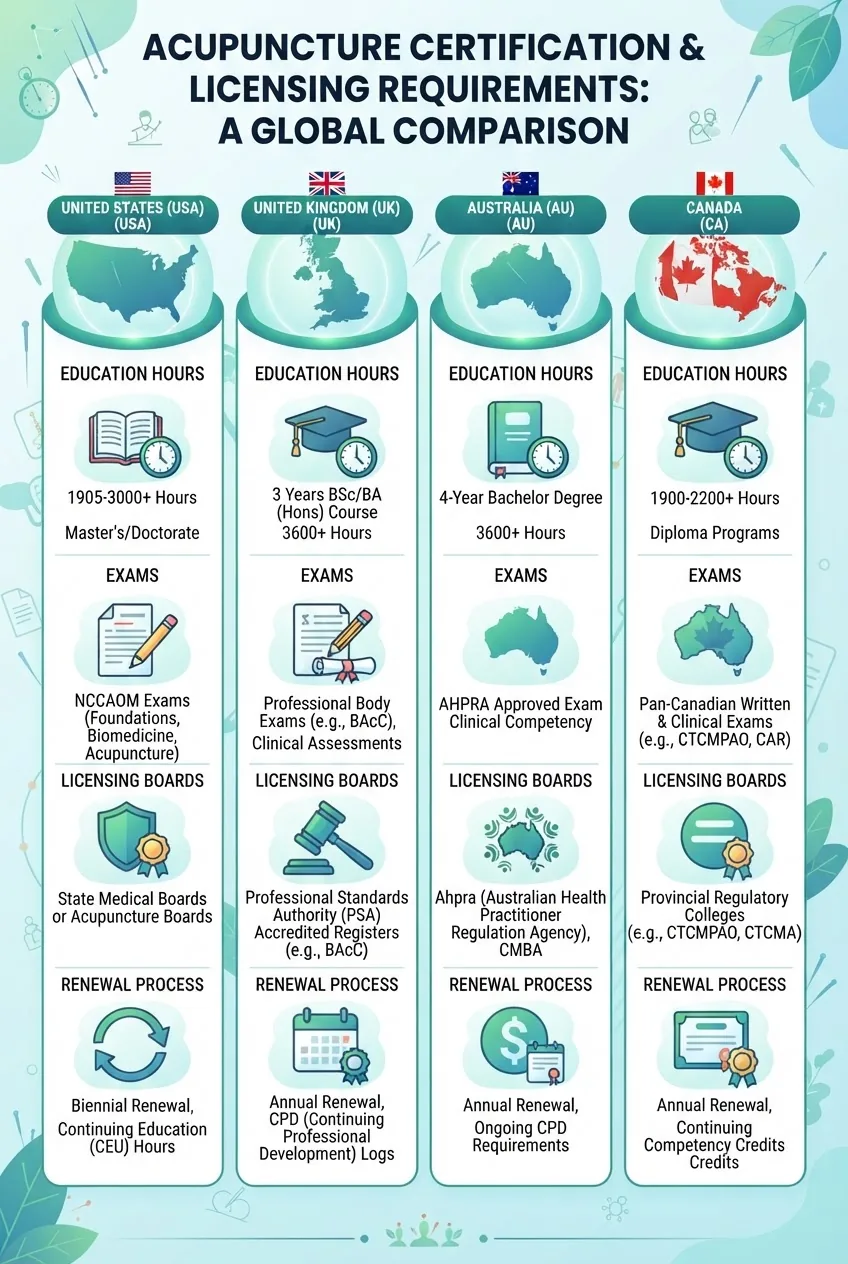
| Region | Education (typical) | Exam / Board | Registration & Renewal |
|---|---|---|---|
| United States | Master’s in Acupuncture (3–4 yrs) or equivalent, 1,000+ clinical hours | NCCAOM certification commonly required; some states have additional exams | State licensure; renewal with CPD, varies by state |
| Australia | Accredited bachelor/master or advanced diploma; clinical placements 500–1,000 hrs | State-based registration; professional associations provide standards | Registration via state boards or associations; ongoing CPD required |
| United Kingdom | Diploma/degree programs accredited by professional registers | Voluntary registers (e.g., the British Acupuncture Council) set standards | Register membership, insurance, CPD, professional indemnity |
| China / Hong Kong | Extensive university-based TCM education; formal clinical apprenticeships | National or regional licensing systems standardise practice | State licensing, continuing education mandated often via state programs |
Key regulatory insights and where to check official guidance:
- In the U.S., search your state medical/health board and NCCAOM for exam pathways; see NCCAOM for certification frameworks.
- In Australia, registration and scope can vary—consult state-based boards and professional associations for approved education lists and scope guidance (source: governmental professional registration pages).
- For international public health policy and traditional medicine frameworks, refer to the World Health Organization’s traditional medicine resources: WHO Traditional, Complementary & Integrative Medicine.
acupuncturist definition and certification requirements provides an expanded jurisdiction checklist and sample application timelines for common regulators.
Registration usually requires proof of education, clinical logbooks, exam results, insurance and criminal background checks; renewal processes typically include verified CPD. When herbal medicine is in scope, additional pharmacist‑level oversight or herbal-specific credentials may be required.
Transition: Having covered regulatory steps, the next section lists the practical clinical and professional skills taught in training programs.
Skills Developed in Acupuncture Training Programs
Question: What practical skills will I learn in acupuncture training? — Answer: Training delivers hands-on needling technique, point location, sterile practice and safety, pulse and tongue diagnosis, treatment planning, manual therapies, documentation, and communication skills required for safe clinical practice.
Core hands-on and professional skills include:
- Needling technique: needle selection, insertion angle, depth control, manipulation and removal.
- Point location and meridian mapping: palpation-based localization and clinical point combinations; use tools such as the 12-meridian charts for study.
- Clinical safety and infection control: single-use sterile needles, sharps disposal, hygiene, emergency response for syncope or adverse events.
- Diagnostic skills: pulse palpation, tongue assessment, symptom pattern recognition and integrating biomedical screening.
- Adjunct therapies: cupping, gua sha, moxibustion, electroacupuncture and auricular protocols.
- Herbal basics: understanding common Chinese herbal drugs and apothecary interactions where herbal prescribing is permitted.
- Documentation and ethics: clinical notes, informed consent, scope boundaries and referral practice.
- Patient education and self-care strategies: acupressure, lifestyle and movement advice (e.g., qigong) to reinforce in-clinic treatment.
Practical resources students use include charts, anatomical atlases, and practice guides; a highly recommended study aid is the 12 meridians chart PDF guide for acupuncture study to master point mapping.
Training emphasises progressive competence: early labs focus on point location on mannequins, mid-clinical placements use peer treatment under supervision, and final placements require independent treatment with instructor oversight. Employers value documented clinical hours and demonstrated soft skills (communication, record keeping).
Transition: With skills clarified, read on for career prospects and how to continue growing as a practitioner.
Career Outlook and Continuing Education for Acupuncturists
Question: What is the career outlook and earning potential for acupuncturists? — Answer: Demand for acupuncture services continues to grow with integrative care trends; earnings vary by region, clinic model and experience—median pay ranges widely, supplemented by private practice income and specialty services; ongoing CPD and niche skills increase earnings and referrals.
Data points and practical advice:
- According to a 2024 industry workforce report, employment for complementary health practitioners including acupuncturists is projected to grow moderately over the next five years as integrative services expand in primary care (source: 2024 industry report).
- Earnings: median earnings depend on country—typical private-practice ranges are modest early in a career and rise with client base, specialties (fertility, sports medicine), and multiple revenue streams (workshops, corporate health contracts).
- Career pathways include private practice ownership, clinic employment, hospital-based integrative roles, research, teaching, and specialist referral networks.
- Specialising in areas with evidence-based demand (e.g., pain, fertility, oncology supportive care) tends to improve referrals and earning potential.
Continuing education strategies that strengthen career prospects:
- Accredit specialty certifications (sports acupuncture, fertility acupuncture).
- Develop referral relationships with GPs, physiotherapists and allied health professionals.
- Publish case reports or small research audits to demonstrate outcomes and credibility.
- Offer patient education workshops and group classes (self-acupressure, qigong) to diversify income.
Practical start-up tips for clinics:
- Budget for initial marketing, insurance, and clinic fit‑out; many new practitioners begin part-time while building caseload.
- Use outcome measures and patient-reported scales to demonstrate effectiveness and improve retention.
Transition: Prospective patients often ask about safety. The following section answers common safety and pain-related concerns succinctly.
Is Acupuncture Safe and What to Expect in Practice
Question: Is acupuncture safe and is it painful? — Answer: Acupuncture is generally safe when performed by trained, licensed practitioners using sterile, single-use needles; brief discomfort can occur at insertion, but serious complications are rare. Expect initial assessment, informed consent, short needling discomfort, and post-treatment mild effects like soreness or fatigue.
Safety evidence: According to a 2022 review of adverse event registries, minor side effects (bruising, transient pain, lightheadedness) are common but self-limiting; serious events (pneumothorax, infection) are rare and associated with improper technique or non-sterile practice (source: peer-reviewed safety review, 2022).
Frequently asked practical points:
- Will it hurt? Expect a quick pricking sensation at insertion; many patients report relaxation or a dull ache known as deqi, which is often therapeutic.
- What should I tell my practitioner? Provide a full medical history, current medications (especially anticoagulants), pregnancy status and prior reactions to needles.
- Contraindications: severe bleeding disorders, uncontrolled epilepsy, or chest needling without advanced training; herbal interactions need pharmacist-level consideration where herbs are involved.
- Aftercare: avoid heavy exercise immediately after treatment if you feel lightheaded; mild soreness may last 24–48 hours.
If you experience unexpected side effects after treatment (severe pain, shortness of breath, fainting that doesn’t resolve), seek emergency care and notify your practitioner. For regulator safety guidance consult national health pages such as NCCIH.
Transition: Final section ties together training, certification and career takeaways to help you commit to the path ahead.
Conclusion: Becoming a Certified Acupuncture Acupuncturist
Question: What are the essential takeaways for someone aiming to become a certified acupuncturist? — Answer: Complete accredited TCM/acupuncture education with required clinical hours, pass jurisdictional exams, register with the local regulator, maintain CPD, and cultivate practical skills in safety, point location and patient communication; specialisation and mentorship accelerate clinical confidence and career growth.
Key action checklist:
- Confirm the regulator and exact education/exam requirements for your target jurisdiction.
- Enroll in an accredited program that includes sufficient supervised clinical hours.
- Document clinical competencies and prepare for board exams or state licensure.
- Pursue mentorship and targeted CPD after initial registration to build a referral-ready practice.
Becoming an acupuncturist bridges traditional Chinese medicine knowledge and modern clinical governance; this guide offers the steps, evidence context and resources to plan training and licensing. If you’re ready to start, review accredited programs and regulator checklists, and map your timeline. Begin with course research and reach out to clinical supervisors to arrange placements—your first clinical hours are the most important investment in safe, effective practice.