
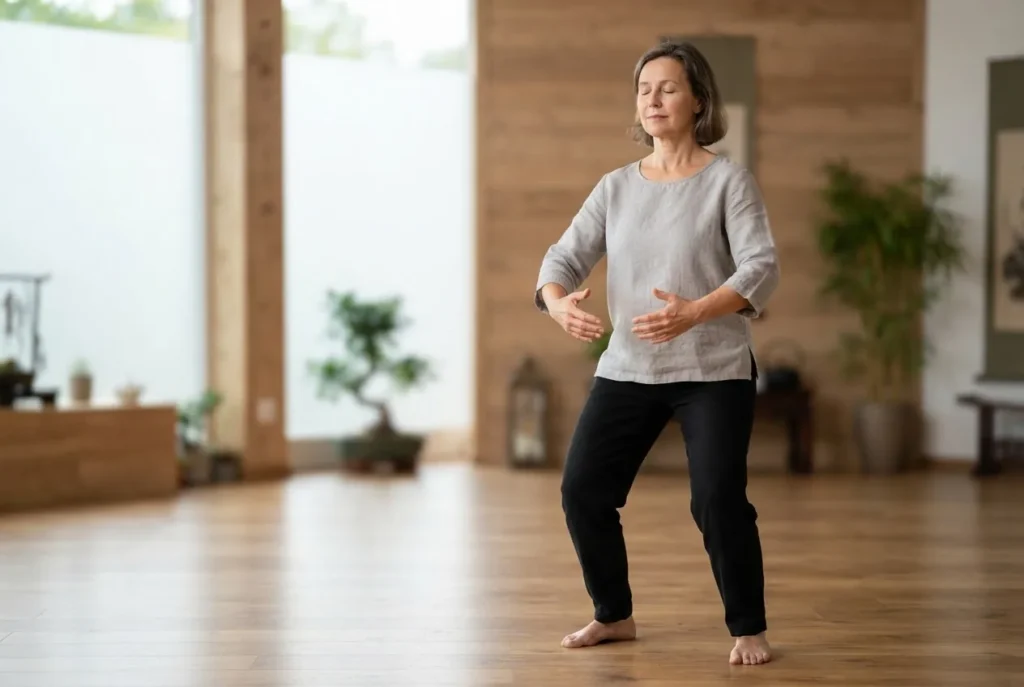
By the end of this hands-on guide you will be able to perform a complete 20–30 minute beginner qigong sequence, understand basic energy (qi) flow concepts, and build a safe daily practice in 4–6 weeks; this assumes you are a total beginner with low to moderate fitness. Start now and expect measurable calm and modest physical gains within 2–6 weeks of consistent practice.
Introduction to Qigong for Beginners
Qigong for beginners is a practical, beginner-friendly combination of breath, posture and slow movement designed to cultivate qi (pronounced “chee”) — the subtle life energy central to Traditional Chinese Medicine (TCM). Think of qi flow like a gentle river: unobstructed it nourishes the body; when it slows or pools, discomfort or tension can follow. This guide gives you a course-style pathway: simple theory, clear step-by-step exercises, a sample routine you can follow immediately, and safety guidance so you build confidence.
You will get: clear definitions, foundational TCM principles, five core breathing techniques, seven beginner movements with timing and alignment cues, a progressive 4-week practice plan, and integration tips for energy therapies like acupuncture. Each exercise includes exact timings (seconds/minutes), recommended repetitions, and traction points to watch so you avoid common beginner mistakes.
What is Qigong? Meaning and Historical Background
Qigong is an umbrella term for a range of Chinese mind-body practices that combine posture, movement, breathwork and focused intention. Historically qigong evolved from martial training, Daoist and Buddhist meditative practices, and the clinical methods of TCM. Classical texts refer to qi cultivation dating back over two millennia; practice forms diversified through agricultural, medical and martial lineages over centuries.
Culturally, qigong sits alongside acupuncture and herbal medicine within TCM as a method to influence the body’s energy systems without needles. In modern times qigong has been taught in community parks, hospitals and research clinics worldwide. Its accessibility — minimal equipment, modifiable intensity — makes it an ideal starting point for people interested in energy therapies and self-regulation.
Transition: With that background, next we look at the core principles that make qigong an energy-cultivating practice and how those principles map onto TCM concepts you’ll actually use in practice.
Core Principles of Qigong and Energy Flow
Qigong rests on a few core principles you should understand before moving into exercises: energy circulation, breath-led movement, alignment and posture, meridian awareness, and mind focus. These principles are practical — they tell you what to feel and adjust during practice.
– Energy circulation: Movements and breath create gentle pressure differences that encourage qi to move through channels. Picture directing a soft current rather than pushing a strong tide.
– Breath-led movement: Breath rhythm sets the pace for movement; inhalation expands the body and opens channels, exhalation grounds and consolidates energy.
– Alignment and posture: Proper alignments (neutral spine, relaxed knees, slightly tucked chin) allow qi to travel without mechanical blockage.
– Meridian awareness: Basic meridian knowledge helps you understand where movement and breath may influence energy flow; you do not need point-level detail to start. For a quick meridian reference, see the 12 meridians chart.
Subtle mental focus directs qi: rather than force, use intention to guide attention to the torso, limbs or an imagined energy centre such as the lower abdomen (the dantian). In TCM terms, balancing yin and yang through even, rhythmic practice stabilises energy circulation and supports organ system harmony.
Transition: Now that you know the framing principles, follow the practical, step-by-step sequence below to learn and integrate the essential movements and breathing techniques.
Basic Qigong Exercises and Movements for Beginners
Before the numbered exercise sequence, read the “Before you start” list below and then move through the numbered steps that follow. Each movement includes exact counts, posture cues and progression notes.
- Space: clear 2m x 2m (6’6″ x 6’6″) area free of obstacles.
- Clothing: loose, breathable garments that allow hip and shoulder movement.
- Surface: firm level ground; barefoot or thin-soled shoes recommended.
- Time: start with 10–15 minutes daily, build to 20–30 minutes over 4 weeks.
- Props: a small cushion to sit on for meditative breathwork if needed.
- Start with a 3–5 minute standing warm-up. Stand with feet hip-width, knees soft, weight evenly distributed. Rotate shoulders gently 8 times each direction; slow neck rolls 6 each way; allow the spine to lengthen and breath to settle. Use diaphragmatic breathing: inhale 4 counts, exhale 6 counts, repeat for 6 cycles. This raises baseline circulation and aligns posture.
- Practice abdominal breathing (dantian focus) for 5 minutes. Place one hand on lower abdomen (2–3 cm below navel). On inhalation for 4 seconds watch the hand rise; on exhalation for 6 seconds watch it fall. Keep chest relaxed. Repeat 6–10 cycles. This breath anchors qi to the lower dantian and builds embodied focus.
-
Begin the core movement set: seven gentle sequences — perform each for 1–3 minutes.
- 1. Standing Awareness (Zhan Zhuang) — 1–3 minutes. Feet parallel, knees soft, tailbone slightly tucked, hands held as if hugging a tree at chest height. Relax jaw and shoulders. Breathe slowly. Keep weight centered. Aim for neutral spine and micro-bend in knees. This builds rootedness and alignment.
- 2. Slow Arm Sways (Opening the Chest) — 1–2 minutes. Inhale as arms sweep forward and up to shoulder height; exhale as they circle down and back to waist level. Keep movements smooth, elbows soft. Coordinate breath: inhale 3 counts, exhale 4 counts. This encourages upper meridian openness.
- 3. Wave Hands Like Clouds — 1–3 minutes. Shift weight slightly side to side while drawing arms in a horizontal, figure-8 pattern at chest height. Pivot the waist subtly, keep knees soft, gaze soft forward. Breathe naturally. This movement links transverse meridians and improves coordination.
- 4. Daoist Spine Stretch (Forward-Back Flow) — 1–2 minutes. Inhale as you lift the chest lightly, exhale as you fold from the hips keeping a straight spine. Return by rolling up vertebra by vertebra. Do 6–10 slow repetitions. This compresses and decompresses front/back channels.
- 5. Brush Knee and Twist — 1–2 minutes. Step one foot forward and gently sink into the stance; sweep the opposite hand across the thigh while the other hand circles near the chest. Alternate sides for 6–10 reps. Keep movement controlled and breath aligned.
- 6. Rubbing the Abdomen (Massage the Dantian) — 1 minute. Circular clockwise rub around the lower abdomen for 30–60 seconds with light pressure to warm the area and stimulate qi circulation. Breathe slowly.
- 7. Closing Posture (Collecting Qi) — 1–2 minutes. Stand feet together, inhale draw arms up slowly, gather imagined energy to chest, exhale bring hands down to dantian, gently press and settle. Visualise energy condensing in the lower abdomen.
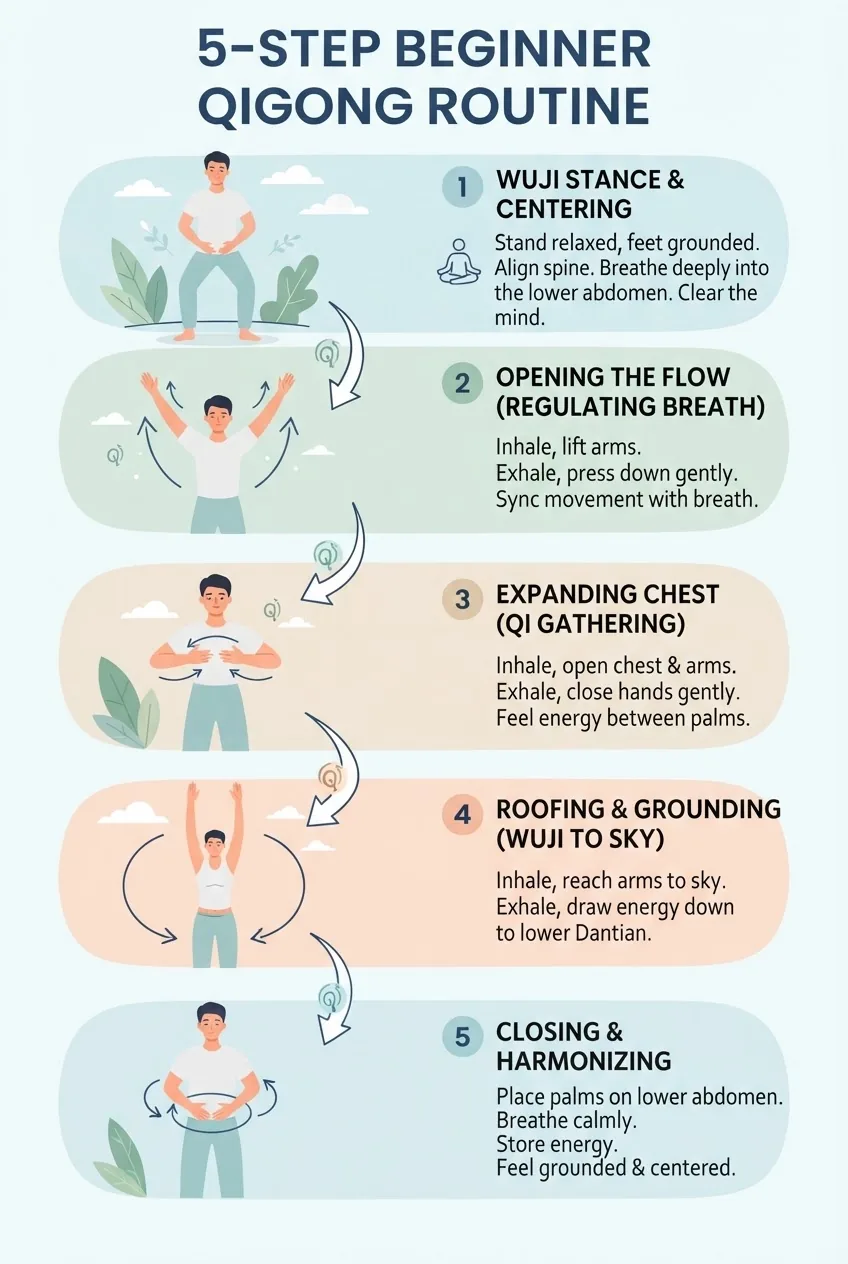
Perform the sequence above as a circuit: move through each of the seven elements with minimal pause between; this creates continuity of breath and energy circulation. For time-constrained practice, complete items 1, 2, 3 and 7 for a 10–12 minute session.
- Add breathwork variations after movement — 5–10 minutes total. Use the following micro-protocol: 4 counts inhale, hold 1–2 counts, 6 counts exhale, pause 1 count. Repeat for 8 cycles. Then do two rounds of alternate nostril breathing (left hand technique) for 3 minutes total to balance lateral channels.
- Finish with a 3–5 minute seated or standing meditation. Sit or stand quietly, hands resting on dantian, eyes lightly closed. Observe breath and sensations without forcing change. If thoughts arise, imagine them moving down the river and away. End by placing palms gently on lower belly for 10–20 seconds to seal energy.
- Track and progress: keep a practice log for 4 weeks. Record date, duration, subjective energy level before and after (scale 1–10), and any physical notes (pain, stiffness). Increase session length by 2–3 minutes each week until you reach 20–30 minutes daily. If you feel dizziness or pain greater than mild discomfort, stop and assess.
Practice frequency: aim for 5–7 sessions per week initially. A realistic target is 4 days per week for beginners building habit. For measurable gains in stress reduction and balance, expect 4–6 weeks of consistent practice. According to a 2023 systematic review in a peer-reviewed journal, regular qigong practice showed moderate improvements in perceived stress and balance in adults (see PubMed search). PubMed: qigong reviews
Breathwork and Meditation in Qigong Practice

Breath is the operational engine in qigong. Here are step-by-step breathing and meditation techniques you can incorporate immediately. Use a quiet space and sit or stand with a neutral spine.
- Practice diaphragmatic breathing (foundation): Sit or stand. Place one hand on chest, one on lower abdomen. Breathe in through the nose for 4 counts so the abdomen rises; exhale through the nose for 6 counts as the abdomen falls. Repeat 8–12 cycles. Keep shoulders relaxed and chest quiet.
- Expand into abdominal counting breath (dantian training): After baseline diaphragmatic breathing, extend inhalation to 5 counts and exhalation to 7 counts for 6 cycles. Visualise breath gathering in the lower abdomen. This slow count encourages parasympathetic activation and anchors qi.
- Practice reverse abdominal breathing (advanced beginner): Once comfortable, try slight abdominal contraction on inhalation and expansion on exhale for 30–60 seconds; stop if lightheaded. This helps tone the lower abdomen and stimulate internal channels.
- Use micro-meditation (3–5 minutes): After breathwork, close eyes softly and observe bodily sensations. Keep attention at the dantian. If a thought arises, label it “thinking” and return attention to breath. This trains the mind to stay with energy sensations and is foundational for guiding qi.
- Finish with grounding breaths: Take three long breaths: inhale 4 counts, exhale 8 counts progressively longer. Place palms on the dantian and feel consolidation of energy.
Practice tips: Always maintain nasal breathing and a soft throat. If you feel light-headed, reduce breath counts and return to natural breathing. For verified safety guidance on breathwork and complementary therapies, see the National Center for Complementary and Integrative Health: NCCIH: Tai Chi and Qigong.
Health Benefits of Regular Qigong Practice
Regular qigong practice produces a range of physical and mental benefits that are well-documented in clinical and observational studies. Below are common outcomes beginners can reasonably expect with consistent practice (4–12 weeks).
- Stress reduction and improved mood: Improved heart rate variability and subjective stress scores are commonly reported. According to a 2022 peer-reviewed randomized trial, participants reported reduced anxiety and improved sleep after 8 weeks of qigong practice (see PubMed search). PubMed: qigong anxiety studies
- Improved balance and mobility: Slow weight shifts and mindful stance work enhance proprioception; clinical trials show reduced fall risk in older adults after regular sessions — improvements visible after 6–12 weeks.
- Circulation and respiratory efficiency: Deep diaphragmatic breathing increases lung capacity and venous return, helping mild cardiorespiratory conditioning.
- Chronic pain and musculoskeletal relief: Gentle stretching and postural correction reduce stiffness and pain intensity in low-back and neck complaints for many practitioners.
- Immune modulation and fatigue reduction: Some small trials indicate improved immune markers and reduced fatigue in chronic conditions following qigong; results vary. According to a 2021 peer-reviewed review, qigong may support symptom management in chronic fatigue syndromes (see PubMed search).
- Complementary pain relief options: For targeted pain, qigong pairs well with acupressure. See related guidance on Abdominal pain acupressure points and knee pain acupressure points to combine strategies for symptom relief.
Evidence and caution: While many trials show positive effects, study designs and populations vary. For broad reviews and clinical evidence, consult peer-reviewed databases: PubMed qigong reviews. For policy perspective on traditional medicine integration, see the World Health Organization’s resources: WHO: Traditional, complementary and integrative medicine.
Starting Your Qigong Practice: Tips for Beginners
Follow these practitioner-proven steps to build a reliable foundation. Each point includes explicit thresholds or timings to guide your progression.
- Commit to short daily sessions: Start with 10–12 minutes daily for week 1–2; increase by 2–3 minutes each week aiming for 20–30 minutes by week 4. Short daily practice beats sporadic long sessions.
- Keep a simple practice log: Note date, duration, perceived energy before and after (1–10), and any pain. Review weekly to measure progress.
- Prioritise posture over range: If you must choose, reduce movement amplitude rather than break posture. Keep knees soft, spine long, chin slightly tucked.
- Use breath counts for pacing: Base movement speed on breath counts (e.g., inhale 4, exhale 6). If you cannot complete the count comfortably, shorten it by 1–2 counts.
- Choose a consistent time and place: Practice morning or evening in a calm corner with minimal interruptions. Aim for the same 10–30 minute window each day to build habit.
- Progress gradually and avoid straining: Increase repetitions by no more than 20% per week. If you experience sharp pain or dizziness, stop and rest; if symptoms persist, consult a clinician.
- Explore further training after mastering basics: Once comfortable with the foundational routine, consider formal education in energy therapies: Qigong healing techniques and training for structured progression.
Transition: Practical safety and common errors are best learned from experienced teachers; below I describe what I see most frequently with beginners and how I correct those issues.
Integrating Qigong with Acupuncture and Energy Therapies
Qigong complements acupuncture and other energy therapies by preparing the body’s energy channels and enhancing patient receptivity to treatment. Practicing before a session can relax tissue, normalise breathing patterns, and make meridians more responsive.
Practical integration suggestions:
- Pre-treatment warm-up: 5–10 minutes of standing awareness and abdominal breathing to settle the nervous system.
- Post-treatment consolidation: After acupuncture, a short seated collection posture (2–4 minutes) helps stabilise sensations and integrate needle effects.
- Home-care routine: Use daily qigong to maintain energy flow between clinical visits, improving treatment longevity and self-management.
- Communication with practitioners: Tell your acupuncturist about your qigong routine; they can align point selection and treatment pacing with your energy work.
For readers interested in professional training that bridges qigong with formal acupuncture education, see the pillar training guide: Acupuncture Acupuncturist Training and Certification Guide
Common mistakes and how to avoid them
I speak from years of teaching beginners: the most frequent errors are mechanical and expectation-based. Below I list the mistakes I observe and exactly how I correct them.
- Rushing the breath: I often see students move faster than their breath. Correction: I instruct them to freeze movement until breath lengthens to the prescribed counts (e.g., inhale 4, exhale 6) — speed follows breath, not the other way round.
- Locking joints: Beginners will over-extend knees and elbows. Correction: I cue “micro-bend” — a 5–10 degree bend keeps joints lubricated and energy flowing.
- Sitting too rigid in meditation: I’ve watched posture turn into bracing. Correction: I move students to a slightly higher seat or use a small cushion so pelvis tilts forward, spine aligns naturally, and relaxation increases.
- Expecting immediate dramatic results: People who want instant change become discouraged. Correction: I set a 4–6 week progress check with quantitative markers (sleep quality, pain scale, stress 1–10) so improvements are tracked and realistic.
- Over-practicing after a good session: After feeling energized some push too hard next day. Correction: I recommend scheduled rest: alternate intensity—longer meditative days and lighter movement days to balance stimulation and recovery.
Checklist: Verify your beginner qigong setup
| Item | Pass/Fail |
|---|---|
| Clear 2m x 2m practice area | [ ] |
| Loose clothing and thin-soled footwear | [ ] |
| Practice log started (date/time/duration) | [ ] |
| Warm-up and dantian breathing completed | [ ] |
| Performed 5–7 core movements with breath coordination | [ ] |
| Session ended with 3–5 minute consolidation | [ ] |
When to call in a professional
Call or consult a qualified practitioner if you experience: sharp or persistent pain after movement, significant dizziness or fainting, newly onset chest pain or shortness of breath, or if you have complex chronic conditions (cardiac disease, uncontrolled hypertension, pregnancy complications). For integration with clinical care or formal energy therapy training, seek accredited professionals.
If you are exploring professional training pathways in acupuncture and related energy therapies, review accredited training options in the field: Acupressure Practitioner Course and Certification Overview
Conclusion
You now have a complete beginner course: core theory of qi and TCM principles, step-by-step breathing and movement practice, a 4-week progression model, and safety and integration guidance. Start with 10–12 minutes daily, use the checklist above, and reassess at 4 weeks. If you want structured study beyond basics, consider formal training in qigong or acupuncture to deepen practice and clinical application. Ready to begin? Commit to two weeks of daily practice and note the changes — small, consistent actions produce reliable energy balance and better wellbeing.