
A Reiki Master is a senior Reiki practitioner who is trained and certified to deliver advanced energy healing, perform attunements that open the practitioner channel, and teach others to become Reiki practitioners and teachers; this role combines clinical healing, teaching, mentoring and stewardship of a Reiki lineage.
What Does It Mean to Define a Reiki Master?
Answer: A Reiki Master is an experienced energy healer and teacher authorised to perform Master-level attunements, deliver advanced healing protocols, and certify other practitioners within a recognised Reiki lineage.
Term: Reiki Master — a certified practitioner who has completed Master-level training and is authorised to teach and attune others in the Reiki system.
Defining a Reiki Master requires attention to three overlapping functions: competency as an energy healer, authority to transmit attunements, and responsibility as a teacher/mentor. Practically, Masters demonstrate:
- Advanced energy channeling ability and confidence conducting multilevel sessions.
- Formal training completion and documented attunements in a specific Reiki lineage.
- Teaching competence: course design, safe initiation practices, and assessment of students.
- Professional ethics: client confidentiality, scope of practice, and referral pathways.
A complete definition ties technical skill (clinical Reiki protocols), relational skill (mentoring and classroom leadership) and custodial responsibilities (preserving and transmitting lineages and standards). Many recognised Reiki federations distinguish between a Master Practitioner (high-level healer) and a Master Teacher (who can certify teachers), so context matters when you interpret the title.

Differentiating Reiki Master from Reiki Teacher and Reiki Instructor
Answer: A Reiki Master combines advanced healing practice and authority to attune and certify; a Reiki teacher focuses on classroom instruction and student certification at specific levels; a Reiki instructor may teach skills without issuing lineage-level attunements depending on training organisation.
Term: Attunement — a ceremonial or energetic initiation that opens or strengthens a practitioner’s channel to work with Reiki energy.
Differentiation depends on certification systems used by training schools and federations. Below is a compact comparison to make the distinctions usable when evaluating courses or credentials.
| Role | Primary Focus | Can Perform Master Attunement? | Likely Tasks |
|---|---|---|---|
| Reiki Master | Advanced healing, attunements, certifying teachers | Yes | Master attunements, curriculum design, mentorship |
| Reiki Teacher | Teaching courses (Levels 1–2), assessment | Sometimes (depends on accreditation) | Teaching students, delivering attunements within scope |
| Reiki Instructor | Skill instruction and supervised practice | Rarely (often limited) | Clinical supervision, skills workshops, practical training |
Key practical distinctions:
- Certification level: Masters hold the highest authorised certification in a lineage; teachers and instructors typically operate within that scope.
- Authority to attune: Masters are generally the custodians who transmit Master attunements; teachers may transmit Level 1–2 attunements depending on accreditation.
- Curriculum ownership: Masters usually design and approve teacher training curricula; teachers and instructors deliver modules under that curriculum.
When choosing training, confirm the issuing organisation, whether the credential is recognised by national Reiki bodies (for example, see the International Center for Reiki Training), and whether the title implies independent certification rights or supervised practice.
External reference: International Center for Reiki Training explains lineage-based differences and credential implications.
Reiki Master Certification Training Overview
Answer: Reiki Master certification typically follows completion of Level 1 and 2, supervised practice, a Master training course (theory, advanced techniques, teaching skills), and one or more Master attunements; certification pathways vary by school and region.
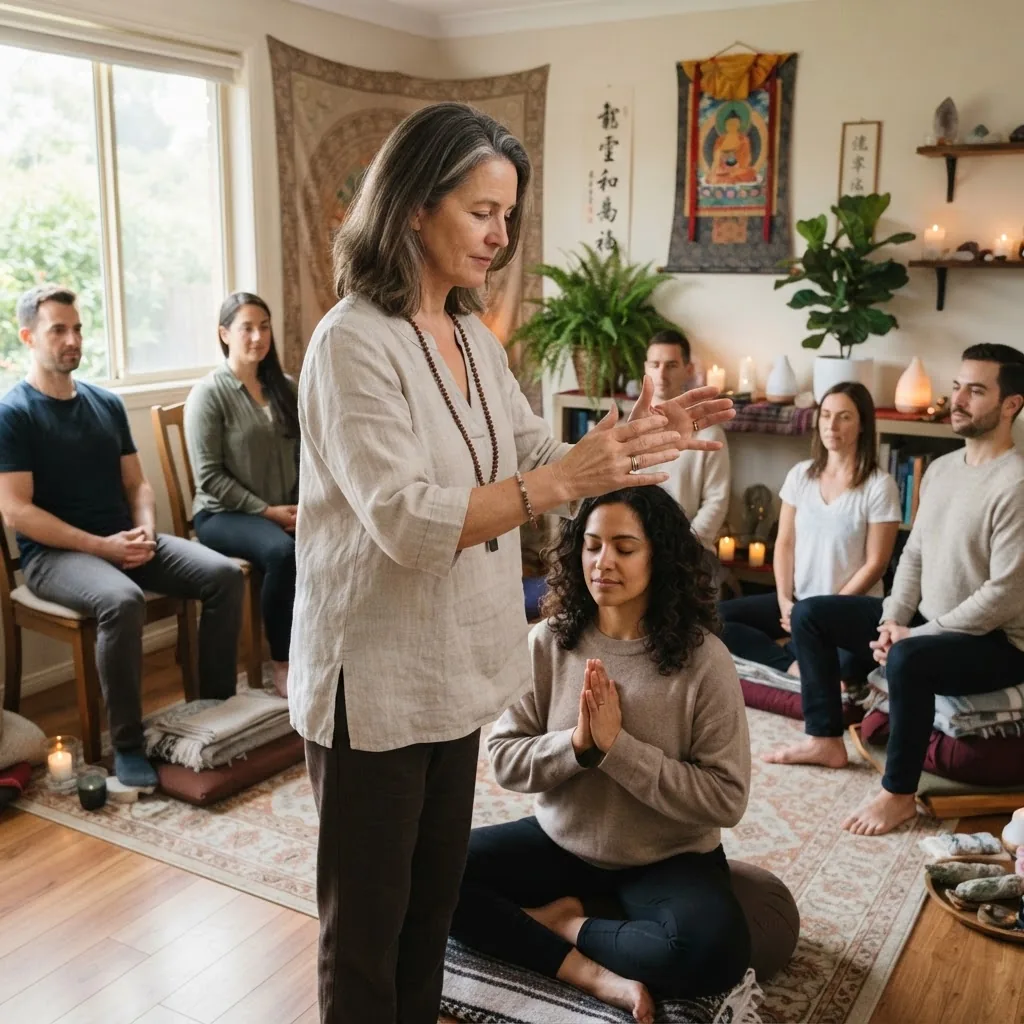
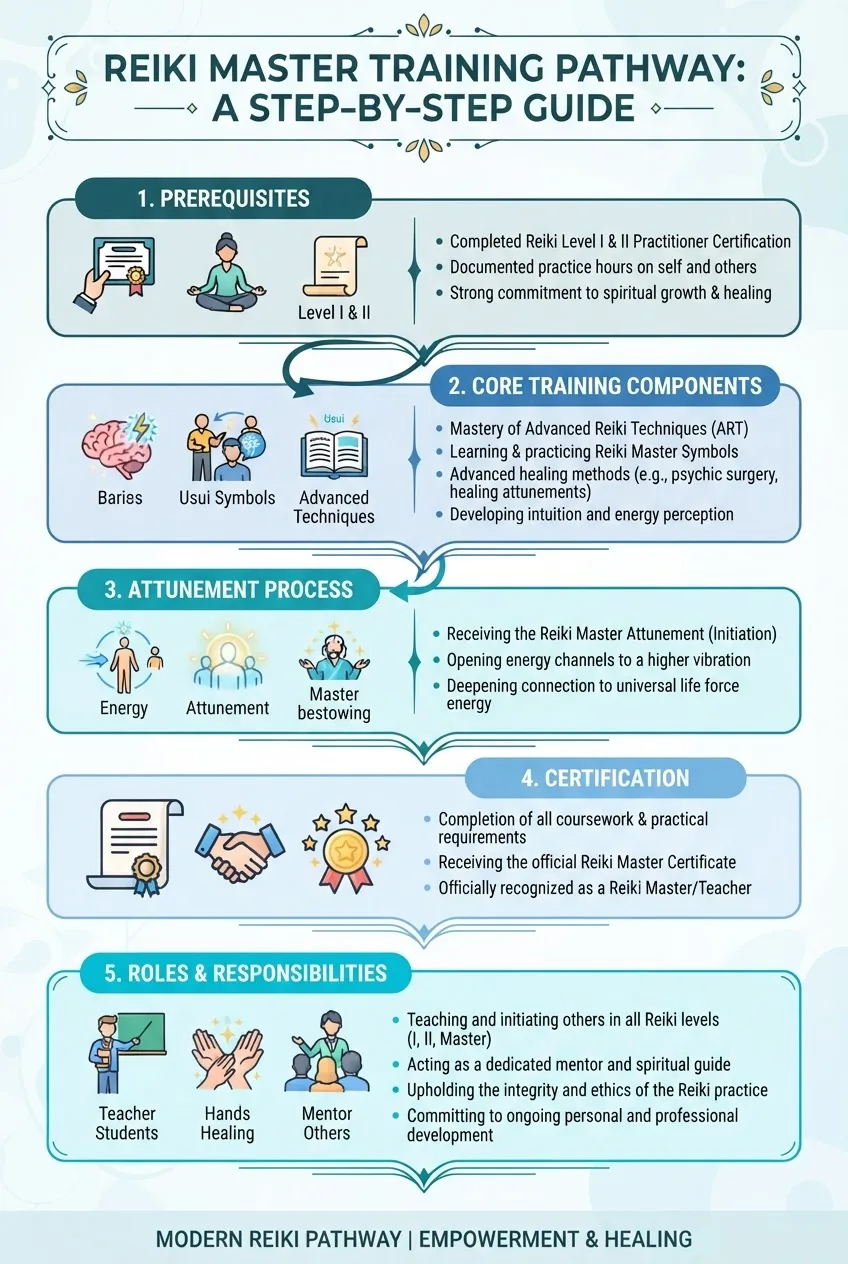
Certification pathways include administrative requirements, curriculum content, practical hours, and lineage confirmation. Below are the typical numbered steps you will encounter; follow-up paragraphs explain variations and local standards.
- Complete Reiki Level 1 (foundational skills and self-healing).
- Complete Reiki Level 2 (distance healing, symbols, clinical practice).
- Accumulate supervised practice hours as a practitioner.
- Enroll in a Reiki Master training course that includes pedagogy and attunement protocols.
- Receive Master attunement(s) and complete required practical assessments.
- Submit documentation to your training school or recognised Reiki body for certification.
- Engage in continuing professional development (CPD) and mentorship post-certification.
Certification timelines and content differ across organisations: some Master courses are delivered intensively over a weekend plus mentorship, while others run across months with multiple attunements and supervised teaching practicums. According to a 2024 industry report from a major energy therapy association, most reputable programs require practical client-hours and evidence of teaching competency before full Master certification.
Practical notes for Australian candidates and international students:
- Expect regional variation in how the title “Master” is regulated; Australia commonly relies on training organisation standards rather than statutory licensure.
- Carefully review the issuing school’s lineage statement and who provides the attunement.
- Seek courses that include ethics, scope of practice, and clinic supervision modules.
Useful course and reference cross-links:
Acupuncture Acupuncturist Training and Certification Guide
Abdominal Pain Acupressure Points Guide
Acupressure Knee Pain Points Training
Acupressure Points in Ankle Chart
Reiki Healing Techniques Course and Practitioner Training
Acupuncture for Back Pain Treatment Guide
Certification standards and bodies: many credible Master programs align with national or international Reiki associations and require documentation of lineage and student assessment. For historical context and lineage guidance, consult traditional sources such as the International Center for Reiki Training and published lineage histories. External authority: International Center for Reiki Training.
Prerequisites for Reiki Master Training
Answer: Typical prerequisites include successful completion of Reiki Levels 1 and 2, documented practitioner experience, demonstration of ethical practice, and sometimes minimum client-hours or mentorship completion.
- Completion certificates for Reiki Level 1 and Reiki Level 2.
- Minimum practical hours as a practicing Reiki practitioner (commonly 50–200 hours depending on school).
- Demonstrated competency in core techniques, symbols, and distance healing.
- Letter of recommendation or verification from your teacher/mentor in some programs.
- Commitment to abide by a code of ethics and professional scope of practice.
Core Components of Reiki Master Training
Answer: Master training combines advanced energy channeling, clinical protocols, teaching skills, lineage study and ethics; modules typically include pedagogy, business considerations, and supervised teaching practica.
Central curriculum elements commonly include:
- Advanced energy channeling and guided multi-person session formats.
- Advanced healing techniques and protocols (e.g., Master-level symbols and protocols).
- Teaching and assessment skills (lesson planning, student assessment, safe initiation).
- Reiki history, lineage study and ethics in energy work.
- Business setup, insurance, and professional boundaries for running classes and clinics.
Sub-bullets for classroom and clinic components:
- Practicum: supervised student teaching with feedback and assessed attunement demonstrations.
- Mentoring: one-to-one mentoring sessions focused on clinical judgment and teaching presence.
- Assessment: written or practical exams, case-study submissions, and documented client outcomes.
Attunement and Energy Alignment Process
Answer: The attunement is a guided energetic initiation where a Master aligns the student’s energetic channel to Reiki frequency; it usually follows preparation, the attunement ritual, stabilization exercises and follow-up practices.
Term: Attunement — an energetic initiation performed by a Master to open and stabilise a student’s connection to Reiki energy.
A concise attunement process:
- Preparation: grounding, intention setting, and clearing (10–20 minutes).
- The Master performs a sequence of ritualised placements, visualisations and symbol transmissions (20–60 minutes).
- Stabilisation: guided breathing and simple self-treatment to integrate the energy (10–20 minutes).
- Integration plan: home practice, journalling, and mentor check-ins scheduled over weeks.
Practitioners report variable subjective experiences—energy sensations, heat, emotional release or quiet clarity—and Masters monitor safety and aftercare. A step-by-step practitioner walkthrough later in this article provides a practical example from training practice.
Roles and Responsibilities of a Reiki Master
Answer: A Reiki Master is responsible for providing advanced healing, performing Master attunements, teaching and assessing students, mentoring practitioners, upholding ethical standards, and maintaining lineage integrity and client safety.
Role responsibilities cluster into three domains:
- Clinical healing: delivering one-to-one and group sessions, maintaining records, referral to healthcare when needed.
- Teaching and certification: designing courses, assessing students, issuing certifications, and supervising attunements.
- Mentorship and stewardship: modelling ethics, preserving lineage teachings, offering ongoing CPD and community leadership.
Real-world examples:
- Healing scenario: A client with chronic tension presents for treatment; a Master integrates Reiki with breathwork and guided relaxation, documents session outcomes, and refers to allied health when structural issues are suspected.
- Teaching scenario: A Master runs a Level 1 weekend and assesses student safety practices before issuing completion certificates; they schedule supervised clinic hours for students and set clear scope-of-practice limits.
- Mentoring scenario: A recently certificated teacher requests feedback on delivering attunements; the Master provides observed practice, reflective feedback and a remediation plan for safe attunement delivery.
Case study/testimonial (anonymised): “After completing Master training, I ran my first teacher training with a mentor present; within six months my student retention and clinical outcomes improved.” — graduate testimonial, 2023 cohort, Soul Body Mind training outcomes. This reflects a common training outcome where structured mentorship increases practitioner confidence and professional readiness.
Ethics and client safety:
- Maintain client confidentiality and informed consent for every session.
- Clearly communicate Reiki as a complementary therapy and not a substitute for medical care; include referral pathways.
- Keep records of client sessions, outcomes and any adverse reactions.
- Abide by continuing education and supervision requirements to ensure competence.
Research context: Several peer-reviewed studies and reviews discuss Reiki’s effects on relaxation and wellbeing; for clinical claims always reference systematic reviews or PubMed-indexed research before making outcome promises to clients. Example resource: energy healing research.
Career and Personal Development as a Reiki Master
Answer: Career development as a Reiki Master involves building a client base, expanding modalities (e.g., acupressure, qigong), engaging in continuing education, and developing teaching and business skills to run courses or clinics professionally.
Practical steps to grow professionally:
- Offer a mix of private sessions, group clinics and introductory workshops to diversify income streams.
- Integrate complementary skills—consider an Acupressure Practitioner Course and Certification Overview to expand manual energetic skills.
- Collect testimonials, anonymised case studies and measurable client outcomes to demonstrate effectiveness.
- Maintain CPD via workshops, supervised practice and peer networks to satisfy training organisation standards.
- Develop clear service contracts, pricing, and skills-based packages; refer medically complex cases to appropriate health professionals.
Building a client base:
- Offer discounted introductory sessions and structured beginner course bundles.
- Partner with allied health clinics (e.g., naturopathy, psychology, physiotherapy) for cross-referrals.
- Publish content (blogs, short videos) explaining clear benefits and what to expect in sessions.
Continuing education and professional development:
- Attend advanced workshops on trauma-informed energy work, ethics, and teaching methodologies.
- Complete supervised teaching practicums and peer-review sessions annually.
- Expand into related energy systems (for example, Qigong or acupressure) to broaden clinical options and credibility—see the Acupressure Practitioner Course and Certification Overview for cross-training ideas.
Personal development:
- Maintain daily self-practice, journalling and supervision to manage energetic boundaries.
- Engage in reflective practice: case reviews, peer supervision and feedback loops.
- Accept that confidence as a Master builds over time through practice and mentoring, not only through credentialing.
Reiki Master Certification in Context of Acupuncture and Energy Therapies
Answer: Reiki Master certification complements acupuncture and other energy therapies by offering non-invasive energetic approaches, and it can be integrated with acupuncture protocols where scope, training and client consent permit.
Comparative observations:
- Complementary modalities: Reiki is a hands-on or hands-above technique focusing on energetic balancing; acupuncture acts on meridian pathways with needles—both aim to restore energetic equilibrium.
- Scope and training: Acupuncture requires formal statutory or accredited training in many jurisdictions; Reiki certification is typically issued by training organisations and professional associations, with variability in requirements.
- Integration in practice: Many practitioners combine Reiki with acupuncture or acupressure for relaxation and to support treatment outcomes; always document informed consent and safety protocols.
Practical cross-over references for Reiki Masters training in complementary energy therapies:
- 12 Meridians Chart PDF Guide
- Acupuncture for Back Pain Treatment Guide
- Healing Modalities Guide and Energy Medicine Training Overview
From a safety and standards perspective, acupuncture and regulated modalities often require clinical licensing; Reiki operates as a complementary therapy and practitioners should clarify scope. According to a 2023 energy therapy association guideline, collaborative practice agreements improve client outcomes when integrating modalities.
Summary and Next Steps to Becoming a Reiki Master
Answer: To become a Reiki Master, complete Levels 1 and 2, gain supervised practice, enrol in a Master course, receive Master attunement(s), satisfy your training body’s requirements, and commit to ongoing mentorship and CPD.
- Confirm prerequisites (Levels 1–2 certificates and practice hours).
- Evaluate Master courses for lineage, assessment methods and mentorship offerings.
- Ensure the course includes teaching skills, ethics and supervised practicum.
- Plan a timeline: many candidates complete Master training within 6–12 months with part-time study.
- Budget realistically: costs vary widely—check course inclusions, mentorship hours and certification fees.
- After certification, pursue CPD and consider integrating complementary skills such as acupressure or qigong to broaden your practice.
Next step: choose a course with clear lineage documentation, supervised teaching opportunities, and active mentorship to transition smoothly from practitioner to Master and teacher.