

By the end of this hands-on guide you will have a practical, day-by-day plan for improving mental and emotional wellness, a set of 12 reproducible self-care routines, and clear thresholds for when to seek professional help. Expect to spend 20–45 minutes per day for at least 6–8 weeks to notice measurable change; this guide assumes a beginner to intermediate skill level in self-directed wellbeing work.
Before you start
- Time: 20–45 minutes daily; set an initial 8-week commitment.
- Tools: notebook or journal, timer (or smartphone), quiet space, exercise shoes, basic mindfulness audio (5–15 minutes).
- Materials: water bottle, calendar or habit tracker, emergency contact list, access to local health services if needed.
- Baseline: record your current mood, sleep hours, and energy level for 7 days before starting.
-
Start by defining core concepts.
Understanding Mental Health: Definitions and Importance
Mental health tips are practical actions you take to protect and strengthen thinking, mood and behaviour patterns. To use them effectively you first need clear definitions: mental health refers to cognitive function, emotional regulation, and behavioural patterns that allow a person to function and adapt. Mental and emotional health definition differentiates mental processes (thinking, attention, decision-making) from emotional processes (feeling, mood, emotional responses).
Good mental health does not mean the absence of difficulty. A person who is mentally healthy can manage stress, maintain relationships, and pursue goals. A person who is mentally stable has steady functioning under routine and predictable stressors; stability emphasizes consistent baseline functioning while health includes growth, resilience and purpose. Below is a concise comparison to clarify differences that often confuse readers.
Term Practical meaning Everyday indicator Mental health Cognitive and emotional function allowing growth and resilience Maintaining routine, problem-solving, mood flexibility Mental stability Consistency of baseline functioning under normal stress Predictable sleep, steady mood, reliable performance Psychosocial well-being is the interaction between social environment and psychological health: relationships, work, and community resources directly influence mental outcomes. For supporting evidence on prevalence and impact see mental health facts and statistics.
Frameworks often used in practice include cognitive behavioural therapy (CBT) basics—identifying thoughts, testing evidence, and changing behaviours—and public health models that emphasise prevention and social supports. Australian Department of Health guidance summarises common protective practices and local service navigation (government resource).
Practical takeaway (do this today): write a single-sentence definition of what “good mental health” looks like for you, and record three daily behaviors that would show progress. Track them for seven days.
-
Map the value to your daily life.
Why Mental and Emotional Health Matter for Overall Wellness
Mental and emotional health shape how you sleep, move, relate and work. Emotional wellbeing and mental health are tightly linked: mood affects concentration, and thinking patterns shape feelings. Improving both reduces sick days, improves relationships and increases life satisfaction.
Physiologically, chronic poor mental health influences hormones, sleep architecture and immune function. According to a 2023 WHO report, mental disorders are among the leading causes of disability worldwide (international health report). The mind-body link is measurable: improved mood correlates with lower cortisol and better sleep efficiency in controlled studies—evidence that small routine changes create measurable body changes.
Concrete examples:
- If you improve sleep by 60 minutes per night over 4 weeks, expect improved concentration and reduced irritability within 2–3 weeks.
- Adding 20–30 minutes of moderate exercise three times per week raises baseline mood and reduces anxiety symptoms for many people within 3–6 weeks.
To better understand the role of stress in these chains, read about common stressors and health impact.
Use the mind-body health connection to plan interventions—sleep, movement, nutrition and social contact are tangible levers. For an integrated primer on how physical states interact with mental states see mind-body health connection.
Practical takeaway (do this week): pick one physiological lever (sleep or exercise), set a measurable target (sleep +45 minutes or walk 20 minutes five days), and measure mood change weekly using a simple 1–10 scale.
-
Build a daily toolkit of evidence-based actions.
Practical Mental Health Tips for Daily Life

This section lists reproducible, time-bound tips you can apply immediately. Each item includes how long it takes, frequency, and immediate measurable outcomes. For focused stress methods see stress relief tips, and for situational flare-ups see episodic stress management.
-
Journal for clarity — 10 minutes daily.
Write one morning page: 3–5 sentences about how you feel, one prioritised task, and one positive observation. Track mood pre/post with a 1–10 scale. Practised for 21 days this stabilises mood and highlights cognitive patterns.
-
Practice mindful breathing — 5–10 minutes twice daily.
Sit comfortably, set a 5-minute timer, breathe in for 4 counts, hold 2, out for 6. Repeat. This reduces physiological arousal and helps emotion regulation. For a full walkthrough see the mindfulness technique example later in this article.
-
Move: 20–30 minutes of moderate exercise, 3–5× per week.
Choose brisk walking, cycling, or a bodyweight circuit. Aim for 60–70% of max heart rate (220-your age * 0.6–0.7). Track sessions and energy before/after to confirm benefit.
-
Sleep hygiene checklist each night — 15 minutes preparation.
Consistent bedtime, screen off 30 minutes before sleep, cool dark room (18–20°C). If adding 45 minutes of sleep, measure daytime alertness. Small gains in sleep equal outsized mental benefits.
-
Set one healthy boundary per day.
Say “no” to an extra task or set a work cut-off time. Practise a 30-second phrase that is polite and firm. Boundaries protect psychosocial well-being and reduce burnout.
-
Connect socially — 2 meaningful interactions per week.
Schedule a 30–60 minute call or meet-up. Quality matters more than quantity; aim for active listening and curiosity. Social support predicts resilience in longitudinal studies.
-
Practice cognitive check-ins — 10 minutes twice weekly.
Use a CBT-style worksheet: identify a negative thought, list evidence for and against, generate an alternative thought. Track distress level before and after the exercise.
-
Use behavioural activation — plan one pleasurable and one meaningful activity weekly.
Pleasurable = immediate enjoyment (e.g., hobby); meaningful = aligned with values (e.g., volunteering). Behavioral activation combats low mood by reinstating positive reinforcement.
-
Micro-rests — 5-minute resets every 90 minutes.
Stand, breathe, stretch, and look away from screens. Short rests prevent decision fatigue and preserve mental clarity over the day.
-
Limit stimulants after 2pm and alcohol near bedtime.
Set a caffeine cutoff and moderate alcohol intake. Sleep and mood improve when these habits are timed to avoid sleep disruption.
-
Practice gratitude — 2 items nightly.
Write two small things that went well. This is quick (2–3 minutes) and reliably increases positive affect over weeks.
-
Plan a monthly ‘mental health day’.
Use one full day per month for restoration: no work, restorative activities only, and limited obligations. See the Self-Care Techniques section for exact mental health day tips.
Real-life scenario: a client I coached introduced a 10-minute evening journal and night routine. Within three weeks sleep duration rose by 40 minutes and daytime irritability dropped from 7/10 to 4/10. Consistency and measurement were the keys.
-
Journal for clarity — 10 minutes daily.
-
Pair emotional healing practices with mental routines.
How to Improve Emotional Wellness Alongside Mental Health
Emotional wellness is about identifying, expressing and integrating feelings. To heal yourself mentally and emotionally, follow stepwise actions that combine internal work with social repair.
Step-by-step actionable plan:
-
Identify emotions daily — 3 times per day.
Pause and name the primary emotion in one word (e.g., tired, anxious, hopeful). Naming reduces intensity by engaging the prefrontal cortex. Keep a simple log: time, trigger, intensity 1–10.
-
Practice acceptance and label sensations — 5 minutes.
When emotions are strong, note bodily sensations (tight chest, shallow breath). Breathe into those sensations for three cycles, then re-evaluate intensity.
-
Express safely — 15–30 minutes weekly.
Write a letter (unsent), speak with a trusted friend, or use creative arts (drawing, music) to express feelings. Expressive practices lower rumination and aid processing.
-
Use structured processing — 20–40 minutes weekly.
CBT and acceptance and commitment therapy (ACT) techniques work here. For example, use ‘thought record’ templates to process a distressing event, then plan a value-aligned action for the coming week.
-
Repair relationships actively — as needed.
When interpersonal issues are present, prepare a short script for honest conversation: state observation, share feeling, request change. Practise role-play if anxious.
For additional techniques and exercises, see emotional wellness resources and emotional health improvement tips.
Example walkthrough — 7-minute mindfulness for emotional regulation:
- Find a seat and set a 7-minute timer.
- Body scan (1 minute): notice feet, legs, torso, shoulders, face.
- Breath anchor (3 minutes): follow the breath at the nostrils; if distracted, note “thinking” and return.
- Emotion naming (2 minutes): bring to mind a recent strong feeling, name it, notice sensations, breathe into them.
- Closure (1 minute): set an intention for one small action you will take to support yourself after the exercise.
Real-life scenario: a workshop participant who practised this 7-minute routine for two weeks reported a drop in reactive arguments and a clearer sense of priorities; they scheduled the practice daily at 9pm and used a timer to track adherence.
-
Identify emotions daily — 3 times per day.
-
Create a stable, protective lifestyle base.
Self-Care Techniques That Support Mental Stability
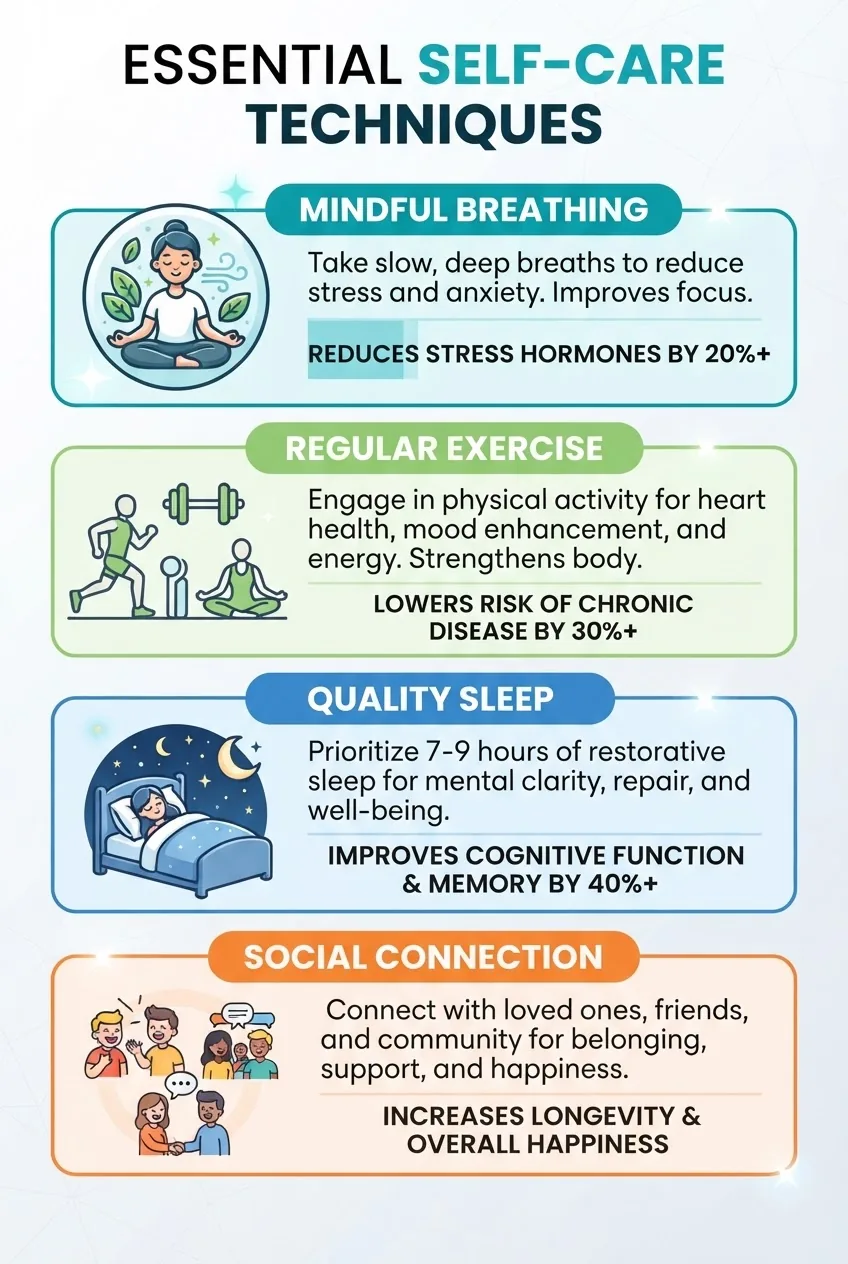
Self-care techniques form the baseline that makes targeted mental health practices effective. Use the following lifestyle practices as non-negotiable supports.
- Sleep: 7–9 hours nightly for adults; consistent bedtime within a 60-minute window.
- Nutrition: regular meals with protein + vegetables; avoid long fasting that increases stress hormones.
- Movement: 150 minutes of moderate activity weekly; split into 20–30 minute sessions.
- Boundaries: daily work cut-off and one phone-free hour before bed.
Short actionable tips (mental health day tips and how to work on yourself mentally):
- Mental health day template: 8–9 hours sleep, 30 minutes movement, 2 hours of restorative hobbies, 1 social connection, nutritious meals, phone-free evening.
- Weekly review: 15 minutes Sunday to review goals and set one achievable focus for the week.
- Emergency toolbox: list of 6 quick resets (5-minute breath, call a friend, short walk, grounding exercise, music playlist, journal prompt).
Trade-offs and pros/cons: mindfulness is low-cost and quick to learn but requires regular practice for lasting benefits. Exercise improves mood and sleep but needs physical capacity and time. Social connection is high-impact but depends on available supportive relationships. Choose a mix that fits your capacity and test for 6–8 weeks.
-
Recognise common pitfalls and where to intervene early.
Common Challenges and How to Fix Mental Health Issues
Common pitfalls include avoidance, inconsistent routine, over-reliance on substances, and isolated coping. Fixes combine short-term stabilisers and longer-term growth work: immediate behavioural activation, sleep restoration, and seeking structured therapy when needed.
If you suspect underlying, subtle issues such as unrecognized stress symptoms are present, begin a 7-day symptom log: note energy, sleep, appetite, concentration and mood twice daily. If patterns persist or worsen, escalate care.
When to combine self-help with professional care:
- If distress is severe (suicidal thoughts, self-harm), contact emergency services and crisis lines immediately.
- If daily functioning drops for 2+ weeks despite consistent self-care, see a GP or mental health professional.
- If medication or structured psychotherapy may be beneficial, consult a psychiatrist or clinical psychologist.
For details on the physical consequences and why prompt care matters, see Physiological effects of poor mental health.
Practical short fixes:
- Stabilise sleep for two weeks: aim for 7–9 hours; track wakefulness and mood.
- Begin 10-minute morning and evening routines: journal + 5-minute breath in morning; gratitude + wind-down in evening.
- Schedule one weekly social contact: phone or coffee to reduce isolation.
- If worry dominates, use a 15-minute worry period: set a timer, write worries down, then defer further rumination until the next scheduled worry period.
Resources and authority: Australian clinical practice guidelines and WHO resources offer screening and referral pathways—see the reliable sources below for recommended next steps. WHO mental health information (international organisation) and Australian Department of Health (government resource) provide evidence-based referral guidance.
-
Consolidate gains and prepare for long-term resilience.
Summary and Continuing Your Mental Health Journey
This guide gave you operational definitions, the “why” linking mental and physical systems, and a stepwise toolkit of daily, weekly and monthly practices to improve emotional wellbeing and mental stability. Remember, good mental health is measurable: improved sleep, reduced reactive episodes, and more consistent energy.
To revisit the upside of sustained practice, review benefits of good mental health.
Final practical checklist you can verify now:
- Have you tracked baseline mood and sleep for 7 days?
- Can you complete a 5–10 minute mindfulness practice daily?
- Are you moving 20–30 minutes at least 3× per week?
- Do you have one weekly meaningful social connection scheduled?
- Is there a designated monthly mental health day in your calendar?
Consistent, measurable actions produce steady gains. Start small, track reliably, and adjust after four to eight weeks.
When to call a professional: if symptoms persist beyond two weeks despite consistent application of these practices, or if there are signs of severe distress (suicidal ideation, severe functional decline), seek a GP, clinical psychologist, or local crisis service immediately. For structured psychotherapy approaches like CBT, consult accredited providers; for medication assessment see a psychiatrist.
Practical closing CTA: choose one practice from the checklist and commit to it for the next 14 days. Track your outcomes and, if you want structured guidance, consider a guided program or consultation.
Common mistakes and how to avoid them
I’ve seen people start enthusiastically and then drop out because they tried to change too many things at once. I once coached a client who attempted daily journaling, hour-long workouts, and a full digital detox simultaneously; adherence collapsed after four days. Solution: pick one manageable habit (10–20 minutes) and secure it for 21 days before adding another. I also observed clients confuse mood swings with long-term decline; tracking objective markers (sleep, activity, mood ratings) for two weeks prevents premature escalation or unnecessary self-criticism.
Checklist: Verify your plan
- Baseline recorded: mood and sleep for 7 days.
- Daily practice scheduled (5–15 minutes minimum).
- One weekly movement session and one social contact scheduled.
- Monthly mental health day blocked in calendar.
- Emergency contacts and local health services listed.
When to call in a professional
Call a GP, clinical psychologist or local crisis line if you experience suicidal thoughts, severe functional decline, self-harm urges, psychosis, or if consistent self-care over two weeks produces no improvement. For therapy options like CBT, consult accredited practitioners; for medication and complex cases, see a psychiatrist.