An ayurvedic practitioner is trained in classical Ayurvedic diagnosis and treatment, combining herbal medicine, diet, lifestyle and therapies; becoming one requires formal study (diploma or degree), supervised clinical hours, recognised certification and adherence to local legal scope of practice. This guide maps pathways, accreditation and career options.
Introduction to Ayurvedic Practitioner Roles and Titles
Answer: Ayurvedic practitioner roles vary from wellness therapists to medically trained ayurvedic medical doctors; roles depend on education, registration and jurisdiction, with distinct scopes of practice between holistic practitioners and licensed medical doctors trained in Ayurvedic medicine.
Term: Ayurvedic practitioner — a health professional trained in Ayurvedic theory and therapies who offers assessment and non-invasive treatment; they may or may not hold a medical (MD/BSAM) qualification.
Term: Ayurvedic medical doctor — a clinician who has completed a recognised medical degree in Ayurveda (for example, BAMS in India) and holds the authority to diagnose, prescribe and manage medical conditions under local law.
Practitioner titles you will encounter include:
- Ayurvedic therapist/consultant: Typically trained in certificate or diploma programs focused on lifestyle, diet and external therapies (massage, Shirodhara).
- Ayurvedic practitioner/diploma graduate: Holds a diploma or advanced diploma enabling independent consultation in many jurisdictions, within complementary health scope.
- Ayurvedic medical practitioner / BAMS (Bachelor of Ayurvedic Medicine and Surgery): A primary care medical qualification common in India and recognised as a medical degree there.
- Registered or certified practitioner: May hold membership of a professional association or certification body that provides codes of practice and CPD requirements.
Many patients search for practitioners who can provide both “Ayurveda for wellness benefits” and clinically-informed herbal guidance; expect to clarify scope of practice, especially where integration with Western medical care is needed. Below is a short case-study excerpt illustrating title differences.
Case summary (practitioner titles): A Melbourne clinic employed a diploma-level Ayurvedic practitioner for diet and lifestyle consultations and an on-call BAMS-qualified Ayurvedic medical practitioner (visiting teleconsultation) for complex cases requiring prescription Ayurveda medicines. The arrangement reduced referrals to GPs by 18% over 12 months while maintaining safety protocols.
Transition: The next section maps the education and training routes that lead to each title, from short certificates to full medical degrees.
Overview of Ayurvedic Practitioner Training Pathways
Answer: Training pathways range from short certificates and diplomas to full medical degrees (e.g., BAMS), with clinical internships, supervised practice hours and elective specialisations; online courses exist but practical training and supervision remain essential for clinical competence.
Term: Diploma in Ayurveda — a post‑secondary qualification focused on clinical consultation, herbal therapeutics, basic anatomy and external therapies, generally requiring practical placement for clinical hours.
-
1. Short courses and certificates (3–12 months)
These programs introduce fundamental Ayurvedic concepts (dosha theory, basic herbal use, Ayurvedic diet). They are suitable for allied wellness workers and therapists; clinical authority is limited and varies by jurisdiction. Many online certificates provide theoretical learning but require local supervised practice to develop hands-on skills.
-
2. Diploma and advanced diploma programs (1–2 years)
Diploma-level training combines theory with practical internships and supervised consultations. Graduates are often eligible to practise as complementary health clinicians, offering consultations, dietary plans, herbal recommendations and non-invasive therapies. Clinical placement hours are commonly required (100–500 hours depending on the program).
-
3. Undergraduate professional degrees (3–5 years)
Examples include Bachelor programs in Ayurvedic studies offered by universities in some countries; these provide in-depth training in Ayurvedic diagnostics, pharmacology, anatomy and supervised clinical practice. Graduates may work in integrative clinics or pursue post-graduate clinical specialisations.
-
4. Medical degrees (BAMS/MD in Ayurveda) (5–6 years)
These are professional medical qualifications (commonly in India and some South Asian countries) combining Ayurveda with modern medical subjects. Holders are Ayurvedic medical doctors with authority to diagnose and prescribe across a broader medical scope in jurisdictions that recognise them.
-
5. Postgraduate and clinical specialisations (1–3 years)
Includes Master’s degrees, clinical residencies in Panchakarma, Ayurvedic obstetrics, geriatrics and research degrees (MPhil/PhD). Postgraduate clinical training often demands supervised casework and research projects.
-
6. Online learning with blended clinical practice
Many reputable providers offer online theoretical modules plus mandatory in-person practicum. For safe clinical practice, ensure the program documents supervised clinical hours and local mentorship; online-only certificates without clinical assessment should be treated as introductory.
-
7. Clinical internships, supervised practice and mentorship
Clinical competence requires supervised consultations, pulse and tongue diagnosis practice, formulation writing and observed Panchakarma procedures. Expect internships (200–1000 hours) for diploma and degree pathways; regulated medical programs have formal residency requirements.
Practical training components to evaluate when comparing programs:
- Number of supervised clinical hours and case diversity
- Assessment of practical skills (observed structured clinical examinations are best)
- Access to a teaching clinic or approved internship locations
- Faculty clinical experience and published work
- Clear pathways to further study or association membership
Transition: With these pathways in mind, the next section compares the accreditation and certification bodies that oversee quality and professional standards in Australia and internationally.
Accreditation and Certification Bodies for Ayurvedic Practitioners
Answer: Accreditation and certification vary: Australia has professional associations offering voluntary registers and CPD requirements, while internationally bodies like AYUSH (India) and university medical faculties govern medical degrees; choose programs recognised by credible councils or universities.
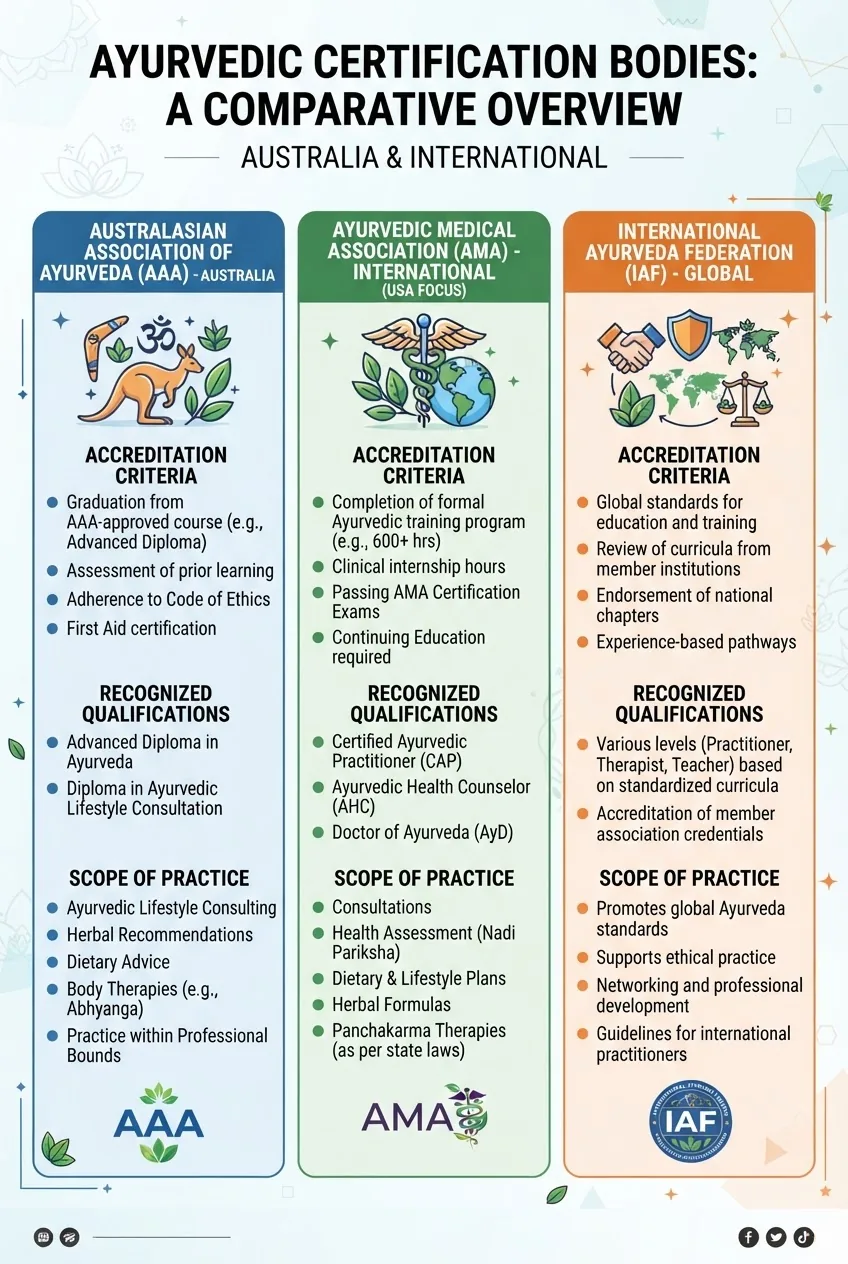
Below is a comparative overview of key certification bodies and associations—Australian and international—highlighting scope, recognised qualifications and typical accreditation criteria.
| Organisation / Body | Recognised Qualifications & Scope | Accreditation Criteria / Notes |
|---|---|---|
| Australasian Association of Ayurvedic Practitioners (example) | Registers diploma-level practitioners; sets CPD and ethical codes; supports clinic standards for non-prescription Ayurveda in Australia. | Requires recognised diploma, minimum supervised hours, annual CPD; membership voluntary (varies by state law). |
| AYUSH (Ministry of Ayush, India) | Regulates medical education (BAMS/MD Ayurveda) in India; direct authority over curricula for Ayurvedic medical degrees. | University affiliation, standardized curricula and clinical requirements; recognized internationally in some bilateral agreements. |
| University-based Ayurvedic Faculties (e.g., accredited universities) | Offer accredited undergraduate and postgraduate degrees with supervised clinical training and research components. | Subject to national higher education accreditation agencies; degrees more widely recognised for professional practice. |
| Complementary Medicine Associations (national) | Provide voluntary registers, insurance pathways and CPD requirements for members practicing non-prescription Ayurveda. | Often require evidence of training, public liability insurance and adherence to codes of practice; not statutory regulators. |
How to evaluate a certification body or course:
- Does the body require verifiable supervised clinical hours and assessment of practical skills?
- Is the course validated by a recognised university or higher education regulator?
- Does membership enable professional indemnity insurance or inclusion on practitioner registers?
- Are clear pathways provided to further study, mentoring and CPD?
Authority signals: For legal practice frameworks, consult government sources; for example, Australian health policy and complementary registration guidance are available through official channels. According to a 2024 government guidance document (government health department), regulation of complementary therapies is state-based and often voluntary.
Transition: With accreditation options clarified, the next section explores the medical and legal status of Ayurveda practice in Australia and internationally, including caveats and jurisdictional differences.
Medical and Legal Status of Ayurvedic Practitioners
Answer: The legal status of Ayurvedic practice differs by country and state: in Australia, Ayurveda is largely regulated as a complementary therapy with voluntary association registers, while in India BAMS-qualified practitioners are medical doctors; practitioners must follow local scope-of-practice laws and refer to regulated medical services when necessary.
Term: Scope of practice — legally defined activities a practitioner is permitted to perform, determined by their qualification and local regulation.
Key legal points and caveats:
- Australia: According to a 2024 state-level advisory from an Australian government health department, Ayurveda is not a nationally regulated medical specialty and practice is governed by consumer protection, advertising laws and voluntary association codes; prescribing of scheduled medicines is restricted to registered medical practitioners or pharmacists.
- India and some South Asian countries: According to AYUSH (2023 policy summary), BAMS and MD (Ayurveda) graduates are recognised as medical doctors with rights to prescribe Ayurvedic formulations and manage many primary care conditions under national law.
- European Union/UK/US: Recognition varies widely—some countries treat Ayurveda as a complementary therapy with voluntary registers, while others limit practice to non-prescription, lifestyle and massage services unless the practitioner holds a medical licence.
Legal caveat: In jurisdictions where Ayurveda is not a regulated medical system, calling oneself an “Ayurvedic medical doctor” may be unlawful or misleading unless the practitioner holds recognised medical registration; always check local health department guidance.
Clinical risk management for practitioners:
- Obtain clear informed consent documenting scope of services and referral pathways.
- Maintain communication with patients’ primary care or specialist physicians when managing chronic conditions.
- Hold appropriate professional indemnity insurance for the services provided.
External resources and authoritative references you should consult:
- Australian Government Department of Health — guidance on complementary therapy regulation and health practitioner obligations.
- Ministry of Ayush (India) — official regulator for Ayurvedic medical education and practice standards.
- PubMed — peer-reviewed studies on Ayurvedic education and clinical efficacy (search for relevant reviews and curriculum studies).
Transition: Next we list the practical skills and competencies you must develop to practise safely and effectively in Ayurveda.
Skills and Competencies Required for Ayurvedic Medical Practitioners
Answer: Core competencies include clinical consultation and communication, classical diagnostic methods (pulse/tongue), herbal pharmacology, formulation skills, Panchakarma therapy proficiency, dietetics, ethics and documented referral/reintegration with conventional medicine.
Term: Diagnostic methods (Ayurveda) — include pulse reading (Nadi Pariksha), tongue inspection, assessment of dosha imbalances and clinical history taking focused on digestion, sleep, mental/emotional state and constitutional type.
- Clinical consultation skills: Structured history-taking, risk screening for red flags, developing individualised treatment plans, and clear documentation. Practice: simulated patient OSCE (Objective Structured Clinical Examination) is standard for assessing these skills in many programs.
- Diagnostic methods and dosha assessment: Competence in pulse diagnosis, tongue examination and dosha classification (Vata, Pitta, Kapha) alongside modern clinical reasoning. Complement with Ayurvedic body types and dosha classification for structured learning.
- Herbal medicine knowledge: Ability to select classical formulations, understand herb-drug interactions and dosing principles. Refer to the Ayurvedic Supplements and Herbal Medicine Explained Guide for formulation principles.
- Formulation and dispensing competency: Preparing classical powders (churna), decoctions (kashaya) and compound formulas, plus knowledge of sourcing, quality and safety. See guide to Ayurvedic herbs and supplements.
- Panchakarma and therapy skills: Knowledge and supervised experience in detoxification procedures, oil therapies and external treatments; refer to practice standards for safety and clinical indications and to learning resources on complete Panchakarma treatments.
- Nutrition and lifestyle counselling: Competence in Ayurvedic diet principles, meal planning and seasonal recommendations; see Ayurvedic diet principles and apply to conditions including weight management with Ayurvedic diet tips for weight management.
- Communication and interprofessional collaboration: Clear documentation, referral criteria and liaison protocols with conventional medical practitioners. Training should include case discussions and integrated care planning.
- Ethics, informed consent and cultural competence: Understanding limitations of Ayurveda as complementary care, transparent advertising, and respecting cultural origins while maintaining evidence-based practice.
- Research literacy: Ability to interpret peer-reviewed studies and apply evidence to practice; familiarity with clinical outcome measures and safety reporting.
- Business and practice management: Clinic hygiene, record keeping, prescribing authority knowledge, insurance and consent forms.
Suggested complementary materials for skill development include the complete Ayurvedic medicine formulations, a practical guide to herbs and supplements, and diagnostic tools such as the dosha test and body type knowledge.
Transition: The following section gives a step-by-step practical guide to becoming certified and clinically competent as an Ayurvedic practitioner.
Steps to Becoming a Certified Ayurvedic Practitioner — A Practical Guide
Answer: To become certified, select an accredited training pathway (certificate/diploma/degree), complete required supervised clinical hours, pass practical assessments, obtain membership or registration with a recognised association, and maintain CPD and insurance; licensing rules vary by country and state.

-
Step 1: Clarify your career goal and legal boundaries
Decide whether you want to practise as a wellness consultant, diploma-level practitioner or pursue a medical degree (BAMS). Check local regulations: in Australia, confirm scope with state health advice and whether you can prescribe or need to collaborate with a registered medical practitioner.
-
Step 2: Choose the right training pathway and verify accreditation
Select programs with documented supervised clinical hours and assessment methods (OSCEs, case logs). Prefer university-validated diplomas or degrees; for online courses ensure a blended practicum. Compare curricula against recognised competence frameworks and ask for graduate outcomes.
-
Step 3: Complete supervised clinical practice and internships
Accumulate the program’s required clinical hours, participate in case rounds and supervised Panchakarma practice, and maintain a clinical logbook with mentor verification. Many diploma programs require 200–500 hours; medical degrees require far higher clinical exposure.
-
Step 4: Pass practical competency assessments
Undergo observed clinical exams, case presentations and written assessments. A typical practical exam component includes live patient consultations and demonstration of pulse/tongue diagnosis, formulation writing and safe therapy application.
Walkthrough example (clinical skill exam component): In an observed station, candidates perform a 15-minute consultation, record dosha assessment, suggest an initial treatment plan (diet, one herbal formula), and demonstrate safe technique for an external therapy. Examiners score communication, diagnostic reasoning, safety and documentation.
-
Step 5: Apply for certification, association membership and insurance
After completing training and practical requirements, apply to a professional association or certifying body that provides a register and CPD standards. Obtain professional indemnity and public liability insurance appropriate to your services.
-
Step 6: Establish clinical practice and referral networks
Create standard operating procedures for patient triage and referrals to GPs or specialists. Build relationships with pharmacies or dispensaries for quality herbs. For locating workplaces or integration partners, consider resources to find Ayurvedic doctors and clinics or locate Ayurveda centers near you.
-
Step 7: Maintain CPD, audit and quality improvement
Engage in ongoing education, audits and peer review. Document CPD activities required by your certifying association. Participate in clinical governance activities and, where possible, contribute to practice-based research.
-
Step 8: Consider further specialisation or medical training
To broaden scope, pursue postgraduate studies (Panchakarma specialization, research degrees) or consider medical degrees in Ayurveda (where available) if your career aims require prescription authority and broader medical practice.
Practical checklist before opening a clinic:
- Verified qualification and clinical logbook
- Professional indemnity insurance and business insurance
- Membership of a recognised association with a code of practice
- Referral agreements with local medical services
- Policies for herb quality assurance and record keeping
Transition: After certification, numerous practice contexts and career growth options are available; the next section explores these paths in detail.
Career Opportunities and Professional Growth for Ayurvedic Practitioners
Answer: Career options include private practice, integrative clinics, wellness centres, spa and Panchakarma retreats, research and teaching; income and scope depend on qualifications (diploma vs medical degree), location and services offered.
Typical workplaces and roles:
- Private practice: Consultations, herbal prescribing (where permitted), lifestyle programmes and small-group workshops.
- Integrative medical clinics: Working alongside GPs, naturopaths and allied health professionals—often requires clear referral pathways and evidence-informed practice.
- Wellness centres and spas: Delivering therapies such as Ayurveda massage and Shirodhara therapy, and designing detox or retreat programmes.
- Panchakarma retreats and wellness tourism: Specialist roles on retreats providing supervised detox and longer residential programmes; see Panchakarma retreats and wellness centers.
- Research and academia: Teaching, clinical research, and developing evidence-based protocols in universities or research centres.
- Product development and consultancy: Formulation design, quality assurance for Ayurvedic products, and consultancy for spas or wellness brands—opportunities include advising on Ayurvedic hair care products and tips.
- Public health and community education: Running community programmes for diet, stress management and chronic disease prevention.
Examples of niche services and revenue streams:
- Specialist consultations (women’s health, pediatrics, geriatrics)
- Group programmes (weight management using Ayurvedic diet tips for weight management)
- Therapy packages (Panchakarma detox packages, Shirodhara sessions)
- Corporate wellbeing workshops
Career growth strategy:
- Begin with a clear scope (e.g., lifestyle counselling) and gradually add services as further training and supervision are completed.
- Build referral networks with conventional healthcare providers and specialist registries (listings to find Ayurvedic doctors and clinics).
- Develop a niche (Panchakarma, women’s health, hair care, detox) and promote specialised offerings—e.g., training in Panchakarma treatments and detox expertise.
Transition: Sustained career success requires continuing education and documented professional development; the next section covers CPD and maintaining certification currency.
Continuing Professional Development and Keeping Certification Current
Answer: Maintain certification by meeting association CPD hours, participating in workshops, peer review, clinical audits and contributing to research; many associations require annual CPD and evidence of safe practice to renew registration.
Common CPD activities:
- Structured workshops and short courses in advanced clinical skills
- Webinars and online modules on herb safety, drug interactions and new evidence
- Clinical supervision and peer-review case rounds
- Attendance at conferences and contribution to presentations
- Participation in research projects or audits
- Teaching or mentoring junior practitioners
Recommended CPD maintenance checklist:
- Keep a CPD log with evidence (certificates, attendance records)
- Complete mandated hours set by your certifying association
- Engage in at least one clinical audit or peer review annually
- Update emergency referral protocols and first-aid certification
Transition: For reliable sources, textbooks and communities to support your learning, consult the resources listed next.
Resources and Further Reading for Aspiring Ayurvedic Practitioners
Answer: Foundational resources include classical texts (Charaka Samhita, Sushruta Samhita), university curricula, peer-reviewed journals and practitioner networks; use accredited course reading lists and structured guides to build a robust knowledge base.
Suggested reading and resources:
- comprehensive guide to Ayurveda books — curated core texts and modern commentaries.
- Peer-reviewed journals: search PubMed for clinical trials and curriculum studies (use PubMed).
- Practitioner support groups and associations—join a recognised association for mentoring and CPD opportunities.
- Online communities and specialist forums for case discussion and practice development.
Transition to FAQs and final summary: The closing section below answers common practical questions for prospective practitioners.
Conclusion — Key takeaways and next steps
Becoming an ayurvedic practitioner requires choosing a training pathway aligned with your career aims, verifying accreditation and supervised clinical hours, and understanding the legal scope in your jurisdiction. Start by selecting a course with verified practicum, plan supervised clinical experience, join a professional association and commit to CPD. Ready to begin? Review accredited course options and reach out to local associations for mentorship.