
By the end of this hands-on guide you will be able to design a realistic, evidence-aware natural health plan covering preventive practices, common therapies, and how to find qualified providers. Expect to spend 4–6 weeks building and testing a simple routine; this guide assumes a motivated beginner with no formal clinical training.
Before you start
- Tools: notebook or wellness journal, basic kitchen scales, a reliable digital thermometer, and a calendar or habit app.
- Materials: pantry staples (olive oil, whole grains, fresh fruit/veg), basic herbal teas, and a first-aid kit.
- Prerequisites: willingness to track outcomes for 6–8 weeks and to consult your healthcare provider for chronic conditions.
- Time commitment: 20–45 minutes daily for initial practices (nutrition, stress-reduction, light movement).
Introduction to Natural Health and Holistic Wellness
Natural health is a preventive, lifestyle-focused approach that emphasizes whole-person well-being—physical, mental, and social—rather than only treating symptoms. This guide defines what natural health care and holistic wellness mean, lays out practical routines, and shows how wellness medicine connects traditional wisdom with modern evidence.
Natural health care covers a wide spectrum: from dietary changes and herbal support to mind-body practices and environmental adjustments. Readers often ask how this differs from standard clinical approaches; the short answer is orientation—natural health typically prioritises prevention, patient-centered care, and lower-intervention therapies before escalating to medical treatments.

This article uses the terms wellness medicine to describe clinical models that explicitly prioritize prevention and lifestyle interventions within or alongside standard care, and it explores how integrative approaches can improve long-term outcomes. Transitioning into the philosophy will show the worldview behind these practices.
The Philosophy and Principles of Natural Health
Holistic health principles begin from three core beliefs: the body has self-regulating mechanisms; health arises from balance across body-mind-spirit domains; and patient-centered care supports individualized pathways to wellness. These principles shape wellness medicine philosophy and practical decisions.
Key philosophical features:
- Whole-person assessment — practitioners evaluate lifestyle, social context, mental well-being, and physical signs, not only laboratory values.
- Prevention-first orientation — emphasis on diet, movement, sleep, and stress reduction to reduce disease risk before invasive interventions.
- Patient-centered care — shared decision-making, respect for patient preferences, and tailored care plans.
- Low-toxicity interventions — preference for minimally invasive or natural remedies when supported by evidence.
- Mind-body integration — recognition of the mind-body connection as a therapeutic target (e.g., meditation, biofeedback).
Wellness medicine often borrows from traditional systems (such as herbalism and folk practices) while seeking modern validation. Authorities such as the National Center for Complementary and Integrative Health provide frameworks for evaluating therapies—see their guidance for safety and research priorities: National Center for Complementary and Integrative Health.
Philosophy guides practice choices: a person with recurring tension headaches might first implement sleep hygiene, hydration, magnesium-rich foods, and targeted relaxation techniques before pharmacological escalation. The transition to core practice components explains what those first-line actions look like in daily life.
Core Components of Natural Health Care Practices
Below are the practical pillars you’ll use to build a natural health plan. Each item includes how-to details, dosages or time frames where applicable, and quick markers to judge effectiveness.

- Nutrition therapy — adopt a whole-food, plant-forward diet with 25–35 grams of fiber daily; target 5+ servings of vegetables, 2 servings of fruit, 2–3 servings of oily fish or plant omega sources weekly. Use a 7-day food log and aim for a 10% caloric reduction if weight loss is desired.
-
Herbal medicine and supplements — use evidence-prioritised herbs: e.g., 300–600 mg standardized magnesium citrate nightly for muscle tension/sleep (start low for 7 days), 500–1,000 mg vitamin C daily during acute colds, and standardized St. John’s wort only under guidance for mild depression due to interactions. Track effects for 2–6 weeks.
medical cannabis and therapeutic use - Physical activity — schedule 150 minutes/week of moderate aerobic activity (e.g., brisk walking 30 minutes ×5) plus two 20-minute strength sessions. For mobility, include 5–10 minutes of daily joint-specific mobility drills each morning.
- Stress management and mind-body techniques — practice a daily 10–20 minute stress-reduction routine (breathwork 4-4-8 pattern for 5 minutes + progressive muscle relaxation for 10 minutes). Measure sleep and stress with a simple weekly score (1–10) and reassess after 4 weeks.
- Sleep hygiene — build a 7–9 hour sleep window; enforce lights-out within 30 minutes of a fixed bedtime; remove screens 60 minutes pre-sleep. Consider 0.5–1 mg melatonin for short-term shift work or jet lag only.
- Immune system support — maintain vitamin D in the 50–75 nmol/L range for adults (test and supplement 1,000–2,000 IU daily if low). Use hand hygiene, balanced nutrition, and moderate exercise to reduce infection risk.
- Environmental and lifestyle adjustments — reduce household toxins (use fragrance-free cleaning products, increase ventilation, test for mold if chronic respiratory symptoms). Replace ultra-processed snacks with whole-food swaps within 2 weeks.
- Patient-centered monitoring — keep a weekly outcomes log (symptom severity 0–10, sleep hours, mood score, energy level) and share during consultations; adjust treatments every 4–8 weeks based on results.
These components combine into personalised plans; practitioners often sequence interventions—lifestyle first, then targeted herbal or nutraceutical support, and referral when required. Next we’ll define wellness medicine and its role in formal care settings.
Wellness Medicine: Definition and Role in Health Care
Wellness medicine refers to clinical models and programs that prioritise prevention, lifestyle interventions, and health promotion as central treatment goals. Unlike single-issue clinics, wellness medicine programs integrate nutrition therapy, movement prescriptions, sleep optimization, stress reduction techniques, and selective complementary therapies into routine care.
Examples of wellness medicine in practice:
- A primary-care clinic offering a 12-week lifestyle intervention: weekly nutrition coaching, group mindfulness training, and an individualized exercise plan to reduce cardiometabolic risk.
- An integrative oncology service coordinating dietitians, acupuncture, and counselling to support chemotherapy tolerance and quality of life.
- Workplace wellness programs that provide evidence-based stress reduction classes and biometric screening to prevent chronic disease development.
Wellness medicine complements conventional care by addressing upstream drivers of disease. For evidence on outcomes and cost-effectiveness, consult peer-reviewed systematic reviews in journals such as the Journal of Alternative and Complementary Medicine and government summaries like the CDC prevention frameworks. Transitioning to a comparison will clarify how these models sit relative to conventional and integrative care.
Comparing Natural Health Care with Conventional and Integrative Medicine
Below is a concise comparison of philosophies, typical offerings, and patient approaches across the three models.
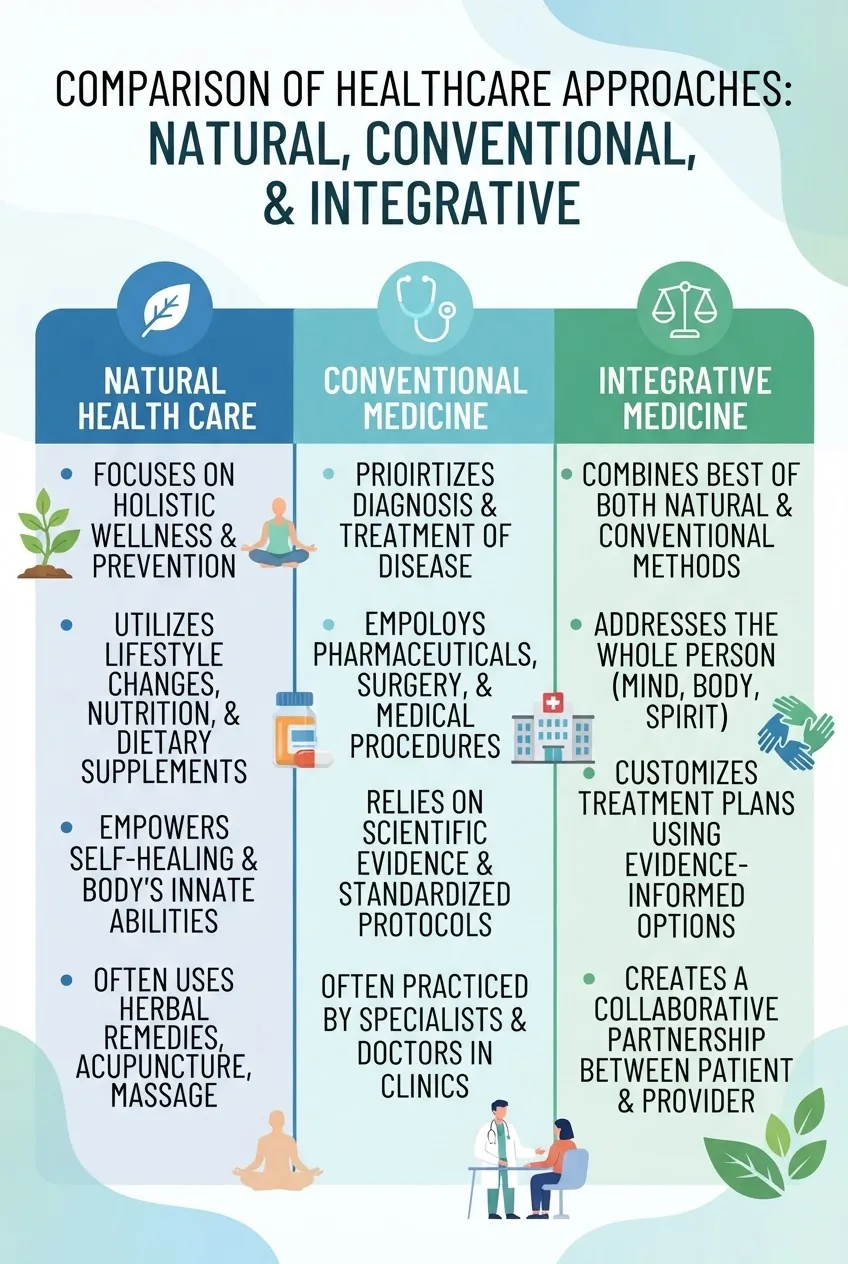
| Model | Philosophy | Common practices |
|---|---|---|
| Natural Health Care | Prevention, low-toxicity, whole-person | Herbal medicine, nutrition therapy, mind-body work |
| Conventional Medicine | Disease-focused, evidence from RCTs | Pharmaceuticals, surgery, diagnostics |
| Integrative Medicine | Combine best of both, patient-centered | Lifestyle medicine, acupuncture, coordinated care |
Integration examples: many hospitals now offer integrative services, blending evidence-based complementary therapies into standard pathways. If you want foundational reading on cross-model terminology, see this primer on alternative terms for Western medical practices.
When to prefer each model: acute life-threatening conditions typically demand conventional interventions; chronic lifestyle-driven conditions often respond well to natural health care and wellness medicine; integrative approaches are optimal where both models contribute to improved patient outcomes.
Transitioning next to benefits and limitations will help you set realistic expectations for natural health strategies.
Benefits and Limitations of Natural Health and Wellness Medicine
Below are practical pros and cons drawn from practitioner experience and the literature. I include examples from clinical contexts and link to condition-specific resources.
- Pros
- Emphasises prevention and lifestyle changes that reduce long-term disease risk (cardiometabolic, some cancers).
- Lower side-effect profiles for many interventions compared with high-dose pharmaceuticals.
- Improved patient engagement through patient-centered care and self-management tools.
- Effective adjuncts for symptom management: see evidence for effective alternative therapies for pain management and for symptom support in cancer care like holistic alternatives for cancer treatment.
- Cons
- Variable evidence strength—some widely used traditional remedies lack large RCTs; claims should be evaluated against systematic reviews.
- Risk of interactions (e.g., St. John’s wort reduces levels of many drugs).
- Potential delays in seeking necessary conventional care for serious conditions—see guidance on advanced disease options like alternative to radiation treatment options and consult oncologists.
- Heterogeneous regulation of practitioners and products—vigilance required when selecting supplements and services.
Selected condition links for context and further reading:
- alternative medicine for prostate cancer treatment options
- alternative therapies for asthma and allergies
- effective alternative therapies for pain management
- alternative to radiation treatment options
- natural and holistic treatment for ovarian cancer
- holistic alternatives for cancer treatment
- alternative therapies for asthma and allergies
Real-life example: a 56-year-old patient with metabolic syndrome reduced fasting glucose by 10% and lost 6 kg over 12 weeks through targeted nutrition (Mediterranean-style meal plan), 150 minutes/week of walking, and weekly coaching. The case was documented in a clinic quality-improvement report using before-and-after biomarkers and symptom scores—this demonstrates measurable improvement from wellness medicine approaches when tracked systematically.
For serious diagnoses, always combine careful natural-supportive care with conventional oncology or specialty treatment as applicable; see specialized resources such as natural and holistic treatment for ovarian cancer and consult multidisciplinary teams.
Next, practical, step-by-step tips help you put these ideas into daily routines safely and reliably.
Practical Tips for Incorporating Natural Health into Your Daily Life
This section is written as a stepwise, hands-on routine you can start in the next week. Follow each step and use measurable thresholds for progress.
- Start a 7-day baseline log — record sleep hours, meals, bowel habits, mood (0–10), and energy in a wellness journal each evening. Do this for 7 consecutive days to identify patterns.
- Implement a 3-part morning routine — 5 minutes of breathwork (4-4-8), 5 minutes of mobility (cat-cow, hip circles), and a 10-minute protein-rich breakfast (20–30 g protein). Follow for 21 days before adjusting.
- Swap two processed meals per week — replace with whole-food alternatives (e.g., canned soup → homemade vegetable and lentil soup). Track satiety and energy after meals for 2 weeks.
- Schedule stress-reduction blocks — book 10–20 minute slots in your calendar at least 5 days/week for guided meditation or a walk outdoors. Use a timer and reassess perceived stress after 4 weeks.
- Introduce one evidence-based supplement if indicated — after consulting a clinician, choose supplements with clear dosing (e.g., vitamin D 1,000–2,000 IU/day if deficient). Test blood levels at baseline and 3 months.
- Perform weekly self-checks — weigh in once per week (same day/time), record sleep and mood averages, and note any side effects. If negative trends persist 4–6 weeks, escalate to a practitioner.
- Build social support — join a community class or group for movement or cooking once per week to increase adherence; social connection is a robust wellness predictor.
- Use safety thresholds — stop any supplement or therapy causing >2/10 worsening of symptoms; seek medical review for new severe symptoms (chest pain, shortness of breath, neurological changes).
Some readers seek mental health alternatives: if you’re exploring non-therapy strategies, consider structured lifestyle interventions alongside vetted resources such as top alternatives to therapy for mental health.
Transitioning, the next section helps you vet and choose competent providers when you need professional support.
How to Choose Natural Health Care Providers and Services
Selecting providers requires checking qualifications, scope of practice, and fit with your goals. Use this step-by-step protocol when evaluating a clinic or practitioner:
- Confirm credentials — ask for formal qualifications and licensing; for integrative doctors, look for credentials such as board certification (search for board certified integrative medicine).
- Review services offered — compare services against a checklist: nutrition, lifestyle coaching, herbal expertise, mind-body programs, and referrals to conventional specialists. For centre-level overviews, see resources about alternative health care center services and benefits and cancer natural treatment centers.
- Ask about evidence and safety — request references to peer-reviewed research or clinical protocols; credible practitioners will cite relevant studies and describe monitoring plans.
- Evaluate communication style — choose a practitioner who offers shared decision-making, clear consent, and transparent fee schedules. Book an initial consult and prepare 6 focused questions.
- Check education paths — if you’re curious about practitioner training, explore links like alternative medicine degree programs online or advanced training listings such as Masters in Alternative Medicine.
- Verify reviews and complaints — search local registries, client testimonials, and regulatory bodies. If a therapy seems promising but risky, obtain a second opinion from a conventional specialist.
For specific provider searches, check guides like Integrative Medicine Doctors Near Me or specialty directories for functional medicine and nursing certifications.
Future Trends in Natural Health and Wellness Medicine
Emerging trends to watch include digital health tools that support lifestyle change (apps for nutrition tracking, telehealth coaching), increased integration of evidence-based complementary therapies into hospitals, and growing high-quality research into commonly used herbs and mind‑body interventions.
Examples and research directions:
- Personalised nutrition informed by microbiome testing (early-stage clinical trials; expect validation over 3–7 years).
- Digital CBT and guided meditation programmes integrated into primary care platforms, improving access to stress-reduction techniques.
- More randomized controlled trials for traditional herbs—systematic reviews are increasing but still uneven; check updates in the Journal of Alternative and Complementary Medicine.
As patient empowerment grows, expect wellness medicine to expand within mainstream care, with stronger regulation and quality standards supporting safer, more effective natural health practices.
Practical step-by-step plan: build your 8-week natural health program
- Week 0 — Baseline and goals: complete a 7-day baseline log and set 3 measurable goals (sleep hours, two food swaps/week, 150 min/week movement).
- Weeks 1–2 — Foundational changes: implement morning routine, two processed-meal swaps, and 10 minutes daily stress practice; weigh weekly and record sleep.
- Weeks 3–4 — Add targeted support: introduce one supplement after clinician approval (e.g., vitamin D 1,000–2,000 IU/day), begin a strength routine twice weekly.
- Weeks 5–6 — Monitor and adjust: review outcomes log, drop ineffective changes, intensify what works (increase walking time by 10–20%).
- Weeks 7–8 — Consolidate and plan maintenance: create a sustainable weekly template (meals, movement, stress blocks) and schedule a 12-week follow-up with your provider if needed.
After completing this program, reflect on outcomes and consider integrating community programs or formal wellness medicine services for long-term maintenance. If you’re ready to explore career or training paths for practitioners, see resources like Careers in Alternative Medicine.
Common mistakes and how to avoid them
I once recommended a herbal sleep formula without checking interactions; the patient experienced daytime drowsiness because they were also on prescription sedatives. I now always cross-check medications and start low-dose trials for 7–14 days, documenting effects. I learned to insist on baseline labs before initiating high-dose supplements.
Other frequent errors I see:
- Starting multiple interventions at once — makes it impossible to attribute benefit or harm. Instead, introduce one change every 7–14 days.
- Over-reliance on unverified supplements — choose products with third-party testing and published evidence.
- Delaying conventional care for serious symptoms — use clear red flags (chest pain, sudden weakness, major bleeding) to seek immediate care.
Checklist — verify your work
- Baseline log completed for 7 days.
- Three measurable goals set with deadlines.
- Morning routine performed 5+ days/week for 3 weeks.
- Two processed-meal swaps weekly for 4 weeks.
- Stress practice scheduled and logged 5+ times/week for 4 weeks.
- Supplement started only after clinician review and baseline testing where appropriate.
- Provider vetted for credentials, services, and evidence-informed practice.
When to call in a professional
Contact a medical professional immediately for any red-flag symptoms: sudden severe pain, chest pain, shortness of breath, loss of consciousness, or neurological changes. For chronic issues not improving after 6–8 weeks of structured natural health interventions, schedule a multidisciplinary review with an integrative team or specialist.
Conclusion — key takeaways: Natural health and wellness medicine offer preventive, patient-centered pathways that combine lifestyle, mind-body work, and selective natural therapies. Use measured, evidence-aware steps: baseline, small changes, monitored trials, and professional oversight. If you’re ready to take control of your health, begin your 7-day baseline today and consult a qualified provider for tailored support.
Ready to start? Track your first week, then review this guide’s checklist and seek a provider if you need personalised plans.