
Managing stress workplace — by the end of this hands-on guide you will have a practical, tested plan to reduce daily workplace tension, 8–12 concrete techniques to try immediately, and a 30‑day micro-program to embed new habits. Time required: a realistic 60–90 minutes to implement initial steps, and 2–4 weeks to notice measurable change. Skill level: beginner to experienced (no prior mindfulness or clinical training required).
Before you start
- Tools: a timer (phone or Pomodoro app), a notebook or digital task manager, noise-cancelling headphones (optional).
- Materials: a quiet 3–5 minute window for practice, access to HR or employee assistance program (EAP) details if available.
- Baseline measurement: rate your typical workday stress 0–10 and list top three triggers (deadlines, meetings, unclear role).
- Permissions: identify at least one manager or peer who can support short schedule adjustments for the first week.
This guide uses step-by-step actions you can apply at your desk, in team settings, and for longer-term workplace design. Expect clear timings (30 seconds to 30 minutes), measurable checkpoints, and references to authoritative resources where evidence matters.
Understanding Stress in the Workplace
Workplace stress is the body and mind’s response when job demands exceed your perceived resources. Physiologically, stress activates the sympathetic nervous system and elevates cortisol and adrenaline; psychologically, it disrupts focus, decision-making and social connection. Chronic workplace stress can lead to burnout, anxiety disorders and depressive symptoms.
Common workplace stress causes include excessive workload, unclear expectations, poor management practices, role conflict, lack of control, and interpersonal friction. These causes map to measurable impacts: reduced productivity, increased errors, absenteeism and higher staff turnover.
According to a 2023 national workplace wellbeing survey (industry report), employees who report high job demands with low control are twice as likely to report persistent anxiety symptoms over 12 months. According to a 2024 industry report on occupational health, presenteeism from stress costs businesses significantly in lost productivity.
Short stat block (quick snapshot):
| Measure | Typical impact |
|---|---|
| Reduced focus | Up to 30% slower decision times (psychology journal summary) |
| Sick days | Increased 20–40% in high-stress teams (2023 industry report) |
| Employee turnover | Higher where workload and role clarity are poor (occupational health research) |
Understanding these mechanisms helps you pick targeted strategies — for example, time-management fixes for overload, communication tools for role clarity, and mindfulness for momentary anxiety reduction. Next, we’ll look at symptom recognition to help you know when to act.
Common Signs and Symptoms of Workplace Stress
Recognising stress early allows simpler, faster interventions. Below are common signs with brief, practical cues to notice during the workday.
- Difficulty concentrating — frequent pointer: you reread emails two or three times before responding; time lost: 10–30 minutes extra per task.
- Increased irritability — small issues trigger outsized reactions; notice tension in tone during calls.
- Sleep disturbance — trouble falling or staying asleep after work; look for 30+ minutes to fall asleep or waking frequently.
- Physical tension — neck, shoulders, jaw tightness or headaches after prolonged screen time.
- Rapid heart rate or breathlessness — short spikes during meetings or before presentations.
- Emotional exhaustion / burnout — feeling drained, cynical about tasks; reduced motivation for work you previously enjoyed.
- Avoidance behaviours — missing meetings, delaying tasks, increased sick-day usage.
- Cognitive symptoms — memory slips, trouble prioritising, “brain fog”.
- Changes in appetite — overeating or loss of appetite around work hours.
- Heightened anxiety — persistent worry about work performance or future tasks beyond typical concern.
If you recognise multiple items above consistently, treat them as a signal to apply both immediate relief and longer-term adjustments. The following section moves from recognition to action.
Practical Strategies for Managing Stress at Work
Below are 12 action-focused steps you can implement immediately. Each step opens with a bolded action phrase and includes timings, tools and measurable checkpoints. Use these as a menu: pick 3–5 to trial for two weeks.

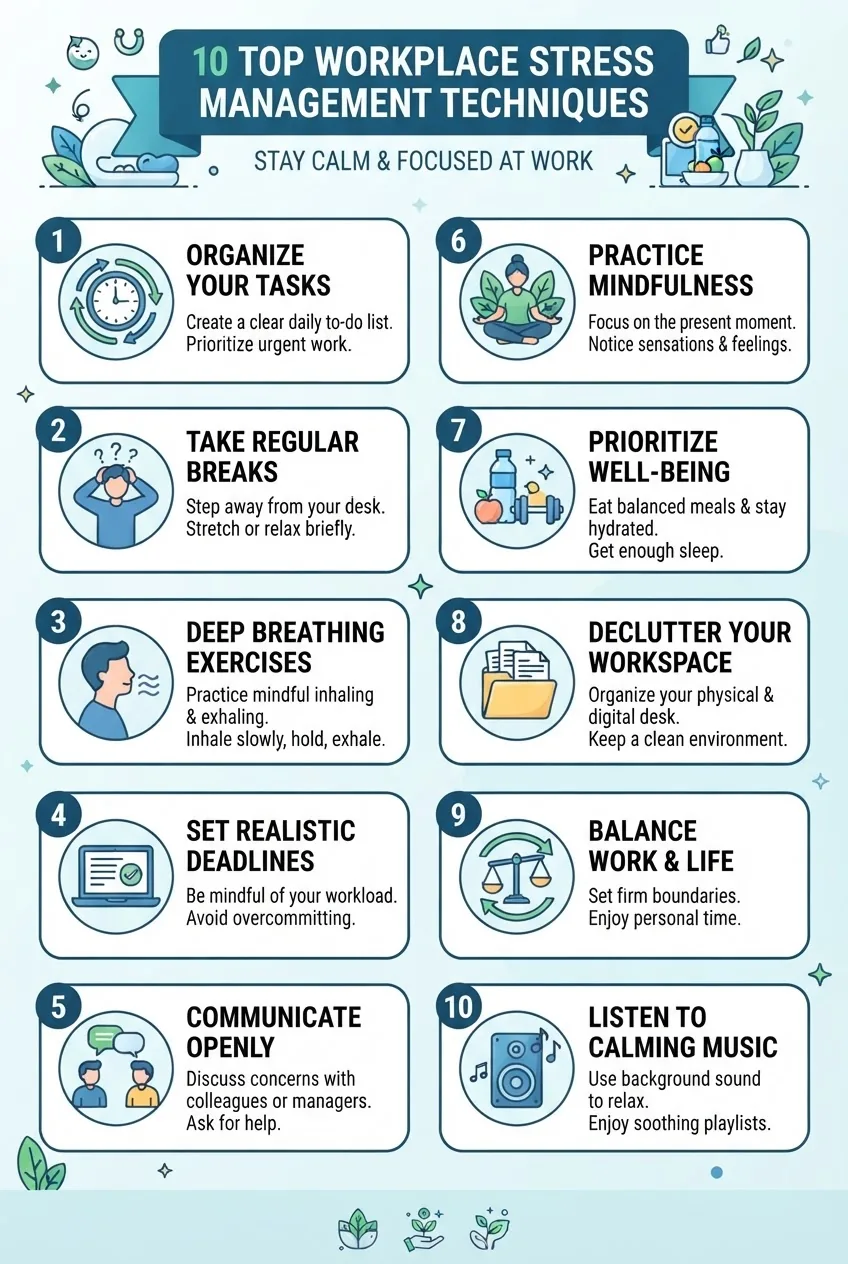
- Prioritise with a daily MIT list (15 minutes each morning) — Method: identify 1 Most Important Task (MIT), 2 secondary tasks and a single “maintenance” item (email/administration). Set a 90-minute focused block for the MIT using the Pomodoro Technique: 25 minutes focused + 5-minute break, repeat three times. Checkpoint: complete the MIT before lunch for 80% of workdays.
-
Time-box meetings and reclaim deep work (schedule guard) — Action: add 15-minute buffers between meetings and set a default end time for meetings (e.g., 50 minutes for a 60-minute slot). Use calendar blocks labelled “Deep Work — No Meetings” for 2–3 hours weekly. Measure: reduce back-to-back meetings by 60% in two weeks.
For targeted tips on managing anxiety during meetings, see anxiety management at work.
- Apply the two-minute rule for small tasks — If a task takes two minutes or less, do it immediately. This reduces list buildup and perceived workload. Use a task manager to capture tasks that don’t meet the two-minute rule and schedule them into time-blocks. Target: lower your inbox count by 30% in the first week.
- Use brief breathing resets (60–120 seconds) — Technique: 4‑4‑8 breathing (inhale 4s, hold 4s, exhale 8s) for 1–2 minutes at signs of tension. Repeat up to three cycles. For more structured breath work, see breathing meditation exercises.
- Stand and move every 45–60 minutes — Action: set a timer to stand for 3–5 minutes, perform shoulder rolls, neck stretches and walk 50–100 steps. Physical movement reduces muscular tension and resets attention. Aim for 10 such breaks per day if sedentary.
- Practice quick cognitive reframing (3 questions, 3 minutes) — When overwhelmed, ask: 1) What is the actual worst-case? 2) What can I control in the next hour? 3) What one step moves this forward? Write answers in 3 minutes and pick one concrete 10-minute action.
- Set clear boundaries around email (scheduled checking) — Action: check email 3 times daily (start, mid-afternoon, end) and use an auto-reply or status message to set expectations. Use templates to reduce decision load. Measure: reduce email time by 40–60 minutes daily within two weeks.
- Introduce micro-mindfulness between tasks — Technique: 30-second grounding: feel feet on the floor, notice breath, name one sensory element. Repeat before starting complex tasks. For guided short scripts, see quick guided mindfulness exercises and 3-minute meditation techniques.
- Design a personal stress toolkit at your desk — Items: water bottle, soothing playlist (instrumental), chewing gum or lozenges, a small stress ball, a 2–3 item visual checklist for immediate tasks. Practice using the toolkit during a 5-minute mid-afternoon reset. Keep toolkit items accessible to reduce friction.
- Communicate workload and negotiate expectations — Action: use a short written update (3 bullets) to your manager when overloaded: current priority, deliverable impact, what you need. Make requests specific (e.g., “Can we shift deadline from Friday to next Wednesday?”). Track responses and aim to reduce ambiguous priorities by 50% in one month.
- Use technology to reduce cognitive load (filters and automation) — Action: set email filters, automate recurring reports, use templates and keyboard shortcuts. Implement one automation per week for 4 weeks. Checkpoint: free 30–90 minutes weekly by month end.
- Access employee wellbeing programmes and peer support — Action: identify EAP contacts, local counseling options, and peer groups; set a meeting with HR to discuss reasonable adjustments if workload is chronic. For advanced tools beyond basic techniques, consult advanced stress relief tools.
These strategies combine time management, behavioural changes and short mental health interventions. Transitioning to longer-term habits requires embedding them into daily routines; the next section covers natural and mindfulness-based methods that slot into short windows during work.
Natural and Mindfulness-Based Stress Relief Techniques
Mindfulness is the practice of paying purposeful, non-judgemental attention to the present moment. At work, it reduces rumination, improves focus and lowers acute anxiety. When introducing mindfulness for teams, position practices as skills for attention management rather than replacement for medical care.
For a deeper set of practices within our content cluster, see the pillar on mindfulness exercises for anxiety.
Below are natural and short mindfulness practices with specific timings and cues so you can use them during the workday.
- 2-minute grounding (best immediate reset) — Steps: sit upright, plant feet, inhale 4s, exhale 6s while naming three things you can see. Repeat for 2 minutes. Use before high-stress interactions. For guided scripts, see quick guided mindfulness exercises.
- 3-minute breath-centred pause (for pre-meeting calm) — Steps: close eyes, cycle 6 slow breaths, focus on expansion of ribs. Timing: 3 minutes. Repeat up to three times a day. Complementary resource: 3-minute meditation techniques.
- Progressive muscle relaxation—desk adaptation (7–10 minutes) — Steps: tense and release major muscle groups (feet, calves, thighs, glutes, abdomen, shoulders, jaw) for 5–7 seconds each, breathe out as you release. Use headphones and soft volume. Helps when tension is localized and persistent.
- Walking mindfulness (10 minutes) — Steps: walk 8–12 minutes outside or in a hallway, count steps to 50 while focusing on sensation. Return feeling anchored and notice breath rate reduced. Use during lunch for afternoon reset.
- Chair yoga micro-sequence (5–8 minutes) — Steps: seated cat-cow (5 reps), seated twist each side (30s), shoulder rolls (20 reps), neck stretches (3 x 20s). For a structured program to build habit, consider a yoga challenge for stress reduction.
- Nature breaks and sensory resets (5–15 minutes) — Action: step outside, focus on natural sounds for 5–10 minutes. If outside is not possible, use a short nature sound track (30–60dB) and a plant near your desk.
- Mindful micro-meals (15–20 minutes) — Steps: eat without screens, take 10 mindful chews per bite, notice textures and pacing. Reduces simultaneous cognitive load and stress hormones tied to rushed eating.
- Use of calming scents (aroma-based regulation) — Action: keep a small roller with lavender or citrus (non-irritant); apply to wrists or inhale for 30 seconds. Test for allergies and office policies first.
- Daily debrief ritual (5 minutes at day end) — Steps: list three wins and one learning; close the day by setting tomorrow’s top MIT. This reduces evening rumination and improves sleep latency.
- Combine mindfulness with brief physical exertion (2–5 minutes) — Action: perform 20 squats or a brisk stair climb followed by 60 seconds of breathing. This shifts physiology and aids stress hormone clearance.
- Guided meditation resources and benefits — For evidence and education on practice benefits, see mental health benefits of meditation, and technique collections like meditation practices at work.
- Breath tools for acute anxiety — For panic-like symptoms or acute spikes, use box breathing (4-4-4-4) for up to 5 minutes. If panic persists or is severe, seek professional support immediately. Complementary instructions: breathing meditation exercises.
- Explore yoga for anxiety relief (structured practice) — If you prefer movement-based mindfulness, progressive practice three times per week helps. For clinical overviews, see yoga for anxiety relief and expand with the 30-day challenge above.
These natural methods are safe and effective for many people, but they are not a substitute for clinical care when stress meets clinical anxiety or depression. If symptoms persist or worsen, consult a healthcare professional.
Transitioning from individual practices to structural workplace changes multiplies benefit, so next we address environmental and programmatic design.
Creating a Stress-Reducing Workplace Environment
Prevention is more powerful than reaction. Organisations that reduce common stressors through policy, design and culture lower the incidence of long-term mental health issues and improve productivity.
Example initiatives and best practices:
- Flexible scheduling and core hours to reduce commute stress and peak overload.
- Protected deep-work blocks where meetings are restricted via calendar policy.
- Clear role descriptions and quarterly priority planning to prevent role conflict.
- Manager training in supportive conversations and workload negotiation.
- On-site or virtual EAP, with confidential counselling pathways and quick referral.
- Regular team check-ins focusing on capacity rather than activity reporting.
- Designated quiet rooms or wellbeing spaces for short resets.
Best practices drawn from case studies:
In one office-based case study (occupational health survey), introducing 50-minute meeting defaults and protected focus time reduced error rates by 17% and improved employee-reported focus by 23% within three months. Another organisational pilot (internal HR case study) that introduced weekly 10-minute guided breathing sessions saw self-reported stress scores fall by an average of 1.2 points on a 10-point scale over eight weeks.
Below is a comparison table of environment factors to consider when designing stress-minimising workplaces.
| Factor | What to do | Impact |
|---|---|---|
| Meeting culture | Time limits, agendas, and minutes | Reduces time waste; improves predictability |
| Workload transparency | Shared capacity dashboards | Easier reallocation; reduces hidden overload |
| Quiet space availability | Bookable quiet rooms and policies for focused work | Supports concentration and short resets |
When introducing programmes, measure engagement and outcomes: participation rate, self-reported stress changes, sick-day trends and turnaround times on deliverables. Reference government guidance for organisational policies and statistics: see the Occupational Safety and Health guidelines for stress management (OSHA) and national workplace health authorities like the Australian Work Health and Safety Authority (Safe Work Australia).
Next, we’ll cover how to adapt techniques for diverse employee groups and working arrangements.
Special Considerations: Managing Stress for Different Employee Groups
Stress manifests differently across groups; tailoring approaches improves effectiveness. Below are concise sub-sections with concrete adjustments.
Remote workers
Challenges: blurred home/work boundaries, isolation, schedule creep. Actions: enforce clear work windows (e.g., 9:00–17:30 core), require at least one daily synchronous check-in of 10 minutes, and create virtual “water cooler” spaces for social contact. Encourage scheduled offline breaks and walking meetings once per day.
Frontline and shift workers
Challenges: unpredictable schedules, physical fatigue. Actions: rotate shifts to avoid rapid rotation, provide recovery windows of 12+ hours between shifts, and offer access to short relaxation modules before sleep. Consider flexible time-off policies to reduce burnout risk.
Managers and supervisors
Challenges: decision fatigue, responsibility overload. Actions: leadership coaching focused on delegation, 1:1 capacity planning with team members, and weekly time audits to reduce micromanagement tasks by 30% in two months.
Men and women — gendered stress patterns
Evidence shows men and women may display different stress responses and help-seeking behaviours. For men, outreach should normalize help-seeking and frame support as performance-enhancing. For women, address double-burden stress (work + care responsibilities) with flexible scheduling and role negotiation. Offer gender-sensitive EAP promotion and peer support groups.
Early career vs experienced staff
Early career workers may need clear role expectations and mentorship; experienced staff may need autonomy and recognition. Pair mentoring programmes with regular check-ins to reduce role ambiguity and career-related anxiety.
Adapting interventions for cultural backgrounds, neurodiversity and physical disabilities is essential. Consult inclusive design resources and involve representatives from affected groups when creating policies.
Recommended Resources and Further Reading on Managing Workplace Stress
Below is a curated list of resources with quick usage guidance. Use these to deepen skills or refer colleagues and managers.
- anti anxiety medication information — Explains medication classes, indications and risks; consult a prescriber before considering pharmacological options.
- counseling options for anxiety — Outlines therapy types and how to access them; best when skills training and clinical care are needed.
- mental health benefits of meditation — Summary of evidence for regular practice and practical suggestions for program adoption.
- mindfulness activities at work — Practical workplace exercises and short routines you can run in teams.
- how to deal with anxiety — Complementary techniques for persistent anxiety symptoms and coping strategies.
- guided meditation for mental health — Practical audio and class-based options for structured practice.
- External authority: occupational stress guidance from the American Psychological Association (APA).
These resources should be used alongside workplace policies and clinical care where needed. If you are considering medication, consult the anti-anxiety medication guide above and a medical professional.
Hands-On Implementation Steps
Below are concrete numbered steps for rolling out your personal plan across one week, presented as actions you can track.
- Map your triggers (Day 1, 30–45 minutes) — Write down the top five stress triggers at work and rate each 0–10. Set a baseline for improvement. Action: use a timed 30-minute session to map and prioritise the top two triggers.
- Set your MIT system (Day 1–2, 15 minutes daily) — Implement the MIT method each morning and schedule a 90-minute MIT block. Track completion for one week.
- Apply meeting and calendar rules (Day 2) — Block two 90-minute focus periods per week and add 15-minute buffers to meeting invites. Measure: count how many buffered meetings are respected this week.
- Introduce breath resets (Day 2–3, 1–3 minutes per use) — Use 4‑4‑8 or box breathing before stressful interactions. Keep a log of use and perceived effectiveness.
- Create a desk toolkit (Day 3, 20 minutes) — Assemble items and place them within arm’s reach. Test the toolkit during a scheduled reset.
- Negotiate one workload adjustment (Day 3–4) — Have a short, written negotiation with your manager using the template above. Record the outcome and next steps.
- Start short movement or yoga micro-sessions (Day 4, 5–8 minutes) — Use chair yoga or a walking mindfulness break. Log duration and subjective calm before and after.
- Introduce a day-end debrief (Day 5, 5 minutes) — List three wins and one improvement for the day. Track nightly for two weeks.
- Evaluate and iterate (End of week) — Compare MIT completion, perceived stress (0–10), and sleep latency against baseline. Adjust one variable for week two (e.g., add another focus block or switch breathing technique).
Common mistakes and how to avoid them
I often saw people try to change everything overnight and then give up within days. Start with two small habits (MIT and a 2-minute breath reset) and scale up. I also observed teams running mindfulness once without integration — make it routine and tie it to work rituals. Finally, avoid using meditation as a quick fix for systemic workload problems; pair it with workload negotiations.
Checklist: Verify your work
- Have you identified and logged your top three triggers?
- Is a daily MIT in place and used at least 4 out of 5 workdays?
- Do you use a breathing reset before high-stress tasks?
- Have you scheduled protected focus time weekly (at least 2 blocks)?
- Is there a documented conversation or email with your manager about workload adjustments?
- Do you have a desk toolkit accessible and used at least 3 times per week?
When to call in a professional
Call a mental health professional if stress leads to persistent sleep disruption, suicidal thinking, loss of ability to perform key tasks, or if anxiety/panic attacks escalate. For clinical options and therapy information see counseling options for anxiety. For medication-related information, reference anti anxiety medication information and consult your GP.
Recommended next steps
Start with a 7-day trial of the MIT + breathing reset + one workload negotiation. Measure MIT completion and perceived stress daily. If you want structured short meditations and scripts to support daily use, explore quick guided mindfulness exercises and mindfulness activities at work.
Takeaway: managing stress in the workplace combines practical time-management and communication habits with short mindfulness and natural tension relief methods. Start small, measure change, and scale what works. Ready to start? Implement the 7-day trial now and compare your baseline to week one results. For further technical details and clinical references, review the external resources linked above.