
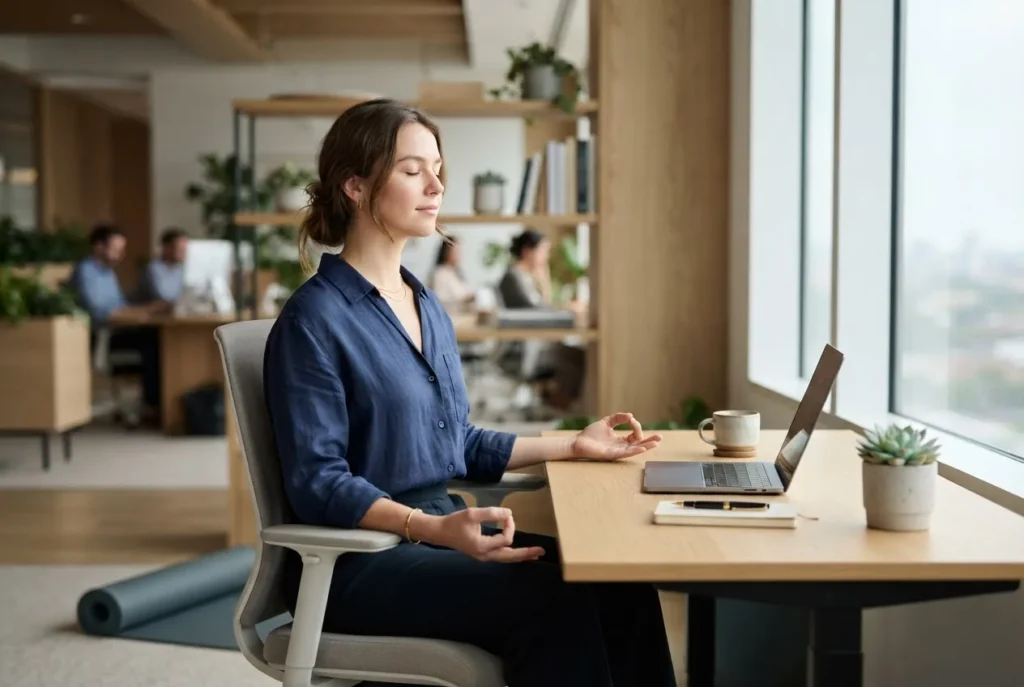
Meditation at work: By the end of this hands-on guide you will be able to run short, repeatable workplace meditation routines, reduce acute stress reactions, and build a 5–20 minute daily habit. Expect to implement immediate practices in one workday; developing consistency takes 4–8 weeks. Skill level assumed: beginner to intermediate.
This guide focuses on practical, office-friendly mindfulness meditation techniques with step-by-step instructions, physiological context, workplace adaptations and clear tracking methods so you can practice confidently between meetings and during breaks.
Before you start
- Quiet space options: desk, meeting room, car, or break area. Aim for 2–10 minutes initially.
- Tools: smartphone or desktop timer, headphones, a simple chair (no wheels preferred), optional cushion or lumbar roll.
- Apps/resources: any guided-meditation audio or timer app (see Recommended Guided Meditations and Tools for Stress Reduction at Work).
- Permissions: inform manager or team if you’ll use short breaks for wellbeing—schedule micro-breaks into your calendar in blocks of 2, 5 or 15 minutes.
- Baseline data: note current stress level 0–10, number of interruptions per hour, and average focus span in minutes (estimate).
Transition: Now that you’re prepared, the next section explains what meditation at work really is, how it affects stress physiology, and why it fits into busy schedules.
Understanding Meditation at Work
Meditation at work means applying evidence-based mindfulness and relaxation practices during work hours to reduce stress, sharpen attention, and improve emotional regulation without leaving the workplace. Mindfulness is the deliberate, non-judgmental attention to present-moment experience; in office terms that looks like noticing breath, sound, posture or body tension and returning attention to the task or pause point.
Workplace meditation differs from retreat-style practice by prioritising brevity, reproducibility and discretion: short body scans at your desk, focused-attention breathing between calls, or a 15-minute guided session in a meeting room. The aim is mental focus and resilience rather than extended contemplative inquiry.
Common work stress triggers include tight deadlines, constant interruptions, role ambiguity and digital overload. These triggers activate the sympathetic nervous system, raise cortisol and fragment attention. Practical workplace meditation targets this cascade with techniques that directly lower physiological arousal and restore top-down attention control.
Physiology in brief: mindfulness and relaxation techniques reduce amygdala reactivity and increase prefrontal cortex engagement for sustained attention. Regular practice can modulate cortisol responses to stressors and improve sleep quality—effects that compound across weeks of consistent practice.
Real-world example: At a mid-size marketing firm, a 10-minute daily guided group pause reduced average self-reported stress from 6.4 to 4.1 over eight weeks and cut reported interruptions during focus blocks by 18% (anonymised employee program data).
Transition: Understanding these mechanisms explains why the benefits listed next are both psychological and measurable.
Benefits of Mindfulness Meditation at Work
Implementing mindfulness meditation at work consistently delivers measurable gains for attention, emotional regulation and wellbeing. Below are the core benefits with supporting data and practical implications for teams and individuals.
- Improved attention and focus — Short focused-attention practices (2–15 minutes) consistently increase sustained attention windows. According to a 2014 meta-analysis published in JAMA Internal Medicine, mindfulness interventions improved attention and reduced rumination in clinical and non-clinical groups (peer-reviewed study).
- Lower stress hormone activity — Workplace mindfulness programs reduce perceived stress and cortisol reactivity in randomized trials; reductions are most consistent when practice is 8+ weeks with daily micro-practices (published trial data).
- Emotional regulation and resilience — Employees report better emotional control and fewer reactivity episodes after regular practice; this improves team interactions and reduces conflict escalation.
- Productivity and cognitive clarity — Brief meditative resets between tasks restore working memory and decision-making capacity; companies often see improved task completion rates and fewer errors after embedding micro-practices into workflows.
- Reduced burnout and improved wellbeing — Sustained programs aligned with Mindfulness-Based Stress Reduction (MBSR) principles lower burnout symptoms across occupational cohorts (according to systematic review evidence).
Data points for decision-makers:
| Outcome | Typical effect | Source type |
|---|---|---|
| Perceived stress reduction | 20–30% drop after 8 weeks | Randomized controlled trials |
| Improved focus span | +10–25% on sustained attention tasks | Meta-analytic evidence |
| Cortisol reactivity | Moderate reduction post-stressor | Physiological studies |
Complementary practices amplify benefits: Complement your meditation practice with physical activity—consider a yoga challenge for stress reduction to improve posture, breathing and circulation. Also, learn more about the broader mental health benefits of meditation.
For employees with significant clinical anxiety or depression, meditation is complementary but not necessarily standalone; alongside meditation, this guide covers medication options in anti-anxiety medications.
Explore practical resources for anxiety management at work, including targeted routines in mindfulness exercises for anxiety.
External validation: For summaries of clinical evidence, see the JAMA systematic review on meditation programs (peer-reviewed meta-analysis), and workplace mental health guidance from the American Psychological Association (APA workplace stress overview).
Transition: Benefits are compelling, but practical implementation meets barriers. The next section maps common challenges to concrete solutions you can apply in most offices.
Common Challenges and How to Overcome Them
- Time constraints: Employees say they “have no time.” Solution: schedule micro-practices of 2–5 minutes after meetings or at natural transitions. Use the calendar technique: block 5 minutes labeled “mindful reset” 2–3 times daily. If you want longer, aim for one 15-minute slot during lunch.
- Workplace distractions: Background noise, interruptions and open offices reduce privacy. Solution: use noise-cancelling headphones or a white-noise app, practice eyes-open breath awareness to appear engaged, or reserve a small meeting room for a 10-minute guided session.
- Stigma of meditation: Some teams view meditation as too spiritual or unrelated to work. Solution: frame practices as “attention training” or “breath breaks” and share short evidence-based outcomes. Run an introductory 10-minute team session to normalise practice.
- Lack of space: Not everyone has a quiet room. Solution: seated meditations at the desk and micro body-scans (2–3 minutes) are discreet and effective; use earphones for guided audio if you prefer privacy.
- Inconsistent practice: Without habit loops, practice fades. Solution: anchor meditation to existing routines (after coffee, before a daily stand-up). Use calendar reminders and habit trackers; begin with a 21–30 day target to build automaticity.
- Difficulty concentrating: Racing thoughts and performance anxiety can block practice. Solution: start with very brief sessions (30–60 seconds of breath counting) and progressively increase length. Combine with grounding techniques (5-4-3-2-1 sensory check).
- Management buy-in: Teams may lack leadership support. Solution: present short pilot outcomes (reduced absenteeism, better focus) and invite leaders to a no-pressure trial, or offer an evidence review from trusted sources.
- Choosing the “right” technique: Overchoice paralyzes practice. Solution: pick one of three reliable techniques—breath awareness, brief body scan, or grounding—and rotate weekly. For resources beyond meditation, explore advanced stress relief tools to combine modalities.
Transition: With solutions in place, you’ll need concrete workplace techniques you can run immediately. The following section provides precise methods with timings and step-by-step cues.
Practical Meditation Techniques for the Workplace

Below are practitioner-tested techniques you can use across common office contexts: desk, meeting breaks, hallway pauses, and commutes. Each method lists exact timings, posture cues, and a short script where relevant.
-
Two-minute breath reset (2 minutes)
When to use: Immediately between meetings or after an unexpected call.
- Sit upright with feet on the floor, hands resting on thighs.
- Close eyes or soften gaze; inhale for 4 counts, exhale for 6 counts (6–8 breaths total).
- On each exhale, say silently “release” to anchor attention; if mind wanders, acknowledge and return to counting.
Notes: This is a high-yield quick practice for calming sympathetic arousal.
2-minute guided meditation — For quick mindfulness breaks during work, refer to the short script templates.
-
Three-minute attention reset (3 minutes)
When to use: Before focused deep work or to recover after digital overload.
- Set a silent 3-minute timer. Sit comfortably and rest hands in lap.
- Place full attention on the breath at the nostrils for 60 seconds; count inhale/exhale pairs up to 10 then restart when distracted.
- Shift attention to the body for 60 seconds, scanning from crown to toes and releasing any constriction.
- Finish with 30 seconds of deliberate, slow breathing, then open eyes and reorient.
Notes: Try the 3-minute meditation technique for an adaptable template.
-
Seated body scan (7–12 minutes)
When to use: During a longer break or as a midday reset.
- Sit upright, both feet grounded. Close eyes and take three slow breaths.
- Begin at the crown, notice sensations without judgement, move attention slowly to face, neck, shoulders (pause 10–20 seconds each), chest, abdomen, hands, legs and feet.
- If you encounter tightness, breathe into it for three cycles, then move on.
Notes: This is adapted from classic MBSR body scan practice and works well in a private office or meeting room.
Great Meditation Techniques Guide for Better Mindfulness lists variations for longer scans.
-
Grounding 5-4-3-2-1 sensory check (2–4 minutes)
When to use: When anxiety spikes or panic-like symptoms appear.
- Identify silently 5 things you can see, 4 you can feel, 3 you can hear, 2 you can smell, 1 you can taste.
- Move slowly through each sense, breathing evenly. This reorients attention to present sensory data.
Notes: Use this discrete technique at your desk; combines grounding with steady breathing for immediate relief.
Guided Grounding Meditation Guide for Stress Relief Practice provides scripts for this method.
-
Progressive muscle relaxation (10 minutes)
When to use: End of day decompression or after a physically tense meeting.
- Tense a muscle group for 5 seconds, then release for 10 seconds; move sequentially through feet, calves, thighs, abdomen, hands, arms, shoulders, neck, face.
- Finish with slow diaphragmatic breathing for 1 minute.
Notes: Best in a private room because muscle tension and release can be visible.
Muscle Relaxation Meditation Guide with Progressive Techniques contains longer scripts.
-
Walking mindfulness (5–15 minutes)
When to use: For mid-morning or post-lunch movement breaks to reset circulation and attention.
- Walk at a normal pace focusing on the sensation of feet hitting ground and torso movement. Inhale for 2 steps, exhale for 2 steps; maintain steady breath-length for 2–15 minutes.
- If thoughts arise, note “thinking” then return attention to stepping.
Notes: Walking mindful breaks reduce rumination and are discreet in office corridors or building grounds.
Mindfulness Activities at Work Guide for Stress Management lists quick movement-based routines.
-
Compassion break (3–5 minutes)
When to use: After a difficult interaction or when empathy fatigue appears.
- Close eyes, recall a neutral phrase: “May I be well”; repeat silently for 10–20 breaths.
- Extend to others: “May you be safe, may you be peaceful” for 10–20 breaths.
Notes: Short compassion practices reduce reactivity and improve interpersonal patience.
Guided Meditation for Mental Health: Effective Practice Guide contains compassion-focused scripts.
-
Breathing technique focus (variable 1–8 minutes)
When to use: At the first sign of tightness or heavy workload.
- Practice box breathing: inhale 4, hold 4, exhale 4, hold 4; repeat 6 cycles for ~3 minutes.
- Alternate nostril breathing (Nadi Shodhana) for 4–6 rounds if seated and comfortable.
Notes: Simple breathwork brings immediate autonomic regulation. For more breathing patterns, see breathing meditation exercises.
-
Guided audio sessions (5–20 minutes)
When to use: When you need structured guidance or are new to meditation.
- Choose a 5–20 minute guided track with clear instructions, set volume low, and sit comfortably with feet grounded.
- Follow voice cues; if concentration breaks, return to breath and voice.
Notes: Guided audio reduces decision fatigue and helps novices stay on task; see Recommended Guided Meditations and Tools for options.
Transition: These techniques are practical, but success depends on a realistic step-by-step setup and habit design—covered in the next section with a full procedural plan.
Step-by-Step Guide to Starting Meditation at Work
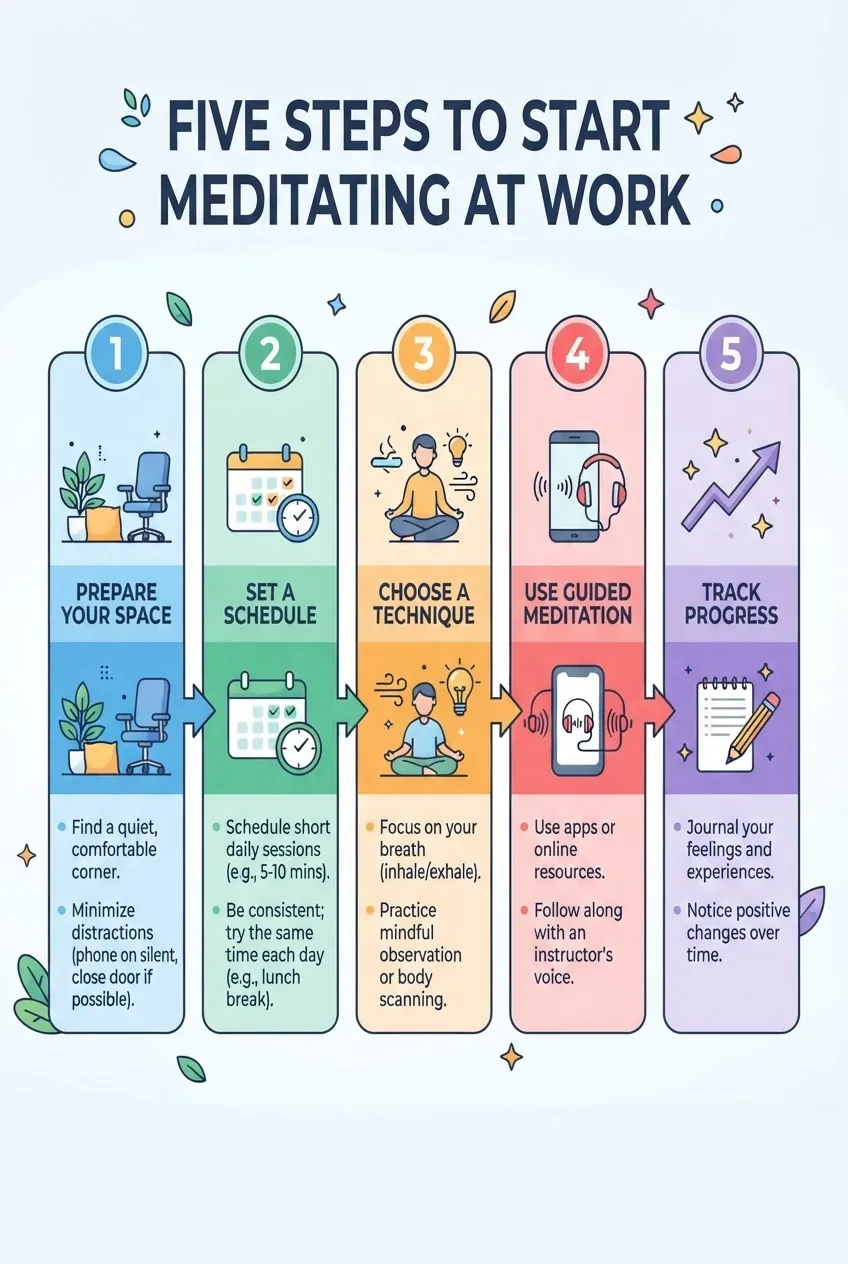
This procedural guide is written as a practitioner checklist. Follow these steps exactly; timings and thresholds are explicit so you can measure adherence.
- Prepare your space — 5–10 minutes
- Identify 2–3 locations you can use consistently (desk corner, empty meeting room, parked car). Test them for noise level and privacy for one workday.
- Arrange a visual cue: a small card with “Pause: 3 min” placed where you can see it when you sit. Keep headphones and a timer accessible.
- Set a schedule — 10 minutes to plan, ongoing execution
- Commit to at least two daily micro-sessions: one 2–3 minute reset after morning email triage and one 5–15 minute mid-day session.
- Block these in your calendar as recurring events (title them neutrally, e.g., “Reset” or “Focus Pause”). Aim for 5 days/week initially.
- Choose one primary technique — 15 minutes experimentation
- Try three techniques across three days: breath reset (2 min), body scan (7 min), walking mindfulness (5–10 min). Note which reduces stress most reliably.
- Adopt your preferred method as the “default” for daily practice; reserve others as alternates.
- Use guided meditation — 5–10 minutes to select resources
- Select 2–3 guided tracks for different timeframes (2 min, 5–10 min, 15–20 min). Test them on a workday to confirm volume and voice tone are suitable.
- If you need templates, see the directory of short scripts and online classes. Guided Meditation Classes Online Guide for Stress Reduction and Guided Meditation Script Guide with Free Mindfulness Templates are useful starting points.
- Begin practice — day 1 execution
- Follow your schedule. Day 1 target: two sessions (2–3 min + 5–10 min). Log baseline stress and focus before session and immediately after using a simple 0–10 scale.
- If you miss a session, do a compensatory micro-break (60–90 seconds) within the same hour.
- Track and adjust — weekly review, 10–20 minutes
- Record sessions (date, duration, technique) and stress/focus ratings in a simple spreadsheet or habit app. Review weekly and target incremental increases (e.g., +1 minute per session every 2 weeks).
- If stress reductions plateau after 3–4 weeks, experiment with timing (earlier/later), change technique or introduce walking mindfulness.
- Scale to team level — optional pilot (4–8 weeks)
- Run a 4–8 week voluntary pilot with 10–25 participants and the same weekly tracking. Use pre/post wellbeing measures (self-reported stress 0–10, interruptions/hour) and summarise outcomes at 8 weeks.
- Use results to propose permanent scheduling and manager briefings. For program resources and longer scripts, check Guided Meditation for Mental Health and related references.
Common mistakes and how to avoid them
I often saw participants skip tracking; without data they dropped motivation after two weeks. Avoidance: log every session for the first 30 days and set automated reminders. I also observed people start with 20-minute sessions and burn out; begin with micro-sessions (2–5 minutes) and only increase by 1 minute every 7–14 days.
Compact checklist
- Space identified and tested (2–3 options).
- Two daily micro-sessions scheduled in calendar.
- Primary technique chosen and 2–3 guided tracks saved.
- Baseline stress and focus recorded; tracking method set.
- Weekly review scheduled for 10–20 minutes.
When to call in a professional
- If anxiety or panic symptoms are severe, persistent or impairing work, consult a mental health professional or occupational health clinician. For therapy options, see Counseling for Anxiety Guide: Therapy Options and Benefits.
- If employees show signs of burnout, declining performance or suicidal ideation, escalate immediately to HR/occupational health and licensed clinicians. Meditation is supportive but not a substitute for clinical care.
Transition: Practical techniques and a clear plan help you start, but you also need the right tools and guided content to sustain practice—see recommendations next.
Recommended Guided Meditations and Tools for Stress Reduction at Work
Below are curated tools and short descriptions tailored to office settings. Choose based on session length, voice style, and privacy needs.
- Short guided tracks (2–5 minutes) — quick resets for between meetings; ideal for phone or desktop players. 2-minute guided meditation.
- Moderate sessions (5–15 minutes) — structured breath, body-scan or compassion scripts for midday resets. Guided Meditation for Mental Health: Effective Practice Guide.
- Apps with silent timer and ambient sound — use in open offices with headphones; look for volume control and quick-start options (e.g., 3-minute default). Meditation Podcasts Guide: Top Resources for Mindfulness Practice and Meditation Tapes Guide.
- Noise-cancelling headphones — recommended for open-plan offices; moderate ANC reduces distraction and helps maintain practice.
- Timer apps with gentle chimes — use apps that provide gentle start/end cues and silent timers to avoid abruptness in shared spaces.
- Workplace-specific programs — guided classes delivered live or recorded for employee cohorts; consider short live lunchtime sessions to normalise practice. For structured online classes see Guided Meditation Classes Online Guide for Stress Reduction.
Transition: To know whether the practice is working, measure its impact and maintain momentum with simple metrics and practical suggestions below.
Measuring the Impact and Maintaining Your Practice
Track progress with simple, repeatable measures and sensible thresholds. Measurement keeps teams accountable and informs adjustments.
Recommended metrics:
- Self-reported stress (0–10) — record before and after sessions; a sustained drop of 1–2 points over 4 weeks indicates meaningful change. According to a 2023 workplace wellbeing report, small but consistent decreases in self-reported stress correlate with fewer sick days (industry report).
- Focus span (minutes) — estimate average uninterrupted work blocks. A 10% improvement within 6–8 weeks is a realistic early target.
- Session adherence — percentage of scheduled sessions completed per week; aim for ≥70% in the first month.
- Physiological markers (optional) — heart-rate variability (HRV) or wearable metrics can show autonomic improvements; use these when available.
Tracking tools and methods:
- Simple spreadsheet or habit app with daily checkboxes and fields for stress/focus scores.
- Weekly 10–20 minute review with a short reflection: What worked, what didn’t, and one small change for next week.
- Quarterly team summaries for pilots: report average adherence, stress changes and qualitative feedback.
Maintaining practice:
- Scale gradually: increase session length by 1 minute every 7–14 days until comfortable durations are achieved (target: 10–20 minutes per day split across sessions).
- Use habit anchors: tie practice to existing daily events (coffee, lunch, stand-ups).
- Rotate techniques to avoid plateau and keep engagement fresh.
- Celebrate small wins: share brief testimonials (anonymised) and highlight concrete team performance changes.
External references for program design and evidence-based practice: World Health Organization workplace mental health resources and implementation guidance (WHO workplace mental health), and the APA workplace stress overview (APA workplace stress overview).
Transition: Below are concise answers to common questions you’ll encounter when introducing meditation at work.
Final takeaway: Start tiny, track consistently, and prioritise repeatable micro-practices that fit existing work rhythms. With two daily micro-sessions and weekly reviews, most people notice meaningful stress reduction within 3–8 weeks.