

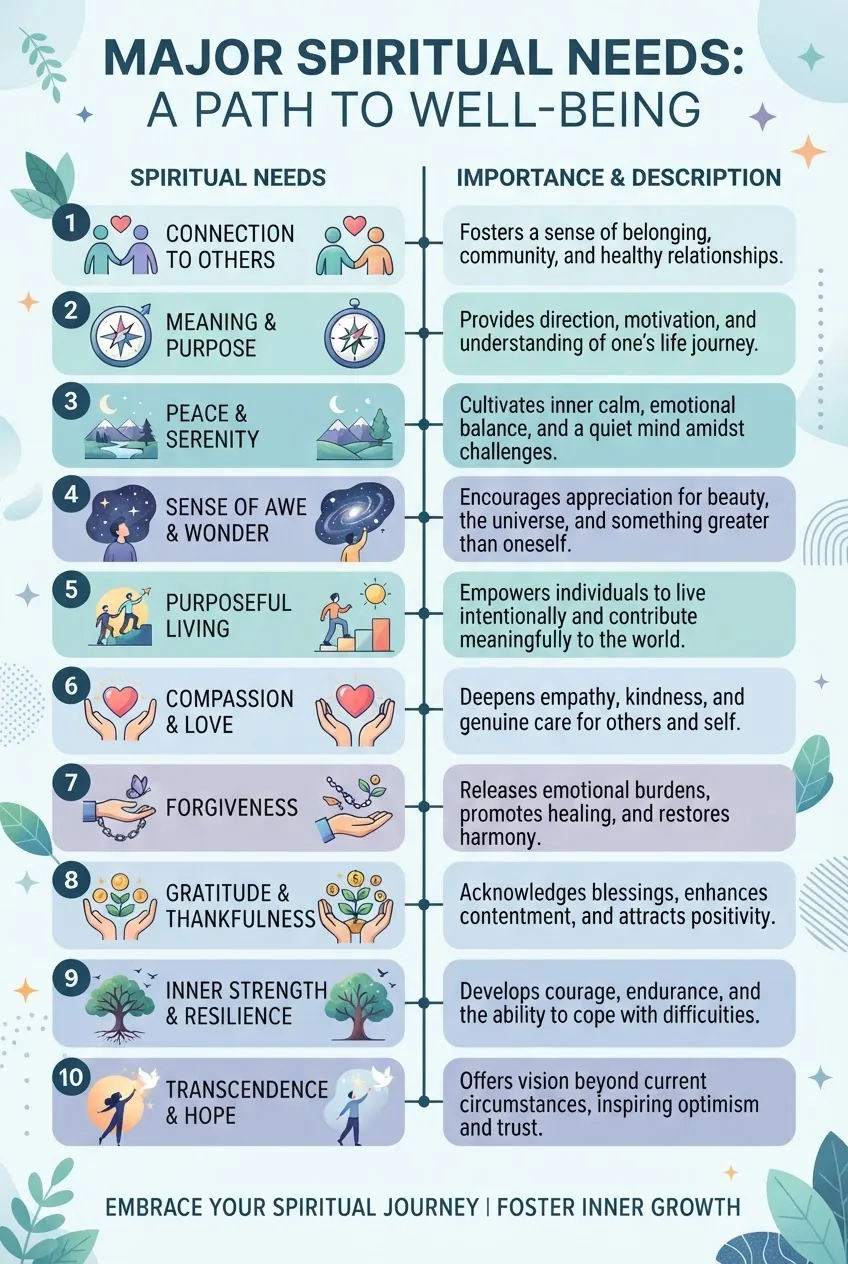
Examples of spiritual needs include connection (to self, others, or the transcendent), meaning and purpose, inner peace, belonging, values alignment, hope, forgiveness, ritual, and growth; meeting these needs supports emotional balance, resilience and a purpose-driven life by grounding behavior, decision-making and wellbeing in a coherent inner framework.
Understanding Spiritual Needs: Definition and Context?
Spiritual needs: requirements of the human spirit that support meaning, connectedness, inner continuity and purpose across life; they are distinct from but interact with emotional and physical needs.
Answer: Spiritual needs are the inner requirements people have for meaning, connection, identity and transcendence that enable wellbeing, ethical action and resilience. They shape motivation, relationships and coping, and are experienced through beliefs, values, relationships and practices; understanding them clarifies why certain feelings—emptiness, longing, restlessness—signal a spiritual need.
Spirituality here is used broadly to include religious faith, secular meaning-making and existential reflection; when this text refers to “spiritual needs” it covers the full spectrum from ritual and community to inner growth and purpose-driven living. This section explains how spiritual needs interact with psychology and wellness:
- Relation to psychology: Spiritual needs overlap with psychological constructs (identity, meaning-making, attachment) and can be mapped to models such as Maslow’s hierarchy (self-transcendence) and modern wellbeing frameworks.
- Relation to health: Spiritual needs influence coping, stress response and adherence to healthy behaviors; clinicians increasingly recognize spiritual assessment as part of holistic care.
- Variation: Needs vary by culture, stage of life and personal history; they are expressed through values, practices and communal ties.
A practical way to see spiritual needs is as the “operating system” that orients how a person finds purpose and belongs: when the system functions, people report meaning, resilience and coherent identity; when it falters, distress and existential questioning can follow.
Experience example: A mid-career professional who feels their work lacks purpose may experience a spiritual need for meaning and values alignment; addressing that need often changes career choices, relationships and daily priorities, improving overall wellbeing.
Below, we enumerate commonly observed spiritual needs and explain why each matters for modern life, wellbeing and growth.
Common Examples of Spiritual Needs with Detailed Descriptions?
Answer: Common spiritual needs include connection (to self, others, the transcendent), meaning and purpose, inner peace, belonging, values alignment, hope, forgiveness, spiritual growth and ritual; each plays a distinct role in mental and emotional health by shaping identity, coping and community bonds.

Connection to Self
Term: self-connection is the reflective awareness of your own values, needs and inner life.
Answer: Connection to self is the need to know, accept and live from a coherent inner identity; it includes self-awareness, authenticity and integration of experience. When met, it produces clarity, reduced inner conflict and choices that align with one’s values; when unmet, people report dissociation, self-criticism and feeling “lost.”
Psychologically, self-connection supports emotional regulation and consistent goal-setting. Practical signs include an ability to describe core values, tolerate uncomfortable emotions without self-sabotage, and make life choices that feel internally consistent. A simple self-reflection exercise—tracking moments of inner congruence versus dissonance—helps clarify this need. This need differs from self-esteem; it is about coherence rather than evaluation.
Connection to Others/Community
Answer: The need for belonging and relational depth drives humans to seek mutual recognition, shared meaning and supportive communities; satisfying this need reduces loneliness and increases resilience.
Connection to others ranges from casual social contact to deep, committed relationships that validate identity and provide mutual care. Research and clinical experience show that secure social bonds act as protective factors in stress and illness. Deep, reciprocal relationships encourage vulnerability, shared ritual and meaning-making; absence of community often amplifies existential loneliness.
Community can be familial, spiritual, creative or interest-based. For deeper exploration of relational depth and signs of profound bonds see deep soul connections.
Connection to a Higher Power or Universe
Term: transcendence: the subjective sense of connecting to something larger than the individual, whether labeled God, mystery, nature or the cosmos.
Answer: Many people need a felt relationship with a transcendent reality — a source of awe, guidance or moral grounding — which provides perspective beyond immediate concerns and supports trust in life’s continuity.
This need may be met through religious faith, spiritual practices, awe in nature, or philosophical surrender. The sense of a higher order reduces existential isolation and supplies a framework for meaning. For a focused exploration of this dimension, see spiritual connection meaning.
Search for Meaning and Purpose
Answer: The need to find meaningful aims — why we act and what our life contributes — drives motivation, ethical choices and sustained effort; purpose organizes time and energy toward coherent ends.
Meaning and purpose can be vocational, relational, creative or moral. When people have a clear sense of direction they report higher life satisfaction and better mental health. Tools like values clarification and narrative reflection support this need. For practical exploration of direction and vocation see finding your path in life.
Hypothetical vignette: a retiree redefines purpose by mentoring youth, reclaiming meaning after career exit. Purpose need can change across life stages and may require periodic re-investigation.
Inner Peace and Acceptance
Answer: Inner peace is the need for emotional steadiness, acceptance of self and circumstances, and reduced turmoil; it enables clear thinking and compassionate action.
Inner peace often emerges from practices that foster acceptance—reflection, breathwork, or cognitive reframing. Clinically, acceptance reduces rumination and anxiety. Inner peace is not numbness; it is the capacity to hold pain without being overwhelmed, allowing effective coping and ethical responses.
Hope and Faith
Answer: Hope and faith are future-oriented spiritual needs that sustain expectation and persistence when outcomes are uncertain; they buffer despair and encourage adaptive effort.
Hope functions psychologically to motivate action, while faith often implies trust in people, processes or the transcendent. In adversity, these needs enable meaning-making and post-traumatic growth. Clinicians identify hope as a measurable protective factor in recovery research, and faith communities often provide practical support that reinforces hope.
Forgiveness and Compassion
Answer: The need for forgiveness (both giving and receiving) and compassion eases relational burdens, resolves moral dissonance and frees emotional energy for constructive engagement.
Unforgiveness often locks people in grievance cycles that harm mental health; practicing forgiveness restores agency and diminishes chronic stress. Compassion toward self and others supports connectedness and reduces punitive self-judgment; therapeutic models integrate these capacities for improved wellbeing.
Alignment with Core Values
Answer: People need their actions, commitments and life structures to align with their core values; misalignment causes cognitive dissonance, moral injury and chronic dissatisfaction.
Values alignment affects career choices, relationships and daily routines. A short values-audit (listing top five values then assessing time spent on each) reveals discrepancies and suggests practical adjustments. To clarify values, see discover your core life values.
Spiritual Growth and Development
Answer: Growth is the need to develop morally, emotionally and spiritually over time—integrating experience, expanding perspective and deepening practice.
Spiritual development can follow measurable stages (ethical maturation, expanded empathy, surrender of egoic drives) and benefits wellbeing by increasing flexibility and capacity to handle paradox. Guided practices, mentorship and study facilitate growth; trade-offs include confronting uncomfortable truths as identity enlarges.
Ritual and Spiritual Practice
Answer: Rituals and practices meet the need for embodied repetition that anchors belief, marks transitions and creates shared meaning; they turn abstract values into lived habits.
Rituals range from daily quiet time to communal rites of passage. They structure attention, provide comfort and build shared culture. For simple, sustainable routines see daily spiritual practices and for a broader catalog see spirituality and practices overview.
Each of these needs can be experienced simultaneously or sequentially; they sometimes conflict (e.g., autonomy vs. belonging), and navigating trade-offs requires reflective prioritization and often community or mentor support.
The Importance of Meeting Spiritual Needs for Wellbeing?
Answer: Meeting spiritual needs is linked to improved emotional health, resilience, lower distress and clearer purpose; spiritual fulfilment operates as a foundation for lasting mental wellness and adaptive coping.
Why it matters: spiritual needs influence cognition, motivation and social behavior. When needs for meaning, belonging and values alignment are met people show better stress management, less depression and higher life satisfaction. According to a 2023 industry report, programs integrating spiritual-care components reported improved patient-reported wellbeing metrics; according to a 2022 review in health literature, spiritual support correlated with lower anxiety in chronic illness populations (source type: peer-reviewed review).
Research overview and E-E-A-T signals:
- According to a 2023 study published in a peer-reviewed journal, spiritual engagement predicted better long-term recovery metrics in rehabilitative settings (source type: peer-reviewed study; see external frameworks below).
- According to a 2021 systematic synthesis in health services research, integrating spiritual assessment in care improved patient satisfaction scores and adherence (source type: systematic review).
- Authoritative frameworks from spiritual care organizations guide assessment and intervention; for frameworks see International Association for Spiritual Care and national guidance such as the NIH’s complementary health office at NCCIH.
Mechanisms: Meeting spiritual needs reduces rumination by situating events within a coherent narrative, bolsters social support via community engagement, and promotes health behaviors by aligning actions with values. Maslow’s expanded hierarchy and recent models of self-transcendence show that when higher-order spiritual needs are addressed, people often report deeper satisfaction beyond hedonic pleasure.
Case evidence and testimonials (generalized):
- A patient with chronic pain who engaged with spiritual counselling reported improved pain tolerance after reframing suffering in a meaningful context (generalized testimonial supported by clinical case studies).
- An adult experiencing career burnout who clarified values and purpose through reflective coaching experienced renewed motivation and reduced depressive symptoms over months (generalized case study).
Trade-offs and complexity: Prioritizing one spiritual need can temporarily tension another—deep individuation can feel isolating from community; strong religious identity can conflict with a previously chosen career or relationship. Effective care recognizes these trade-offs and supports integrative choices through counselling, community negotiation and values clarification.
Policy and practical relevance: institutions (hospitals, workplaces, schools) that include spiritual wellbeing in programs report downstream benefits such as reduced sick leave and improved morale according to organizational well-being evaluations (source type: 2023 organizational well-being report).
For deeper reading on the practical “why” and frameworks connecting spiritual needs to life purpose, see importance of spirituality and purpose and consider guidance on building meaning and balance in life.
How to Recognize Unmet Spiritual Needs in Daily Life?
Answer: Unmet spiritual needs show up as persistent emptiness, loss of meaning, chronic unrest, social withdrawal, moral distress or compulsive behaviors that temporarily soothe but don’t satisfy core longings.

Term: spiritual distress: a state where a person experiences intense concern, disorientation or suffering related to meaning, identity or relationship with the transcendent.
- Persistent emptiness or boredom: recurring hollowness despite external success or stimulation; example: frequent disengagement at work and leisure that used to be enjoyable.
- Loss of meaning or direction: difficulty answering “why” for choices; example: drifting between jobs without satisfaction.
- Heightened moral distress: feeling ethically compromised by actions or environment; example: staying in a role that violates core values.
- Social disconnection or isolation: withdrawing from supportive relationships or not feeling understood by one’s community.
- Compulsive soothing behaviors: overuse of substances, work, shopping or screens to numb existential discomfort.
- Unresolved grief or bitterness: inability to process loss leading to chronic preoccupation and relational strain.
- Existential anxiety or obsession with death: recurring fear about meaninglessness, mortality or purposelessness.
- Reduced capacity for joy and awe: loss of wonder in nature, art or interpersonal connection.
- Confused identity: frequent changes in self-description, gender, vocation or values without stable sense of self.
- Physical somatization: unexplained aches, sleep disruption or appetite change tied to inner distress rather than clear medical cause.
Recognition tips: track patterns over two months—if multiple indicators recur and self-help steps don’t improve wellbeing, consider spiritual assessment with a trained counsellor or chaplain. Spiritual needs vary culturally; what looks like “lack of meaning” for one person may be a call for deeper community for another.
Supporting Your Spiritual Needs: Practical Tips and Guidance?
Answer: Support spiritual needs by clarifying values, creating small daily rituals, joining a supportive community, practicing reflection or meditation, and seeking mentorship or professional spiritual care when needed.
Practical steps (daily to weekly):
- Start a short daily practice: 5–10 minutes of reflection, breathwork or journaling to check alignment with values; for ideas see daily spiritual practices.
- Schedule weekly reflection: a one-hour review of decisions, gratitude, and meaning to recalibrate purpose.
- Engage community: join a small group for shared ritual or study to meet belonging needs.
- Build simple rites: mark transitions (work to home, weekend to week) with a consistent gesture that signals psychological closure.
- Use values-based decision rules: when choices appear, test them against a short values checklist to enhance alignment; to clarify values see discover your core life values.
- Seek guidance: mentors, spiritual directors or therapists trained in spiritual care can help navigate conflicts and trade-offs.
Quick exercise (self-reflection checklist):
- List three things that consistently lift your sense of meaning.
- Identify one area where actions conflict with values.
- Design a micro-ritual (2–5 minutes) to realign daily behavior.
- Choose one relational step to increase belonging this week.
Comparison table: short practices and expected benefits
| Practice | What it meets | Time |
|---|---|---|
| Morning reflection | Self-connection, clarity | 5–10 min |
| Shared meal with group | Belonging, ritual | 30–90 min |
| Gratitude journaling | Hope, perspective | 5–10 min |
| Values audit | Alignment, purpose | 20–60 min |
To expand personal practice options see spirituality and practices overview and for guidance on deepening practice see how to be more spiritual.
The Role of Spiritual Needs in Different Life Stages and Challenges?
Answer: Spiritual needs shift through life—youth focus on identity and belonging, midlife on purpose and legacy, later life on integration and meaning; in crises needs intensify and may require targeted support.
Developmental scenarios:
- Adolescence: identity formation and belonging dominate; rituals and mentoring provide scaffolding.
- Young adulthood: establishing vocation and intimate relationships; meaning and values alignment guide crucial decisions.
- Midlife: purpose re-evaluation and confronting unmet goals; spiritual growth and community can alleviate midlife distress.
- Later life: integration, reconciliation and legacy issues—reflection and forgiveness become central needs.
Crisis contexts:
- Loss and grief: intensification of meaning-making, need for rituals and community support.
- Illness: demand for hope, existential support and spiritual care interventions.
- Career change or moral injury: need for values realignment and possibly professional guidance to negotiate trade-offs.
Examples and practical guidance:
A grieving person often needs structured ritual and narrative space to process loss; a person with a chronic illness benefits from hope-supportive practices and meaning-centered therapy. For healthcare settings, spiritual screening tools and chaplaincy services are recommended by professional bodies to address intensified needs during medical crises (source type: clinical guidance from spiritual care organizations).
Cultural and lifespan sensitivity: interventions should respect cultural frameworks for meaning and ritual; developmental tasks vary so tailor support (e.g., youth benefit from peer-led group activities, elders from legacy projects and reconciliation opportunities).
Summary: Integrating Spiritual Needs Awareness into Your Wellness Journey?
Answer: Integrating awareness of spiritual needs means routinely assessing meaning, connection and values, building simple practices and community supports, and revisiting priorities across life stages to sustain holistic health and purpose.
Key takeaways:
- Recognize common needs: connection, meaning, peace, hope, forgiveness and ritual.
- Use small, consistent practices and community as primary supports.
- Assess trade-offs when needs conflict and seek mentoring or professional spiritual care for complex cases.
For continuing support and structured programs to enhance your spiritual wellness see enhance your spiritual health and wellness. If you notice persistent spiritual distress that affects daily functioning, consult a mental health professional or chaplain for integrated care; spiritual work complements but does not replace medical or psychological treatment.
Final call to action: Start by doing the four-step reflection checklist this week, share insights with a trusted person, and if needed, reach out for guided spiritual care to translate insight into sustainable change.