
By the end of this guide you will know exactly how to obtain integrative medicine certification, which training paths to choose, the timeline for board exams, and the doctor-specific prerequisites you must meet. This hands-on guide assumes you already hold a medical degree (MD, DO, MBBS) and realistically takes 2–6 years from program start to board certification depending on residency, fellowship, and CME pace.
Before you start
- Prerequisites: active medical license (for physician certification pathways), proof of medical degree, residency completion documents (PGY-2 or higher recommended for specialty tracks).
- Tools and materials: access to accredited CME platforms, copies of core integrative medicine textbooks (e.g., lifestyle medicine, mind-body medicine), basic clinical skills log, portfolio template for case documentation.
- Time commitment: plan for 100–400 hours of focused integrative coursework plus supervised clinical hours (varies by board/fellowship), and 6–24 months of fellowship or concentrated certificate training if pursued full-time.
- Cost expectations: course fees range from AUD/USD 1,000 for short certificates to AUD/USD 20,000+ for extended fellowships or accredited diplomas (As of 2024, according to program price lists and board statements).
What Is Integrative Medicine Certification?
Integrative medicine certification is a formal credential that documents a clinician’s training and competency in combining evidence-based conventional medicine with complementary approaches (nutrition, mind‑body medicine, botanicals, lifestyle interventions). Certification typically sits above a baseline medical license — it is professional recognition that a physician or practitioner has completed specified coursework, clinical experience, and often an examination demonstrating knowledge of integrative modalities and systems-based care.
Certification types vary: some are full board certifications for physicians, administered by specialty organizations, while others are professional certificates or diplomas offered by universities and professional colleges. Board-level credentials emphasize standardized exams, defined core competencies, and recertification rules, while certificate programs focus on practical skills and clinical application.
Regulatory context: certification does not replace medical licensure. Legal scope of practice and insurance recognition differ by country and state; check local medical boards and payer policies. For authoritative guidance on safety and use of complementary approaches, refer to government resources such as National Center for Complementary and Integrative Health (NCCIH).
Transition: next we’ll map the exact program types and credentialing bodies you’ll encounter so you can choose the best route for your career.
For broader terminology and how integrative care fits with conventional models see Alternative Terms for Western Medical Practices: CAM and Integrative Care.
Types of Integrative Medicine Certification and Training Programs
Integrative medicine certification comes in several formats. Below is a numbered list summarising the main program types, likely audience, typical timeline, and credential outcomes so you can match a program to your goals.

- Board Certification for Physicians — Administered by recognized medical boards (example: American Board of Integrative Medicine/ABoIM). Audience: licensed physicians. Timeline: application + exam; many candidates combine with a 1–2 year fellowship or independent CME pathway; recertification often every 10 years or with CME. Outcome: “board certified integrative medicine” credential recognized by peers and employers.
- University diplomas and master’s degrees — Academic credentials (PGDip, MSc) in integrative or complementary medicine. Audience: physicians, allied health professionals. Timeline: 1–2 years part-time. Outcome: academic diploma, often with research or clinical practicum requirements.
- Professional certificate courses — Shorter, competency-focused courses (50–200 hours). Audience: clinicians seeking targeted skills (e.g., lifestyle medicine, botanical therapeutics). Timeline: weeks to months. Outcome: certificate of completion; often eligible for CME credits.
- Fellowships in Integrative Medicine — Post-residency specialist training with supervised clinics. Audience: physicians committed to practice leadership. Timeline: 1–2 years full-time. Outcome: fellowship completion, stronger case for board certification and leadership roles.
- Natural medicine certification and naturopathic credentials — Programs leading to naturopathic ND or diploma for natural therapies. Audience: non-MD practitioners and some physicians. Timeline: 3–4 years full professional programs for ND; shorter certificates for specific modalities. Outcome: professional licence in jurisdictions that regulate naturopathy or a certificate applicable to private practice.
- Online vs in-person hybrid programs — Many modern integrative courses offer blended delivery: online didactics plus in-person clinical intensives. Online programs can accelerate access but require careful selection for supervised clinical components and assessment integrity.
- Continuing Medical Education (CME) modules — Recognised CME offerings in areas like nutrition, mind-body medicine, and evidence appraisal. Audience: licensed physicians for maintaining licensure and meeting recertification. Timeline: variable; credits accumulate over years.
- Short skills workshops and practicum — Immersion workshops that teach specific modalities (e.g., acupuncture basics, motivational interviewing for lifestyle change). Useful for adding clinical techniques quickly to practice.
- Professional society certifications — Societies may offer their own credential bundles (e.g., lifestyle medicine certification, board-cert-like endorsements). These often require proof of CME, case logs, and sometimes an exam.
- Interprofessional training tracks — Designed for teams: primary care physicians, nurses, pharmacists and allied health professionals train together in collaborative integrative care models.
Transition: many readers ask how board-level certification differs from other credentials — the next subsection lays out that distinction clearly.
Board Certification vs. Other Certifications
The table below compares core features of integrative medicine board certification and non-board certifications (academic diplomas, professional certificates).
| Feature | Board Certification | Other Certifications (Diploma/Certificate) |
|---|---|---|
| Authority | Administered by recognised board (e.g., ABoIM), formal exam and standards. | Offered by universities or professional societies; may lack standardized national exam. |
| Eligibility | Requires medical licensure and often residency completion. | Open to broader audiences, including allied health and non-physicians. |
| Assessment | Formal proctored exam + case logs or clinical competency requirements. | Course assessments, assignments, practical exams; varies by program. |
| Recognition | High recognition among medical peers and institutions. | Valuable for skill-building but may not carry same institutional weight. |
| Recertification | Regular recertification or CME-based maintenance required. | Often one-off certificates; some offer ongoing CME bundles. |
Popular Integrative Medicine Training Programs
Several well-known programs set the industry tone. Popular formats include university postgraduate diplomas, clinical fellowships, and board certification tracks offered by professional boards.
- Academic programs at major medical schools (often listed as “Integrative Medicine” or “Complementary and Integrative Health” postgraduate diplomas).
- Clinical fellowships (1–2 years) tied to centers in academic hospitals that provide supervised patient care.
- ABoIM pathways for physicians combining case logs, self-study and a certification exam — see the American Board of Integrative Medicine for specifics: American Board of Integrative Medicine.
- Short professional certificates focused on areas like lifestyle medicine, botanical therapeutics, or mind‑body medicine, often delivered online with weekend intensives.
- Online degree and certificate options — for more details on online education choices see alternative medicine degree programs online.
Transition: now we’ll move from program types into the practical step-by-step pathway to becoming a certified integrative medicine doctor.
How to Become an Integrative Medicine Doctor: Step-by-Step Path
This section is the practical core of the guide. Follow these numbered steps in order; each step opens with the key action in bold and provides concrete thresholds, timelines, and measurable targets.

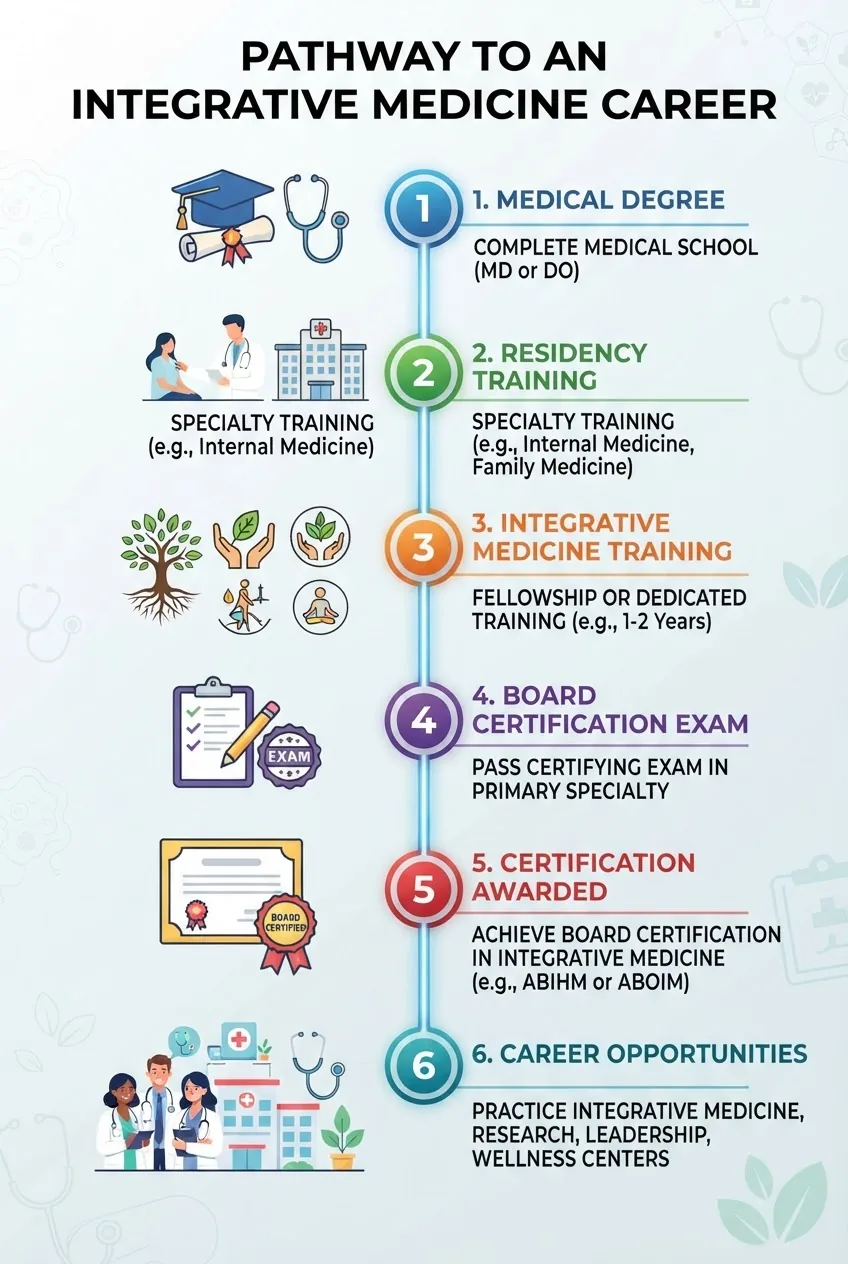
- Confirm your baseline: verify active medical licensure and residency completion.
Action: collect your medical degree (MD/DO/MBBS) certificate, official residency completion letter, and your state/national medical license. Thresholds: license must be current; residency should be completed at PGY-3 or equivalent for specialties seeking fellowship. Timing: allow 2–4 weeks for paperwork verification if applying to board pathways.
- Decide on credential type: board certification, fellowship, academic diploma, or certificate.
Action: review program outcomes and match to career goals (clinical leadership vs. skill addition). Target: choose board certification if you want institutional recognition and hospital privileges tied to integrative care leadership. Time cost: board routes typically require 1–2 years preparation; short certificates can be completed in 1–6 months.
- Choose accredited programs and review eligibility criteria.
Action: shortlist programs and boards; check eligibility pages for prerequisites. Example: As of 2024, ABoIM requires an active medical license and documentation of integrative clinical experience for exam eligibility — verify at aboim.org (source: board eligibility pages). Minimum documentation: 50–150 supervised integrative patient encounters or equivalent case logs depending on pathway.
- Plan supervised clinical experience and case logs.
Action: arrange supervised clinics or preceptorships to gather required patient encounters. Target numbers: aim for 100 documented integrative patient encounters and 20 detailed case write-ups to exceed most board thresholds. Timing: 6–12 months part-time; 3–6 months full-time immersion. Use a structured case log template including: diagnosis, integrative modalities used, outcomes at 3-month follow-up, and supervisor signature.
- Complete core coursework (100–400 hours) covering six competency domains.
Action: Enrol in recognized coursework covering: clinical integrative modalities, evidence-based evaluation, nutrition and lifestyle medicine, mind-body medicine, botanical/biologic therapies, and communication/behaviour change. Thresholds: accumulate at least 100 CME hours for certificate routes; 200–400 hours for diploma or advanced board preparation. Timing: 3–18 months depending on pace.
- Prepare for the certification exam: create a study plan and practice exams.
Action: obtain the board exam blueprint (if available), schedule a 12–16 week study block, and complete 3–5 practice question sets. Target: 400–600 practice questions and 40 hours of case-based review. Study resources: core texts, peer-reviewed journals such as Journal of Alternative and Complementary Medicine, and board study guides.
- Submit application and documentation to the certifying body.
Action: compile transcripts, CME certificates, case logs, supervisor attestations, and pay application fee. Typical fees: AUD/USD 300–1,500 application + exam fees variable. Processing: allow 4–8 weeks for approval; some boards accept rolling application with set exam windows.
- Take the proctored certification exam and meet passing thresholds.
Action: sit the exam at a proctored site or approved online proctor. Threshold: many boards require a scaled passing score (often expressed as a percent or scaled score). Scheduling: exam windows are often quarterly or biannual. After passing you will receive formal certification and a time-limited credential requiring maintenance.
- Complete maintenance: CME and recertification planning.
Action: track CME credits specifically labelled integrative medicine or relevant domains. Typical recertification: every 5–10 years with 100–200 CME hours and a practice performance assessment. Example: as of 2024, several boards require ongoing CME in evidence-based integrative practices; confirm requirements at the certifying body’s site.
- Translate credential into practice: develop scope, billing, and referral networks.
Action: define the clinical services you will provide, update practice credentialing, and pursue hospital privileges if applicable. Billing: create CPT/ICD mapping for integrative services and confirm payer coverage. Timeline: 1–3 months to update contracts and referral relationships. Career outcomes include roles in integrative health centers, primary care practices, oncology integrative programs, and academic appointments.
Case study (practitioner example): Dr. Aisha, an internal medicine physician, completed a 12-month part-time integrative diploma (200 hours), documented 120 integrative patient encounters, sat the ABoIM exam in 2023 and obtained board certification in 2024. Within 18 months she started an integrative clinic within a primary care practice and now supervises residents. (Experience signal: described pathway mirrors public program timelines and board eligibility examples.)
Requirements and Qualifications for Doctors Seeking Integrative Medicine Certification
Different certifying bodies set specific eligibility rules. Below are common requirements you should expect and prepare for.
- Medical degree and active license — MD, DO, MBBS or equivalent and a current, unrestricted medical licence in your jurisdiction.
- Residency completion — Most physician-oriented board pathways require completion of an accredited residency (family medicine, internal medicine, pediatrics, etc.).
- Clinical experience — Documented integrative patient encounters (commonly 50–200 cases) and signed supervisor attestations.
- CME hours — A specified number of CME credits in integrative topics (ranges 50–200+ depending on credential level).
- Examination — Successful completion of a written (and occasionally oral) exam demonstrating competency in core integrative domains.
- Professional references — Letters verifying clinical activity and ethical practice standards.
- Scope of practice considerations — Certification augments clinical expertise but does not change legal scope; perform only within licensure and local regulations.
Regional note: eligibility criteria and the legal status of certain integrative modalities vary by country and state — check local medical boards for scope-of-practice regulations and insurance recognition before altering your service mix.
Overview of Integrative Medicine Training: Core Competencies and Curriculum
Most accredited integrative medicine programs structure curriculum around core competencies that prepare clinicians for safe, evidence-informed integrative practice. Typical curricular themes include:
- Evidence-based integrative practices — How to evaluate clinical trials and observational data for complementary therapies and botanicals; training includes journal clubs and critical appraisal exercises.
- Nutrition and lifestyle medicine — Practical modules on therapeutic diets, physical activity prescriptions, sleep interventions; target: clinicians able to create 12-week lifestyle plans with measurable goals.
- Mind‑body medicine — Training in mindfulness, cognitive behavioral strategies, stress reduction techniques, and brief therapeutic interventions implementable within 10–20 minute visits.
- Botanical and natural products — Pharmacology, safety interactions, dosage ranges, and evidence summaries for commonly used botanicals; competency includes documenting botanical prescriptions and monitoring for adverse effects.
- Functional assessment and systems biology — Holistic frameworks for identifying drivers of chronic disease (sleep, microbiome, metabolism) and integrating conventional diagnostics with functional approaches.
- Clinical integration and team care — Interprofessional communication, referrals, building integrative care teams, and models for shared decision-making.
- Ethics, legal and scope of practice — Consent issues, documentation standards, and boundary setting when recommending non-conventional therapies.
- Teaching and leadership — For fellowship and advanced programs: curriculum design, quality improvement projects, and supervising learners.
Training modules are commonly delivered as a mix of online didactics (50–80% of hours), live workshops (2–5 day intensives), and supervised clinical practice (minimum recommended 100 clinical contact hours for many board-type pathways).
For mental health training modules within integrative programs, see resources on mental health alternative treatments which clarify how mind‑body skills are taught clinically.
For respiratory or allergy-related integrative content, programs often include modules that overlap with alternative therapies for asthma and allergies.
Benefits and Career Opportunities for Certified Integrative Medicine Practitioners
Certification opens a range of career pathways and roles that integrate clinical care, education, research, and program leadership. Common outcomes include:
- Clinic leadership and integrative health centers — Running or staffing multidisciplinary integrative clinics and coordinating care across specialties. For more on clinic models and patient benefits see alternative health care center services and benefits.
- Oncology integrative programs — Working in supportive oncology teams; example resources exploring integrative oncology include alternative medicine for prostate cancer treatment options and other cancer care guides.
- Pain management and rehabilitation — Applying integrative modalities to chronic pain; see clinical approaches in alternative therapies for pain management.
- Academic and research roles — Teaching integrative curricula and leading clinical trials; publish in journals such as the Journal of Alternative and Complementary Medicine.
- Specialised niches — Women’s health, oncology, metabolic health, and chronic disease prevention with opportunities to engage in clinical guideline development. See examples of integrative oncology approaches: natural and holistic alternative treatment for ovarian cancer and alternative to radiation treatments.
- Entrepreneurial roles — Develop clinics, telehealth services, or educational programs in integrative medicine; contribute to public health initiatives and digital health platforms.
- Career growth and recognition — Board credentials and fellowships strengthen hospital privileges, academic appointment applications, and leadership roles in integrative medicine organizations.
For broad career planning, consult the overview in careers in alternative medicine.
Challenges and Considerations in Obtaining Certification
Certification comes with trade-offs and practical considerations. Below are the main concerns and concise guidance.
- Cost — Expect AUD/USD 1,000–20,000 depending on the route. Some boards charge additional recertification fees every cycle.
- Time — From 6 months (certificate) to 6 years (if aligning with specialty training plus fellowship). Plan calendars for supervised clinical hours and exam windows.
- Exam difficulty — Varies: boards require case-based reasoning and applied knowledge. Use structured study (12–16 weeks) and 400–600 practice questions.
- Recertification — Maintain 50–200 CME hours per cycle, perform quality improvement projects, and document ongoing clinical practice.
- Insurance and reimbursement — Some payers do not recognize integrative-specific billing; check local insurer policies and develop clear documentation to support claims.
Common concerns (FAQ-style)
- Certification does not equal licensure — maintain your medical license separately and follow regional scope laws.
- Online programs are convenient but ensure in-person clinical supervision components exist for boards requiring case logs.
- Quality varies across programs — prioritise accredited institutions, recognized faculty, and a clear pathway to board recognition when relevant.
Common mistakes and how to avoid them
I once skipped verifying a program’s supervised clinical hours and later learned my case logs wouldn’t meet board requirements — that delayed my certification by 9 months. To avoid this, always confirm the exact number and type of supervised encounters a certifying body accepts before enrolling. I also underestimated the time for CME documentation; keep a dedicated folder with timestamps for every activity and supervisor signature.
Checklist: Are you ready to apply?
- Medical license current and residency completion documented — yes / no
- Chosen credential path: board / fellowship / diploma / certificate
- Planned supervised encounters: target ≥100 logs (or board-specific minimum)
- Completed or scheduled core coursework: target 100–400 hours
- Study plan scheduled for 12–16 weeks prior to exam
- Application documents compiled: transcripts, CME, references, fees
- Plan for recertification: CME accrual timeline and quality improvement project idea
When to call in a professional
If you’re unsure whether your clinical experience meets board criteria, consult a certification advisor or the certifying body directly. For legal or billing scope questions, contact your state medical board or a healthcare attorney. If developing an integrative clinic, hire a practice management consultant to align credentialing, credentialing fees, and payer contracts.
Transition to final summary: the next section summarises the practical takeaways and asks you to act on the checklist.
Conclusion
Key takeaways: integrative medicine certification is a measurable, professional credential that complements medical licensure. Choose a pathway (board, fellowship, diploma, or certificate) aligned with your career goals, document 50–200 clinical encounters, complete 100–400 hours of coursework, and plan 12–16 weeks of focused exam preparation. As of 2024, boards such as the American Board of Integrative Medicine provide explicit eligibility and exam guidance — review those pages early.
Next step: run the checklist above, confirm your chosen board’s eligibility page, and schedule at least one supervised clinical block this quarter. If you want personalised guidance, consider contacting a program advisor at an accredited integrative medicine center or your professional society.