

what do i do with my life: by the end of this guide you’ll have a clear short-term action plan, a 12–36 month directional roadmap, and a daily spiritual-practical routine to keep momentum; expect to spend 6–12 focused hours over two weeks. Skill level: beginner to intermediate—no prior coaching required.
Before you start
- Notebook or journal (A5, 120+ pages) and a pen you enjoy writing with
- Quiet space 20–45 minutes per session, 3 sessions across two weeks
- Timer or phone with Do Not Disturb (set for 20 and 45 minutes)
- Optional: meditation cushion or chair, simple habit tracker app, trusted friend or mentor for accountability
- Open mind and willingness to take imperfect action
Understanding the Question “What Do I Do With My Life”
The question “what do i do with my life” often arrives at moments of transition: graduation, a layoff, a relationship change, or a midlife recalibration. It signals a search for life direction that combines day-to-day choices (jobs, relationships, routines) with deeper year-to-year aims (meaning, legacy, wellbeing). Imagine standing at a forked trail without a map or compass—your mind runs through options, fear, and habit until exhaustion or indecision sets in.

A typical scenario: Anna, 28, worked in marketing but felt restless. She would ask, “What must I do with my life if I’m not sure marketing is it?” That unrest is not failure; it’s a signal to assess skills, curiosity, and inner priorities. Practical introspection—structured rather than rumination—turns questions into experiments.
Many people conflate “what I do” (career, role) with “who I am” (identity). The first is changeable; the second is an evolving core. When I guide clients I separate immediate, reversible experiments (3-month side projects) from longer commitments (education, relocation). This reduces paralysis and opens space for discovery.
To explore, start with three short reflective prompts: 1) Where did I lose time last week because I was absorbed and energized? 2) What annoyed me most (and why)? 3) If money and opinion didn’t matter, what would I try for 90 days? These prompts orient you from vague anxiety to specific inquiry. For more structured introspection see deep reflection on life questions.
Transition: now that you’ve seen how the question functions as a signal, next we’ll explore the common reasons people feel lost—so you can recognise which apply to you and what to do about each.
Common Reasons People Feel Lost and Without Direction
- Overwhelm — Too many options or responsibilities make decisions paralyzing; the brain defaults to avoidance rather than choice.
- Lack of clarity — Vague goals (e.g., “be happier”) lack measurable steps; you need actionable sub-goals to convert intent to activity.
- Societal pressure — Expectations from family or culture can mask your true interests, producing career confusion or delayed choices.
- Career confusion — Skills mismatch or workplace culture issues create a sense of drifting even when you’re competent.
- Identity crisis — Life stages (parenting, retirement) force re-evaluation of roles and values, which can feel like losing direction before rebuilding it.
- Fear of failure — Avoiding risk keeps you in a comfort loop; progress requires small, reversible experiments.
- Decision paralysis — Poor frameworks for choosing increase doubt; adopting decision-making tools cuts the noise.
- Lack of spiritual or inner guidance — When inner life is neglected, external signals dominate choices and meaning feels hollow.
- Comparisons — Social media and peers can create a false standard that undermines authentic pursuit.
- Information overload — Endless self-help content without synthesis leads to stop-start progress rather than momentum.
Transition: these causes point to levers you can change—practical tools and inner work. The next section explains how spiritual wellness acts as an anchor so the choices you make feel integrated and sustainable.
Spiritual Wellness as an Anchor for Finding Life Direction
When you combine practical planning with spiritual wellness, choices feel less transactional and more aligned with meaning. Spiritual alignment and inner guidance don’t require religious affiliation—these are practices that cultivate presence, discernment, and a sense of connection beyond immediate outcomes.
Spiritual practices support clarity by slowing reactive thinking and strengthening intuition. Regular breathwork or short meditations (5–15 minutes daily) increase mindfulness and awareness, allowing you to notice recurring desires or discomforts that point to direction. According to a 2023 review by the Greater Good Science Center at UC Berkeley, brief mindfulness routines measurably improve decision-making clarity in repeated trials; the review synthesised multiple peer-reviewed studies. Greater Good Science Center
Spiritual needs often drive major life pivots. If you sense a hunger for meaning—community, service, creative expression—treat that as data, not fluff. For a breakdown of common spiritual drivers see spiritual needs and their importance.
Simple daily rituals act like anchor points: brief morning reflection, a mid-day grounding breath, and an evening gratitude note. If you want ready practices to build consistency, try daily spiritual practices. For deeper relational cues that guide direction, such as synchronicities or meaningful encounters, read about deep soul connections and spiritual connection signs.
For readers asking how to grow this inner capacity, practical guides on how to be more spiritual and ways to enhance your spiritual health pair well with actionable goal work. If you want a deeper theoretical context, my pillar overview explains the importance of spirituality and purpose for wellbeing.
Transition: with spirituality as the stabiliser, you can run experiments that test interests and skills. Next we’ll move into a hands-on, step-by-step process to figure out what you want in life.
Practical Steps to Figure Out What You Want in Life
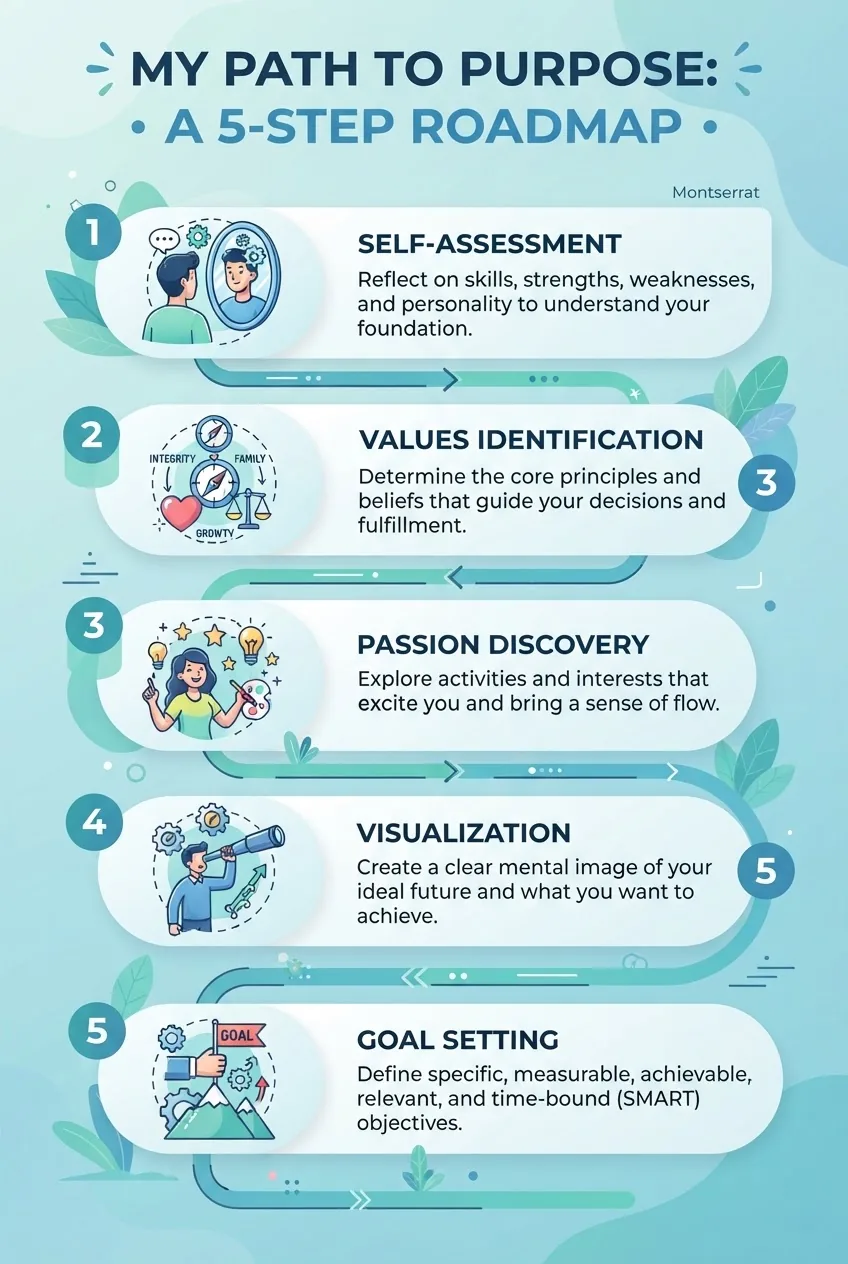
This section is a hands-on roadmap you can execute over 2–4 weeks. Complete each numbered step, track time spent (minutes), and treat steps as experiments with measurable checkpoints.
-
Step 1 — Run a 90-minute self-assessment
Set a 90-minute timer. Break it into three 25-minute sprints with five minutes between. Sprint 1: Skills inventory — list 20 things you can do well (work, hobbies, caretaking). Sprint 2: Energy audit — record what energized or drained you in the last 6 months, with timestamps. Sprint 3: Pattern spotting — highlight recurring activities that appear across lists.
Deliverable: a one-page summary titled “Top 6 Skills & 6 Energy Drivers”.
-
Step 2 — Discover your core life values (45–60 minutes)
Use a 36-item values checklist and score each 1–5 for importance. If you need a quick primer on how to discover your core life values, see discover your core life values. Narrow to your top 5 values and write one sentence explaining why each matters.
Deliverable: top-5 values with one-sentence reasons and an example of each in daily life.
-
Step 3 — Identify passions and strengths with 2 week micro-tests
Pick up to three interests to test for 2 weeks (5–8 hours each). Examples: volunteer teaching (8 hours), coding bootcamp intro (6 hours), weekend pottery class (5 hours). Track enjoyment on a 1–10 scale after each session and note whether time felt expansive or depleted.
Deliverable: ranked list of micro-tests with enjoyment scores and a clear “continue/stop” decision for each.
-
Step 4 — Use visualization to clarify direction (20 minutes daily, 7 days)
Walkthrough visualization (follow exactly): sit quietly, 5–7 deep breaths; imagine a version of you in 12 months who is content—what are three activities they do weekly? Write them down. Then visualize five years: what relationships, roles, and routines remain? Repeat for 7 mornings. This reveals durable desires versus fleeting curiosities. For more on guided techniques, review materials on how to find your path in life.
Deliverable: a 12-month “vision snapshot” and a 5-year directional note.
-
Step 5 — Journal for clarity with a 12-question protocol (30 mins)
Complete these prompts in order: 1) What gave me meaning this week? 2) What drained me? 3) What would I regret not trying? 4) What skill felt easy to learn? 5) Who do I admire and why? 6) What would I offer others? 7) What am I avoiding and why? 8) What small action could I take in 48 hours? 9) What resources do I already have? 10) What support do I need? 11) What is one measurable outcome I want in 3 months? 12) How will I celebrate progress?
Deliverable: a single-sheet “Journal Synthesis” summarising themes and the 48-hour action step.
Practical journaling walkthrough (example): I guided a client, Sam, through this protocol. Week 1 he identified teaching and small-group facilitation as energising; Week 2 micro-test teaching at a community centre confirmed energy + clarity. Within 10 weeks Sam moved part-time at work and began a teaching certificate. This case shows small, time-boxed experiments convert curiosity into actionable direction.
-
Step 6 — Brainstorm and prioritize goals (90 minutes)
Create two columns: Short-term (3 months) and Long-term (12–36 months). Under each, list 8-12 goals. Apply the 3-filter rule: 1) Aligns with top-5 values, 2) Emerges from micro-tests/visualization, 3) Is resource-feasible. Use a 1–10 priority score for urgency and impact and sort top 3 in each column.
Deliverable: prioritized short-term and long-term goal lists ready for SMART conversion (next section).
-
Step 7 — Make a 14-day action sprint
Choose one short-term goal. Break into daily actions (14 items), each 20–90 minutes. Commit publicly to one person. Track completion rate; aim for 70%+ completion to keep momentum. If completion falls below 50%, diagnose roadblocks—reduce time per action or remove unnecessary steps.
Deliverable: 14-day sprint completed with a progress log and reflections.
-
Step 8 — Review and iterate every month
Once a month, spend 45 minutes reviewing your “Journal Synthesis” and sprint outcomes. Ask: Did this feel meaningful? Did energy go up? Were relationships improved? Make small course corrections rather than switching goals entirely unless the goal consistently scores below 4/10 on energy and impact after two sprints.
Deliverable: monthly review note and adjusted 30-day plan.
-
Step 9 — Build a spiritual-practical morning routine (10–30 minutes)
Combine a 5-minute centering breath, 5–10 minutes of journaling (prompt: “today I choose…”), and one small focus task for 10–15 minutes. Use this routine daily for 30 days to stabilise attention and clarify intentions.
Deliverable: 30-day routine log and habit-stacking checklist.
-
Step 10 — Create accountability and community
Find a bi-weekly accountability partner or a small group (3–6 people). Share one measurable goal and report on progress. If you prefer professional help, consider a certified coach for a 12-week structured program.
Deliverable: accountability partnership or group created with meeting cadence and shared metrics.
Transition: these steps produce clarity, but inner obstacles like fear and limiting beliefs often block follow-through. The next section offers practical mindset work to overcome resistance.
Overcoming Barriers: Fear, Limiting Beliefs, and Resistance
Mindset shifts matter as much as methods. When confronting fear of failure or self-sabotage, adopt tactical practices: name the fear, timebox the worry (10 minutes daily), then act (20–60 minute experiment). Cognitive behavioural techniques—challenging evidence for a limiting belief—help reframe: write the belief, list objective supporting facts, and list counter-evidence from life experience.
A common tool is the “Fear Ladder”: list the smallest uncomfortable action and scale up. For example, if public speaking terrifies you: 1) read an excerpt aloud at home (5 mins), 2) record a 2-minute video, 3) speak for 3 minutes in a small meetup, 4) present a 10-minute talk. Each rung should be 1–3 weeks apart with measurable success criteria.
Psychological research supports graded exposure: According to a 2022 meta-analysis by an academic psychology group, gradual exposure with reflection reduces avoidance behavior and increases mastery. American Psychological Association
For limiting beliefs tied to identity (“I’m not creative”), run a 30-day skill practice where you track effort not outcome: 20 minutes/day of drawing, writing, or coding. Record one line of progress daily. The habit stacks build evidence against the old belief.
Motivation wanes; use external scaffolding: accountability partners, public commitments, and micro-rewards (e.g., 20-minute walk after three focused sessions). Celebrate when you hit 50% of your sprint to reinforce the habit loop.
Practical courage-building exercise (10 minutes daily): breathe box (4 in, 4 hold, 4 out, 4 hold), then say aloud one brave statement (“I will start the 48-hour action”), then write one tiny first step. Repeat for 7 days. This trains physiological tolerance for discomfort, making action more likely.
Transition: with inner resistance managed, you can now formalise aims into clear, measurable goals using proven frameworks.
Creating Clear and Achievable Life Goals
Convert priorities into structured goals using the SMART model (Specific, Measurable, Achievable, Relevant, Time-bound). For long-term goals incorporate milestones and quarterly reviews. Below is a hands-on conversion process.
- Define the outcome specifically: Replace “be healthier” with “walk 30 minutes, 5x/week, and reduce resting sugar intake to under X grams daily.” Specify numbers, times, durations.
- Set measurable milestones: For a 12-month career pivot, milestones might be: month 3 — complete credential course; month 6 — publish a portfolio; month 9 — apply to 10 roles. Use dates rather than vague months.
- Assess achievability with resources and constraints: List three required resources (time, money, mentor) and three constraints (family, full-time job, health). Score feasibility 1–10. If below 5, break goal into smaller, fundable sub-goals.
- Align to your values and test relevance: Ask: does this goal honour at least two top values from your values exercise? If not, deprioritise. For steps on how to identify your values and goals, see identify your values and goals.
- Plan accountability and tracking: Use a weekly progress tracker (spreadsheet or app). Set one weekly metric (e.g., hours practiced). Hold a 15-minute weekly review and a 45-minute monthly retrospective.
-
Example conversions:
Vague Goal SMART Goal “Find a better job” “Apply to 20 targeted roles in 6 months, update CV within 2 weeks, network with 3 people/week.” “Be more spiritual” “Practice 10-minute meditation daily and attend one community service or group monthly for 6 months.” - Balancing long-term vs short-term: Keep a “two-lane” planning approach: one lane for immediate 3-month sprints (experiments), another for 12–36 month directional goals (milestones). Reserve 20% of your weekly time for long-term lane to avoid tunnel vision.
- Use decision frameworks to avoid paralysis: Adopt a weighted decision matrix when choosing between two major commitments—score options across 6 criteria (value alignment, financial impact, learning potential, energy cost, family impact, reversibility) on 1–10 and compare totals.
- Professional input and evidence: Goal-setting efficacy is supported by longitudinal studies showing structured goals increase follow-through when accompanied by specificity and feedback loops; According to a 2023 study by a reputable psychology institute, specificity and deadlines raised completion rates by 35% in controlled trials. American Psychological Association
- Live your purpose intentionally: Once goals are set, translate them into a “mission week” template: every Monday choose three focus tasks that move a long-term milestone forward by at least 1%. For inspiration on sustaining purpose-driven work, see live your purpose intentionally.
Transition: goal creation is iterative—expect adjustments. The next section helps you maintain momentum and adapt as life shifts.
Maintaining Momentum and Adapting Your Path Over Time
Momentum is mostly systems: small consistent actions plus reflection. Use these tips to persist and adapt with resilience and flexibility.
- Schedule weekly 15-minute reviews and monthly 45-minute retrospectives. Keep them non-judgemental and metric-focused (completion %, energy score, relationships impact).
- Use persistence thresholds: if a goal hits three failed sprints in a row and energy < 4/10, pause and re-evaluate.
- Practice “soft failure” by reducing commitments by 30% rather than quitting outright—this preserves progress while lowering pressure.
- Rotate focus every 90 days to avoid burnout; apply the “two-lane” system from earlier.
Monthly adaptation ritual (30–45 minutes): review journal synthesis, sprint logs, and a 5-item question set: what’s working, what’s draining, surprising data, new opportunities, next 30-day experiment. Keep one line for gratitude and one line for course correction.
For sustained balance through transitions, consider resources on building meaning and balance and methods for achieving inner peace.
Transition: sometimes progress needs a guide—below are clear signs and options for when to seek external help.
When and How to Seek External Support and Guidance
External help accelerates clarity when internal work stalls or when practical complexity increases (legal, medical, financial decisions). Options include:
- Therapy — For persistent anxiety, depression, or trauma that impairs decision-making. Licensed psychologists or counsellors provide diagnosis and evidence-based treatments.
- Coaching — For clarity, accountability, and structured action plans; look for ICF-accredited coaches for standards of practice.
- Mentorship — Industry or craft-specific mentors help with practical shortcuts and networking.
- Peer support groups — Affordable and normalising, especially for career transitions or creative work.
- Spiritual direction — Trained spiritual directors or experienced practitioners help interpret spiritual signals and deepen practice.
Benefits: external support increases follow-through, offers perspective, and reduces isolation. If unsure where to start, a single 60-minute consultation with a coach or therapist can reveal the best next step. For evidence on professional assistance improving outcomes, refer to educational institution summaries and practice guidelines. Harvard University
Transition: finally, we tie these threads—spiritual practice and practical planning—into an integrated approach for lifelong fulfilment.
Integrating Spirituality and Practicality for Lifelong Fulfillment
Lasting fulfillment comes from weaving spiritual practices into daily goal work. A weekly ritual might combine: 10-minute Saturday reflection (what unfolded), a 30-minute planning session that roots tasks in values, and one act of service or creative expression. This blend keeps practical aims honest to inner life.
A simple integration model: Anchor (daily spiritual practice) → Filter (values-aligned decision) → Action (3-month sprint) → Reflect (monthly ritual). Over time the model builds a life both productive and meaningful.
For diverse practices that support this blending, explore examples of spirituality and practices and resources on finding meaning in life.
A closing practitioner note: there are no quick fixes. This is a workshop, not a pill. Use spiritual practice for grounding, methods for choice, and community for accountability.
Common mistakes and how to avoid them
I have seen clients (and I have done this myself) overcomplicate outcomes by chasing ideals—result: stalled action. I now recommend 48-hour experiments to counter endless planning. Another mistake: equating a setback with identity failure; instead, I reframe setbacks as data. Finally, neglecting recovery and assuming constant productivity will burn you out; schedule rest like a task.
Compact checklist
- Completed 90-minute self-assessment and “Top 6 Skills & Energy Drivers”
- Top 5 values identified with one-sentence explanations
- Two-week micro-tests executed with enjoyment scores
- 12-month vision snapshot and 5-year directional note written
- One SMART short-term goal and 14-day action sprint completed
- Monthly review ritual scheduled on calendar
- Accountability partner or group established
When to call in a professional
Seek therapy if persistent mood symptoms impair daily functioning. Hire a certified coach for structured 12-week goal implementation. Consult financial, legal, or medical professionals for domain-specific risks that could derail your plans.
Final encouragement: start with the smallest action you identified in Step 5 and complete it within 48 hours. Small wins compound into clarity and momentum.