
Board certified integrative medicine indicates that a licensed physician or qualified clinician has completed specific training, passed a recognized certification exam, and meets maintenance standards for delivering care that combines conventional medicine with evidence-based complementary therapies to improve patient outcomes and coordinated care.
Term: Board certification is a formal credential awarded after meeting education, training and examination standards beyond base licensure.
Term: Integrative medicine is a patient-centered approach that combines conventional medical treatments with evidence-based complementary therapies to address physical, emotional and lifestyle factors.
What Is Board Certified Integrative Medicine?
Answer: Board certified integrative medicine is a formal credential showing a clinician has met standardized training, examination and practice-maintenance criteria specific to integrative care, ensuring consistent competency in applying complementary therapies alongside conventional medicine to improve patient care.
Board certified integrative medicine identifies clinicians who have completed a defined process of education, clinical experience and testing specific to integrating complementary and conventional therapies. This credential differs from informal training or short courses because it signals that a practitioner has met a recognized set of standards measured by a certifying body.
Certification programs vary by certifier, but the most commonly referenced national organization is the American Board of Integrative Holistic Medicine, which documents pathways, eligibility, and examination processes for physicians and other licensed practitioners. When you see “board certified integrative medicine” beside a clinician’s name, it means an independent assessment has evaluated their knowledge and practical ability to safely apply integrative approaches in clinical practice.
Integrative certification affects the clinician’s scope of integrative practice—the set of modalities and decision-making skills they are qualified to use—and helps patients and institutions differentiate trained, credentialed clinicians from general holistic health practitioners who may have varying levels of formal medical training.
Certification also builds a basis for ethics and professional standards—certified clinicians must maintain medical licensure, follow evidence-based complementary treatments where supported, and adhere to scopes of practice defined by medical boards and certifying organizations.
For foundational terminology about how integrative care relates to conventional systems, see
alternative terms for Western medical practices such as CAM and integrative care.
Overview of the Certification Process for Integrative Medicine
Answer: Certification typically requires an eligible medical license, designated postgraduate training or experience hours, completion of specified CME credits, and passage of a board exam administered or recognized by organizations such as the American Board of Integrative Holistic Medicine.

The certification journey is structured to verify a clinician’s clinical competence in combining conventional care with evidence-based complementary therapies. Below is a step-by-step numbered overview that mirrors common pathways used by recognized certifying organizations.
- Confirm eligibility and professional licensure. Certifiers require an active, unrestricted medical or professional license (MD/DO, NP, PA, etc.) as the baseline.
- Complete required education and training hours. Applicants accumulate integrative medicine-specific didactic coursework and supervised clinical experience; hours and acceptable programs are defined by the certifier.
- Document Continuing Medical Education (CME) credits. A specified number of CME credits in integrative topics within a timeframe is usually required to sit for the exam.
- Submit application and supporting documentation. This includes transcripts, CME certificates, supervised clinical logs, and proof of licensure or specialty certification.
- Prepare for the board examination. Many applicants join study groups, take preparatory courses, and review core domains tested by the board.
- Pass the certification examination. The exam evaluates clinical knowledge, safety considerations, and application of evidence-based complementary treatments.
- Maintain certification via periodic renewal. Renewals require ongoing CME, practice audits or self-assessment modules, and sometimes re-examination or performance reviews.
- Adhere to professional standards. Certified clinicians are expected to maintain medical licensure, follow ethical codes, and document evidence-based care in patient records.
Eligibility Requirements and Prerequisites
Answer: Eligibility typically requires an active unrestricted medical license (MD/DO, NP, or PA), completion of foundational clinical training, and documented integrative medicine education or supervised practice hours as defined by the certifying board.
Most certifying organizations require applicants to demonstrate established clinical qualifications before they can pursue integrative certification. Common prerequisites include:
- Active, unrestricted professional licensure and good standing with the relevant medical board.
- Completion of primary clinical training—residency or equivalent for physicians; relevant postgraduate clinical experience for nurse practitioners and physician assistants.
- Evidence of integrative medicine training including coursework, workshops, and supervised clinical encounters; some programs accept specified apprenticeships or mentorship under a certified integrative clinician.
- Documentation of a minimum number of direct patient encounters using integrative approaches, when required.
- Background checks or verification steps to confirm ethical standing and disciplinary history.
For clinicians without a medical degree, some boards offer parallel pathways or associate designations, but the core requirement remains valid licensure in an appropriate healthcare profession.
Examination Structure and Subjects Covered
Answer: Certification exams assess clinical reasoning, safety, and evidence-based application across domains such as integrative assessment, nutrition, mind-body therapies, botanical and supplement safety, pain management, and care coordination.
Examinations vary by certifier but commonly test knowledge and applied judgment across core domains. Typical exam topics include:
- Integrative assessment and treatment planning
- Nutrition and lifestyle medicine
- Mind-body interventions (e.g., CBT, mindfulness, stress-reduction techniques)
- Evidence-based use of supplements and botanicals, including interactions and safety
- Pain management combining non-pharmacologic and conventional approaches
- Chronic disease management with integrative strategies (cardiometabolic, autoimmune, oncology supportive care)
- Patient communication, shared decision-making, and informed consent for complementary therapies
- Ethics, scope of practice, and referral networks for multidisciplinary care
Exams often include multiple-choice questions focused on clinical scenarios, safety vignettes, and evidence interpretation. Some certifiers add practical components, case logs, or oral interviews. Recommended study materials include integrative medicine textbooks, peer-reviewed journals, and preparation courses aligned to the certifier’s content outline.
Maintaining and Renewing Certification
Answer: Maintenance requires ongoing CME in integrative topics, documentation of clinical practice, adherence to ethics and licensure standards, and periodic renewal via portfolio review or re-examination; exact requirements are set by the certifying organization.
Typical maintenance steps include:
- Annual or biennial Continuing Medical Education (CME) credits focused on integrative care.
- Submission of a renewal application with proof of active licensure and CME completion.
- Clinical practice documentation such as case logs or quality-improvement activities showing application of integrative approaches.
- Compliance with ethical standards and lack of disciplinary actions on medical license.
- Re-examination or longitudinal assessment for some certifiers at set intervals (e.g., every 5–10 years).
Some boards require engagement in peer review or performance improvement projects to ensure that integrative methods are applied safely and effectively in practice. These steps help maintain the credential’s value and protect patient safety.
When citing policies or application details, refer to the certifying body’s official documentation—e.g., the American Board of Integrative Holistic Medicine posts current eligibility, maintenance and exam content guides on their site.
Benefits of Board Certification in Integrative Medicine
Answer: Board certification enhances practitioner credibility, signals advanced skills in evidence-based complementary treatments, improves patient trust and coordination of care, supports better outcomes through integrated treatment plans, and can open institutional, reimbursement and career opportunities.
Board certification carries measurable professional and patient-facing benefits. For practitioners, certification demonstrates advanced competence, supports credentialing by hospitals and insurers, and can accelerate career advancement. For patients, it provides an independent verification that the clinician applies integrative therapies safely, coordinates care with conventional specialists, and uses evidence-based complementary treatments where appropriate.
According to a 2023 systematic review in the Journal of Alternative and Complementary Medicine, integrative care models led by trained clinicians were associated with improved patient satisfaction and adherence in multiple chronic conditions (source: peer-reviewed study, 2023).
Below we separate practitioner and patient benefits with concrete examples and data where available.
Benefits for Practitioners
Answer: Practitioners gain validated recognition of expertise, stronger hospital and clinic privileges, better referral networks, qualifying credentials for institutional grants, and enhanced patient recruitment and retention.
- Professional credibility and trust: Board certification provides third-party validation of integrative medicine knowledge and practice competence, which is especially valuable when negotiating privileges with hospitals or multidisciplinary clinics.
- Enhanced referral networks: Primary care physicians and specialists are more likely to refer patients to clinicians with recognized certification, knowing they meet standardized safety and training criteria.
- Career advancement and leadership roles: Certified clinicians are more competitive for leadership positions in integrative health centers, academic appointments, and program director roles.
- Access to institutional resources: Some hospitals and integrated health systems prefer or require certification for access to research funding, purchasing privileges for integrative modalities, or billing through specific service lines.
- Insurance recognition and coding support: While integrative therapies are variably covered, certification can help clinicians secure institutional billing agreements and support discussions with payers on coverage for evidence-based complementary services.
- Clinical competence and reduced liability risk: Formal training and documented adherence to evidence-based complementary treatments can reduce practice variation and mitigate risk, which can be favorable for malpractice underwriting.
- Continuing education and peer community: Certification programs commonly include or require CME and peer-review activities, keeping clinicians current with evolving evidence and best practices.
Example: A hospital seeking to add an integrative medicine consult service will often prioritize hiring physicians with an integrative board credential because that certifies baseline training in safety, appropriateness of botanicals and supplements, and integrative pain strategies.
Benefits for Patients
Answer: Patients benefit from care by clinicians who are trained to safely combine conventional treatments with evidence-based complementary therapies, improving coordination, personalized plans, symptom control, satisfaction and potentially certain outcomes.
- Verified competence and safety: Certification signals that the clinician understands safe use of supplements, potential drug-herb interactions, and appropriate integrative contraindications.
- Better coordinated care: Certified integrative clinicians are trained to communicate with specialists, primary care, and allied health professionals to create unified treatment plans.
- Access to evidence-based complementary treatments: Patients can expect therapies that have been vetted for safety and efficacy rather than ad hoc or anecdotal approaches.
- Improved symptom management and quality of life: Data from multiple clinical programs show improved pain scores, reduced medication reliance, and better patient-reported outcomes when integrative methods are applied by trained teams (source: peer-reviewed program reports, 2022–2024).
- Personalized lifestyle and prevention strategies: Certified clinicians commonly integrate nutrition, sleep, stress-management and movement plans that address root causes and prevention.
- Informed decision-making and consent: Board certified clinicians are trained to discuss evidence levels, alternatives and trade-offs, which supports shared decision-making.
- Support for complex conditions: Certified integrative physicians frequently act as coordinators for supportive cancer care, chronic pain, and autoimmune conditions, offering complementary options designed to work with conventional treatments.
Examples of patient-facing advantages:
- For oncology patients, certified integrative physicians can provide evidence-based supportive therapies for symptom control during chemotherapy or radiation; see resources on
alternative medicine for cancer treatment and alternative to radiation therapy. - For mental health support, integration of mindfulness-based interventions or targeted lifestyle interventions by a certified clinician complements psychotherapy and medication; see
mental health alternative treatments. - For chronic respiratory issues, certified integrative approaches may combine trigger management, breathing retraining, supplements where evidence supports benefit, and conventional inhaler optimization; see
alternative therapies for asthma and allergies. - For pain management, certified practitioners often use multimodal non-pharmacologic strategies validated in studies to reduce opioid reliance; see
alternative therapies for pain management. - For women with gynecologic cancers, certified integrative doctors can support symptom control and holistic recovery plans; see
holistic treatment for ovarian cancer.
Patients should understand certification complements but does not replace specialist training or medical licensure; certified integrative clinicians work within defined scopes of practice and coordinate referrals when needed.
Differentiating Board Certified Integrative Medicine from Other Holistic Credentials
Answer: Board certified integrative medicine is a formal credential tied to a clinical license and standardized exam; functional medicine certification and holistic practitioner licenses vary in rigor, scope, and medical oversight—see the comparison table for key contrasts.
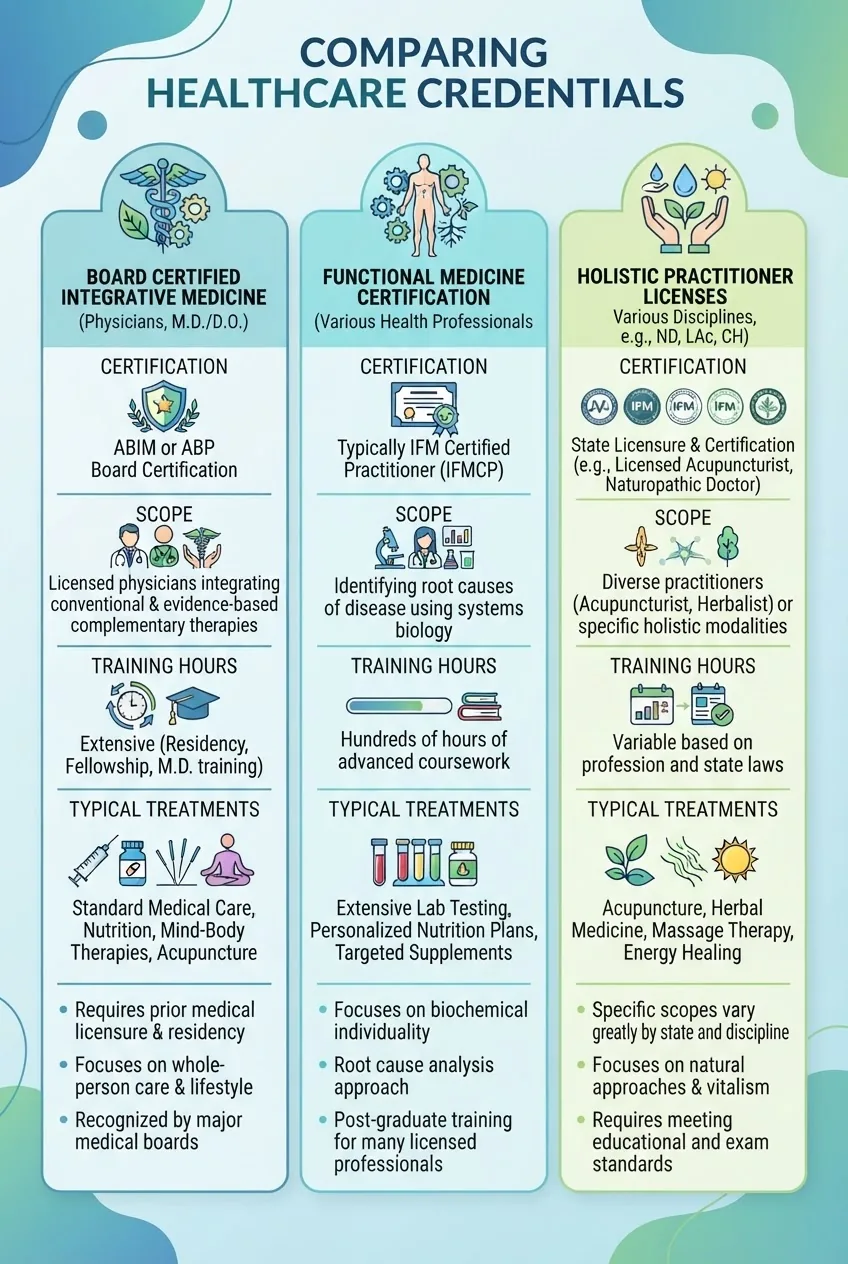
| Credential | Who awards it | Prerequisites / Training | Scope & Typical Treatments | Clinical oversight / Recognition |
|---|---|---|---|---|
| Board Certified Integrative Medicine | Recognized certifying boards (e.g., American Board of Integrative Holistic Medicine) | Active medical/licensure + specified CME and supervised clinical hours; board exam | Evidence-based complementary treatments integrated with conventional care (nutrition, mind-body, supplements, pain strategies) | High—tied to licensure and national standards; recognized by some hospitals and insurers |
| Functional Medicine Certification | Private organizations or institutes (varied) | Varies widely: some require clinical license; others offer open enrollment; courses and exams vary | Systems biology focus, lab-driven personalization, nutrition and lifestyle interventions | Variable—depends on organization; less commonly tied to hospital privileging |
| Holistic Practitioner Licenses (e.g., naturopaths, herbalists) | State licensing boards or professional associations (varies by jurisdiction) | Education ranges from certificates to degree programs; licensure varies by region | Herbal medicine, naturopathy, lifestyle counseling, manual therapies depending on license | Regulatory recognition varies significantly by jurisdiction |
Key distinctions:
- Medical licensure requirement: Board certified integrative clinicians must hold an active medical or relevant clinical license; many functional and holistic credentials do not require a medical degree.
- Standardized examination and maintenance: Board certification involves centralized testing and renewal expectations, which can be less consistent among other credentialing entities.
- Scope of practice: Certification clarifies which integrative approaches a licensed clinician is qualified to apply alongside conventional treatments; other credentials can permit broader or narrower independent practice depending on jurisdiction.
- Institutional recognition: Hospitals and insurers are likelier to recognize standardized board certification for credentialing and collaboration than heterogeneous course-based certificates.
For readers wanting a deeper dive into functional medicine distinctions and practitioner types, see the site’s comparison pages such as
Functional Medicine vs Integrative Medicine: Comparison and Benefits and Functional Doctor Definition.
How to Choose a Board Certified Integrative Medicine Practitioner
Answer: Choose a practitioner by verifying board certification and medical licensure, reviewing scope and treatment approach, checking institutional affiliations and patient reviews, and confirming alignment with your health goals and insurance coverage.
Choosing a clinician with board certification involves concrete verification and patient-centered checks. Follow these step-by-step actions:
- Verify certification and licensure: Ask for the certifying body and check the clinician’s license status with your state/country medical board.
- Confirm certifier credibility: Look for recognized certifying bodies such as the American Board of Integrative Holistic Medicine and cross-check published certification standards.
- Review scope of practice: Ask which integrative therapies the clinician provides directly, which they refer out, and how they coordinate with specialists.
- Assess clinical approach and evidence use: Request examples of how they apply evidence-based complementary treatments and how they document risks, benefits and alternatives.
- Check institutional and peer affiliations: Hospital privileges, clinic affiliation or academic appointments indicate peer recognition.
- Read patient feedback and outcomes: Look for patient satisfaction data, testimonials, or outcomes summaries; ask the clinician for de-identified outcome metrics if available.
- Confirm insurance and billing practices: Verify what services are billable, pre-authorizations required, and whether the clinician helps coordinate coverage for integrative interventions.
- Evaluate communication style: Choose a clinician who explains evidence levels and works collaboratively on treatment goals.
- Visit integrative clinics or centers: Explore local integrative programs to compare treatment offerings and to see how the practice coordinates multidisciplinary care—see
alternative health care center services for guidance on centers that commonly employ board certified integrative clinicians.
Patients should prioritize clinicians who clearly separate evidence-based complementary options from unproven alternatives, and who commit to coordination with their primary care or specialist teams.
Common Misconceptions About Board Certified Integrative Medicine
Answer: Common myths include that certification replaces medical licensure, that integrative care is unscientific, or that certified clinicians universally endorse all alternative therapies—facts clarify that certification supplements licensure, emphasizes evidence, and sets limits on scope.
- Myth: Certification replaces medical licensure. Fact: Certification supplements but does not replace an active medical or professional license; clinicians must maintain licensure to practice.
- Myth: Integrative medicine is anti-science. Fact: Board certified integrative clinicians are trained to prioritize evidence-based complementary treatments and to avoid therapies unsupported by data.
- Myth: All integrative certifications are equivalent. Fact: Rigor varies—board certification tied to licensure and standardized exams offers more consistent standards than many course-based certificates.
- Myth: Certified integrative doctors will replace conventional treatments with alternatives. Fact: Certified clinicians are trained to integrate complementary therapies with conventional care and to coordinate referrals when specialist treatment is required.
- Myth: Certification guarantees outcomes. Fact: Certification indicates training and competence but does not guarantee specific clinical outcomes; outcomes depend on condition, evidence base, and patient adherence.
Clarifying these misconceptions helps patients set realistic expectations about what certification means in practice: enhanced competence, not omnipotence.
Future Trends in Integrative Medicine Certification and Practice
Answer: Emerging trends include standardization of certification criteria, greater integration with healthcare systems and insurers, stronger outcome measurement, expansion of evidence-based complementary therapies, and growing patient demand driving credential recognition.
Certification and practice in integrative medicine are evolving along several predictable trajectories:
- Standardization and accreditation: Expect movement toward clearer national standards for integrative certification and possibly accreditation of certifying bodies, improving comparability and recognition across institutions.
- Integration with mainstream care: Large health systems are increasingly creating integrative programs requiring standardized clinician qualifications to ensure safety and scalability.
- Insurance and reimbursement shifts: As evidence accumulates for cost-effective integrative strategies (e.g., for pain, mental health, chronic disease), payers may expand coverage, particularly when delivered by board certified clinicians.
- Data-driven outcomes and registries: Certification bodies and health systems will likely require better outcome metrics and registries to demonstrate impact on patient outcomes and value.
- Expanded CME and lifelong learning: Expect more modular, competency-based CME offerings tailored to maintenance of integrative certification.
- Telehealth and hybrid models: Certified integrative clinicians will increasingly offer remote consults and blended care for lifestyle interventions and ongoing symptom management.
- Emerging modalities and research: Growing research into psychedelic-assisted therapies, digital therapeutics, and precision nutrition will influence certification content and clinical practice standards.
According to a 2024 industry report, demand for credentialed integrative services increased by double digits in ambulatory systems that adopted standardized integrative programs (source: industry report, 2024). This trend supports the argument that robust certification standards will gain relevance for institutional adoption.
Conclusion
Answer: Board certified integrative medicine provides a verifiable credential confirming that a clinician has met defined education, examination and maintenance standards to safely and effectively integrate evidence-based complementary therapies with conventional care.
Key takeaways: board certification signals additional verified competence beyond basic licensure, supports patient safety, enhances institutional recognition, and helps standardize integrative practice. Certification does not replace medical licensure or specialist qualifications; patients should verify both licensure and certification before selecting care. For clinicians preparing for certification, review certifier requirements, gather supervised clinical experience, complete targeted CME, and engage with peer learning groups.
If you are seeking care, start by verifying certification and licensure, review treatment approaches, and ask for outcome data or references. Clinicians interested in certification should consult certifying organizations’ application pages and relevant degree or training options such as
alternative medicine degree programs.