

Functional medicine vs integrative medicine: both pursue holistic, personalized care but use different starting points — functional medicine emphasizes systems biology and root-cause diagnosis, while integrative medicine blends conventional care with evidence-based complementary therapies and mind–body practices to optimize health.
What are functional medicine and integrative medicine?
Answer: Functional medicine and integrative medicine are complementary healthcare paradigms focused on whole-person care; functional medicine prioritizes root-cause systems analysis, while integrative medicine combines conventional treatments with validated complementary therapies for wellbeing.
Term: Functional medicine is an approach that uses systems biology to identify and treat root causes of illness rather than only symptoms.
Term: Integrative medicine is a model that blends conventional medical treatments with evidence-based complementary therapies (like acupuncture, nutrition, and mind–body techniques) to support healing.
Both approaches sit in the broader map of alternative healthcare methods and patient-centered care, but they occupy different niches: functional medicine is diagnostic and investigative; integrative medicine is therapeutic and pluralistic. alternative terms for Western medical practices
Transition: The next section explains how functional medicine defines its philosophy and clinical workflow.
What is functional medicine?
Answer: Functional medicine is a systems-based, personalized approach that seeks to identify root causes of chronic and complex illness through detailed history, targeted testing, and individualized, multi-modal treatment plans.
Functional medicine uses concepts from systems biology to view the body as interconnected systems (metabolic, immune, endocrine, gut microbiome, nervous system). Practitioners take extended histories, order targeted laboratory and functional testing, and create personalized plans combining nutrition, lifestyle, supplements, and medication when needed.
Term: Systems biology — a discipline that models biological systems as interacting networks rather than isolated organs or symptoms.
- Typical diagnostic steps: comprehensive intake (diet, environment, stress, sleep), specialized labs (micronutrients, hormone panels, stool microbiome, metabolic markers), and functional testing to map system dysfunction.
- Therapies commonly used: tailored nutrition plans, elimination diets, targeted supplements (vitamins, minerals, botanicals), gut-healing protocols, graded exercise, sleep optimization, and prescription medication when indicated.
- Philosophy: detective-style root-cause analysis — clinicians act like investigators mapping triggers, susceptibilities and downstream consequences.
Case example (hypothetical patient): a 45-year-old with chronic fatigue, IBS, and mood swings would receive a systems-based assessment (detailed history, adrenal/hormone and gut testing). The functional plan might prioritize gut microbiome restoration, personalized nutrition and targeted supplements, alongside counseling for sleep and stress — aiming to address upstream drivers rather than layering symptomatic drugs.
Training pathways for clinicians vary; many physicians, naturopathic doctors, and nurse practitioners complete additional certification. For those exploring formal education, see functional medicine training programs. For practitioner role clarity, see functional doctor definition.
Transition: Next we contrast that with integrative medicine’s model, which focuses on combining modalities around patient preferences and evidence strength.
What is integrative medicine?
Answer: Integrative medicine blends conventional medical care with complementary, evidence-based therapies (e.g., acupuncture, mindfulness, nutrition counseling) to treat the whole person — body, mind, and community — and support conventional treatments when needed.
Term: Complementary therapies — non-mainstream practices used together with conventional medicine, such as acupuncture, yoga, and certain botanical medicines.
Integrative medicine centers on a therapeutic mix: evidence-based complementary therapies are applied alongside medications, surgery, or other conventional interventions to reduce side effects, improve recovery, and address quality-of-life factors. For a deeper definition of integrative practices, see define integrative medicine.
Examples of integrative interventions:
- Nutritional counselling integrated with diabetic medication management;
- Acupuncture or massage to reduce chronic pain alongside physiotherapy;
- Mindfulness-based stress reduction (MBSR) to support oncology care and mitigate anxiety.
Integrative clinics often use multidisciplinary teams—medical doctors, naturopaths, acupuncturists, nutritionists, psychologists—and emphasize shared decision-making with patients about acceptable evidence and modalities. For an overview of common therapies used in integrative settings see complementary therapies.
Transition: The following section contrasts these two models side-by-side so you can see differences in practice, credentialing, and patient experience.
How do functional medicine and integrative medicine compare directly?
Answer: Functional medicine emphasizes individualized root-cause diagnosis and system-level testing; integrative medicine emphasizes combining conventional care with validated complementary therapies—both value personalization, but they differ in diagnostic depth, scope, and standardization.

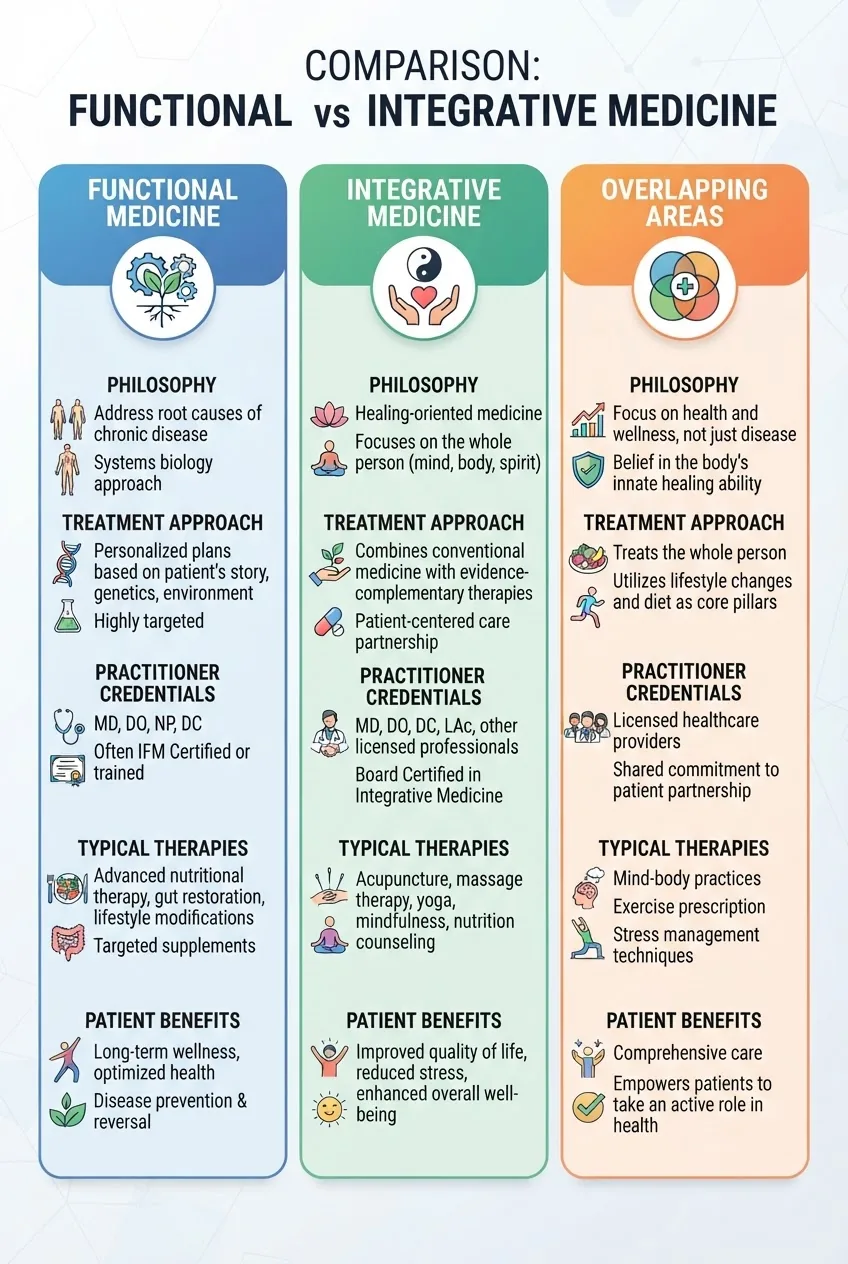
| Topic | Functional Medicine | Integrative Medicine |
|---|---|---|
| Philosophy | Systems biology; root-cause detective work. | Whole-person healing; blend of conventional and validated complementary care. |
| Primary focus | Diagnose and reverse underlying dysfunction (metabolic, inflammatory, microbial). | Optimize outcomes and quality of life using multiple modalities. |
| Typical diagnostics | Extended history, targeted labs (micronutrient, hormone, GI, metabolic panels). | Standard medical tests plus functional assessments as needed; emphasis on safety and interactions. |
| Common therapies | Personalized diet, supplements, lifestyle medicine, sometimes off-label meds. | Acupuncture, massage, MBSR, nutritional counseling, herbal adjuncts with conventional care. |
| Practitioner credentials | Varied; many complete functional certification; licensed MDs/DOs and others. | Often board-certified MDs with integrative training; see integrative medicine certification. |
| Patient experience | Extended visits, investigative testing, longitudinal individualized plans. | Collaborative care, multimodal treatment plans, emphasis on comfort and symptom management. |
Both approaches can overlap: a functional clinician may recommend acupuncture; an integrative service may perform targeted functional testing. Where they diverge most is in diagnostic philosophy and standardization of protocols.
Transition: Below we clarify whether these two models are the same and unpack persistent confusions.
Is integrative medicine the same as functional medicine?
Answer: No — they are distinct but overlapping; functional medicine is primarily a root-cause, systems-focused diagnostic framework, while integrative medicine is a pluralistic treatment model combining conventional and complementary care.
FAQ-style clarifications:
- Overlap: Both prioritize patient-centered care and may share therapies (nutrition, stress management).
- Key difference: Functional medicine invests heavily in systems-level testing to identify upstream causes; integrative medicine focuses on combining therapies to improve outcomes and quality of life.
- Integrator vs investigator: Think of integrative medicine as the orchestra conductor who combines proven instruments; functional medicine is the forensic investigator who maps why the music is off.
- Integrative functioning: Combining both often yields synergistic care — a clinic might use functional diagnostics to guide integrative therapies (strong evidence base varies by condition).
Expert perspective: current professional bodies emphasize safety and evidence. For overviews of evidence and safety in integrative approaches see the NIH National Center for Complementary and Integrative Health (government agency) — NCCIH. For the principles behind functional medicine, see the Institute for Functional Medicine (professional body) — IFM.
Transition: Next, detailed benefits supported by research and clinical practice are summarized to help you weigh options.
What are the benefits of functional and integrative medicine?
Answer: Both approaches can improve chronic disease management, enhance preventative care, boost patient empowerment, and improve quality-of-life by delivering person-centered, multi-modal plans tailored to individual needs.

- Improved chronic disease outcomes: Functional and integrative approaches can reduce symptom burden and improve metabolic markers through targeted lifestyle and nutritional interventions; some studies suggest measurable improvements in conditions like type 2 diabetes and chronic pain (peer-reviewed evidence; see PubMed reviews).
- Root-cause resolution (functional medicine): By identifying upstream drivers (gut dysbiosis, nutrient deficits, chronic infections), functional approaches can yield longer-term remission rather than short-term symptom control.
- Enhanced symptom management (integrative medicine): Integrative therapies such as acupuncture, mindfulness, and massage frequently reduce pain, anxiety, and chemotherapy side effects according to systematic reviews (peer-reviewed literature).
- Preventative health emphasis: Both models prioritize prevention — personalized nutrition, activity prescriptions, sleep and stress strategies reduce future disease risk; current research indicates lifestyle interventions are highly cost-effective for prevention (peer-reviewed economic analyses).
- Patient empowerment and education: Longer visits, collaborative planning, and structured education increase adherence and self-efficacy; patient-reported outcomes often show improved satisfaction and perceived control.
- Holistic wellness outcomes: Addressing mental, social, and lifestyle drivers alongside biology tends to improve overall wellbeing, resilience, and daily functioning for many patients.
- Flexible integration with conventional care: Integrative medicine is explicitly designed to be added to standard care safely, reducing treatment side effects and improving recovery.
- Personalization and fewer one-size-fits-all protocols: Both fields reduce inappropriate polypharmacy by tailoring regimens and monitoring biomarkers closely.
- Access point to multidisciplinary teams: Many centers provide coordinated care (physicians, nutritionists, therapists) which can improve continuity and outcomes; to find such services see alternative health care center services.
- Limitations and evidence caveats: Not all interventions have equal evidence; some botanical therapies lack large RCTs. Current research indicates benefit for certain conditions, but quality varies (peer-reviewed medical journals; see PubMed for systematic reviews).
Evidence note: systematic reviews and RCTs have demonstrated benefit for integrative modalities like acupuncture for chronic pain and mindfulness for relapse prevention in depression (peer-reviewed journals indexed on PubMed). For a searchable repository, consult PubMed (peer-reviewed medical database).
Transition: If you’re deciding between these approaches, the next section gives a structured selection process tailored to your goals and condition.
How do I choose between functional and integrative medicine?
Answer: Choose based on your primary goals: if you want deep root-cause investigation for chronic complex illness, consider functional medicine; if you seek a blended program to complement conventional care and improve symptom control, consider integrative medicine.
- Clarify your goal: Root-cause resolution (functional) vs. symptom and quality-of-life optimization alongside conventional care (integrative).
- Assess disease type and complexity: Complex, multisystem chronic conditions (fatigue, autoimmune clusters, persistent GI issues) often benefit from functional diagnostics; single-system issues may be addressed within integrative frameworks.
- Evaluate practitioner credentials and team composition: Look for licensed clinicians with formal training and verifiable certifications; review clinic protocols for safety and evidence-based practice. If comparing with mainstream care, see functional medicine vs conventional medicine.
- Consider accessibility and cost: Functional medicine often involves more testing and longer visits (higher upfront cost), integrative care may be available within hospital-based clinics or community centers and sometimes covered in part by insurance.
- Request outcomes and measurement: Ask prospective clinicians how they measure success (patient-reported outcomes, biomarker targets, timelines) and how they will coordinate with your primary care or specialists.
- Trial a short course: Start with a 3–6 month trial period focused on measurable goals and re-evaluate; both models emphasize iterative adjustments based on response.
Decision tip: If you need both deep diagnostics and supportive therapies, consider a blended plan that uses functional testing to guide integrative therapies — sometimes called integrative functioning in practice.
Transition: To prepare for visits, know what to expect from practitioners in each approach.
What should I expect from a functional or integrative medicine practitioner?
Answer: Expect a patient-centered intake, longer consultations, a diagnostic plan (labs, functional tests), a personalized treatment plan, measurable goals, and ongoing education and follow-up coordinated with other healthcare providers.
Typical visit workflow:
- Intake and history: Extended intake (60–120 minutes) covering lifestyle, diet, exposures, family history, mental health, and social factors.
- Diagnostic plan: Targeted labs and functional tests tailored to suspected systems (endocrine, immune, GI, metabolic); clinicians explain test rationale and interpretation.
- Treatment plan: Multi-modal plan with prioritized actions (nutrition, movement, sleep, supplements, integrative therapies) and timelines for re-evaluation.
- Education and empowerment: Practitioners provide resources and coaching to build self-management skills and health literacy.
- Coordination of care: A good clinician will communicate with your primary care physician or specialists to ensure safety and reduce redundant testing or interactions.
Credential verification: states and countries vary in titles and scope of practice; verify licensing (MD/DO/ND/NP) and additional certifications. Integrative boards and functional certification programs exist but are not universally regulated — ask for documented credentials and patient outcome data. For official guidance on integrative certification standards, see professional resources and clinic disclosures, and consult national bodies.
Safety note: discuss potential herb–drug interactions, supplement dosing and laboratory monitoring with your clinician; consult licensed providers before stopping or altering prescribed medications.
Conclusion and next steps
Functional medicine and integrative medicine both prioritize whole-person care but differ: functional medicine digs deeply to find and treat root causes; integrative medicine combines conventional care with validated complementary therapies to improve outcomes and quality of life. Compare practitioner credentials, measurement strategies and costs, then choose the approach that matches your clinical complexity and personal goals. To explore nearby services and center types, start with clinic directories and verified credential listings and consult licensed providers for personalized recommendations.
Call to action: If you have chronic or complex symptoms, gather your medical records and book a consult with a clinician who outlines measurable goals and a clear plan for follow-up.