

A functional doctor is a healthcare practitioner who applies functional medicine — a patient-centered, systems-based approach that seeks underlying causes of disease rather than only treating symptoms — using detailed history, lab testing, and personalized lifestyle and biomedical interventions to restore functional health. This definition frames the role and methods clearly.
What Is a Functional Doctor? Definition and Role
Answer: A functional doctor is a clinician who practices functional medicine, focusing on root cause analysis, personalised care plans, and systems biology to treat complex, chronic, or multi-factorial health issues rather than only addressing isolated symptoms.
Term: functional doctor — a healthcare practitioner (often an MD, DO, naturopathic doctor, or NP) who uses functional medicine principles to assess and treat patients holistically.

Functional doctors combine extended clinical interviews, targeted laboratory testing, and multi-modal treatments. They prioritise a thorough medical and lifestyle history, environmental exposures, genetics, and psychosocial factors to build a personalised care plan. Typical workflows include an initial 60–120 minute intake, detailed test interpretation, a collaborative plan, and scheduled follow-ups to measure progress.
Term: patient-centered care — care that actively involves the patient in decision-making and tailors treatment to individual values, preferences, and contexts.
Role components of a functional doctor:
- Comprehensive intake and timeline mapping to uncover triggers and patterns.
- Targeted diagnostics beyond standard panels (see clinical diagnostic tools section).
- Multi-domain interventions (nutrition, sleep, stress, movement, targeted supplements or pharmaceuticals where indicated).
- Ongoing iterative care: monitor, adjust, and retest to restore function.
A functional doctor often coordinates care across specialities, bridging primary care, specialists, and complementary practitioners to implement a coherent, longitudinal plan. Think of the role as clinical detective work: synthesising many small clues into a mechanistic explanation that guides treatment priorities.
Typical patient consultation and follow-up process (walkthrough):
- Pre-visit questionnaires and health timeline collection.
- Extended intake visit: three-generation family history, exposures, diet, sleep, stress, and symptom timeline.
- Order targeted laboratory and functional tests (metabolic, endocrine, microbiome, nutrient panels).
- Report visit: explain findings, identify root causes, and co-create the treatment plan.
- Follow-ups at defined intervals (4–12 weeks) with objective measures and adjustments.
Patient profiles often include chronic fatigue, autoimmune conditions, metabolic syndrome, digestive disorders, hormonal imbalances, and multi-system complaints where conventional single-diagnosis approaches have been insufficient.
Understanding Functional Medicine: Meaning and Principles
Answer: Functional medicine is a systems-oriented, patient-centred approach that seeks to identify and treat the root causes of disease using individualized assessment, systems biology concepts, and targeted interventions across nutrition, lifestyle, environmental, and biochemical domains.
Term: functional medicine — an approach to care emphasizing root causes, systems biology, and personalised treatment plans to restore physiological function and prevent disease.
Core principles that define functional medicine:
- Root cause analysis: prioritising explanations (e.g., gut dysbiosis, chronic inflammation, nutrient deficiency) that explain symptom clusters.
- Systems biology: viewing the body as interconnected systems rather than isolated organs.
- Individualised care: treatments tailored to the person’s genetics, environment, lifestyle, and goals.
- Patient partnership: patients are active collaborators in planning and executing changes.
- Prevention and resilience: emphasis on preventive strategies to restore long-term function and reduce disease progression.
Functional medicine meaning becomes practical when translated into therapies: personalised nutrition plans, sleep and circadian rhythm optimisation, stress resilience training, targeted supplement regimens, and precise use of pharmaceuticals when indicated. These combine to address the mechanisms driving disease.
Examples integrated with principles:
- For a patient with chronic fatigue and poor sleep, a functional doctor might test adrenal and thyroid function, screen for nutrient deficits (iron, B12), evaluate sleep hygiene and circadian cues, and design a phased program combining diet modification, cognitive-behavioural sleep therapy elements, and nutrient repletion.
- For a person with autoimmune thyroid disease, the approach could include identifying gut permeability, food sensitivities, environmental toxin load, and implementing dietary repletion, microbiome support, and immune-modulating strategies alongside endocrinology care.
Functional health medicine emphasises measurable outcomes: symptom tracking, biomarker improvement, and restoration of functional capacity. The focus is not merely “alternative” interventions but integration of evidence-informed tools to correct identified imbalances.
Real-world diagnostic tools used in functional medicine include advanced metabolic panels, micronutrient testing, stool microbiome analysis, endocrine panels, food sensitivity assays, and genetic risk or pharmacogenomic tests — each selected based on clinical context rather than routine ordering.
Transition: With the principles and tools in view, the next section compares functional medicine directly to other care models to clarify overlaps and differences.
How Functional Medicine Differs From Conventional and Integrative Medicine
Answer: Functional medicine differs by prioritising systems-based root cause analysis and personalised, often non-pharmacologic interventions, whereas conventional medicine emphasises disease-specific diagnostics and standardized treatments; integrative medicine overlaps with functional medicine but typically integrates complementary therapies within conventional frameworks.

| Dimension | Functional Medicine | Conventional Medicine | Integrative Medicine |
|---|---|---|---|
| Primary focus | Root causes, systems dysfunction | Diagnoses and disease-specific treatment | Combination of conventional care + complementary therapies |
| Visit length | Long initial visits, iterative follow-up | Shorter, focused clinical encounters | Varies; adds complementary visits to conventional care |
| Diagnostic approach | Targeted functional and systems-based tests | Standard labs and imaging to confirm disease | Blends standard diagnostics with some functional tests |
| Treatment style | Personalised nutrition, lifestyle, supplements, selective meds | Medications, procedures, evidence-based acute care | Complementary therapies added to standard care |
| Typical conditions addressed | Chronic, multi-system, autoimmune, metabolic disorders | Acute illnesses, surgical conditions, well-defined disease states | Chronic conditions alongside conventional management |
The label “functional health medicine” sometimes causes confusion with integrative or holistic care. Term: integrative medicine — a model combining conventional and complementary approaches in a coordinated way. Functional medicine is more tightly defined by its systems approach and emphasis on root causes.
Importantly, functional medicine sits inside the broader landscape of alternative medicine practices, which helps readers understand where functional approaches overlap with other complementary models.
Benefits and limitations compared to conventional care:
- Benefits: personalised plans, emphasis on prevention and upstream causes, often higher patient engagement.
- Limitations: some tests and interventions vary in evidence strength; longer visits and potential out-of-pocket costs.
Transition: With the comparison grounded, the next section shows concrete clinical examples so you can see how functional medicine plays out in practice.
What Are Examples of Functional Medicine in Practice?
Answer: Functional medicine examples include personalised nutrition therapy, targeted gut microbiome interventions, tailored hormonal optimization, metabolic syndrome reversal plans, and integrative pain management combining lifestyle, supplements, and procedural care.
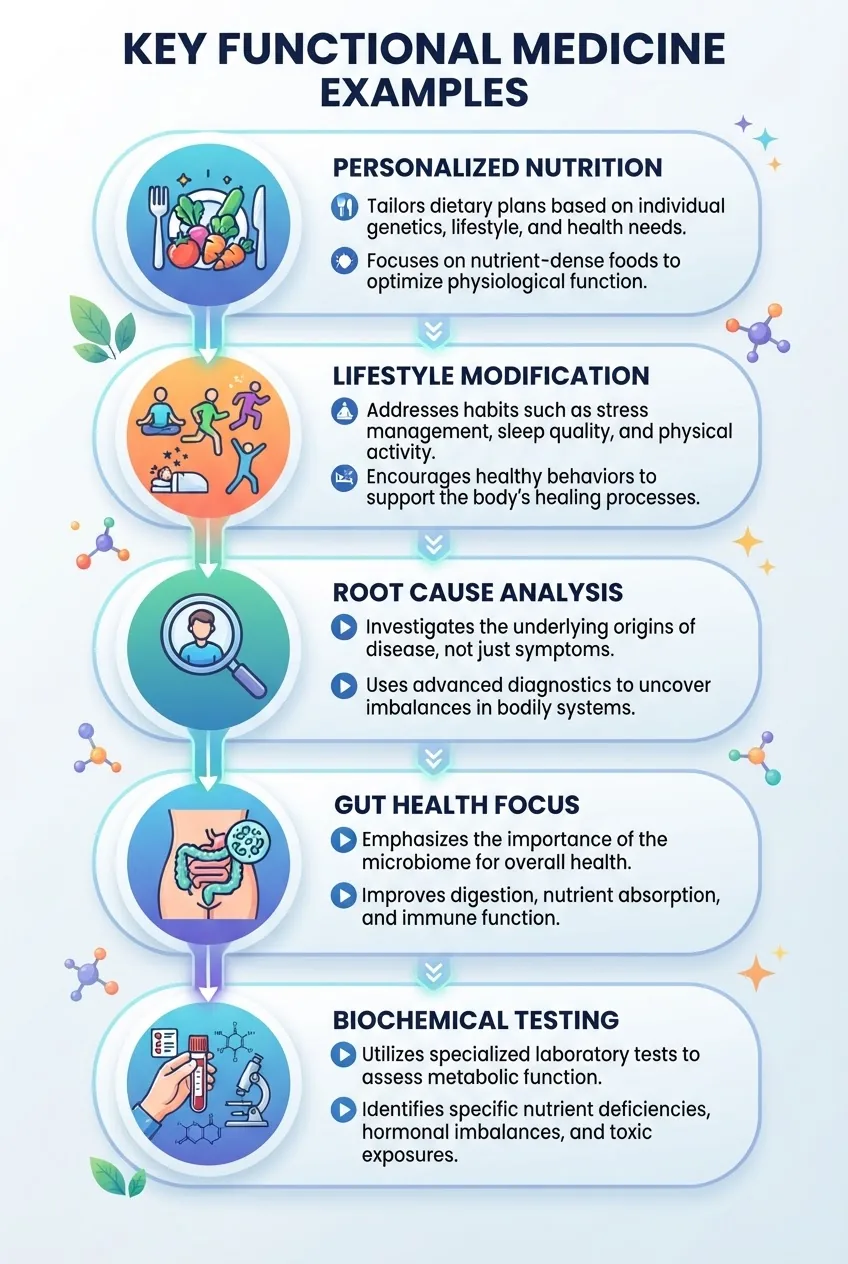
-
Personalised nutrition and metabolic reset
Scenario: A 52-year-old with prediabetes, high triglycerides, and fatigue. The functional doctor orders an oral glucose tolerance test, advanced lipid panel, and micronutrient profile; designs a Mediterranean-style, time-restricted eating plan; prescribes targeted magnesium and vitamin D repletion; schedules 12-week monitoring. Outcome goal: improved HbA1c, reduced triglycerides, weight loss. -
Gut-focused intervention for chronic IBS and fatigue
Scenario: A 36-year-old with bloating, inconsistent bowel habits, and low energy. Tests: comprehensive stool analysis, small intestinal bacterial overgrowth (SIBO) breath test, and food sensitivity screening. Treatment: stepwise antimicrobial or probiotic therapy as indicated, low-FODMAP or elimination diet, gut-healing nutrients (glutamine, zinc), and a plan to retest microbiome markers. This demonstrates root cause analysis and sequenced treatment.
-
Autoimmune modulation
Scenario: A 44-year-old with rheumatoid arthritis suffering incomplete control on standard therapy. Functional approach: evaluate gut permeability and dysbiosis, identify dietary triggers, assess vitamin D and omega-3 status, screen for chronic infections or toxin exposures. Interventions focus on anti-inflammatory diet, microbiome rehabilitation, and co-management with rheumatology. -
Mental health and brain optimisation
Scenario: A 29-year-old with anxiety, poor sleep, and brain fog. Tests: thyroid panel, inflammatory markers, nutrient levels (B12, folate), and sleep assessment. Treatment: targeted nutrition, cognitive-behavioural elements, exercise prescription, and when needed, pharmacologic therapy in coordination with psychiatry. This links to broader non-pharmacologic options in mental care.
-
Pain and inflammatory conditions
Scenario: A 60-year-old with chronic low back pain unrelieved by standard analgesics. Functional plan: screen for metabolic contributors (vitamin D deficiency, magnesium), sleep and stress factors, ergonomic and movement interventions, targeted anti-inflammatory diet, and interventional pain therapies as needed. This integrated plan mirrors evidence-based complementary strategies.
-
Cancer supportive care planning
Scenario: A patient undergoing cancer treatment seeks supportive strategies for side-effect reduction and resilience. Functional approaches may include nutritional optimisation, inflammation control, microbiome support, and careful coordination with oncology to avoid contraindicated supplements. For disease-specific discussion, see resources on alternative medicine for prostate cancer and broader integrative guides. -
Sleep and circadian restoration
Scenario: A 41-year-old shift worker with insomnia, metabolic disturbance, and mood swings. Interventions: circadian-aligned meal timing, light exposure scheduling, melatonin or chronobiotic strategies as indicated, and behavioural sleep therapy elements.
These examples show the practical, iterative nature of functional care: assess, treat mechanistically, monitor, adjust. They also demonstrate overlap with other alternative therapies and advanced cancer options; for a focused exploration of oncology options, see alternative to radiation therapy.
Transition: Many readers ask whether these approaches are legitimate and supported by evidence — the next section examines that directly.
Are Functional Medicine Doctors Legit? Understanding Legitimacy and Criticism
Answer: Functional medicine doctors are legitimate clinicians in that many hold medical or advanced healthcare degrees and apply recognised clinical tools, but the model faces scientific scrutiny regarding variable evidence for some tests and treatments; balanced evaluation of evidence and transparent practices are essential.
Term: root cause analysis — a diagnostic method seeking upstream biological, environmental, or lifestyle drivers of presenting problems rather than only treating downstream symptoms.
Legitimacy signals:
- Many practitioners are licensed physicians (MD/DO), nurse practitioners, or naturopathic doctors who supplement conventional training with functional frameworks.
- Professional bodies such as the Institute for Functional Medicine articulate clinical models and training pathways. Institute for Functional Medicine provides clinical resources and practitioner directories.
- Functional medicine draws on established biomedical principles (inflammation, metabolic dysfunction, microbiome science) and applies them within a personalised context.
Criticisms and limitations:
- Some diagnostic tests used in practice (commercial food sensitivity panels, certain non-standard labs) have inconsistent validation — critics point to limited reproducibility and cost-effectiveness concerns (opinion and methodologic critiques in medical literature).
- Evidence hierarchy: while mechanistic rationale exists for many interventions, high-quality randomised controlled trials (RCTs) demonstrating superiority over standard care are limited for some protocols. According to a 2023 peer-reviewed review, evidence quality varies by condition and intervention (source type: peer-reviewed review).
- Potential for over-testing and increased out-of-pocket expenses if unnecessary diagnostics are ordered without clear clinical indication.
Balanced interpretation: functional medicine’s focus on diet, activity, sleep, stress reduction, and micronutrient correction aligns with mainstream preventive medicine and carries measurable benefits for many chronic conditions. Where controversy arises is in the use and interpretation of certain specialty tests and some off-label supplement protocols.
Research and resources:
- For a curated view of research publications, search PubMed for clinical studies and systematic reviews on functional medicine: PubMed: functional medicine.
- For an official government perspective on complementary and alternative modalities and evidence assessment, see the U.S. National Center for Complementary and Integrative Health: NCCIH.
Education pathways and professional credentials vary. For readers exploring formal training programs, see resources on alternative medicine degree programs for details on available curricula and credentialing variability.
Clinical evidence example: According to a 2022 cohort-based clinical pilot (source type: peer-reviewed pilot study), interdisciplinary, lifestyle-focused programs produced clinically meaningful improvements in metabolic markers for participants with cardiometabolic risk; however, the authors recommended larger RCTs to confirm causality (source type: peer-reviewed study).
Practical trust guidance:
- Verify clinician credentials and scope of practice.
- Ask for evidence supporting recommended tests and treatments.
- Prefer practitioners who coordinate with conventional specialists when treating serious disease.
- Avoid anyone promising guaranteed cures or suggesting cessation of standard cancer therapies without oncologist collaboration.
Transition: If you decide to explore functional medicine, the next section gives practical steps to find and evaluate a functional doctor.
How to Find and Choose a Functional Doctor: Practical Considerations
Answer: To find and choose a functional doctor, verify credentials, clarify the clinic’s diagnostic and treatment approach, check patient reviews, confirm collaboration with conventional providers, and ensure transparent costs and expected timelines before committing.
Checklist for evaluating a functional medicine practitioner:
- Credentials: Confirm medical or relevant healthcare licensure (MD/DO/NP/ND) and ask about functional medicine training and clinical experience.
- Clinical approach: Request a written or verbal overview of their diagnostic strategy, visit lengths, and follow-up schedule.
- Testing rationale: Ask why each test is ordered and how results change the treatment plan.
- Integration: Ensure the practitioner will coordinate with your existing specialists and not advise stopping necessary conventional treatments.
- Costs & insurance: Clarify which services are billable to insurance vs. out-of-pocket; ask for sample care-plan pricing.
- Patient outcomes: Request examples of measurable outcomes and average timelines for improvement in conditions similar to yours.
- Trial visit: Consider starting with a single consultation to assess fit before long-term commitment.
Practical steps and resources:
- Search practitioner directories, ask trusted clinicians for referrals, or use clinic websites that describe their team, services, and care model.
- For clinics offering broader supportive services alongside functional care, explore alternative health care center services to understand complementary offerings like nutritionists, physiotherapy, and counseling.
- Prepare a concise medical timeline and list of prior tests to make the most of initial visits.
Red flags to avoid:
- Practitioners who recommend expensive, non-validated diagnostics without clear indication.
- Anyone advising stopping evidence-based treatments for serious disease without multidisciplinary agreement.
- Grandiose cure claims or lack of willingness to collaborate with your primary care physician or specialists.
Transition: Understanding how functional health fits in the larger care landscape supports decisions about incorporating these models into long-term wellness plans.
Functional Health Definition and Its Importance in Modern Healthcare
Answer: Functional health emphasises maintaining physiological resilience and preventing disease by optimising diet, sleep, activity, stress, and environment to sustain function across the lifespan; it complements traditional disease-focused care by prioritising prevention and quality of life.
Term: functional health — a state where body systems operate efficiently and adaptively, minimising symptoms and reducing disease risk through lifestyle, environment, and targeted biomedical interventions.
Importance in modern healthcare:
- Supports shifting from acute, reactive care to preventive, proactive care.
- Addresses rising prevalence of chronic, lifestyle-related diseases by focusing on modifiable drivers.
- Promotes patient empowerment and long-term cost-effectiveness when interventions reduce disease progression.
Functional health dovetails with public health and preventive medicine by operationalising individualised strategies that scale from primary prevention to chronic disease management, enhancing overall population resilience.
Conclusion: Functional medicine, practised by a functional doctor, is a legitimate, patient-centred approach emphasising root cause analysis, personalised diagnostics, and integrative interventions to restore function and prevent disease. It complements conventional care but requires careful evaluation of tests, evidence, and collaboration with licensed specialists. If you’re considering this path, start by verifying credentials, asking for evidence-based rationales, and seeking transparent, coordinated care. To explore related clinic services, training options, or condition-specific guides, use the internal resources linked above or consult recognised organisations for research and standards.
Ready to learn more or evaluate your options? Book a single consultation with a qualified practitioner, gather your medical timeline and key test results, and come prepared with the checklist above to decide if functional medicine fits your healthcare goals.