
What is another term for Western medical practices? Common alternatives include “conventional medicine,” “biomedical medicine,” or simply “Western medicine”; the acronym CAM denotes Complementary and Alternative Medicine, and “integrative medicine” describes coordinated use of conventional care with evidence-based complementary therapies in a patient-centred plan.
Introduction to Western Medical Practices and Their Alternative Terms
Answer: Alternative terms for Western medical practices are “conventional medicine,” “biomedical medicine,” and “allopathic medicine”; they contrast with CAM (Complementary and Alternative Medicine) and the coordinated, patient-focused model called integrative medicine.
Term: CAM — Complementary and Alternative Medicine, a collective label for non-mainstream approaches used alongside or instead of conventional care.
This article, Alternative Terms for Western Medical Practices: CAM and Integrative Care, explains the vocabulary patients and clinicians encounter when discussing treatment choices and how those labels map to real-world therapies and practitioners.

Patients often ask, “what is another term for western medical practices?”—knowing the synonyms helps when reading medical reports, researching care options, or comparing treatment philosophies. This introduction defines the language and points readers to the broader pillar resource above for deeper policy and systems coverage.
Defining Western Medicine and Its Traditional Practices
Answer: Western medicine, often called conventional or biomedical medicine, relies on the biomedical model: diagnosis based on biology, standardized treatments (drugs, surgery), and regulated professionals delivering evidence-based protocols.
Term: Western medicine — a system emphasizing pathophysiology, laboratory diagnostics, pharmaceutical treatments, and surgical interventions grounded in biomedical science.
Western medicine, historically rooted in scientific investigation and institutional healthcare, emphasizes disease mechanisms, measurable biomarkers, and population-level clinical trials to guide care. Typical interventions include prescription medications, diagnostic imaging, immunizations, minimally invasive and open surgeries, and hospital-based acute care. What has traditionally been a common practice in western medicine includes stepwise diagnostic algorithms, guideline-driven pharmacotherapy, and specialist referral networks.
Common elements of conventional practice:
- Evidence hierarchy that prioritises randomized controlled trials and meta-analyses.
- Regulated professions: physicians, surgeons, pharmacists, nurses, allied health.
- Standardised care pathways for common conditions (e.g., hypertension, diabetes).
Conventional medicine’s strengths are rapid diagnostics, acute life-saving interventions, and well-characterised pharmacology. Limitations cited by patients and some clinicians include a perceived focus on disease rather than whole-person well-being, and sometimes fragmented care between specialties.
For readers seeking a focused explainer on conventional frameworks and treatments, see Conventional Medicine Explained: Definition and Treatment Overview.
Understanding Complementary and Alternative Medicine (CAM)
Answer: CAM (Complementary and Alternative Medicine) includes diverse therapies used either alongside conventional care (complementary) or instead of it (alternative); examples range from acupuncture and herbal medicine to energy therapies and naturopathy.
Term: Complementary medicine and alternative medicine — terms describing non-mainstream health approaches; “complementary” pairs with conventional care, “alternative” replaces it.

CAM therapy covers an expansive set of practices: botanical medicine, acupuncture, ayurveda, traditional Chinese medicine (TCM), homeopathy, naturopathy, massage, chiropractic care, meditation, and energy-based modalities. Usage patterns vary by country and culture; many patients combine CAM with conventional treatments (integrative use) to address symptoms, improve quality of life, or align with personal health beliefs.
Examples of CAM in daily practice (short vignettes):
- Acupuncture for chronic low back pain, delivered by a trained acupuncturist.
- Herbal supplements (e.g., St. John’s wort) for mild depression used alongside psychotherapy.
- Naturopathic nutritional plans to improve metabolic health under primary care supervision.
- Mindfulness-based stress reduction for chronic anxiety and sleep disturbance.
Why patients use CAM: motivations include seeking fewer side effects than pharmaceuticals, wanting personalised or whole-person care, cultural or traditional preferences, dissatisfaction with conventional outcomes, and interest in preventive lifestyle strategies.
Regulatory and terminology notes: some CAM providers are licensed (e.g., licensed acupuncturists, regulated chiropractors), while others operate under varying professional standards. The acronym cam medicine is often used colloquially but should be expanded to CAM (Complementary and Alternative Medicine) for clarity in clinical communication.
For readers interested in services and settings where CAM practitioners work, consult alternative health care center services.
Evidence landscape: some CAM approaches have strong evidence for specific uses (e.g., acupuncture for certain pain conditions), while others have limited or conflicting data; see evidence summaries at the National Center for Complementary and Integrative Health (NCCIH/NIH) and WHO resources on traditional and complementary medicine (WHO).
What Is Integrative Medicine and How Does It Differ from CAM and Western Medicine?
Answer: Integrative medicine coordinates evidence-informed complementary therapies with conventional treatments to treat the whole person—body, mind, and lifestyle—often in multidisciplinary teams aiming for safe, effective, patient-centred care.
Term: Integrative medicine — an approach combining conventional medical treatments with validated complementary therapies in collaborative care plans.
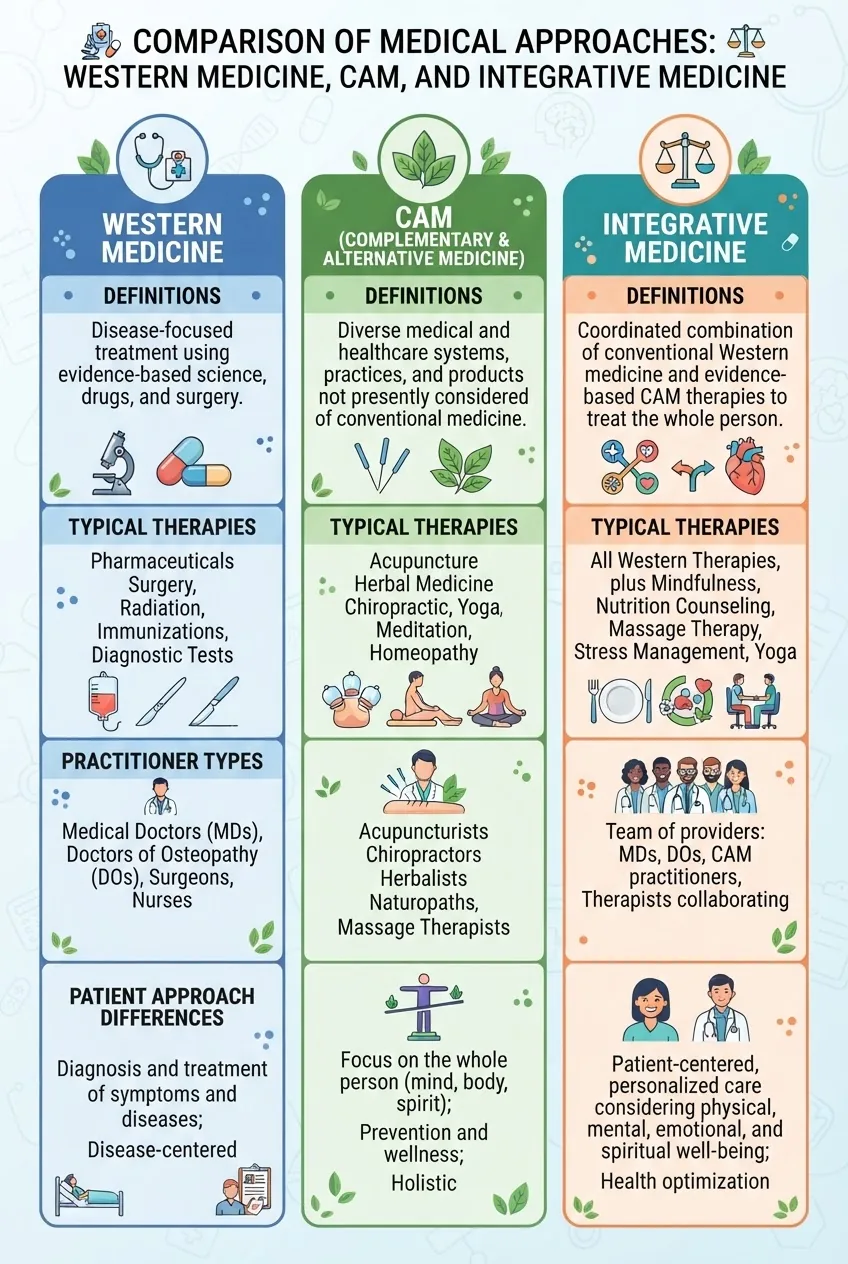
| Model | Focus | Typical Therapies | Delivery |
|---|---|---|---|
| Western / Conventional | Disease biology, acute intervention | Drugs, surgery, diagnostics | Physicians, hospitals, clinics |
| CAM | Whole-person, traditional/holistic | Herbs, acupuncture, energy work | Independent practitioners, clinics |
| Integrative | Combines evidence-based CAM + conventional | All of the above, coordinated | Multidisciplinary teams, shared care plans |
Integrative medicine examples include oncology clinics offering acupuncture to mitigate chemotherapy-induced nausea, or cardiology programs combining exercise, dietary counselling, and mindfulness with statin therapy. Integrative models emphasise shared decision-making, safety (checking for interactions), and using high-quality evidence when available.
Key differences in practice:
- CAM alone may be chosen as an alternative treatment — integrative care uses CAM as complementary, not replacement.
- Integrative medicine applies conventional diagnostics and may refer back to specialist care as needed.
- Credentialing and collaborative communication are central to integrative programs to ensure safety and efficacy.
For an expanded definition and clinical practice frameworks, see Define Integrative Medicine: Meaning and Care Practices Guide and policy summaries at NCCIH/NIH.
Roles and Types of Practitioners in Alternative Medicine and Integrative Care
Answer: Alternative healthcare practitioners include licensed professionals (acupuncturists, chiropractors, naturopaths), allied therapists (massage, yoga instructors), and integrative physicians who coordinate care across disciplines.
Term: Practitioner of alternative medicine — a clinician or therapist practising non-mainstream therapies, with variable regulation depending on the modality and jurisdiction.
Practitioner types (common roles):
- Medical doctors with integrative certification (MD/DO plus integrative training) — bridge conventional and CAM approaches; see Board Certified Integrative Medicine: Certification and Benefits.
- Naturopathic doctors (ND) — focus on natural therapies, nutrition, and lifestyle medicine; training and licensing vary by region.
- Acupuncturists — trained in TCM acupuncture and related modalities; licensed in many jurisdictions.
- Chiropractors — spinal manipulation and musculoskeletal care with formal licensing in many countries.
- Registered massage therapists — soft tissue techniques, often integrated for pain management.
- Herbalists and phytotherapists — prescribe botanical medicines, variable regulation.
- Mind-body therapists — psychologists or instructors offering mindfulness, CBT-informed approaches, or meditation programs.
- Energy healers and complementary therapists — e.g., Reiki, therapeutic touch; credentialing is diverse.
Education pathways: many practitioners pursue degrees, diplomas, or certification programs. For prospective students, see alternative medicine degree programs and graduate-level training like Masters in Alternative Medicine.
Where practitioners work: clinics, integrative health centres, hospitals (increasingly), community health settings, or private practice. Check local licensing boards and professional associations for verified credentials, and consider practitioners who collaborate with conventional clinicians for complex conditions.
Find practical service listings and integrative centre information at Integrative Health Centers: Services and Alternative Treatment Guide and career pathways at Careers in Alternative Medicine: Degree Paths and Job Opportunities.
Common Alternative and Complementary Therapies Explained
Answer: Complementary therapies include acupuncture, herbal medicine, massage, chiropractic, mindfulness, probiotics, homeopathy, and energy therapies—each has specific indications, mechanisms, and evidence profiles.
Term: Complementary therapy — a non-mainstream approach used together with conventional medical treatments to support healing or symptom relief.
- Acupuncture — needling points to modulate pain and autonomic function; evidence supports use for certain pain and nausea conditions. See systematic reviews on PubMed (PubMed).
- Herbal and botanical medicine — plant-derived compounds used for a spectrum of conditions; drug–herb interactions require oversight by a qualified clinician.
- Chiropractic care — spinal manipulation for back and neck pain with moderate evidence for short-term relief.
- Massage therapy — soft-tissue work for musculoskeletal pain, anxiety, and recovery support.
- Mind-body interventions — mindfulness, meditation, CBT-based therapies reduce stress and improve mental health outcomes.
- Probiotics and functional nutrition — dietary modulation for gut health and some metabolic conditions; evidence is strain-specific.
- Naturopathy — combined use of nutrition, lifestyle, botanical and manual therapies within a health-promotion framework.
- Homeopathy — highly diluted remedies; clinical evidence is controversial and often not supported by systematic reviews.
- Energy therapies (Reiki, therapeutic touch) — aimed at wellbeing and symptom relief; evidence is mixed and often relies on patient-reported outcomes.
- Ayurveda and TCM — traditional whole-systems approaches with multi-modal treatments including herbs, manual therapies, and lifestyle prescriptions.
For mental health-specific alternatives, review alternative therapies for mental health. For respiratory-focused examples, see alternative therapies for asthma and allergies. For pain management, consult alternative therapies for pain management.
Effectiveness, Evidence, and Patient Perspectives on Alternative and Integrative Treatments
Answer: Effectiveness varies by therapy and condition—some CAM approaches have robust support (e.g., acupuncture for selected pain), while others lack high-quality evidence; patient satisfaction and symptom improvement are common drivers of use.
Term: Evidence-based complementary and alternative medicine — CAM approaches supported by rigorous research showing benefits that outweigh harms.
Current evidence summaries:
- According to a 2023 NIH report, approximately 30–40% of adults in several high-income countries use some form of CAM each year for wellness or symptom control (source type: federal health agency report).
- According to a 2022 systematic review published in a peer-reviewed journal, acupuncture shows consistent benefit over sham for chronic low back pain in several trials (source type: peer-reviewed meta-analysis).
- According to a 2021 Cochrane review, some herbal products have condition-specific evidence but variable quality; standardisation and contamination remain concerns (source type: systematic review).
Patient narratives (case examples):
Case 1: A 57-year-old patient with chemotherapy nausea added acupuncture in an integrative oncology clinic and reported significant nausea reduction after three sessions while continuing antiemetic medication; the clinic documented reduced antiemetic needs in a chart audit.
Case 2: A 45-year-old with chronic low back pain combined physiotherapy, chiropractic care, and mindfulness training and reported improved function and reduced opioid use over six months in a functional-medicine-informed program.
Safety and interactions: alternative drug therapy (herbal or supplement use) can interact with pharmaceuticals (e.g., St. John’s wort reduces effectiveness of some prescription drugs). Always disclose all supplement and CAM use to prescribing clinicians to avoid adverse interactions.
How to evaluate effectiveness for your condition:
- Check evidence summaries in peer-reviewed literature or authoritative databases like PubMed and the Cochrane Library (source types: research repositories).
- Prefer interventions with randomised controlled trial support and consistent meta-analytic findings for the condition of interest.
- Consider patient-centred outcomes: symptom relief, quality of life, reduced medication burden, and functional improvement.
Examples of condition-specific guidance and resources:
- For oncology-focused integrative options, review integrative oncology programs and the evidence summaries they provide; for an applied example see alternative medicine for prostate cancer.
- For alternatives to radiation in oncology settings and investigational options, consult alternative to radiation cancer treatments.
- For natural approaches applied to ovarian cancer supportive care, see natural treatment for ovarian cancer.
Limitations and debates: systematic reviews sometimes find small effect sizes, heterogeneity between trials, and publication bias. Trustworthy clinical recommendations balance promising CAM options with caution where evidence is weak. According to a 2024 industry report, integrative services are expanding in academic medical centres but standardisation of credentialing remains incomplete (source type: industry report).
Practical steps for patients:
- Discuss CAM use with primary care or specialist clinicians to evaluate interactions and coordinate care.
- Select licensed, credentialed practitioners and inquire about training and outcome data.
- Ask for measurable goals and time-limited trials to assess benefit (e.g., a 6–12 week review).
Conclusion – Navigating the Terminology and Choosing the Best Approach
Answer: Understanding the terms—conventional medicine, CAM, integrative medicine—lets patients make informed choices; combine evidence review, practitioner credentials, and open clinician communication to build safe, effective care plans.
Key takeaways: use “conventional” or “biomedical” for Western medical practices, expand CAM to Complementary and Alternative Medicine when discussing non-mainstream therapies, and prefer integrative programs when seeking coordinated, evidence-informed combinations. Prioritise safety, check authoritative sources like NCCIH/NIH and WHO, and discuss alternatives with your clinical team.
If you’d like practical next steps, consult local credentialing resources, review evidence on PubMed, and consider an introductory integrative consult to align therapies with your health goals.