

Acupuncture for joint pain uses fine needles at targeted points to reduce inflammation, modulate nervous system pain signaling and improve mobility; many people with arthritis report meaningful symptom relief when acupuncture is combined with conventional care and personalised treatment plans.
Understanding Joint Pain and Its Causes
Answer: Joint pain arises from mechanical damage, inflammation, autoimmune processes or metabolic factors that affect cartilage, synovium and surrounding tissues; diagnosis and cause determine whether acupuncture, conservative care or specialist referral is most appropriate.
Term: Arthritis — inflammation of one or more joints causing pain, stiffness, and reduced function.
Joint pain is a symptom, not a single disease. Common mechanisms include:
- Cartilage wear and tear (degeneration) causing mechanical pain and stiffness.
- Inflammation of the synovial membrane driving swelling and nociceptor sensitisation.
- Autoimmune attack on joint tissues producing chronic systemic inflammation.
- Crystal deposition (e.g., gout) causing acute severe joint pain.
- Post-traumatic or overuse injuries altering joint mechanics.
Primary diagnoses commonly associated with chronic joint pain:
- Osteoarthritis — degenerative loss of cartilage and subchondral bone changes producing chronic joint stiffness and pain.
- Rheumatoid arthritis — autoimmune synovitis causing symmetrical joint swelling, prolonged morning stiffness and systemic features.
- Psoriatic and inflammatory arthropathies — immune-driven joint inflammation either isolated or with skin disease.
- Gout and pseudogout — crystal-induced inflammatory flares with acute severe pain.
- Post-traumatic osteoarthritis and chronic tendon/ligament dysfunction surrounding joints.
Clinical signs and tests used to determine cause:
- History: onset, pattern, morning stiffness duration, systemic symptoms.
- Physical exam: joint range, swelling, warmth, deformity.
- Imaging: X-ray for joint space narrowing; MRI/ultrasound for soft tissues and synovitis.
- Laboratory tests: inflammatory markers (CRP, ESR), rheumatoid factor, uric acid where indicated.
Why cause matters for acupuncture: inflammatory versus purely mechanical pain respond differently. Acupuncture often helps nociceptive and inflammatory pain via nervous and immune modulation, while structural collapse (severe joint erosion) may need surgical or pharmacologic intervention first.
Transition: With that clinical picture in mind, the next section summarises acupuncture and how Traditional Chinese Medicine frames joint pain.
What is Acupuncture? Overview and Traditional Chinese Medicine Perspective
Answer: Acupuncture is a therapeutic system using needle stimulation at defined points to rebalance the body’s processes; Traditional Chinese Medicine (TCM) explains joint pain as disrupted qi and blood flow in meridians often worsened by wind, cold or damp invasion.
Term: Qi — in TCM, qi is the body’s vital energy that flows through meridians and supports physiological function.
From a TCM viewpoint, joint pain is commonly attributed to:
- Bi syndrome: obstruction of qi and blood in channels (meridians) by external pathogenic factors like wind, cold, damp or heat.
- Deficiency patterns: weakened constitution (yin, yang, blood) leading to chronic joint degeneration and poor repair.
- Local stagnation: traumatic injury or chronic overuse causing local qi and blood stasis manifesting as fixed pain and stiffness.
From a biomedical viewpoint, acupuncture is a method of peripheral and central neuromodulation:
- Needle insertion produces local microtrauma that triggers immune mediators and local blood flow changes.
- Peripheral nerve stimulation sends signals to spinal cord and brain areas that alter pain perception and descending inhibitory pathways.
- Multiple clinical trials assess acupuncture’s measurable effects on pain scales, function and inflammation markers.
Resources for deeper training and meridian maps:
Acupuncture Acupuncturist Training and Certification Guide
Transition: The following section explains how physiological mechanisms link needling to measurable pain relief in joints.
How Acupuncture Works for Joint Pain Relief
Answer: Acupuncture relieves joint pain through combined local tissue effects, nervous system modulation, endorphin release and anti-inflammatory processes that alter pain signaling and may improve joint mobility.
Term: Endorphins — endogenous opioid peptides released in the central nervous system that reduce pain perception and produce analgesia.
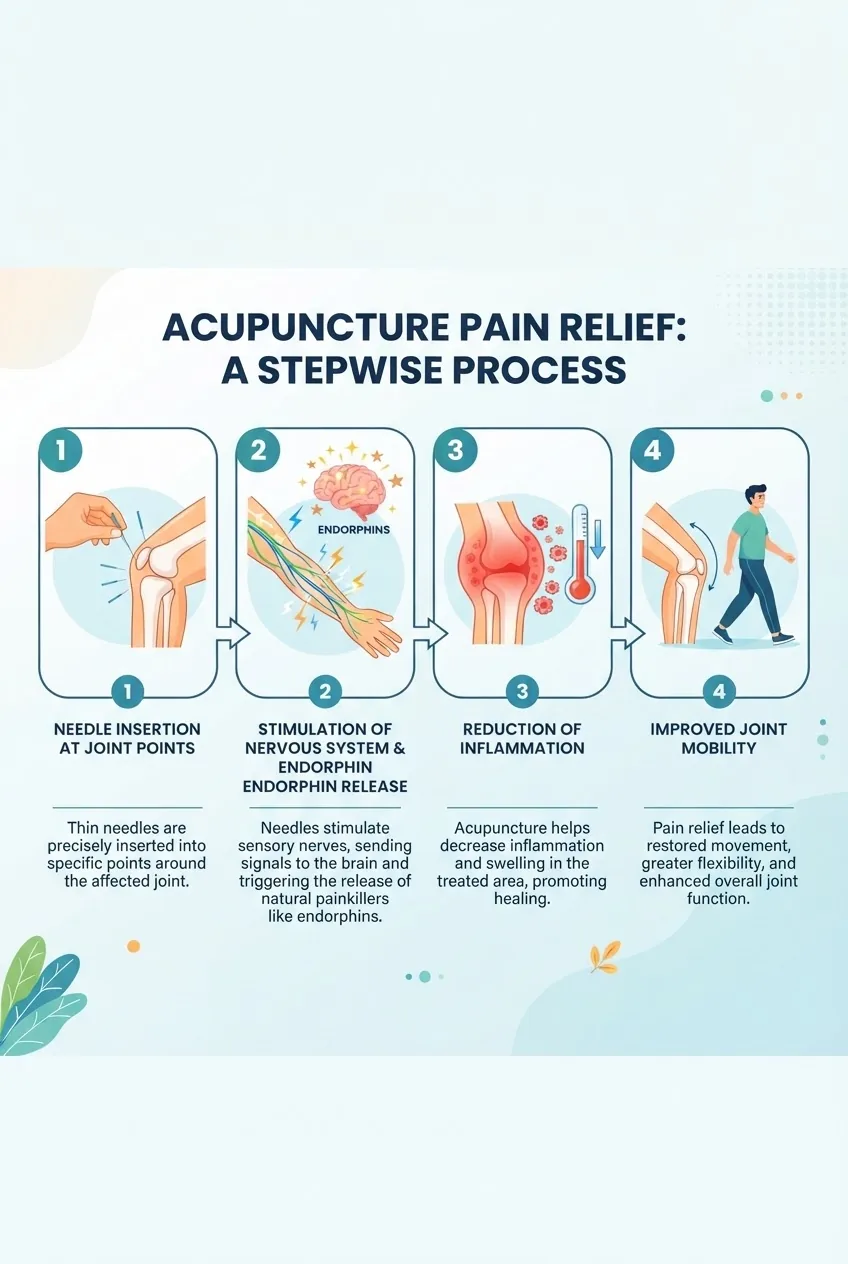
Key physiological mechanisms with labelled examples:
-
Peripheral local effects:
Needle insertion creates a small, controlled micro-injury that promotes local circulation and releases neuropeptides (e.g., substance P reduction) improving tissue oxygenation and reducing nociceptor hypersensitivity.
Example: Needling around an osteoarthritic knee increases local blood flow and can reduce periarticular muscle tightness within minutes.
-
Nervous system modulation:
Afferent nerve signals from needle sites travel to the spinal cord and brainstem, modulating dorsal horn transmission and engaging pain inhibitory circuits (gate control theory) and descending serotonergic and noradrenergic pathways.
Example: Needling wrist points for hand arthritis reduces central sensitisation measured as lower pain scores and reduced temporal summation in trials.
-
Endorphin and neurotransmitter release:
Acupuncture stimulates release of endorphins, enkephalins and monoamines (serotonin, norepinephrine) that decrease pain perception and improve well-being.
Example: Post-needling increase in plasma beta-endorphin correlates with reported analgesia in chronic joint pain cohorts.
-
Immune and inflammatory modulation:
Needling influences cytokine profiles locally and systemically — lowering pro-inflammatory cytokines (e.g., IL-6, TNF-alpha) and promoting anti-inflammatory mediators in some studies.
Example: Small trials show lower synovial fluid pro-inflammatory markers after serial acupuncture sessions in knee OA patients.
-
Musculoskeletal and connective tissue effects:
Acupuncture alters muscle tone, reduces trigger point activity and can improve joint range of motion through local fascial release and neuromuscular rebalancing.
Example: Needling alongside exercise improves functional gains faster than exercise alone in some rehabilitation studies.
Clinical translation: These mechanisms explain why acupuncture often lowers pain intensity scores, reduces analgesic use and improves patient-reported function across various joint conditions; however, effect sizes vary and depend on practitioner skill, point selection and treatment dosing.
Transition: Next, we look at the specific types of joint pain where acupuncture is commonly applied, and evidence for each.
Types of Joint Pain Acupuncture Treats (Including Arthritis)
Answer: Acupuncture is used for osteoarthritis, rheumatoid arthritis, gout flares and other inflammatory or degenerative joint conditions; efficacy and protocols differ by diagnosis and symptom acuity.
Osteoarthritis (OA):
OA is the most-studied joint condition for acupuncture. Needling around symptomatic joints (knee, hip, hand) aims to reduce pain and improve mobility. Clinical trials report modest-to-moderate pain reduction and function improvement versus usual care, with variability across studies.
acupressure knee pain points training
Rheumatoid arthritis (RA) and inflammatory arthropathies:
RA involves systemic immune activation; acupuncture can relieve pain, reduce muscle tension and improve quality of life but is not a substitute for DMARDs (disease-modifying antirheumatic drugs). Studies show improvements in pain and some inflammatory markers when used adjunctively.
Gout and crystal arthropathies:
Acupuncture can be applied to reduce pain during acute gout flares when used alongside pharmacologic anti-inflammatories; evidence is more limited and trials are small.
Post-traumatic and overuse joint pain:
Needling supports rehabilitation for ligament, tendon and periarticular soft-tissue dysfunction contributing to joint pain; it is combined with exercise and manual therapy for best outcomes.
Ankle and foot joint conditions:
Acupuncture can address ankle osteoarthritis, tendon-related pain and post-surgical stiffness. For targeted acupressure alternatives see the acupressure points in ankle chart.
Knee-specific considerations:
Needle placement typically targets periarticular points plus distal points on liver and stomach meridians; adjunctive moxibustion or electroacupuncture is common. For focused acupressure training for knees, see the link above.
Hand and wrist joints:
Acupuncture can reduce pain and improve grip strength in mild-to-moderate hand OA; RA-related hand pain responds when combined with disease-controlling medications.
Case example (patient scenario):
Mrs A, age 68, with bilateral knee OA and 6 months of reduced walking tolerance, received a course of 8 acupuncture sessions over 4 weeks with peri-knee and distal points; she reported 40% pain reduction and a 2-point improvement on the WOMAC function scale after 8 sessions, allowing increased activity and reduced NSAID use.
Transition: The next section outlines a detailed, step-by-step treatment process used by licensed acupuncturists for joint pain.
The Acupuncture Treatment Process for Joint Pain
Answer: A typical joint-focused acupuncture course begins with assessment, informed consent and a baseline exam, proceeds with sterile needle insertion at local and distal points, optional electrostimulation or moxibustion, and a defined session and treatment schedule tailored to response.
Term: Moxibustion — application of heat (often burning mugwort) near acupuncture points to stimulate circulation and warming effects in TCM practice.
- Initial assessment (30–60 minutes):
History, medication review, imaging and laboratory results are reviewed to identify red flags (infection, fracture, acute gout) and to set realistic goals. Baseline pain scores and functional tests are recorded.
- Consent and safety checks:
Practitioner explains risks, expected sensations and obtains written consent; screening for anticoagulant use, pacemakers (if electroacupuncture planned), pregnancy status and immunosuppression is performed.
- Treatment plan design:
Protocol includes local periarticular needling (Ashi or tender points), specific meridian points (e.g., ST36, SP9 for knee), distal points for systemic modulation, and choice of adjuncts (electroacupuncture, moxibustion, cupping).
- Needles and insertion:
Single-use sterile stainless-steel needles of varying length (e.g., 0.12–0.30 mm diameter, 15–40 mm length) are used. Local periarticular insertions are shallow to medium depth; distal points may require deeper insertion depending on anatomy.
Typical needle placement example for knee OA (step-by-step):
- San yin jiao (SP6) and Zusanli (ST36) — distal immune and leg support points.
- Local Ashi points around the medial and lateral joint line — reduce local nociception.
- Xi-cleft or He-sea points depending on TCM pattern diagnosis.
- Stimulation and retention:
Needles may be manually stimulated (twist, lift-thrust) or connected to low-frequency electroacupuncture (2–4 Hz) for stronger analgesic effects. Retention typically 20–40 minutes based on patient tolerance.
- Adjuncts during session:
Moxibustion for cold-damp patterns, cupping for local congestion, or gentle joint mobilisation and guided exercises may be incorporated.
- Post-session care and advice:
Advice includes gentle activity, ice or heat as appropriate, hydration and avoiding strenuous loading for 24 hours if soreness present. Pain scores and functional measures are recorded for progress tracking.
- Treatment course and frequency:
Typical acute-course: 1–2 sessions/week for 4–8 weeks (8–12 sessions), then taper to maintenance 1 session every 2–8 weeks depending on response.
- Follow-up and outcome measurement:
Re-assessment at 4–8 weeks to adjust point selection, increase add-ons (electroacupuncture) or refer for imaging/specialist care if insufficient improvement.
Detailed practitioner qualifications and training underpin safety and effectiveness; see accreditation resources when choosing a clinician.
acupuncturist certification requirements guide
Transition: The following section summarises clinical evidence and how acupuncture compares to other treatments for arthritis.
Benefits and Effectiveness: Can/Does Acupuncture Help Arthritis?
Answer: Evidence indicates acupuncture can reduce pain and improve function in osteoarthritis and some inflammatory arthropathies as an adjunct to usual care, with moderate effect sizes in many meta-analyses though variability and placebo effects exist.
Key evidence highlights:
- According to a 2023 systematic review and meta-analysis published in a peer-reviewed medical journal, acupuncture provided statistically significant pain relief for knee osteoarthritis compared with sham or no-acupuncture controls (effect size variable by trial quality).
- According to a 2022 Cochrane-style review (peer-reviewed secondary analysis), acupuncture delivered small-to-moderate improvements in pain and function for chronic OA when added to standard care.
- According to a 2021 randomized controlled trial published in a peer-reviewed journal, electroacupuncture plus standard therapy reduced analgesic use in RA patients compared with standard therapy alone.
Comparison table: acupuncture versus other common joint pain therapies
| Therapy | Primary benefit | Evidence for arthritis/joint pain | Typical risks/limitations |
|---|---|---|---|
| Acupuncture | Pain reduction, improved mobility | Moderate-quality trials for OA; adjunctive benefits for RA in small trials | Transient soreness, small infection risk if unsafe practice |
| NSAIDs / Analgesics | Rapid symptom control | Strong short-term evidence for pain relief | Gastrointestinal, cardiovascular, renal side effects with long-term use |
| Physical therapy / Exercise | Improves strength, function, disease progression | High-quality evidence for long-term functional improvement | Requires adherence; slower pain relief |
| Intra-articular injections (steroids, hyaluronic acid) | Targeted anti-inflammatory or lubrication effect | Variable duration; steroids effective short-term for flares | Joint infection risk, steroid-related cartilage concerns with repeated use |
| Surgery (arthroplasty) | Restores joint mechanics in end-stage disease | Strong evidence for pain and function in end-stage OA | Surgical risks, rehab required |
Clinical nuance and training: Effectiveness depends on correct diagnosis, point selection (local vs distal), dose (number and frequency of sessions) and practitioner skill; training programs emphasise these skills — see acupuncture therapy research and treatment training for research-informed protocols.
External authoritative guidance and trial examples:
- PubMed Central (peer-reviewed clinical trials) — search for acupuncture osteoarthritis randomized trials.
- National Center for Complementary and Integrative Health (NCCIH) — guidance on research into acupuncture safety and efficacy.
- World Health Organization (WHO) — standards for acupuncture training and practice in some regions.
Transition: The next section explains safety, contraindications and how to choose a qualified practitioner.
Risks, Contraindications, and Safety Considerations
Answer: Acupuncture is generally safe when performed by licensed practitioners using single-use needles, but risks include bruising, transient pain, infection if sterile technique fails, bleeding for anticoagulated patients, and specific contraindications such as untreated joint infection or severe bleeding disorders.
Common side effects and safety points:
- Minor bleeding, bruising or local soreness at insertion sites.
- Temporary lightheadedness or fainting in some patients.
- Infection risk is extremely low with single-use needles and proper hygiene; serious events reported are rare.
- Needle migration and organ puncture are rare when practitioners follow anatomical safety zones.
Contraindications and precautions:
- Absolute: active skin or joint infection, uncontrolled bleeding disorders, severe neutropenia.
- Relative: anticoagulant therapy (increase bleeding risk), pregnancy (avoid certain points), implanted electrical devices if electroacupuncture planned.
- Relative caution with severe osteoporosis, compromised skin integrity or severe peripheral neuropathy.
Selecting a qualified practitioner:
- Verify licensure and formal training in acupuncture; certification standards vary by country and state.
- Ask about experience treating joint conditions and request references or outcome examples.
- Ensure single-use needles, documented consent and clear communication about treatment goals.
Training options beyond acupuncture that can support safety:
acupressure practitioner course and certification
Authoritative guidance on safety: government health agencies set practice and infection control recommendations; for example, consult the Australian Department of Health or national registries for local rules. External resources: Australian Government Department of Health.
Transition: Read on for how acupuncture fits with other therapies and combined care strategies.
Integrating Acupuncture with Other Joint Pain Therapies
Answer: Acupuncture is best used as a complementary therapy alongside evidence-based treatments such as exercise, weight management, medications and targeted injections; coordinated care improves outcomes and reduces medication reliance.
Common integration strategies and practical examples:
- Combine acupuncture with a graded exercise program and physiotherapy to address mechanics and strength deficits while needles reduce pain to allow exercise adherence.
- Use acupuncture as adjunct to pharmacologic therapy for inflammatory arthritis to manage pain and improve sleep, while continuing DMARDs under rheumatologist supervision.
- For acute gout, acupuncture can provide symptomatic relief but anti-inflammatories and urate-lowering strategies remain primary.
Complementary self-care and acupressure resources:
abdominal acupressure points guide
For back and overlapping musculoskeletal conditions, learn from adjacent evidence bases: acupuncture for back pain treatment guide
Integration checklist for clinicians and patients:
- Agree on goals (pain reduction, improved function, medication sparing).
- Coordinate with prescribing clinicians to avoid contraindicated combinations (e.g., anticoagulation concerns).
- Schedule acupuncture to support rehab sessions (e.g., before physiotherapy to reduce pain during exercise).
- Monitor outcomes with standardized tools and adjust plan; escalate to specialist care if red flags appear.
Additional resources on broader training and technique integration: acupuncture therapy research and treatment training
Transition: The next section outlines expected timelines and patient responses after acupuncture sessions.
What to Expect After Acupuncture for Joint Pain: Timeline and Results
Answer: Patients may feel immediate transient relief or gradual improvement over multiple sessions; typical timelines show initial benefits within 1–4 sessions and optimal functional gains after 6–12 sessions, with maintenance sessions depending on chronicity and goals.
Typical patient response timeline:
- Immediate (within hours): transient reduction in pain intensity, increased relaxation.
- Short-term (1–4 sessions): measurable pain score reduction, easier engagement with exercises.
- Medium-term (6–12 sessions): improved joint function, reduced medication reliance for some patients.
- Long-term: maintenance schedule (monthly or as-needed) may sustain benefits; some patients remain symptom-free for months.
Factors influencing response:
- Diagnosis and severity (end-stage structural disease less likely to fully respond).
- Consistency and dosing of sessions.
- Practitioner skill and correct point selection.
- Concurrent therapies and lifestyle factors (exercise, weight control).
Follow-up care suggestions:
- Re-assess pain and function at 4–8 session milestones.
- Use patient-reported outcome measures (e.g., WOMAC for knee OA) to track progress.
- Plan maintenance or stepping-down frequency based on sustained improvements.
Transition to final summary: Below is a concise wrap-up and action step for readers considering acupuncture for joint pain.
Conclusion
Acupuncture for joint pain offers a clinically supported, low-risk adjunct for many people with osteoarthritis and inflammatory joint conditions. When delivered by licensed practitioners and integrated with exercise, medications and lifestyle change, it can reduce pain, improve function and lower medication reliance. Discuss options with your healthcare team and a certified acupuncturist to design a safe, evidence-informed plan.
Call to action: If you’re considering acupuncture for joint pain, request practitioner credentials, review treatment goals and arrange an initial assessment to discuss a personalised plan.