

Acupuncture for sore muscles reduces pain, calms inflammation and restores circulation to injured tissue by local and central neurochemical effects, improving recovery speed and mobility; practitioner training combines anatomy, needling skills and supervised clinical practice to safely treat muscle soreness and related dysfunction.
Understanding Muscle Soreness and Its Causes
Answer: Muscle soreness arises from mechanical overload, microtrauma, inflammation or strain; diagnosis distinguishes delayed onset muscle soreness (DOMS), acute strain, trigger-point myofascial pain and fatigue to guide appropriate acupuncture or combined therapy.
Term: Delayed onset muscle soreness (DOMS) — muscle pain and stiffness appearing 24–72 hours after unaccustomed or intense exercise, caused by microtrauma and inflammatory responses.
Term: Trigger point — a hyperirritable spot in skeletal muscle associated with a palpable nodule in a taut band that can refer pain.
Muscle soreness presents in a few common patterns and causes:
- DOMS: Post-exercise microdamage, delayed stiffness, tenderness and reduced range of motion.
- Acute strain: Sudden overload or tearing of muscle fibres with immediate pain and possible bruising.
- Myofascial trigger points: Local nodules producing referred pain and tightness, often chronic and activity-related.
- Overuse and fatigue: Repetitive loading without recovery causing metabolic stress and local inflammation.
- Secondary causes: Poor biomechanics, joint dysfunction, nerve entrapment or systemic inflammation (less common).
Key symptoms and differentiators:
- Onset timing — immediate suggests strain; delayed 24–72 hours suggests DOMS.
- Pain quality — sharp or tearing indicates structural injury; dull, aching and stiff suggests DOMS or trigger points.
- Range of motion — significant loss can indicate severe strain or referral from trigger points.
- Palpation findings — taut bands, local twitch responses, or visible swelling inform treatment choice.
Clinical assessment for acupuncture-focused treatment typically includes:
- History of injury, activity load and symptom timeline.
- Palpation for trigger points, muscle tone and fascial restrictions.
- Functional tests for strength, flexibility and movement patterns.
- Red-flag screening (neurological deficit, systemic illness) for medical referral.
Effective management begins by classifying the soreness mechanism — inflammatory DOMS may respond better to microcirculation and anti-inflammatory effects of acupuncture, whereas trigger-point dominated pain often requires local needling and myofascial release techniques.
Transitioning from causes to mechanisms clarifies how acupuncture targets these specific processes.
How Acupuncture Works for Sore Muscles
Answer: Acupuncture eases sore muscles through local mechanical effects on muscle and fascia, neurochemical modulation (endorphins, serotonin), autonomic balancing that improves circulation, and TCM-guided regulation of Qi along meridians to restore functional movement.
Term: Qi — in Traditional Chinese Medicine (TCM), Qi is the functional life-energy circulating along meridians that supports tissue function; in biomedical terms Qi-related concepts map to neural, circulatory and connective-tissue dynamics.
Term: Meridian — a TCM pathway linking acupuncture points across the body; meridians often correspond to neurovascular or fascial lines relevant to muscle pain.
Mechanisms explained simply:
- Local mechanical effects: Needle insertion and manipulation disrupt tight muscle bands and stimulate local fibroblasts and microcirculation, reducing ischemia and pain-spasm cycles.
- Neuromodulation: Needle stimulation engages A-delta and C fibres, activating spinal gating and descending inhibitory pathways to reduce nociceptive signalling.
- Neurochemical release: Clinical studies show increases in endorphins, enkephalins and serotonin after acupuncture, which lower perceived pain and improve mood.
- Anti-inflammatory effects: Acupuncture can reduce pro-inflammatory cytokines and promote local resolution pathways, aiding tissue repair.
- Autonomic regulation: Parasympathetic activation through needling supports muscle relaxation and improved blood flow, accelerating healing.
Visual learners: imagine meridians as maps for where neural and fascial pathways converge; targeted needling opens local circulation and resets dysfunctional neural signals, much like releasing a stuck valve in a hydraulic system.
Evidence and research context:
- Systematic reviews and clinical trials show consistent benefit for musculoskeletal pain conditions; meta-analyses attribute effect sizes to both specific needling and non-specific contextual effects (PubMed reviews).
- According to a 2023 review from a national research body, acupuncture modulates pain via measurable neurochemical changes and improved microcirculation (source type: government-funded review).
- For detailed, research-driven training material, see Acupuncture therapy research and treatment training.
Practical point selection for sore muscles blends TCM point prescriptions with local trigger-point needling:
- Local Ashi points (tender spots) and adjacent motor points to release tight fibres.
- Distal meridian points that influence related muscles and energy flow (e.g., Gallbladder channel for lateral hip/thigh pain).
- Balancing points to modulate autonomic tone and systemic inflammation.
For students and practitioners, mapping the meridian links that commonly relate to muscle groups is essential. For an anatomical meridian reference, download the 12 Meridians Chart PDF Guide.
Next, the measurable patient benefits clarify why therapists choose specific protocols.
Key Benefits of Acupuncture for Sore Muscles and Pain Relief
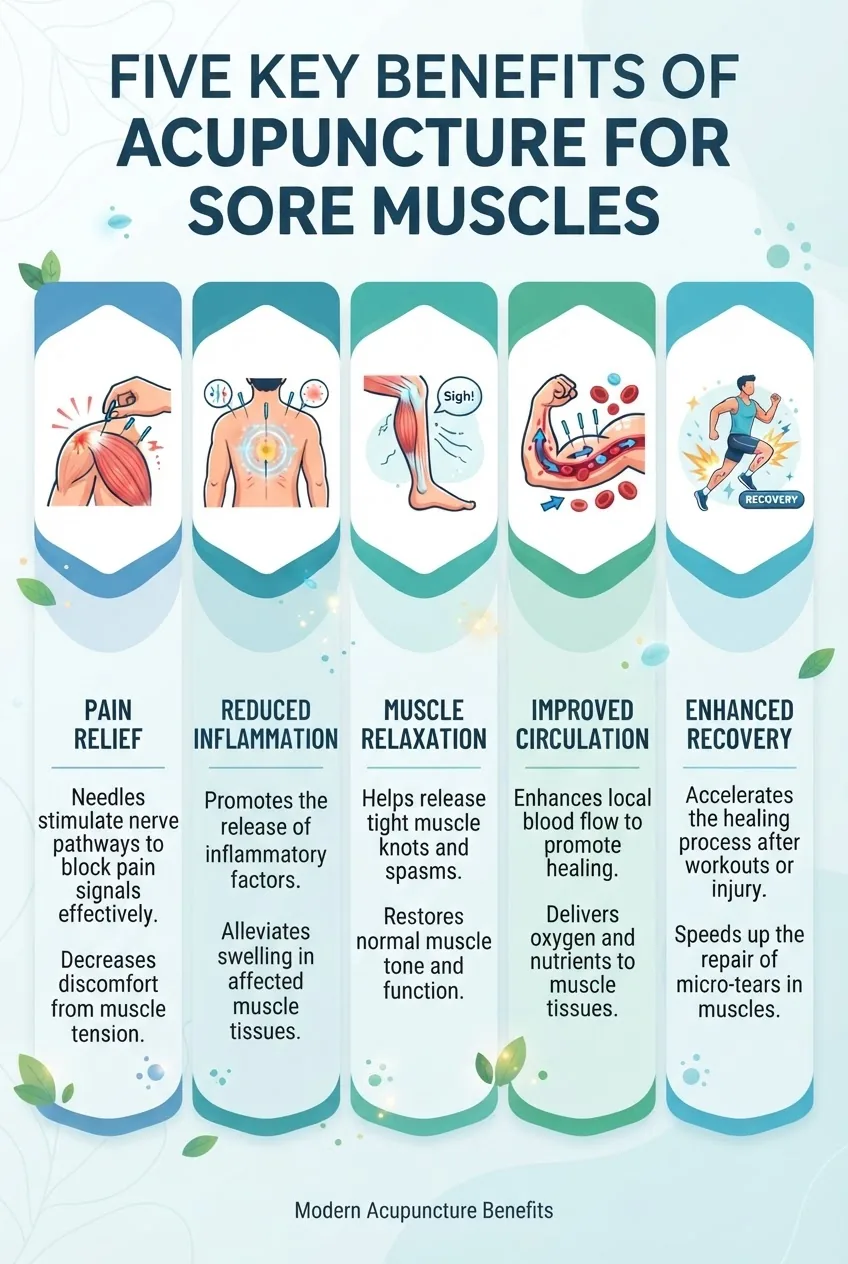
Answer: Acupuncture provides pain relief, reduces inflammation, relaxes muscle tone, improves local circulation and accelerates tissue repair — benefits that together restore function and shorten recovery time for many patients.
-
Pain relief:
Needle stimulation activates descending inhibitory pathways and increases endogenous opioids (endorphins), producing measurable reductions in pain intensity. According to a 2021 meta-analysis published on PubMed, patients report clinically meaningful pain improvement vs sham in many musculoskeletal conditions (source type: peer-reviewed meta-analysis).
-
Reduced inflammation:
Acupuncture downregulates pro-inflammatory cytokines and upregulates anti-inflammatory mediators in local tissue, shortening the inflammatory phase of healing and decreasing pain linked to swelling.
-
Muscle relaxation and trigger-point release:
Local needling breaks the contraction knot in trigger points, produces local twitch responses and restores normal sarcomere length, which reduces referred pain and improves range of motion.
-
Improved microcirculation:
Needling increases local blood perfusion and lymphatic drainage, delivering nutrients and clearing metabolites that contribute to soreness and fatigue.
-
Enhanced recovery and functional gains:
Combined effects accelerate return-to-activity, reduce reliance on analgesics and complement rehabilitation exercises for more durable outcomes.
-
Low-risk adjunct to standard care:
When performed by a licensed practitioner, acupuncture has a low incidence of serious adverse events and can reduce medication use for some patients, according to a 2022 government safety summary (source type: government report).
-
Improved sleep and mood:
By modulating autonomic balance and neurochemicals, acupuncture often improves sleep and reduces the central sensitisation that exacerbates chronic muscle pain.
-
Customisable protocols:
Practitioners can tailor point selection and techniques (manual, electro-acupuncture, dry-needling style techniques) specifically to DOMS, strain or trigger-point dominated presentations, enhancing specificity and results.
Clinical parallels: For conditions like low back muscular pain, acupuncture shows consistent benefits; see acupuncture for back pain treatment for parallels in outcome measures and protocol design.
Next, see how those benefits are delivered in a typical therapy session and what techniques achieve them.
Typical Acupuncture Therapy Procedures for Muscle Soreness
Answer: A standard session includes assessment, palpation and point selection, needle insertion (local and distal), retention (10–30 minutes), optional adjuncts (electro-acupuncture, cupping), and aftercare guidance; frequency and duration depend on cause and severity.

Term: Electro-acupuncture — the application of a mild electrical current to acupuncture needles to amplify stimulation, often used for chronic or severe muscle pain.
Step-by-step session walkthrough (typical 45–60 minute appointment):
-
Intake and functional assessment (5–10 min):
Confirm symptom onset, aggravating/relieving factors, red flags and relevant medical history; observe posture and movement; palpate muscle tone and locate trigger points.
-
Point selection and treatment plan (3–5 min):
Choose local Ashi points, nearby motor points, and distal meridian points to address systemic factors such as Qi stagnation or autonomic imbalance.
-
Needle insertion (5–10 min):
Use single-use sterile filiform needles. Typical insertion depths for limb and trunk muscle therapy range from 5–25 mm depending on muscle thickness and point location; deeper needling (20–40 mm) only when trained in intramuscular techniques and anatomically safe zones. Gentle lifting/thrusting or rotation may be applied to elicit a Deqi (needle sensation) when clinically indicated.
-
Adjunct stimulation (10–20 min):
Needles retained for 10–30 minutes. Use manual stimulation or connect to an electro-acupuncture device at low-frequency (2–4 Hz) for analgesic endorphin release or higher-frequency settings (50–100 Hz) for neuromodulation; settings tailored per protocol.
-
Other modalities:
Cupping for local congestion, Tui Na massage for soft-tissue mobilisation, or moxibustion for chronic cold-type conditions may be added as appropriate.
-
Needle removal and immediate reassessment (2–5 min):
Check for pain reduction, muscular tone change and range-of-motion improvement; advise on post-treatment activity and self-care.
Frequency and course planning:
- Acute DOMS or mild strain: 1–3 sessions over 1–2 weeks often sufficient to reduce symptoms and restore function.
- Persistent myofascial pain: 6–10 sessions over 4–8 weeks with integrated rehabilitation and home self-care for durable improvement.
- Maintenance or flare management: periodic sessions (monthly or as-needed) may prevent recurrence in athletes or high-load workers.
Mini case example (experience signal):
A 34-year-old cyclist developed lateral thigh soreness (trigger-point dominant) after increased training. After three weekly acupuncture sessions combining local trigger-point needling, electro-acupuncture (2 Hz), and mobilisation, pain decreased from 7/10 to 2/10 and pedal mechanics normalised; patient returned to full training in two weeks.
Safety and technique notes within sessions:
- Needle depth must respect local anatomy—avoid deep needling over lungs, large vessels or nerves without specific advanced training.
- Monitor for vasovagal responses and provide recovery time; use sterile disposables only.
- Document objective changes and adjust protocols; combine with rehabilitative exercises for best functional outcomes.
| Technique | Typical Needle Depth | Session Duration | Best Use |
|---|---|---|---|
| Superficial needling (Ashi/local) | 5–15 mm | 10–20 min | Trigger points, superficial taut bands |
| Intramuscular/manual stimulation | 15–40 mm (operator dependent) | 10–30 min | Deep myofascial release, chronic tightness |
| Electro-acupuncture | As per needle type | 10–30 min with stimulation | Severe pain, chronic cases needing amplified stimulation |
Next: how acupressure and other manual therapies integrate with acupuncture for broader muscle pain relief.
Integrating Acupressure and Other Therapies for Muscle Pain Relief
Answer: Combining acupressure, massage, Tui Na and cupping with acupuncture enhances circulation, speeds trigger-point resolution and reinforces neuromodulation; simple self-acupressure techniques support clinic work between sessions.
Complementary therapies commonly used alongside acupuncture:
- Acupressure: Non-invasive point stimulation useful for home care and immediate relief.
- Therapeutic massage and Tui Na: Mobilise fascia and relieve adhesions that perpetuate muscle soreness.
- Cupping: Useful for muscle congestion and fascial restriction, often paired with needling for synergistic effects.
- Exercise therapy and stretching: Restores muscle length-tension relationships after pain reduction.
Practical how-to examples for patients and students:
-
Self-acupressure routine for thigh soreness:
Apply firm, circular pressure for 30–60 seconds to local Ashi points and selected distal points to reduce local hypoxia and stimulate analgesic pathways.
-
Integrative clinic flow:
Begin with acupuncture to reduce pain, then perform Tui Na or massage to lengthen muscles and finish with self-care instruction for home practice.
Comparing points across regions teaches transferability; for abdominal-related muscle tension reference the abdominal pain acupressure points guide to see point selection logic in another region.
For joint-specific acupressure techniques that also affect surrounding muscle tone, consult training resources such as acupressure knee pain points training and acupressure points in ankle for technique transfer to limb muscles.
Integration tips for clinicians:
- Sequence modalities: needle → manual therapy → active rehabilitation for best tissue remodelling.
- Educate patients on pacing and progressive loading to prevent re-injury following pain reduction.
- Use acupressure training as a low-cost adjunct to empower patients (see Acupressure practitioner course and certification).
Transitioning from clinic practice to practitioner training highlights the education needed to deliver these integrated approaches safely and effectively.
Acupuncture Training Focused on Therapy for Sore Muscles
Answer: Training combines foundational TCM theory, anatomy and physiology, point location, needle techniques (including trigger-point and motor point approaches), supervised clinical internships and certification; specialised muscle-therapy modules teach palpation, depth control and electro-acupuncture protocols.
Training components specific to muscle-soreness therapy:
- Core knowledge: TCM diagnosis, meridian theory and integration with musculoskeletal anatomy.
- Anatomy and clinical palpation: Regional musculoskeletal anatomy, neurovascular mapping and fascial planes essential for safe needling depth control.
- Point location practice: Repeated, supervised mapping of common muscle-related points (Ashis, motor points, local and distal meridian points).
- Needling techniques: Superficial, intramuscular, electro-acupuncture, dry-needling style trigger-point release and gentle manual stimulation.
- Adjunct therapies: Training in cupping, Tui Na and rehabilitative exercise prescription for combined treatment plans.
- Clinical internships: Progressive hands-on practice with patient loads that include DOMS, strains and chronic myofascial pain under supervision.
- Safety and professionalism: Infection control, emergency response, contraindications and practice management.
Typical course structure and milestones (common in accredited programs):
- Didactic modules (TCM theory, medical sciences) — semester-based learning with assessments.
- Practical labs — point location, needling skill drills and supervised palpation labs.
- Musculoskeletal specialisation modules — targeted training in trigger-point therapy and sports-related presentations.
- Clinical internship — minimum clinical hours working with diverse muscle-pain cases, increasing in complexity.
- Capstone assessments — competency-based evaluations of practical and clinical reasoning for muscle-soreness care.
Practical training exercises and internship scenarios (experience signals):
- Pair palpation drills: Students practice identifying taut bands and motor points on each other with timed accuracy targets.
- Needling proficiency circuits: Repeated sterile single-use needle insertions into model zones to refine depth control and hand technique.
- Mock clinic rotations: Simulated patient cases (DOMS after exercise, acute strain, chronic trigger-point pain) with supervisor feedback focused on point selection rationale and outcome measures.
- Electro-acupuncture competency: Students learn safe device settings, electrode placement, and contraindications under supervision.
Certification and regulatory pathways:
- Most jurisdictions require accredited diploma or degree-level training plus supervised clinical hours before registration; check local regulatory boards for exact hours and exams.
- For professional credential details see acupuncturist certification requirements.
- Related qualifications in acupressure and manual therapy enhance practice options; see Acupressure practitioner course and certification.
How muscle-soreness modules differ from general acupuncture training:
- Greater emphasis on musculoskeletal anatomy, biomechanics and movement assessment.
- Specific hands-on hours focused on trigger-point, motor point and intramuscular needling techniques.
- Integration of exercise prescription and rehab progression into treatment planning.
Accreditation and professional body guidance:
- Graduates should seek registration with recognised bodies and adhere to continuing professional development standards set by national associations; for an example of a professional body, see the Australian association site (Australian Acupuncture and Chinese Medicine Association), which outlines scope, ethics and training expectations (source type: professional body).
- For a comprehensive overview of certification and training pathways, align your course with the standards in the Acupuncture Acupuncturist Training and Certification Guide.
Transitioning to safety considerations ensures sound clinical decisions for muscle-soreness patients.
Safety, Limitations, and When to Seek Professional Advice
Answer: Acupuncture is generally safe when performed by licensed practitioners, but has contraindications (bleeding disorders, certain implants, local infection); recognise limitations—variable response rates and need for multi-modal care—and seek medical review for red flags like severe weakness, numbness or systemic signs.
Contraindications and precautions:
- Absolute contraindications: unclean skin over the site, active systemic infection, patient refusal.
- Relative contraindications: anticoagulant therapy or bleeding disorders (modify technique, avoid deep needling), pregnancy (avoid certain points), implanted electronic devices (consult cardiology for electro-acupuncture use).
- Children and frail elderly require dose adjustments and lower stimulation intensities.
Common side effects:
- Mild local soreness or bruising at needle sites, transient lightheadedness, minor bleeding; serious events (e.g., pneumothorax) are rare when practitioners use correct anatomy and technique.
When to refer or seek immediate medical advice:
- Progressive neurological deficit (new weakness, numbness), signs of systemic infection (fever with focal muscle pain), severe unremitting pain after trauma—refer to emergency or specialist care.
- Non-responders after an appropriate course should be re-assessed for alternative diagnoses (e.g., tendon rupture, compartment syndrome).
Safety guidance and professional standards:
- Follow national and international safety guidelines for acupuncture (e.g., WHO safety recommendations and national regulators). See WHO resources for complementary medicine policy (source type: international health agency): WHO Traditional & Complementary Medicine.
- Institutional reviews (e.g., NCCIH/National Institutes) summarise known risks and efficacy profiles for musculoskeletal conditions (source type: government health agency): NCCIH: Acupuncture.
Limitations and realistic expectations:
- Not every patient responds; effect sizes vary and placebo/contextual factors contribute.
- Acupuncture is most effective as part of an integrated plan including exercise, load management and, where indicated, medical therapy.
- According to a 2024 industry report, patient-reported improvement rates differ by condition and methodology, underlining the need for evidence-based protocols (source type: industry report).
Final summary and next steps for readers and prospective practitioners are below.
Conclusion
Acupuncture for sore muscles delivers multi-modal benefits—analgesia, reduced inflammation, improved circulation and muscle relaxation—when integrated with manual therapies and rehabilitation. For clinicians, specialised training in muscle assessment, trigger-point needling and electro-acupuncture is essential; for patients, seek licensed practitioners and combined care for optimal recovery. Consider training pathways and accreditation if you plan to practice.
Ready to learn more or pursue training? Explore accredited training pathways and clinical resources to develop safe, effective muscle-soreness treatment skills.