

Acupuncture therapy is a regulated clinical practice rooted in Traditional Chinese Medicine (TCM) that uses fine needles at specific points to reduce pain, modulate nervous system function, and support healing; evidence shows moderate efficacy for some chronic pain and nausea conditions, while training requires accredited programs and supervised clinical hours.
Introduction to Acupuncture Therapy Research
Answer: Acupuncture therapy research combines historical practice description, TCM theoretical frameworks, and modern clinical research methods to evaluate efficacy, safety, mechanisms, and training outcomes; studies range from randomized controlled trials to systematic reviews, and research increasingly focuses on physiological mechanisms and integrative care models.
Acupuncture: a procedure that inserts fine needles into specific anatomical points to produce therapeutic effects through neurophysiological and, in TCM terms, energetic mechanisms.
Traditional Chinese Medicine (TCM): a historical system of health including herbal medicine, acupuncture, tui na and dietary advice based on patterns of imbalance rather than single-organ pathology.
Research into acupuncture spans three overlapping domains: clinical efficacy (does it work for specific conditions?), mechanistic studies (how might needling change biology?), and education/outcomes (what training produces safe, competent practitioners?). Early observational and case-series work established clinical hypotheses; since the 1970s the field has shifted to randomized controlled trials (RCTs), sham-controlled studies, and meta-analyses to meet contemporary evidence standards.
Methodological challenges shape the literature: heterogeneity in diagnostic frameworks (TCM patterns vs biomedical diagnoses), variable sham controls, operator skill and experience effects, and outcome selection (patient-reported pain vs objective biomarkers). High-quality trials attempt to control for expectancy and non-specific effects, while mechanistic studies use functional MRI, neurophysiology, and immunology to document measurable changes after needling.
Contemporary research strategies also examine implementation in integrative settings — for example, acupuncture provided in primary care or oncology clinics — and educational research assesses which curricula and clinical training approaches produce better patient outcomes and safer practice. The research field now sits at the interface of evidence-based medicine and traditional systems, with growing emphasis on reproducible methods and practitioner competencies.
Scientific Evidence and Efficacy of Acupuncture
Answer: High-quality evidence supports acupuncture’s moderate effectiveness for certain chronic pain conditions, postoperative nausea, and chemotherapy-induced nausea, while evidence is mixed for other indications; systematic reviews show small-to-moderate effect sizes versus usual care and variable effects versus sham needling.
Randomized controlled trial (RCT): an experimental study in which participants are randomly allocated to interventions to reduce bias and estimate causal effects.
Key study results summary (stat block)
- Chronic musculoskeletal pain (low back, neck): moderate benefit versus usual care; effect sizes often small-to-moderate versus sham — source: Cochrane reviews and systematic reviews (latest reviews, 2022–2024).
- Osteoarthritis of the knee: consistent small-to-moderate improvements in pain and function versus usual care — source: systematic reviews (2020–2023).
- Chronic tension-type headache and migraines: benefit in frequency reduction vs. usual care; mixed vs. sham — source: meta-analyses (2016–2021).
- Postoperative and chemotherapy-induced nausea/vomiting: strong evidence of benefit — source: randomized trials aggregated in systematic reviews (2015–2022).
Evidence quality varies by condition. Systematic reviews and meta-analyses synthesize heterogeneous trials; many high-quality RCTs show superiority to no-treatment or usual care, while comparison with sham acupuncture often yields smaller differences, which fuels ongoing debate about specific vs non-specific effects.
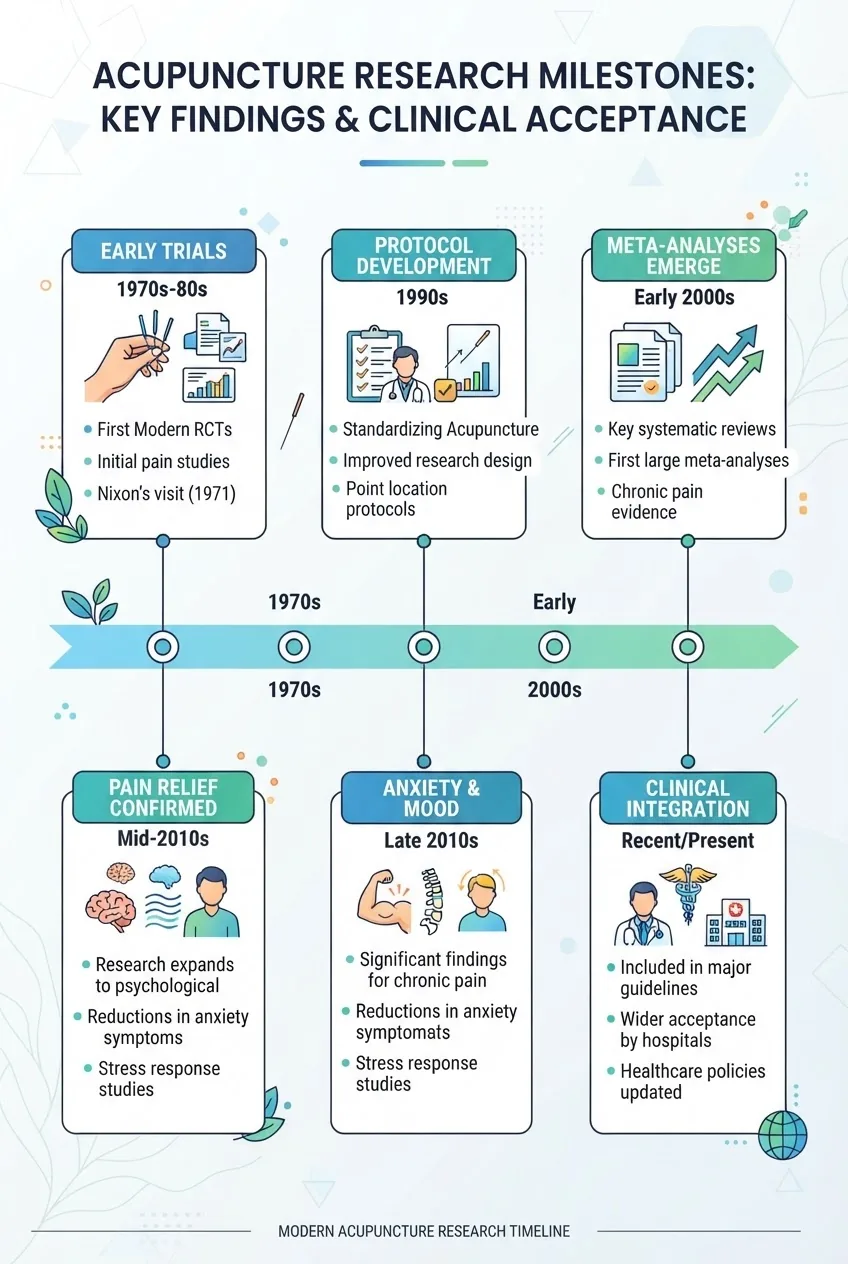
For authoritative overviews, professional health agencies maintain evidence summaries. According to a 2023 synthesis on the National Center for Complementary and Integrative Health (NCCIH) website, acupuncture shows the clearest evidence for certain types of chronic pain and for chemotherapy-related nausea (NCCIH – Acupuncture).
Mechanistic research increasingly documents plausible biological pathways: needling stimulates peripheral nerves, modulates spinal cord processing, engages descending inhibitory pain pathways, and alters functional connectivity in brain regions implicated in pain and emotion regulation (e.g., studies using fMRI and neurochemical assays). These findings help explain objective physiological changes beyond patient expectation.
Study quality and limitations:
- Blinding: true double-blind designs are challenging because acupuncturists deliver treatments; sham needles (non-penetrating or superficial needling) can still provoke physiological responses.
- Practitioner variability: outcomes are sensitive to practitioner training, needling technique, and therapeutic context.
- Outcome selection: many trials rely on patient-reported pain scales, which are valid but influenced by expectation and ritual effects.
- Heterogeneity: mixed patient populations and diverse acupuncture protocols complicate pooled effect estimates.
Real-world effectiveness studies and pragmatic RCTs help bridge efficacy and clinical application by testing acupuncture as delivered in routine practice, often demonstrating larger benefit sizes when acupuncture is integrated into multimodal pain management.
Overview of Key Acupuncture Research Studies
Answer: Landmark trials and syntheses—ranging from individual RCTs to pooled meta-analyses—provide the main empirical backbone; the list below highlights representative studies and their outcomes to illustrate the evidence trajectory.
-
Individual patient data meta-analysis of chronic pain (landmark synthesis):
Summary: Pooled individual patient data from multiple high-quality RCTs showed acupuncture superior to both no-acupuncture controls and sham acupuncture for chronic pain (effect sizes modest but clinically relevant). Source type: peer-reviewed meta-analysis (2012–2018 era syntheses).
-
Randomized trials for knee osteoarthritis:
Summary: Multiple RCTs reported improved pain and function with acupuncture versus usual care; pooled analyses show small-to-moderate effect sizes. Source type: randomized controlled trials and systematic reviews (2015–2022).
-
Trials for migraine prevention:
Summary: Several RCTs found acupuncture reduced migraine frequency compared with standard therapy, with some trials reporting non-inferiority to pharmacologic prophylaxis. Source type: randomized controlled trials (2010–2020).
-
Postoperative and chemotherapy-induced nausea:
Summary: Multiple RCTs show consistent reductions in nausea and vomiting with acupuncture or acupressure applied perioperatively or during chemotherapy. Source type: randomized trials and pooled reviews (2010–2021).
-
Neuroimaging mechanistic studies:
Summary: fMRI and PET studies demonstrate that acupuncture alters activity in pain-processing and affective brain regions, supporting neurophysiological mechanisms. Source type: mechanistic peer-reviewed studies (2005–2022).
-
Pragmatic effectiveness trials:
Summary: Trials embedding acupuncture into primary care or pain services often report larger effects on pain and quality of life versus usual care, highlighting implementation value. Source type: pragmatic RCTs (2016–2023).
Acupuncture in Conventional vs Alternative Medicine
Answer: Medical acupuncture (delivered by medically trained clinicians) and alternative/traditional acupuncture (delivered within TCM frameworks) differ in philosophical framing, credentialing, and clinical integration; acceptance in conventional medicine increases when evidence, safety, and credential standards align.
Term: Medical acupuncture refers to acupuncture practice integrated into conventional healthcare by clinicians (physicians, physiotherapists) who apply needling alongside biomedical diagnosis.
| Aspect | Conventional / Medical Acupuncture | Alternative / Traditional Acupuncture |
|---|---|---|
| Philosophy | Biomedically framed, symptom- and mechanism-focused | TCM pattern differentiation, meridian/energy frameworks |
| Practitioner background | Physicians, physiotherapists with extra acupuncture training | Licensed acupuncturists trained in TCM |
| Reasoning for use | Adjunct for pain control, rehab, side-effect management | Holistic balance, constitutional patterns, preventive care |
| Acceptance in healthcare | Growing; used in integrative clinics and hospitals | Variable; common in complementary therapy settings |
| Training focus | Biomedical anatomy, safety, evidence-based protocols | Meridian theory, pattern diagnosis, herbal integration |
To review the foundational differences that guide clinical acceptance, see the Traditional Chinese Medicine vs Western Medicine Comparison Guide.
Public perception often conflates the two approaches; integrative medicine programs typically emphasise licensed practitioners using evidence-based protocols and clear patient selection criteria to expand acupuncture’s role within mainstream services.
Clinical uptake rises when:
- Acupuncture is delivered by credentialed practitioners with clear scope of practice.
- Protocols align with evidence for specific conditions (e.g., chronic low back pain).
- Safety systems and adverse event reporting are in place.
For condition-specific treatment outcomes and cost-overview details, see the Acupuncture for Back Pain Treatment Guide.
Controversies and Skepticism: Is Acupuncture a Hoax?
Answer: Acupuncture is not a hoax: it has reproducible clinical effects for several indications, but skepticism arises from methodological issues (sham control validity, small effect sizes versus sham) and variable practitioner standards; balanced appraisal recognizes both measurable physiological effects and the influence of non-specific/placebo elements.
Placebo effect: a beneficial health outcome resulting from a person’s expectations of treatment rather than the treatment’s specific physical action.
Common skeptical points and responses:
-
Claim: Effects are only placebo.
Response: Sham-controlled trials often show reduced differences versus active needling, but many high-quality RCTs still favor acupuncture over sham; mechanistic studies (neuroimaging, neurochemical) document objective physiological changes after needling that are unlikely to be explained solely by expectation.
-
Claim: Studies are low quality or biased.
Response: While early studies had limitations, recent RCTs and meta-analyses have stricter designs and transparent reporting; systematic reviews evaluate risk of bias and often conclude moderate evidence for specific conditions.
-
Claim: Sham needling is an inadequate control.
Response: Non-penetrating placebo needles or superficial needling can elicit tactile or physiological responses; this makes sham comparisons conservative tests of specific effects but also complicates interpretation.
-
Claim: Safety concerns and variability in training.
Response: Adverse events are uncommon when practitioners are properly trained and regulated; regulation and certification standards minimise risks, making training crucial for trust and safety.
Balanced scientific positions accept that acupuncture contains specific physiological effects (demonstrated in multiple mechanistic studies) and meaningful contextual/ritual effects. Policy statements from health agencies recommend acupuncture as an option for specific conditions rather than a universal cure. For authoritative guidance on safety frameworks and global recommendations, see the World Health Organization’s material on traditional and complementary medicine (WHO – Traditional, Complementary and Integrative Medicine).
Acupuncture Therapy Training and Certification Overview
Answer: Becoming a competent acupuncturist requires accredited education covering anatomy, meridian theory, needle technique, clinic supervision, and assessment; certification and licensing standards vary by jurisdiction but typically require graduation from accredited programs, clinical hours, and national board exams.
Term: Meridians — the TCM concept of channels or pathways through which qi (vital energy) flows; in biomedical discourse meridian maps correspond to anatomically consistent point distributions where needle stimulation produces physiological effects.

Typical pathways to practice include diploma/degree programs in acupuncture or Traditional Chinese Medicine, followed by licensing exams and continuing education. Educational models range from postgraduate medical-acupuncture courses for licensed physicians to professional TCM-acupuncture bachelor’s or master’s degrees for career practitioners.
Typical Curriculum and Skillsets Taught in Training
Answer: Accredited acupuncture programs teach foundational biomedical sciences, TCM diagnosis, meridian and point theory, manual and needling techniques, safety/sterilisation, and supervised clinical practice; the list below maps common curriculum elements and core skillsets.
- Biomedical sciences — anatomy, physiology, pathology, and pharmacology to ensure safe clinical decision-making and integration with conventional care.
- TCM theory and diagnosis — pattern differentiation (zang-fu, yin-yang imbalances), meridian mapping, tongue and pulse assessment.
- Acupuncture point location and needling techniques — point selection, needle insertion angles/depths, manual stimulation, electroacupuncture, and cupping adjuncts.
- Clinical skills and patient management — intake, consent, contraindications, treatment planning, documentation, and outcome measurement.
- Safety, infection control, and emergency response — sterile technique, single-use needles, management of vasovagal reactions and rare complications.
- Clinical practicum — supervised hands-on hours in teaching clinics with staged competency assessments and case logs.
- Research literacy — reading clinical trials, understanding RCT design and critical appraisal to practice evidence-informed acupuncture.
- Professional ethics and business skills — scope of practice, referral pathways, record-keeping, and practice management when running a clinic.
Typical training exercises and walkthrough (example):
- Needle-handling workshop: students practice sterile setup, point palpation, angle and depth control on models under instructor correction.
- Paired supervised needling: students perform a standardised six-point treatment protocol for tension-type headache under direct observation, followed by structured feedback.
- Case-based clinic: student completes full intake, TCM pattern diagnosis, treatment plan, and documents outcomes across 6–8 supervised sessions.
Refer to the Acupressure Practitioner Course and Certification Overview for complementary training that aligns well with acupuncture practice.
Certification Bodies and Standards Explained
Answer: Certification and licensing are administered by national or regional bodies; standards typically require accredited coursework, minimum clinical hours, and successful performance on national competency exams—examples include NCCAOM in the United States and country-level registration boards elsewhere.
Major certifying organizations and standards examples:
- National Certification Commission for Acupuncture and Oriental Medicine (NCCAOM) — provides national certification examinations and credentials used by many U.S. states; see NCCAOM for exam and credential details.
- State and national registration boards — many jurisdictions (e.g., Australian state boards, UK regulators) set licensing rules that reference accredited programs and continuing professional development requirements.
- Accrediting bodies for education — programs accredited by recognised bodies ensure curriculum and clinical standards meet competency frameworks used by licensing boards.
Acupuncture Acupuncturist Training and Certification Guide
For practitioners, continuing education and documented clinical supervision are commonly required to maintain licensure. Check local regulatory authorities for jurisdiction-specific rules and scope-of-practice definitions; in many regions national exams combined with accredited degree completion are prerequisites to independent practice. For a focused explanation of what it takes to be accredited, see the Acupuncturist Definition and Certification Requirements Guide.
Integrating Acupuncture with Other Energy Therapies and Medical Practices
Answer: Acupuncture is commonly integrated with energy therapies (qigong, reiki, acupressure) and biomedical interventions to enhance outcomes; combined approaches are selected based on patient goals, evidence, and practitioner competencies.
Integration examples and models:
- Oncology clinics offering acupuncture for chemotherapy-induced nausea while providing counselling and pharmacologic antiemetics as needed—multimodal symptom management.
- Primary care or pain clinics providing acupuncture alongside physiotherapy, exercise therapy, and medication optimisation for chronic low back pain.
- Complementary sessions where acupressure or qigong are taught to patients to augment in-clinic acupuncture effects and support self-care.
Examples of specific combined therapy approaches:
- Acupuncture plus acupressure self-care for abdominal discomfort—acupuncturists teach acupressure techniques and provide needle therapy for acute symptom control. See the Abdominal Pain Acupressure Points Guide for acupressure complements.
- Acupuncture with targeted acupressure for joint rehabilitation—clinicians may combine needle therapy with manual acupressure protocols; training resources include Acupressure Knee Pain Points Training and ankle resources at Acupressure Points in Ankle Chart and Treatment Guide.
- Energy-movement integration: clinicians recommend qigong or tai chi programs alongside acupuncture to support long-term function and energy balance; see Qi Gong Training Guide and Exercises for Energy Healing.
Hybrid treatment plans emphasise informed consent, clear referral pathways, and documentation of outcomes. Many complementary therapies (reiki, qigong) focus on non-invasive energy techniques that patients can self-practice; acupuncturists trained in these modalities can combine them responsibly within scope of practice.
For applied acupressure protocols related to common complaints, clinicians often refer patients to targeted guides such as the Abdominal Pain Acupressure Points Guide, Acupressure Knee Pain Points Training, or Acupressure Points in Ankle Chart and Treatment Guide.
Future Directions in Acupuncture Research and Therapy Training
Answer: Future research will prioritise precision protocols, digital tools for training, objective biomarkers, larger pragmatic trials, and competency-based education to align acupuncture practice more closely with evidence-based, scalable healthcare delivery.
Emerging research trends and educational innovations include:
- Precision acupuncture trials: testing individualized point selection and dose-response using adaptive designs to identify which patient subgroups benefit most.
- Digital training aids: virtual reality and simulation tools for needle practice and anatomy education to increase access and standardise competencies.
- Objective biomarkers and neurophysiology: standardized fMRI, peripheral nerve conduction, and immune markers to quantify physiological effects and predict responders.
- Implementation research: pragmatic trials in integrated care to test cost-effectiveness, referral pathways, and workforce models.
- Competency-based accreditation: curricula shifting from time-based hours to demonstrable clinical competencies and outcomes.
Technology integration—such as apps for patient-reported outcomes, telehealth pre-assessments, and digital case-based assessments—will shape future training, enabling more rigorous supervision and continuing competency assessment. Educational programs will likely incorporate interprofessional training to ensure acupuncture fits safely alongside other health services.
Conclusion: Balancing Science, Tradition, and Training in Acupuncture Therapy
Answer: Acupuncture therapy stands at the intersection of traditional practice and modern science: evidence supports use for specific conditions, mechanistic work demonstrates plausible biological effects, and robust training plus regulation ensures safe, effective clinical delivery; informed choices and accredited education are essential.
Key takeaways:
- Evidence supports acupuncture for several indications (chronic pain subtypes, nausea) though effect magnitudes versus sham vary.
- Mechanistic research strengthens biological plausibility, complementing clinical outcomes.
- Training, accreditation, and ongoing research are central to responsible integration into mainstream care.
For next steps—whether you are a prospective student or a clinician evaluating integration—review accredited program requirements and authoritative evidence summaries, and consult our Acupuncture Acupuncturist Training and Certification Guide for detailed pathways. To explore condition-specific evidence, see our guides like Acupuncture for Back Pain Treatment Guide and Can Acupuncture Help with Anxiety Treatment and Cost Guide.
If you want help choosing a training program or reviewing evidence for a particular condition, contact a licensed practitioner or accredited training provider to review your training and clinical goals.