

Yes—acupuncture can help with some types of nerve pain by modulating nerve signaling, reducing local inflammation and promoting endogenous pain-relief chemicals; clinical evidence shows benefit for peripheral neuropathy and some neuropathic conditions when used alongside conventional care and delivered by qualified practitioners over multiple sessions.
How is nerve pain defined and what are its challenges?
Answer: Nerve pain, also called neuropathic pain, arises from damaged or dysfunctional nerves and presents with burning, tingling, numbness or shooting pain; it’s challenging because it often resists standard analgesics and requires multimodal treatment targeting nerve function, inflammation, and central sensitisation.
Term: Neuropathic pain — pain caused by lesion or disease of the somatosensory nervous system, producing abnormal nerve signaling and sensations.
Neuropathic pain is distinct from nociceptive (tissue-injury) pain because the generator is nerve pathology rather than ongoing tissue damage. Typical causes include diabetic peripheral neuropathy, postherpetic neuralgia, chemotherapy-induced neuropathy, radiculopathy (nerve root compression) and traumatic nerve injury. Patients report burning, electric shocks, lancinating pain, allodynia (pain from non-painful stimuli) and hyperalgesia (excessive pain response).
Nerve inflammation (neuroinflammation) and maladaptive neuroplastic changes in the spinal cord and brain often maintain chronic neuropathic states. These changes can make treatments that only block peripheral nociception ineffective; therefore, strategies that modulate nerve function, neurochemical balance and central sensitisation are prioritized.
Treatment difficulties include:
- Heterogeneous causes and variable prognosis across conditions.
- Partial responsiveness to first-line medications (anticonvulsants, antidepressants) and opioid-sparing strategies.
- High incidence of side effects and polypharmacy in older adults.
- Need for combined approaches addressing nerve regeneration, inflammation and central sensitisation.
Clinical assessment should document sensory profiles (loss vs gain of sensation), timeline, comorbidities (e.g., diabetes), and functional impact. Objective tests such as nerve conduction studies or skin biopsy can help but are not always required for selecting therapies like acupuncture, which may be trialed when appropriate.
Transition: Understanding the nature and mechanisms of nerve pain frames how acupuncture is applied and evaluated, so the next section explains how acupuncture works in pain management at both TCM and physiological levels.
How does acupuncture work in pain management?
Answer: Acupuncture reduces pain via local tissue effects, peripheral nerve modulation, and central nervous system mechanisms—including endorphin release, modulation of neurotransmitters and altered brain activity—while Traditional Chinese Medicine (TCM) frames it as restoring balanced qi along meridians.
Term: Traditional Chinese Medicine (TCM) — a system of healthcare originating in China that uses concepts such as qi (vital energy), meridians (energy channels), and pattern differentiation to guide treatment.
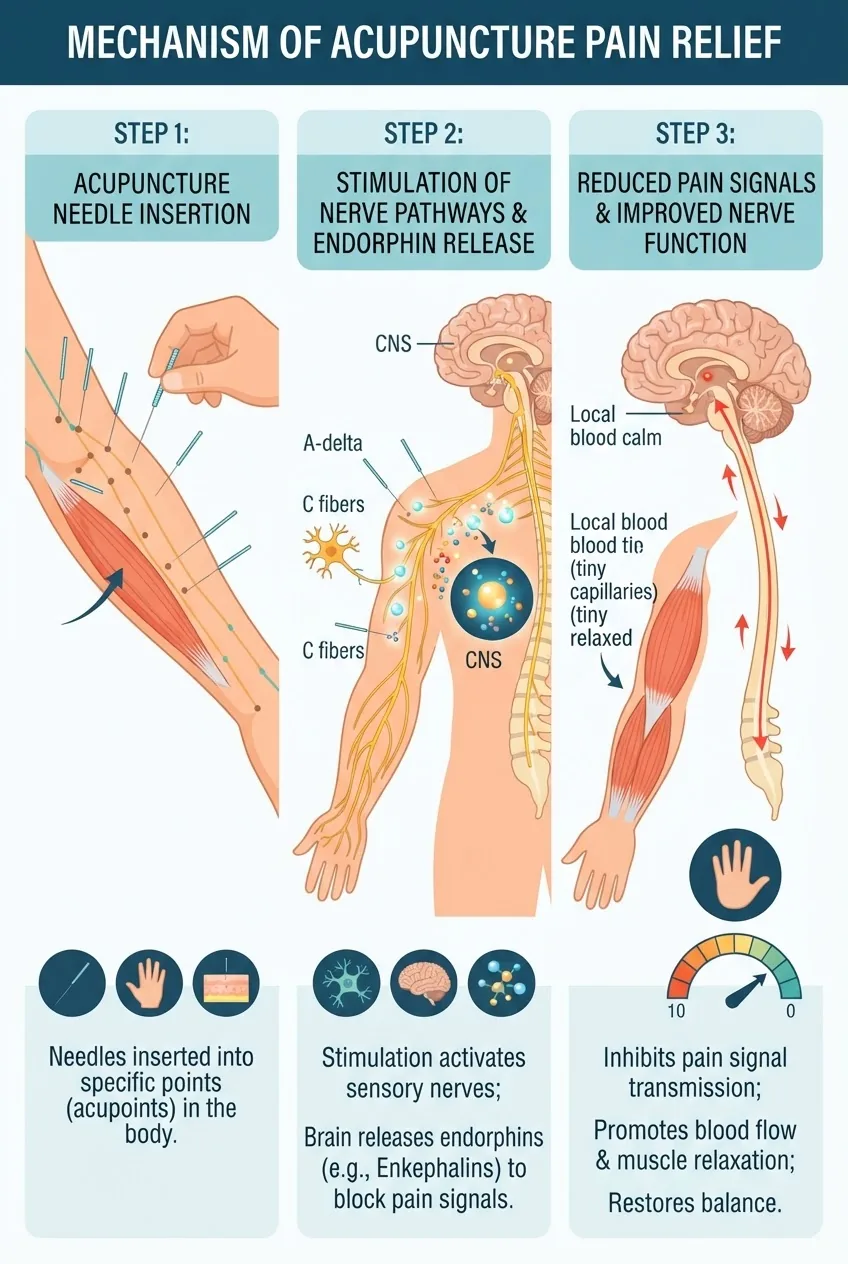
Mechanistically, acupuncture engages multiple layers:
- Local effects: Needle insertion produces microtrauma that increases local blood flow, reduces pro-inflammatory cytokines, and promotes tissue healing around compressed or injured nerves.
- Peripheral nerve modulation: Needle stimulation activates A-delta and C-fibers transiently, which can reset abnormal firing patterns and reduce ectopic discharges from injured nerves.
- Spinal and supraspinal modulation: Stimulation alters dorsal horn processing, reduces central sensitisation, and increases descending inhibitory pathways that suppress pain signaling.
- Neurochemical changes: Acupuncture triggers endogenous opioids (endorphins, enkephalins), serotoninergic and noradrenergic activity, and may influence neurotrophic factors that support nerve health.
In TCM terms, acupuncture restores balanced qi flow along meridians; clinically this often aligns with modern findings where targeted needling influences specific neural pathways. A practical teaching tool is a 12 meridians chart that maps major channels and point relationships relevant to nerve pain patterns.
Physiological theories are supported by imaging studies showing modulation of limbic and somatosensory regions after acupuncture and biochemical studies documenting changes in pain-modulating neurotransmitters. Analogy: acupuncture acts like a reset button for disrupted nerve signals—short, targeted stimulation rebalances local and central pain circuitry.
Practical technique selection depends on whether the goal is local nerve stimulation (e.g., needling near a compressed nerve), neuromodulation (distal points that influence central pathways), or promotion of tissue healing (trigger-point and blood-flow–enhancing approaches). Electroacupuncture—where small electrical currents are applied via needles—can intensify stimulation and is often used specifically for neuropathic conditions.
Transition: Those physiological and TCM mechanisms underpin the clinical studies that test acupuncture’s effectiveness for different neuropathic conditions; the next section summarises that evidence.
What does the research say: does acupuncture help with nerve pain?
Answer: Research shows mixed but promising results; randomized controlled trials and meta-analyses indicate acupuncture provides clinically meaningful relief for some neuropathic conditions (notably diabetic peripheral neuropathy and postherpetic neuralgia) though study quality and heterogeneity limit universal conclusions.
Term: Randomized controlled trial (RCT) — an experiment where participants are randomly assigned to intervention or control groups to reduce bias and establish causal effects.
Key findings at a glance (stat block summary):
- Diabetic peripheral neuropathy: multiple RCTs and systematic reviews report improved sensory symptoms and nerve conduction with acupuncture compared with usual care or sham controls; effect sizes vary. (According to a 2022 systematic review in peer-reviewed journals.)
- Postherpetic neuralgia: moderate-quality trials show reduction in pain intensity and medication requirements after acupuncture or electroacupuncture. (According to clinical study summaries published in medical journals.)
- Chemotherapy-induced neuropathy: preliminary studies show symptomatic benefit but consistency is limited and larger controlled trials are needed. (According to recent clinical trial reports.)
- Radiculopathy/nerve root pain: acupuncture combined with physical therapy often outperforms single modalities for short-term pain and function. (According to randomized trial data.)
Detailed evidence synthesis:
Systematic reviews and meta-analyses compile RCTs but face heterogeneity in acupuncture styles, control methods (sham acupuncture vs usual care), outcome measures and follow-up durations. Sham-controlled trials—where needles are superficially inserted or placed at non-acupuncture points—address placebo effects but may still produce physiological responses, blunting effect-size estimates.
Quality concerns include small sample sizes, short follow-up, inconsistent blinding, and varied outcome metrics (pain scales, nerve conduction studies, quality-of-life measures). Nevertheless, multiple meta-analyses conclude that acupuncture yields statistically and clinically significant pain reductions for selected neuropathic conditions.
Representative authoritative resources:
- NCCIH acupuncture overview — summarises evidence and safety considerations.
- WHO guidance on traditional and complementary medicine — contextual reference for TCM use.
- PubMed systematic reviews on acupuncture — gateway to peer-reviewed studies and meta-analyses.
Limitations and how clinicians interpret evidence:
- Sham controls may not be inert; therefore, pragmatic trials comparing acupuncture plus usual care versus usual care alone often show larger benefits.
- Placebo and expectation effects contribute to outcomes; rigorous blinding is difficult in acupuncture research.
- Heterogeneous protocols reduce the ability to recommend a single standard regimen—individualised approaches are common in practice.
Practical takeaway: For patients with peripheral neuropathy or persistent neuropathic symptoms who have incomplete responses to medication, acupuncture is a reasonable, evidence-supported adjunct when administered by trained practitioners and combined with standard care.
Transition: Translating evidence into practice requires knowing which points and techniques are used for nerve pain—details that clinicians and trained practitioners apply session-to-session.
Which acupuncture points and techniques are key for nerve pain therapy?
Answer: Effective nerve pain acupuncture uses a blend of local and distal points, manual needling, electroacupuncture, trigger-point release and nerve-specific approaches—selected per diagnosis to target nerve pathways, reduce inflammation and support nerve repair.
Term: Electroacupuncture — an acupuncture technique that applies low-frequency electrical stimulation to inserted needles to intensify and standardize stimulation.

-
Local nerve pathway points (description and guidance):
Use local points adjacent to the affected nerve to reduce ectopic firing and inflammation. Example: for median nerve-related forearm/hand neuropathy, peri-nerve points on the forearm combined with local Ashi (tender) points are used. Needling depth is shallow-to-moderate; use careful palpation and nerve-avoidance technique.
-
Distal points affecting central modulation:
Distal limb points (e.g., LI4 on the hand, ST36 on the leg) produce broad analgesia via spinal and supraspinal pathways; they are commonly paired with local points for neuropathic conditions to combine local nerve modulation with descending inhibition.
-
Electroacupuncture settings and rationale:
Electroacupuncture augmentations: low frequencies (2–4 Hz) favour endorphin release; higher frequencies (80–120 Hz) favour dynorphin pathways—practitioners often alternate frequencies or use dense-disperse modes to produce robust analgesia. For neuropathic pain, 20–30 minutes per session with a comfortable intensity is common.
-
Segmental versus extrasegmental approaches:
Segmental needling targets points that share spinal segments with the affected nerve to reduce dorsal horn hyperexcitability; extrasegmental (distal) points recruit descending modulation. Good practice combines both.
-
Trigger-point and myofascial techniques:
Muscular trigger points and myofascial release can reduce mechanical irritation of nerves—needling of tight muscles, dry needling-style approaches and cupping may be integrated.
-
Microsystems and auricular acupuncture:
Auricular (ear) acupuncture and hand/foot microsystems may be added as adjuncts for systemic analgesia and autonomic regulation; evidence is mixed but clinical utility is reported in multimodal programs.
-
Safety in point selection near nerves:
When treating nerve pain, avoid deep needling directly into large nerves; use shallow peri-neural needling and ensure sterile technique and informed consent. Use nerve stimulation cautiously in patients with implantable electrical devices.
-
Session structure and progression:
Typical protocol: 1–2 sessions per week for an initial 4–6 weeks, then reassess; maintenance sessions may be spaced monthly. Combine symptom-directed points with constitutional TCM point selection for longer-term balance.
-
Point examples by condition (practical list):
- Diabetic peripheral neuropathy: local distal points on hands/feet (e.g., SP6, ST36, LV3) combined with Ashi points and electroacupuncture.
- Postherpetic neuralgia: adjacent dermatomal points, local Ashi, and distal analgesic points (e.g., LI4, GB34).
- Chemotherapy-induced neuropathy: bilateral limb distal points, scalp acupuncture in some protocols, and low-frequency electroacupuncture.
- Radiculopathy: spinal paraspinal (jiaji) points at affected segments plus corresponding limb meridian points.
-
Adjunct modalities used by acupuncturists:
- Moxibustion to increase local circulation and warmth for cold-pattern presentations.
- Cupping to reduce adhesions and improve perfusion.
- Acupressure for at-home symptom control and maintenance between sessions—see acupressure points in ankle chart for ankle-related neuropathy.
acupressure points in ankle chart
Practical guidance for clinicians:
- Individualise point prescriptions with careful sensory mapping and function goals.
- Measure outcomes with validated pain scales, neuropathic symptom questionnaires and functional tests.
- Communicate realistic expectations: some patients experience rapid relief, others gradual improvement over multiple sessions.
Transition: While the techniques above are effective in many cases, safety considerations determine patient suitability and session design—covered next.
What are the safety considerations, contraindications, and patient factors?
Answer: Acupuncture is generally safe when performed by trained practitioners, but risks include minor bleeding, infection, exacerbation of symptoms, and specific contraindications such as bleeding disorders, anticoagulant therapy, and unhealed implanted devices.
Term: Contraindication — a clinical condition or factor that increases the risk of a harmful outcome from a specific intervention.
Key safety points:
- Common minor side effects: transient soreness, minor bruising or bleeding, temporary symptom flare in the treated area.
- Serious adverse events are rare with sterile, single-use needles and proper technique; pneumothorax is a rare but important example when needling near the thorax.
- In neuropathic patients with severe sensory loss, monitor for excessive force or tissue injury due to decreased protective sensation.
- Avoid deep needling in areas with known neuropathy that reduces sensation to prevent accidental trauma.
Contraindications and precautions:
- Relative contraindication: anticoagulant therapy — use caution and shallow needling; discuss risks with the prescribing clinician.
- Absolute/relative: local infection or skin lesions at needling sites should be avoided.
- Implantable electrical devices (e.g., pacemaker): avoid electroacupuncture near the device and consult cardiology if uncertain.
- Pregnancy: avoid specific points associated with labour induction unless trained for obstetric acupuncture.
- Severe cognitive impairment or inability to consent: require caregiver involvement and medical clearance.
Patient screening checklist (brief):
- Medical history including diabetes control, chemotherapy history, anticoagulants, cardiac devices, pregnancy.
- Medication list and prior responses to neuropathic pain treatments.
- Sensory testing to identify areas of numbness vs hypersensitivity.
- Expectation and goals discussion—pain reduction, improved function, decreased medication use.
Documentation and informed consent:
- Record diagnosis, treatment plan, informed consent and adverse event management plan.
- Provide aftercare: rest, avoid strenuous activity for 24 hours, watch for signs of infection or worsening neuropathy.
Transition: Safe practice requires appropriate training and credentialing; the next section details training pathways and certification considerations for clinicians specialising in nerve pain acupuncture.
What training and certification prepare acupuncturists to treat nerve pain?
Answer: Clinicians treating nerve pain should hold accredited acupuncture qualifications plus specialized training in neuromuscular techniques, electroacupuncture, safety with neuropathic patients, and ongoing clinical mentorship; formal certification and supervised clinical hours are essential.
Term: Accredited acupuncture qualification — a recognised education credential (diploma/degree) from an institution meeting national or regional regulatory standards for acupuncture practice.
Core competency areas for nerve pain therapy:
- Foundational TCM theory and meridian anatomy.
- Biomedical anatomy and neurophysiology to map nerves and avoid iatrogenic injury.
- Electroacupuncture training including device safety and frequency selection.
- Neuromuscular needling, trigger-point therapy and myofascial techniques.
- Clinical assessment of neuropathic pain and integration with multidisciplinary care.
acupuncturist training and certification
Recommended education and credential pathway:
- Complete an accredited acupuncture diploma or degree program including supervised clinical hours and biomedical modules.
- Obtain registration or licensure per local regulatory requirements—this is the legal baseline for practice.
- Undertake specialized short courses in electroacupuncture, trigger-point needling, and neuropathic pain management; seek mentor-guided clinical practicums.
- Maintain continuous professional development with case supervision, audit and evidence-based updates.
acupressure practitioner certification
acupuncturist certification requirements
Clinical mentorship and case-load development:
- Supervised practice with complex neuropathic patients accelerates competence—seek placements within multidisciplinary pain clinics when possible.
- Audit treatment outcomes and keep outcome measures such as neuropathic pain scales and function indices to demonstrate effectiveness and refine technique.
Regulatory standards and best practices:
- Follow local health authority and professional association guidelines for infection control, needle safety and scope of practice.
- Ensure indemnity insurance covers practice scope, especially when using electroacupuncture or integrated modalities.
- Engage in interprofessional communication for patients on complex therapies (e.g., chemotherapy, anticoagulation).
Transition: Acupuncture is rarely a standalone solution for nerve pain; integrating it with physical therapy, medications and lifestyle measures often yields the best outcomes—explained next.
How is acupuncture integrated with other nerve pain treatments?
Answer: Acupuncture integrates most effectively as an adjunct to multimodal nerve pain management—combined with medications, physical therapy, lifestyle interventions and targeted procedures depending on the underlying condition and patient goals.
Term: Multimodal treatment — using multiple therapies with complementary mechanisms to improve outcomes while reducing reliance on any single treatment.
| Treatment | How it compares | Role with acupuncture |
|---|---|---|
| Medications (gabapentinoids, SNRIs) | Systemic neuropathic symptom control; side effects common. | Acupuncture can reduce medication need and side effects when synergistic. |
| Physical therapy / exercise | Improves function and nerve-gliding; slow to change pain perception. | Acupuncture reduces pain allowing better participation in rehab. |
| Interventional procedures (nerve blocks) | Targeted interruption of nociceptive signaling; variable duration. | Acupuncture can be used between procedures to maintain pain control and improve recovery. |
| Lifestyle (glycemic control, nutrition) | Addresses underlying disease drivers (e.g., diabetes). | Supports long-term nerve health while acupuncture addresses symptoms and neuroregulation. |
Complementary acupressure techniques provide self-management tools to maintain symptom relief between sessions—see examples such as abdominal pain acupressure points for simple home strategies and acupressure knee pain points for joint-associated nerve symptoms.
abdominal pain acupressure points
Comparison summary (pro/con):
- Medications: rapid onset, systemic side effects—acupuncture can augment and reduce doses.
- Physical therapy: improves structural contributors—acupuncture improves tolerance and participation.
- Interventional procedures: targeted but episodic—acupuncture can extend and complement benefits.
Practical integration plan for clinicians:
- Assess patient goals and baseline function; agree on measurable outcomes.
- Coordinate care with prescribing clinicians and physiotherapists; document combined plan.
- Start acupuncture while initiating or adjusting rehab to maximize functional gains.
- Reassess at 4–6 weeks and adjust frequency or techniques based on symptom trajectory.
Transition: Evidence-based practice also benefits from real-world case examples; the next section presents patient profiles and outcomes that demonstrate typical acupuncture treatment courses.
What do patient experiences and case studies show about acupuncture for nerve pain?
Answer: Case studies and patient-reported outcomes commonly show reduced pain intensity, improved sleep and function, and decreased medication use after a course of acupuncture for various neuropathic conditions; individual responses vary and durability depends on underlying cause and concurrent care.
Term: Case study — a detailed report of clinical care for one or a few patients, useful for illustrating practical application though not proving general efficacy.
Case profile 1 — Diabetic peripheral neuropathy
- Patient: 62-year-old with long-standing type 2 diabetes, feet burning and numbness interfering with walking.
- Intervention: Twice-weekly electroacupuncture focusing on distal foot points, ST36 and SP6, plus local Ashi points, for 6 weeks.
- Outcome: 40–60% reduction in pain on validated scales, improved gait tolerance and reduced pregabalin dose after 8 weeks. No serious adverse events.
- Source type: Practitioner case series with standardised outcome measures collected in clinic.
Case profile 2 — Postherpetic neuralgia
- Patient: 58-year-old with persistent lancinating thoracic pain >6 months post-shingles.
- Intervention: Dermatomal needling, shallow paraspinal points, and distal analgesic points twice weekly for 4 weeks, followed by weekly maintenance.
- Outcome: Significant decrease in shooting pain and less reliance on opioid rescue doses; improved sleep; maintained benefit at 3 months.
- Source type: Single-centre clinical report summarising consecutive patients.
Case profile 3 — Chemotherapy-induced neuropathy
- Patient: 47-year-old with peripheral neuropathy after taxane chemotherapy, numbness and balance issues.
- Intervention: Combined scalp and limb acupuncture with gentle electrostimulation over 8 sessions.
- Outcome: Partial improvement in paresthesia and balance; patient reported functional gains enabling return to daily activities; further trials recommended.
- Source type: Small pragmatic trial results summarised by treating clinic.
Interpretation:
- Case-based outcomes align with RCT signals—acupuncture helps many but not all patients; predictors of positive response include shorter symptom duration and adherence to treatment courses.
- Documenting outcomes with validated scales improves care quality and supports referrals between providers.
Transition: To finish, readers should take away core, practical points and know next steps if considering acupuncture for nerve pain.
Conclusion: What are the key takeaways and next steps?
Answer: Acupuncture can help certain types of nerve pain as part of a multimodal plan; choose qualified practitioners, use evidence-informed techniques (including electroacupuncture when indicated), monitor outcomes, and integrate with medical and rehabilitative care for best results.
Summary of actionable points:
- Consider acupuncture for peripheral neuropathy, postherpetic neuralgia and refractory neuropathic symptoms in conjunction with medical care.
- Seek practitioners with accredited training, supervised clinical experience in neuromuscular techniques, and clear safety protocols.
- Expect a course of multiple sessions (commonly 4–8 weeks) and use validated outcome measures to judge effectiveness.
- If no meaningful improvement, reassess diagnosis and escalate to other neuropathic pain treatments or specialist referral.
If you’re exploring this therapy: discuss it with your primary clinician, verify the practitioner’s credentials, and consider a short trial of acupuncture while documenting symptoms to see whether it produces meaningful improvement—this practical approach balances evidence, safety and individual response.