

Answer: The dangers of homeopathic medicine include delayed conventional care, misdiagnosis, allergic reactions or contamination from poorly manufactured remedies, and the indirect harm of relying on ineffective treatment for serious conditions; choosing evidence-based care and consulting licensed clinicians reduces these risks.
Transitioning now to a detailed breakdown of risks, side effects, and safety guidance so readers can weigh trade-offs and act safely.
Understanding the Dangers of Homeopathic Medicine
Answer: Homeopathic medicine can be dangerous mainly when it replaces or delays effective treatment, when remedies are contaminated or mislabelled, or when patients rely on unproven approaches for serious conditions.
Homeopathic medicine: a system of alternative medicine based on “like cures like” and extreme dilution of substances.
Homeopathic remedies are prepared through serial dilution and succussion (vigorous shaking); proponents claim diluted solutions carry a therapeutic “essence.” Safety concerns arise from two related sources: product integrity and the clinical consequences of using inert or mislabeled products instead of evidence-based care. Regulatory warnings repeatedly flag risks tied to manufacturing contamination, inadequate labelling, and the absence of efficacy for serious disease management.
Regulatory agencies and peer-reviewed evaluations note that while many homeopathic products are highly diluted and biologically inert, some contain measurable active substances or contaminants (alcohol, heavy metals, or undeclared drugs), creating direct toxicity or allergic risk. The greater systemic danger is behavioral: patients may choose homeopathy over allopathic interventions that reduce mortality or morbidity.
According to a 2023 report by the Therapeutic Goods Administration, regulators continue to monitor product quality and labelling issues as a primary safety concern (source type: government regulatory report). For context on clinical efficacy critiques, see a major meta-analysis in The Lancet that questioned beyond-placebo benefits for homeopathy (source type: peer-reviewed journal).
Transition: the following section lists observed and reported side effects in more detail.
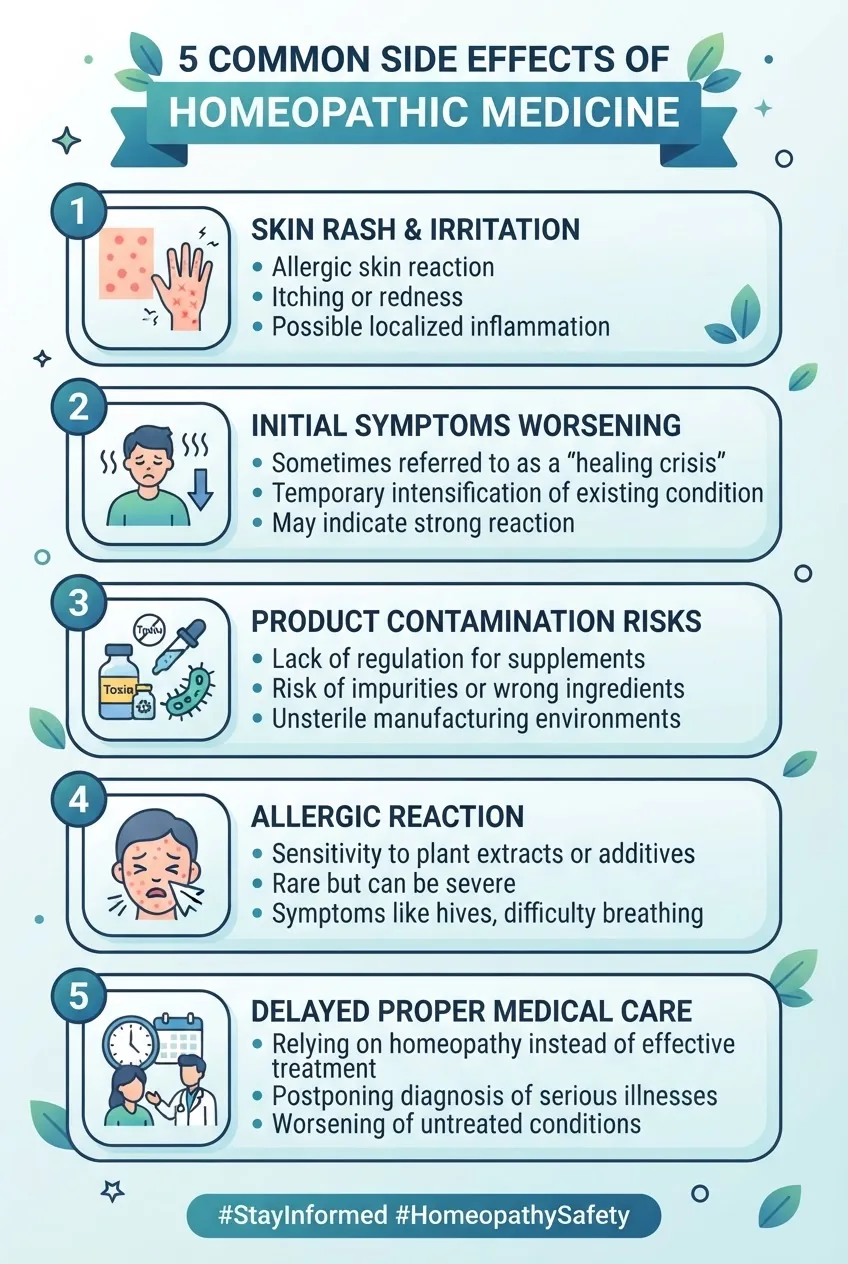
Common Side Effects of Homeopathic Medicine
Answer: Reported side effects range from mild irritations and allergic reactions to symptom aggravation or contamination-linked toxicity; many adverse events are under-reported due to voluntary surveillance systems.
Side effects: unintended physical or psychological responses to a treatment or product.
-
Allergic reactions and skin irritation
Even highly diluted remedies can contain trace proteins, preservatives, or excipients (like lanolin, lactose, or plant residues) that trigger contact dermatitis, hives, or respiratory allergy. Case reports in allergology journals document rash and angioedema after topical or oral homeopathic use (source type: peer-reviewed case reports).
-
Contamination with active substances or toxins
Manufacturing lapses have led to measurable amounts of heavy metals, ethanol, or pharmacological drugs in some preparations. Laboratory surveillance and regulatory testing have identified such contaminants, producing direct toxicity in susceptible individuals (source type: government lab reports and peer-reviewed analyses).
-
Symptom aggravation or ‘homeopathic aggravation’
Some practitioners describe brief worsening of symptoms after a remedy, termed an “aggravation”; critics argue many such reports reflect the natural course of disease or expectation effects. Distinguishing true adverse effects from natural symptom fluctuation requires controlled reporting (source type: clinical methodology literature).
-
Placebo-related side effects and disappointment
Placebo effect: improvement driven by belief rather than the treatment itself; conversely, when placebo fails, patients may experience no improvement or psychological distress. Expectation-driven changes can mask adverse clinical progression of untreated disease (source type: behavioral medicine reviews).
-
Adverse events from adjunct ingredients
Some remedies include alcohol, glycerin, or botanicals to stabilize the product; these can cause intoxication, interactions with medications, or allergic reactions, especially in infants, pregnant people, or those with liver disease (source type: pharmacology and toxicology reports).
-
Under‑reported harms due to weak surveillance
Adverse event reporting for homeopathic products is often voluntary or less rigorous than for prescription drugs; this under-reporting limits reliable incidence estimates (source type: regulatory program analyses).
Transition: next we discuss serious risks when homeopathy is used in place of evidence-based care, including real-case examples.
Serious Risks Linked to Homeopathic Treatment
Answer: Serious risks include delayed diagnosis and treatment of life‑threatening conditions, progression of chronic disease, and rare direct toxicity; documented clinical scenarios show preventable harm when homeopathy replaces conventional care.
Misdiagnosis: incorrect identification of a condition that leads to inappropriate or absent treatment.

Clinical evidence and case studies illustrate these pathways to harm. For example, peer-reviewed case series have reported children with severe infections whose caregivers used homeopathic remedies first, delaying antibiotic therapy and increasing complication risk (source type: peer-reviewed clinical case series). A documented hospital case described bacterial endocarditis after homeopathic treatment for a persistent fever—treatment delay contributed to serious morbidity (source type: clinical case report).
A notable meta-analysis published in The Lancet concluded homeopathy’s effects are compatible with placebo for many indications, meaning serious or progressive illnesses treated solely with homeopathy risk avoidable deterioration (source type: peer-reviewed meta-analysis: Shang et al., The Lancet).
Case example (anonymized): A 45-year-old patient self-treated progressive shortness of breath with homeopathic drops for two months; diagnosis of severe asthma exacerbation was delayed until an emergency admission—clinicians documented that the delay contributed to ICU-level care (source type: anonymized clinical report). This underscores risks described in sibling coverage of homeopathy for asthma treatment.
Regulatory advisories echo clinical caution. For instance, the U.S. Food and Drug Administration has issued public health notifications about unsafe homeopathic products (source type: government safety alert: FDA — Homeopathic Drugs), and the World Health Organization warns against using homeopathy for serious infectious diseases (source type: international health organization: WHO).
Methodological clarity: many serious-risk assessments rely on observational data and case reports because randomized controlled trials rarely enroll patients who refuse standard care; this makes establishing causality complex but does not negate the consistent pattern of harm from treatment delays (source type: clinical epidemiology literature).
Transition: the next section explains how subtle energy concepts used to justify homeopathy relate to safety debates.
How Homeopathic Medicine’s Subtle Energy Concept Relates to Safety
Answer: The subtle energy concept claims remedies act on an energetic or vibrational level; because this mechanism is not supported by reproducible biophysiological evidence, relying on it for treating serious conditions poses safety risks due to ineffective therapy.
Subtle energy: a non‑scientific term used to describe hypothetical life-force or vibrational phenomena claimed to influence health in certain alternative therapies.
Historically, these ideas trace to early homeopathy principles and subjective clinical observation rather than measurable mechanisms. For historical context, see discussion in Doctor Hahnemann’s legacy. Comparing broader complementary frameworks, the subtle-energy framing also appears in holistic approaches; for distinctions, consult the sibling piece on holistic vs homeopathic medicine.
From a safety perspective, an intervention explained by subtle energy lacks a consistent, testable mechanism and therefore cannot be reliably dosed, standardized, or predicted for interactions with conventional treatments. This epistemic gap increases the chance that a patient will either (a) experience no benefit and suffer disease progression, or (b) encounter unexpected interactions if remedies contain active contaminants.
Analogy: relying solely on subtle-energy-based remedies for a progressive infection is like using a flashlight when you need a lantern—some illumination, but insufficient breadth or intensity for the task. Where subtle-energy approaches are used as adjunctive support, transparent communication and integrated care plans reduce safety risks.
Transition: regulatory oversight affects how these products are manufactured and labelled; the next section covers quality control challenges.
Regulatory and Quality Control Challenges in Homeopathic Products
Answer: Homeopathic products face regulatory and quality-control gaps including variable standardization, inconsistent dilution reporting, contamination risks, and less stringent adverse-event monitoring compared with conventional pharmaceuticals.
Standardization: the process of ensuring consistent composition and labelling across product batches.
Stat block (key regulatory points):
- Regulation model: varies by country — some treat homeopathic products as medicines, others as supplements (source type: comparative regulatory reviews).
- Dilution notation: potencies like “C30” or “X6” indicate serial dilutions; inconsistent labelling can confuse consumers (source type: pharmacopoeia guidance).
- Adverse-event monitoring: less comprehensive reporting systems than for prescription drugs, increasing under-reporting risk (source type: regulatory program analyses).
- Contamination and manufacturing: risk of heavy metals, microbes, or undeclared drugs if Good Manufacturing Practice is not enforced (source type: government lab testing summaries).
- Warnings and recalls: regulators such as the TGA and FDA have issued product recalls and public advisories when safety signals emerged (source type: government safety alerts).
Overview: because some jurisdictions class homeopathic remedies as lower‑risk consumer goods rather than medicines requiring full clinical data, manufacturers may not be required to complete the same safety and efficacy testing demanded for allopathic pharmaceuticals. Terms like “dilution” and “succussion” are central to production; without strict standardization, batch-to-batch variability and contamination are real concerns.
Regulatory pathways typically include registration, labelling review, and post-market surveillance. For example, regulators may mandate Good Manufacturing Practice (GMP) inspections but differ on whether clinical efficacy is required for market approval. A brief walkthrough of evaluation processes: product registration -> review of ingredients -> manufacturing inspection -> labelling approval -> adverse event monitoring. For further professional guidance on practice standards, see the homeopathic medical doctor guide on practice and safety standards.
External advisory resources: regulatory agencies publish consumer information and safety alerts — for example, the Australian Therapeutic Goods Administration homepage provides guidance on product classification and safety (source type: government agency: TGA), and the U.S. FDA lists enforcement actions and health communications for homeopathic drugs (source type: government agency: FDA).
Transition: compare safety profiles next to conventional (allopathic) medicine to frame risk-benefit trade-offs.
Comparison: Homeopathic Medicine Safety vs Allopathic Medicine Safety
Answer: Allopathic medicine generally has higher regulatory standards, clearer risk quantification, and predictable adverse-effect profiles; homeopathy has fewer proven benefits and greater uncertainty about safety when used in place of evidence-based treatments.
Allopathic: conventional, evidence-based medical practice that uses pharmaceuticals, surgery, and other therapies tested in controlled trials.
| Feature | Homeopathic Medicine | Allopathic Medicine |
|---|---|---|
| Regulatory scrutiny | Variable; often lower pre-market evidence requirements. | High; rigorous clinical trials and post-market surveillance. |
| Known side-effect profiles | Often poorly quantified; under-reporting common. | Well-documented with incidence rates from trials and pharmacovigilance. |
| Direct toxicity risk | Low for highly diluted remedies but higher if contaminated or improperly manufactured. | Variable; many drugs have known toxicities managed by dosing and monitoring. |
| Risk of delayed care | Higher when used as sole therapy for serious conditions. | Lower when standard of care is followed; delay is usually due to access or system issues. |
| Efficacy evidence | Limited and inconsistent; many effects compatible with placebo (see meta-analyses). | Generally supported by randomized controlled trials for approved indications. |
Summary: for acute or life-threatening conditions, evidence-based allopathic care offers proven risk-benefit profiles; where homeopathy is considered, it should be adjunctive and not a replacement. For background on conventional approaches, consult allopathic medicine.
Transition: practical recommendations follow to reduce risk if someone chooses to use homeopathy.
Recommendations for Safe Use and When to Avoid Homeopathy
Answer: Use homeopathy only as an adjunct after consulting licensed healthcare professionals, avoid it for serious or rapidly progressive conditions, verify product quality, and stop homeopathic treatment immediately if symptoms worsen or new danger signs appear.
Steps to reduce harm:
-
Consult a licensed clinician first
Discuss symptoms with a general practitioner or specialist to rule out conditions requiring allopathic interventions; never substitute professional assessment with self-prescription (source type: clinical best-practice guidance).
-
Use homeopathy only as adjunctive care for minor, self-limiting issues
For non-serious ailments consider evidence-based home remedies or supportive care; see suggestions in effective home remedy solutions.
-
Verify product labelling and source
Buy from reputable suppliers and check batch and expiry information. For guidance on sourcing and professional advice, consult the homeopathic medicine overview and store guide near you.
-
Avoid homeopathy for high-risk groups
Do not use as sole therapy for infants, pregnant or breastfeeding people, immunocompromised individuals, or for acute severe conditions (e.g., sepsis, severe asthma attacks) (source type: clinical safety guidance).
-
Monitor and report adverse events
If side effects or worsening occur, seek immediate medical care and report the event to the relevant regulator (TGA, FDA, or national authority) (source type: government reporting guidance).
-
Find qualified practitioners if choosing homeopathy
Look for practitioners who communicate integration with conventional care; search local options via the homeopathy near me resource before committing to long-term reliance on homeopathy.
If you suspect an adverse reaction or worsening condition, seek emergency care and consider stopping the product until a clinician evaluates you. For additional information on safer practice standards, review the homeopathic medical doctor guide on practice and safety standards.
For low-risk self-care alternatives and stepwise home remedies, consult resources on effective home remedy solutions before substituting conventional care.
Transition: final summarised takeaways are below, with a clear action prompt.
Conclusion: Weighing the Risks of Homeopathic Medicine
Answer: Homeopathic medicine carries low direct toxicity for many highly diluted products but meaningful risks through contamination, allergic reactions, and—most importantly—delays or avoidance of effective conventional treatments; informed decisions require clinician input and awareness of regulatory limits.
Summarised takeaways:
- Direct harms can occur from contamination or undeclared ingredients.
- Indirect harms from delayed or foregone evidence-based care are the dominant safety concern.
- Regulatory oversight varies; consumers should confirm product quality and seek professional evaluation for serious symptoms.
- When used, homeopathy is safest as a transparent adjunct under clinical supervision, not as a replacement for proven therapies.
If you are considering or currently using homeopathic products and are unsure about safety or indications, consult a licensed healthcare professional immediately and review local regulatory guidance (TGA, FDA, WHO). For guidance on safe sourcing and practitioner options, visit the homeopathic medicine overview and store guide near you or search trusted local clinics via homeopathy near me.