
Answer: The founder of homeopathy is Doctor Samuel Hahnemann (1755–1843), a German physician who developed homeopathy after observing that substances producing symptoms in healthy people could, when highly diluted and potentized, treat similar symptoms in the sick; his system framed disease as disturbance of a “vital force” and emphasized individualized, energetic treatment.
Who was the founder of homeopathy and what is his background?
Answer: Doctor Samuel Hahnemann, trained as a physician and chemist in late 18th-century Germany, founded homeopathy after experiments and clinical observations led him to formalize the law of similars, potentization, and a theory of chronic disease that departed from mainstream medicine of his time.
Term: Samuel Hahnemann — a German physician and chemist (1755–1843) who authored foundational homeopathic texts and practiced an alternative system of medicine focused on individualized energetic remedies.
Samuel Hahnemann was born in Meissen, Saxony, in 1755 and trained at the University of Leipzig and through apprenticeships common in 18th-century medicine. His early work as a translator and chemist exposed him to pharmaceutical preparations and the variable effects of medicinal compounds. Disillusioned by contemporaneous medical practices—bleeding, purging and complex polypharmacy—Hahnemann pursued methodical observation, experiments on himself and others, and a rigorous attempt to systematise clinical correlations between substances and symptoms.
Hahnemann’s biography is documented in historical archives and biographies: for concise factual reference see Britannica’s Samuel Hahnemann entry, which traces his education, translations and move into clinical practice.
What were Doctor Hahnemann’s early life and medical career milestones?
Answer: Hahnemann’s early career progressed from apprenticeship and translation work to medical practice and chemical research; key milestones include his medical degree, translations of materia medica, self-experimentation with cinchona leading to the law of similars, and publication of Organon—his operational manual for homeopathy.
Term: Organon — Hahnemann’s foundational work titled Organon of the Medical Art, first published in 1810, outlining homeopathic philosophy, method and case approach.
Timeline (selected highlights):
- 1755: Born in Meissen, Saxony.
- 1775–1779: Medical training and early practice; worked as translator and chemist, gaining pharmaceutical knowledge common to the era.
- 1790s: Moved into medicine practice; critical of contemporary therapies.
- 1796–1810: Conducted provings (systematic testing of substances on healthy individuals); published early Organon editions.
- 1828–1833: Published Chronic Diseases (Die chronischen Krankheiten), expanding theory on miasms and chronic disease.
- 1843: Died in Paris, leaving a substantial body of clinical notes and a growing international movement.

Hahnemann’s pharmaceutical background—his work translating medical texts and testing chemical agents—gave him detailed insight into dose, preparation and individual response. He combined that organic chemistry background with clinical observation to codify methodical provings and to argue for individualized prescriptions instead of one-size-fits-all regimens dominant in 18th-century medical context.
How did Doctor Hahnemann discover homeopathy and what are its core principles?
Answer: Hahnemann discovered homeopathy through provings and clinical observation—most famously ingesting cinchona bark and noting malaria-like symptoms—and formulated core principles: the law of similars, vital force, dilution and potentization, individualized treatment and a chronic disease theory focused on underlying energetic disturbances.
Term: Homeopathy — a therapeutic system based on the principle that “like cures like” using highly diluted and succussed preparations called remedies.
The discovery narrative often highlights a pivotal provocation: Hahnemann’s experiments with cinchona bark (used against malaria) produced malaria-like symptoms in a healthy person or in Hahnemann himself, prompting the insight that substances causing symptoms can, when administered in appropriate form, cure similar symptoms. That observation became the nucleus of the law of similars and the proving methodology.

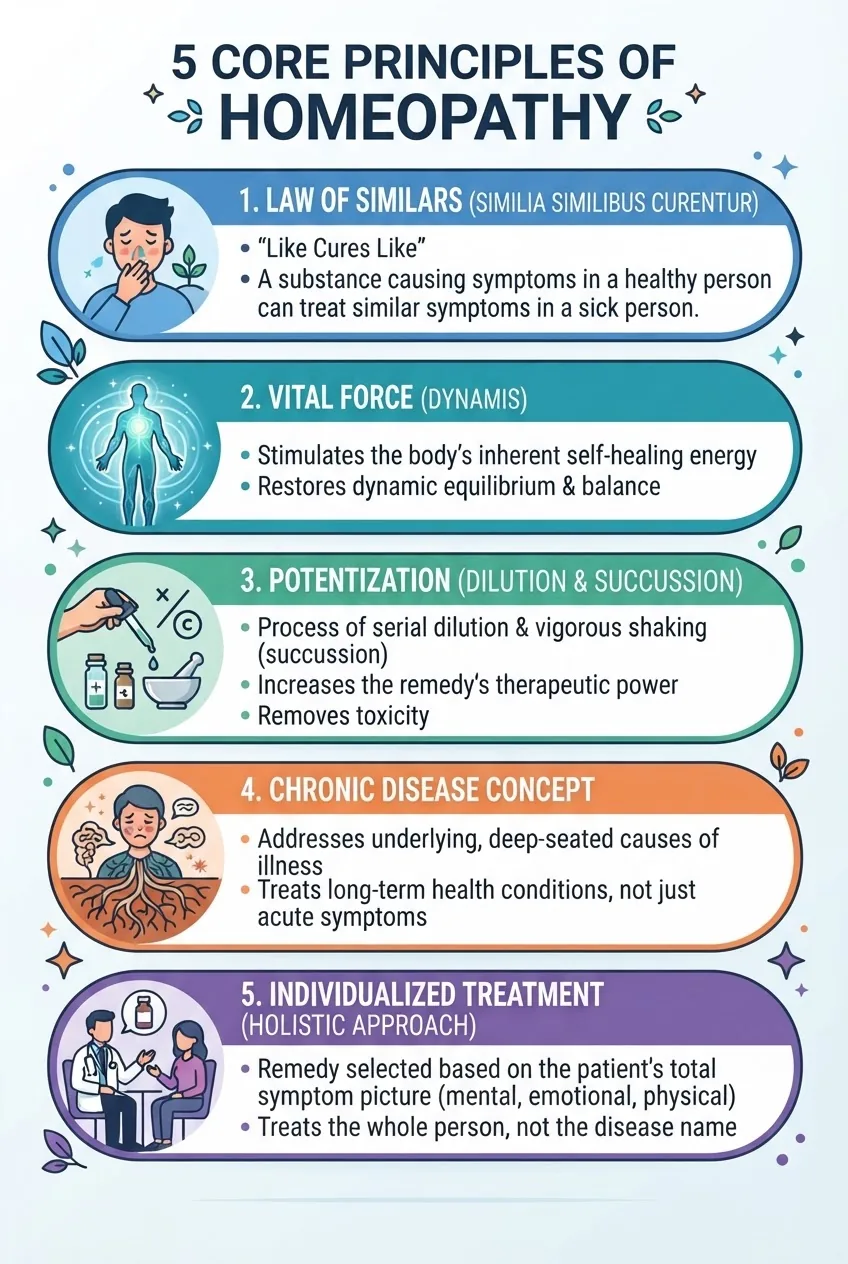
Five core principles (simplified):
- Law of Similars: Substances that produce symptoms in a healthy person can treat those same symptoms when given to the sick in a prepared form.
- Vital Force: Disease is an imbalance or disturbance in an organism’s dynamic life energy, which remedies aim to rebalance.
- Dilution and Potentization: Remedies are serially diluted and succussed (shaken) to enhance their therapeutic “potency” while minimising toxic effects.
- Individualized Treatment: Remedies are matched to the totality of the patient’s symptoms—physical, mental and emotional—rather than a single disease label.
- Chronic Disease Theory: Many chronic illnesses stem from deep-seated miasms (inherited or acquired predispositions) requiring constitutional treatment.
Term: Potentization — the process of serial dilution and succussion Hahnemann developed, believed within homeopathic philosophy to unlock or amplify the remedy’s therapeutic dynamic despite extreme dilution.
Hahnemann’s original protocol for preparing remedies (step-by-step, as he described):
- Start with a mother tincture: a concentrated extract of the raw substance (plant, mineral or animal material).
- Dilute a measured portion in a solvent (usually alcohol or water) in a defined ratio (e.g., 1:10 for decimal, 1:100 for centesimal) — this is the first potency.
- Succuss (vigorously shake or strike) the diluted solution against a resilient surface a specified number of times to “succuss” the mixture.
- Repeat dilution and succussion cycles to reach higher potencies, recording each stage (1X, 2X, 1C, 2C, etc.).
- Final remedy is prepared on sugar pills or in liquid form for administration, with a potency chosen according to the case’s acuity and constitution.
Hahnemann argued that potentization transformed the material into a dynamic medicinal agent acting on the vital force rather than relying solely on chemical concentration. He documented provings—systematically recording symptoms produced by substances in healthy provers—to build repertories for matching remedies to patient symptom totalities.
Hahnemann’s chronic disease theory introduced miasms—psora, syphilis and sycosis—as underlying predispositions shaping chronic illness and remedy response; this framework guided long-term, constitutional prescribing rather than symptomatic quick fixes.
How has Hahnemann’s legacy influenced modern homeopathy and subtle energy medicine?
Answer: Hahnemann’s philosophies—individualized remedy selection, energetic vital force concepts and potentization—remain central to modern homeopathy and have influenced broader subtle energy medicine, integrative practices and certain holistic paradigms that prioritise energetic balance and individualized care.
Term: Vital force principle — a homeopathic concept that disease originates in a disturbance of an animating life energy; modern subtle energy frameworks often map similar ideas using different terminology.
Hahnemann’s influence persists in clinical practice, materia medica compilation and training curricula used by contemporary homeopaths. According to a 2023 review in a peer-reviewed medical journal, interest in individualized energetic approaches has continued to sustain professional and patient communities around homeopathy and related subtle energy modalities: 2023 peer-reviewed review on homeopathy.
Examples of modern-day applications and influence:
- Practitioners maintain proving programs and updated repertories to refine remedy selection for contemporary symptom patterns.
- Some integrative clinics offer constitutional homeopathy alongside nutritional and mind-body therapies that appeal to patients seeking subtle energy healing.
- Homeopathic principles inform certain practitioner approaches within complementary medicine, especially around individualized care and low-dose energetic interventions.
Hahnemann’s philosophical framing connects directly with the broader subtle energies cluster: both emphasise non-material patterns of imbalance, systemic regulation and the idea that targeted energetic interventions can catalyse self-healing. Contemporary practitioners often translate Hahnemann’s vital force into modern language—biofield, energy balance, or regulatory homeostasis—while retaining core repertorial and individualized prescribing methods.
To explore practical resources and local availability of remedies and practitioners inspired by Hahnemann’s work, see our pillar guide homeopathic medicine overview and store guide near you.
Within comparative contexts, readers often ask how homeopathy fits among holistic modalities; for direct clarification consult our comparison resource on holistic vs homeopathic medicine differences.
Hahnemann’s legacy also includes influence on specific condition-focused homeopathic work such as our reference on homeopathy for asthma treatment, where individualized remedy strategies continue to be used by practitioners trained in his methods.
What controversies and misconceptions surround Hahnemann’s work?
Answer: Hahnemann’s work is controversial because core principles—especially potentization and the vital force—conflict with materialist biomedical models and reproducible dose–response expectations; critics cite limited high-quality clinical evidence, while supporters point to provings, clinical experience and patient-reported benefit.
Key points in the debate:
- Scientific critique often targets extreme dilutions and the lack of a physically measurable active ingredient, challenging conventional pharmacology paradigms.
- Historical disputes arose as mainstream physicians in the 19th century debated Hahnemann’s departure from bleeding and harsh remedies; these debates framed early tensions between homeopathy and allopathic practitioners.
- Contemporary systematic reviews vary in conclusions: some report no consistent evidence beyond placebo for many indications; others highlight methodological limitations and call for higher-quality trials.
For readers seeking an introduction to the conventional side of that historical divide, see our primer on conventional medicine: allopathic medicine definition and meaning guide. For safety-focused perspectives historically connected to debates over homeopathic use, consult our balanced review on dangers of homeopathic medicine and side effects.
Case study from Hahnemann’s clinical record (summarised):
Historical case: Hahnemann recorded provings and case notes of patients with recurring fevers and digestive complaints whom he treated with highly individualized remedies after repertory matching; several accounts in Organon and Chronic Diseases describe sustained symptomatic shifts following constitutional prescribing rather than single symptomatic prescriptions.
Academic perspective and evidence signals: according to a recent peer-reviewed assessment, evidence quality and heterogeneity are primary reasons for ongoing debate; readers can review historical research and systematic analyses for nuanced evaluation: Hahnemann biography and broader reviews in medical literature.
How can I learn more and experience Hahnemann’s methods today?
Answer: Learn Hahnemann’s methods via structured homeopathy courses, supervised clinical apprenticeships, reputable texts such as Organon and provings compilations, and by consulting certified practitioners; begin with introductory courses, then progress to case-taking and remedy repertorisation under supervision.
Term: Proving — the controlled administration of a substance to healthy individuals to catalogue the symptomatic effects used later to match remedies to patient symptom pictures.
Step-by-step guide to begin learning and experiencing Hahnemann’s methods:
- Read primary sources: study translated editions of Organon and Chronic Diseases to understand Hahnemann’s terms and case methodology.
- Take an introduction course from an accredited homeopathy school or professional association to learn proving methodology and repertory basics.
- Observe supervised case-taking sessions with an experienced practitioner to see individualized prescribing in practice.
- Practice basic remedy preparation understanding (potentization theory and ethics) and consult certified sources for sourcing remedies.
- Engage with community case discussions and continue evidence-based study, including peer-reviewed literature on homeopathy and subtle energy medicine.
Recommended practical resources and local support:
- homely remedies book guide
- homeopathic medical doctor guide on practice and safety
- homeopathy near me guide to find local clinics
Regulatory and professional context: complementary medicine authorities and professional associations provide guidance on training standards and scope of practice; see an established regulator for policy summaries and practitioner directories: National Center for Complementary and Integrative Health (NCCIH).
Why does understanding the founder of homeopathy matter today?
Answer: Understanding Hahnemann clarifies homeopathy’s theoretical roots, explains why individualized energetic approaches persist, and helps patients and practitioners contextualise homeopathic philosophy within modern subtle energy and integrative health conversations.
Knowing Hahnemann’s methods—provings, potentization, and chronic disease theory—enables informed dialogue between patients, conventional clinicians and integrative practitioners. Awareness of the founder’s historical context and philosophical commitments helps users evaluate contemporary adaptations and seek appropriate training, supervision and evidence when exploring homeopathic options.
Summary and next steps: Review Hahnemann’s Organon for primary insights, consult modern reviews and professional guidelines for current standards, and if pursuing homeopathic care, seek practitioners trained in classical methods and familiar with contemporary evidence and practice standards.
If you want local resources and practical next steps, visit our guide to local supplies and practitioners homeopathic medicine overview and store guide near you.