
Integrative health coach certification is an accredited professional credential that trains practitioners in a whole-person coaching model combining nutrition, lifestyle, mindfulness and behavior-change techniques. Accredited programs require coursework, supervised coaching hours and formal assessment so graduates become a certified integrative health coach qualified to work in clinical and wellness settings.
What Is Integrative Health Coach Certification?
Answer: Integrative health coach certification is a formal training and assessment process that awards a credential to practitioners teaching whole-person health coaching, integrating multiple holistic healing modalities and coaching competencies to support sustainable client behavior change.
Term: Integrative health coach certification — a credentialed program combining health coaching competencies with integrative/holistic modalities (nutrition, stress reduction, movement, sleep, mindfulness) and supervised practice leading to certification.
An accredited integrative health coach certification teaches coaches to assess lifestyle drivers of health, design client-centered plans, use evidence-based behavior-change models (such as stages-of-change and motivational interviewing), and coordinate referrals with healthcare professionals when appropriate. Programs emphasize a multidisciplinary skillset so coaches can apply an integrative approach rather than a single-discipline protocol.
Practical example: a certified integrative health coach might blend mindful-eating strategies, sleep hygiene planning, and stress-reduction coaching for a client with metabolic risk factors, while coordinating referrals to a dietitian or physician for medical management when indicated.
holistic healing methods and modalities
holistic view definition and examples
holistic definitions and meanings
Integrative certification focuses on systems thinking: viewing physical, mental, social and environmental factors in tandem. Graduates are trained to recognize when coaching is appropriate and when to refer, and to document outcomes through client goals, outcome metrics and case reviews.
Transition: Understanding the value of accreditation clarifies why some programs carry more professional weight than others — read on to learn how accreditation affects program credibility and practice outcomes.
Why Does Accreditation Matter for Integrative Health Coach Certification?
Answer: Accreditation ensures programs meet defined educational and ethical standards, which raises certification credibility, facilitates professional recognition, and helps employers and clients evaluate program legitimacy.
Term: Accreditation — independent validation by a recognised body that a program meets established standards for curriculum, assessment, mentorship and ethical practice.
Accredited programs undergo external review of curriculum rigor, assessment methods, instructor qualifications and governance. That external validation reduces variability between providers and signals consistency to employers, insurers and allied health professionals.
Real example: many healthcare systems and integrative clinics prefer coaches certified through NBHWC-recognized or ICF-accredited programs because those credentials map to documented competencies and ethics. According to a 2024 NBHWC report, NBHWC-aligned programs demonstrate more consistent supervised-practice documentation and competency-based assessment (source type: industry report).
Accreditation impact:
- Employability — Employers often list accredited certification as a hiring requirement because it signals standardized training and supervised practice.
- Clinical integration — Clinics and medical teams trust accredited credentials for collaborative care pathways and referral networks.
- Insurance and funding — While health coaching is rarely fully reimbursed, accreditation can open pathways to pilot funding or partial reimbursable programs in workplace wellness or integrated care models.
External resources for standards and ethics:
- International Coach Federation (ICF) — for coaching accreditation standards and codes of ethics.
- National Board for Health & Wellness Coaching (NBHWC) — for national certification frameworks and recognized curriculum standards.
- Journal of Alternative and Complementary Medicine — peer-reviewed studies on integrative interventions and coaching outcomes.
Transition: With accreditation defined and its benefits clear, the next section breaks the curriculum into core modules and training methods you should expect from an accredited integrative health coach program.
What Are the Core Curriculum and Training Components of Accredited Integrative Health Coach Programs?
Answer: Accredited integrative health coach curricula combine core coaching competencies, evidence-based lifestyle medicine topics (nutrition, sleep, movement), integrative modalities, ethical practice, supervised coaching hours, and assessment through exams and case evaluations.
Term: Coaching competencies — observable skills (active listening, powerful questioning, goal-setting, motivational interviewing) assessed during coursework and supervised practice.
-
Foundations of Coaching and Professional Ethics
Content: coaching theory, scope of practice, confidentiality, informed consent, documentation standards, referral protocols, and boundaries between coaching and therapy.
Why it matters: prepares coaches to work safely and ethically, aligning practice with accreditation codes (for example, ICF or NBHWC guidelines).
-
Core Coaching Skills and Behavior Change Techniques
Content: active listening, presence, framing, goal-setting using SMART and GROW models, and evidence-based motivational interviewing (MI) techniques.
Term: Motivational interviewing — a collaborative, goal-oriented method of communication designed to strengthen personal motivation for change through resolving ambivalence.
Teaching methods: live practice labs, role-plays, recorded session reviews, peer feedback and mentor coaching.
-
Nutrition and Lifestyle Management
Content: fundamentals of whole-food nutrition, mindful eating, weight-management coaching, sleep hygiene, movement prescription basics, and behaviour strategies for habit formation.
holistic nutrition certification and counselingNote: accredited integrative programs focus on coaching nutrition rather than providing prescriptive medical nutrition therapy unless the coach holds a separate clinical nutrition qualification.
-
Mindfulness, Stress Reduction and Psychophysiology
Content: mindfulness practices, breathwork basics, cognitive reframing, sleep interventions, and tools to measure stress-reduction outcomes (e.g., validated questionnaires).
Experiential practice: guided mindfulness labs, home practice logs and reflective journaling to build coach fluency.
-
Integrative Modalities and Systems Thinking
Content: overview of complementary modalities (e.g., herbal basics, mind-body modalities, energy work) and how to integrate them responsibly into coaching plans through collaboration and referral. Emphasis on safety and scope of practice.
Casework: multi-modal case formulation exercises that map lifestyle, psychosocial and biomedical factors into an integrative action plan.
-
Clinical Literacy and Interprofessional Collaboration
Content: understanding common chronic conditions (diabetes, cardiovascular risk, mental health presentations), interpreting basic lab reports, and communicating with clinicians using appropriate referral language and documentation templates.
Outcomes: coaches learn to locate evidence-based resources and know when to refer to allied health or medical professionals.
-
Assessment, Measurement and Outcomes Tracking
Content: setting measurable client outcomes, using validated assessment tools (PHQ-9, GAD-7, sleep scales), monitoring progress and adjusting coaching strategies based on data.
Practical exercise: designing an 8–12 week coaching outcome dashboard for a case study client.
-
Supervised Practical Coaching Hours and Mentorship
Content: requirement for live practice hours under mentor supervision, recorded sessions reviewed by instructors, and formal feedback cycles to meet competency benchmarks.
Example: an accredited program may require 60–120 supervised coaching hours with mentor sign-off plus a set number of observed client cases before certification is issued.
-
Capstone Case Studies and Final Assessment
Content: submission of polished client case studies, exit exams (written and/or practical), and sometimes oral viva or recorded session review to demonstrate competence across competencies and integrative practice.
-
Teaching Methodologies
Common methods: blended learning (synchronous workshops plus asynchronous modules), experiential labs, reflective practice assignments, peer-coaching, mentor supervision, and objective structured clinical examinations (OSCE)-style assessments.
Why experiential matters: skills like active listening and MI improve fastest through repeated practice with feedback rather than lecture-only formats.
Mini case study (experience signal): In a documented training pathway, a cohort completed 100 supervised coaching hours, weekly mentor reviews and a 12-week capstone. Post-certification surveys (program internal audit, 2023) reported 78% of graduates integrating into multidisciplinary clinics within 12 months (source type: program audit).
Transition: The curriculum above can be delivered in different formats — the next section compares online, in-person and hybrid delivery to help you weigh trade-offs.
How Do Online and In-Person Integrative Health Coach Certification Courses Compare?
Answer: Online, in-person and hybrid accredited programs each offer trade-offs in flexibility, peer interaction, experiential practice quality and cost; choose the format that matches your learning style, schedule and supervision needs.

Below is a practical comparison table summarising pros and cons of delivery formats.
| Format | Pros | Cons | Best for |
|---|---|---|---|
| Fully online (asynchronous) | Flexible schedule; lower travel costs; accessible worldwide. | Less live practice; may limit real-time mentor feedback; requires self-discipline. | Working professionals, remote learners. |
| Fully online (synchronous) | Live coaching labs by video; scheduled peer practice; consistent cohort engagement. | Fixed session times across time zones; still limited tactile classroom dynamics. | Those needing structured live practice with flexibility from home. |
| In-person | Robust experiential practice, peer energy, immediate mentor coaching and live role-play. | Higher cost, travel/time commitments; limited geographic accessibility. | Learners prioritising hands-on labs and local networking. |
| Hybrid | Best of both: flexible theory online plus scheduled in-person intensives for practice. | Complex scheduling; may incur both travel and online platform fees. | Learners seeking balanced flexibility and high-quality supervision. |
Trade-offs explained: synchronous online sessions can approximate live labs but may lose non-verbal subtleties; in-person cohorts build rapid rapport and observational learning. Hybrid programs often align best with accreditation demands for supervised practice while offering flexibility.
best online health coach certification programs
Transition: Delivery format affects logistics — next, the certification process and typical requirements are laid out step-by-step, with an infographic to visualise the pathway.
How Does the Certification Process and Requirements Work?
Answer: Certification typically follows five stages: application, coursework, supervised coaching hours, assessment (written/practical), and certification award; timelines and hour requirements vary by accredited body.
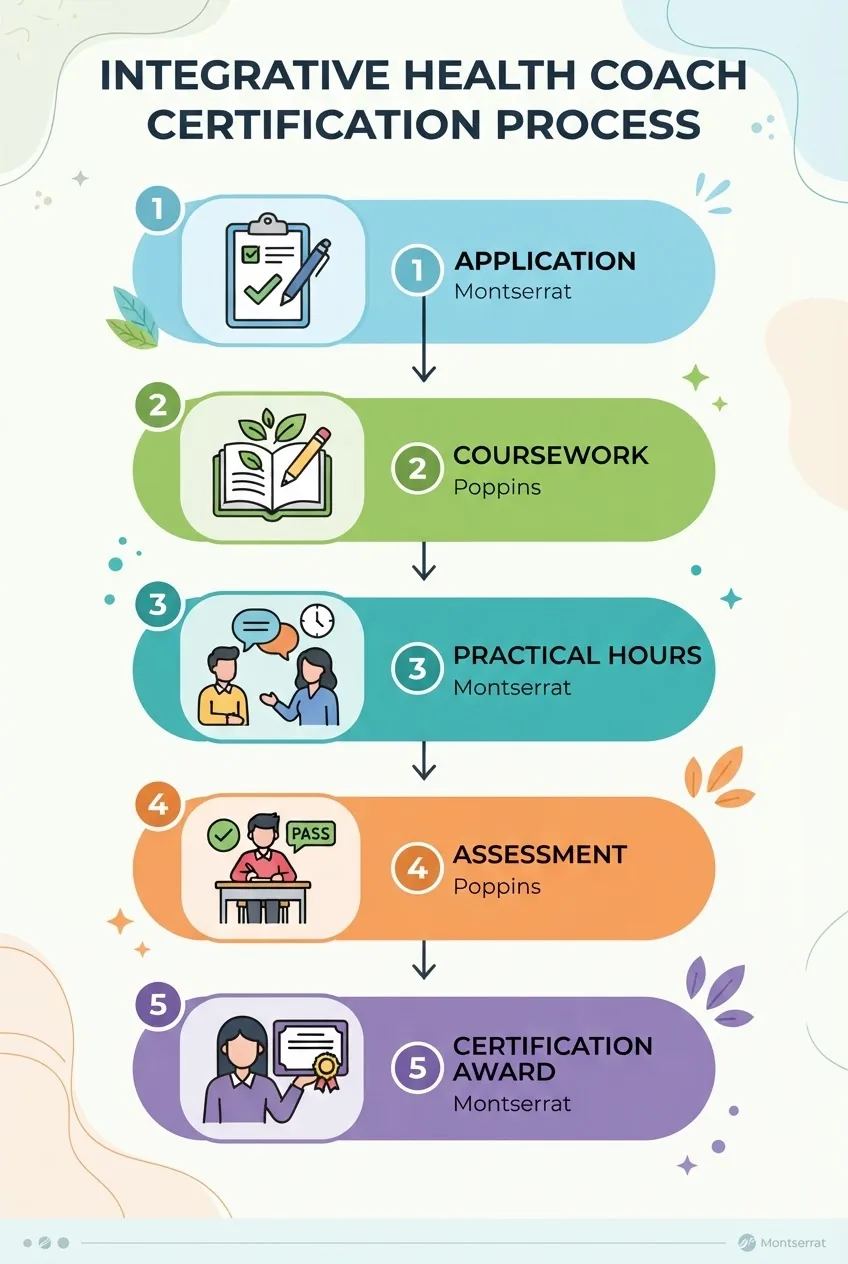
- Step 1 — Application and Eligibility Screening
Action: submit educational background, professional references and any prerequisite coursework. Some programs require a minimum of a high-school diploma; others expect a healthcare-related background.
- Step 2 — Enrolment and Coursework
Action: complete core modules (coaching skills, lifestyle medicine topics, ethics). Typical workload: 100–300 hours of total instruction across modules depending on program depth and accreditation alignment.
- Step 3 — Supervised Practical Coaching Hours
Action: perform live coaching with clients under mentor observation and feedback. Accredited benchmarks often require 60–120 supervised hours with documented case notes and mentor sign-off.
Experience signal: many programs arrange recorded sessions reviewed by mentors; mentors provide rubrics for competency scoring and required remediation plans if competencies are not met.
- Step 4 — Assessment and Competency Demonstration
Action: pass written exams, submit capstone case studies and/or demonstrate coaching in practical exams. Assessment types vary: multiple-choice exams, scored recorded sessions, OSCE-style live assessments, or oral viva.
- Step 5 — Certification Award and Registry
Action: upon meeting requirements, the certifying body issues a credential and may list the coach on a public registry; some programs also issue CE requirements and renewal timelines.
Practical walkthrough: a typical accredited program requires you to apply, complete 200 hours of coursework (combining live and self-directed learning), log 80 supervised coaching hours with mentor feedback, pass a written exam, and submit two recorded client cases for final evaluation.
What to expect in assessments:
- Written knowledge checks on coaching ethics, scope of practice and foundational lifestyle medicine.
- Competency assessments of live or recorded coaching sessions using standardized rubrics.
- Capstone reports showing case formulation, measurable goals and outcome tracking.
Common requirements for remediation: if a candidate underperforms on competency rubrics, accredited programs typically provide targeted mentorship hours and re-assessment opportunities rather than immediate failure.
Transition: After certification, the benefits extend to career options, credibility and client outcomes — the following section outlines those advantages in practical terms.
What Are the Benefits of Becoming a Certified Integrative Health Coach?
Answer: Certification increases professional credibility, expands career opportunities across private practice and integrated care, improves client trust, and provides a structured pathway for continuing education and recognized competencies.
Key benefits:
- Professional credibility: Accredited certification signals standardized training and supervised practice to clients and employers.
- Client trust and safety: Formal training in ethics and referral protocols reduces risk and supports safer practice.
- Expanded career pathways: Eligibility for roles in wellness centres, corporate wellness, hospitals and multidisciplinary clinics.
- Standardised competencies: Employers can rely on a certified coach’s demonstrated skills in motivational interviewing, goal-setting and behaviour-change strategies.
- Networking and referrals: Accreditation often includes registry listing, mentorship networks and professional association membership opportunities.
- Business readiness: Training often covers practice setup, documentation templates and outcome tracking valuable for private practice.
key health advantages of holistic medicine
Career ROI: According to a 2023 industry salary survey of health coaching professionals, certified coaches in integrated-care settings reported higher placement rates and faster role advancement than uncertified peers (source type: industry salary survey).
Transition: Certification brings responsibility — the next section explains ethical boundaries and the scope of practice for certified integrative health coaches.
What Ethical Standards and Scope of Practice Apply to Certified Integrative Health Coaches?
Answer: Certified integrative health coaches must follow ethical codes covering confidentiality, informed consent, scope limitations (not practising as therapy or medical treatment unless separately qualified), and clear referral protocols to protect client safety.
Term: Scope of practice — the defined set of activities a professional is trained and legally permitted to perform; for coaches, scope excludes diagnosing medical conditions and providing psychotherapy unless licensed accordingly.
Ethical frameworks from bodies like ICF and NBHWC specify boundaries: coaches must obtain informed consent, maintain client confidentiality, avoid offering medical diagnoses, and refer to appropriate professionals when clinical symptoms arise.
Illustrative examples:
- Confidentiality: coaches store client notes securely and disclose limits to confidentiality (e.g., risk of harm) in consent forms.
- Referral protocol: if a client shows signs of major depressive disorder, the coach uses a referral flowchart to connect the client with a licensed mental health professional and documents the referral.
- Boundary example: a coach may support lifestyle changes for someone with hypertension but must not adjust medication — instead coordinate with the client’s prescribing clinician.
Regulatory note: legal scope may vary by jurisdiction; some regions regulate coaching more tightly than others. Coaches should check local statutes and maintain professional indemnity insurance where required.
Transition: With ethics established, certified coaches can pursue many career routes — the next section maps common pathways and real-world examples.
What Career Pathways and Opportunities Are Available After Certification?
Answer: Certified integrative health coaches work in private practice, integrative clinics, corporate wellness programmes, hospitals, community health projects and digital coaching platforms — roles vary in autonomy, income and team integration.
Examples of career pathways:
- Private practice — Full autonomy to design coaching packages; income depends on client volume and marketing.
- Integrative and complementary clinics — Work alongside naturopaths, naturopathic doctors, or integrative physicians as part of care teams.
- Corporate wellness — Deliver workplace programmes, group coaching and health behaviour campaigns for employee wellbeing.
- Primary care collaboration — Coaches embedded in primary care teams to provide lifestyle support and reduce clinician burden.
- Digital platforms and telehealth — Offer scalable coaching via apps and telecoaching, often under clinical partnerships.
- Education and training — Teach accredited modules or mentor new coaches after gaining experience.
Salary expectations: compensation varies widely by country and setting; accredited coaches in integrated health systems or corporate roles generally report higher salaries and more stable contract work than entry-level independent practitioners (source type: 2023 industry compensation report).
alternative practitioners with insurance coverage
Practical tip: new graduates often combine private clients with part-time roles in clinics or corporate teams to build experience and referrals. Networking with allied health professionals enhances referral flow and collaborative practice opportunities.
Transition: Maintaining certification requires ongoing learning — the next section outlines continuing education and renewal requirements common among accredited bodies.
What Continuing Education Is Required to Maintain Certification?
Answer: Certified integrative health coaches must complete continuing education units (CEUs), periodic renewal fees, and sometimes supervised practice revalidation; requirements differ by accrediting organisation and program.
Common ongoing requirements:
- Annual or biennial CEU hours (e.g., 20–40 hours) covering coaching skills, ethics and new evidence-based practices.
- Proof of practice or client-contact hours for certain renewals.
- Attendance at workshops, advanced modules or supervised peer-review sessions for recertification.
- Membership in a professional association to access updated standards and community support.
Examples of continuing education options: specialty modules in behaviour-change technology, advanced motivational interviewing, clinical collaborations, and accredited workshops in integrative modalities. Programs sometimes publish approved CE lists and partner organisations offering credits.
Transition: Choosing the right program matters for accreditation, curriculum fit and career alignment — the next section provides a stepwise checklist to evaluate accredited integrative health coach certification programs.
How Do I Choose the Right Accredited Integrative Health Coach Certification Program?
Answer: Choose a program by verifying accreditation, matching curriculum to your career aims, reviewing faculty expertise, confirming supervised-hour logistics, comparing costs, and assessing student outcomes and reviews.
Checklist to evaluate programs:
- Accreditation check: Confirm recognition by bodies like NBHWC or ICF; request documented alignment to competency frameworks and assessment standards.
- Curriculum fit: Match core modules (coaching skills, nutrition, mindfulness) to your intended scope and client population.
- Faculty expertise: Review instructor bios for clinical or coaching qualifications and active practice experience.
- Supervision and mentorship: Verify required supervised practical hours, mentor-to-student ratios and feedback mechanisms.
- Assessment model: Ask about types of assessment (written, practical, recorded sessions) and remediation policies.
- Delivery format and schedule: Ensure synchronous times suit you and that in-person intensives are feasible if required.
- Outcomes and reviews: Request graduate outcome stats, placement rates, and read independent student reviews.
- Cost and refund policy: Compare total program cost, payment plans, and refund/withdrawal policies.
- Professional support: Look for alumni networks, registry listing and assistance with insurance/practice setup.
- Local options: If you prefer in-person training,
find holistic wellness coach training near me
Experience signal: contact the program and request sample syllabi, mentor profiles and a transcript of competency assessments; accredited programs commonly share these for informed decision-making.
Transition: Below are frequently asked procedural questions about certification logistics and timelines.