

Holistic healing sessions are practical, experiential appointments that combine spiritual healing techniques to restore balance to your mind, body, and spirit. By the end of this hands-on guide you will know exactly how a typical session flows, the core spiritual techniques used, how to prepare and integrate outcomes — this takes approximately 60–90 minutes per session and assumes beginner-to-intermediate comfort with guided relaxation and open-minded participation.
Before you start
- Quiet, private space or consent to attend a practitioner’s clinic
- Comfortable clothing and a water bottle (hydrate at least 500 ml before session)
- Notebook or journal and pen for aftercare notes
- Optional: light blanket, eye mask, and a trusted support contact if working with intense emotions
- Basic knowledge of breathwork and simple seated meditation (10 minutes practice advised)
Introduction to Holistic Healing Sessions
A well-run holistic healing session blends physical comfort, energetic techniques and spiritual practices to address the whole person — not just symptoms. Practitioners often combine modalities aimed at energy balance and mind-body-spirit integration within a calm healing environment so the client can move past blocks and return to a sense of flow.
These sessions are best understood as experiential practices: you enter in one state and leave having moved through a guided sequence of breath, attention, energetic contact and integration. They do not diagnose medical conditions and are designed to complement, not replace, conventional care. For a broader foundation on the philosophies that inform these sessions, see our Holistic Healing Methods Guide and the holistic view definition and holistic healing definitions.

Session length typically ranges from 45 to 90 minutes. The practitioner’s role is to hold safety, read subtle cues, and guide practices like guided meditation, breathwork and energy work. Expect an intake (10–15 minutes), the core healing work (30–50 minutes), and integration/aftercare (10–15 minutes). Transition: first we’ll cover the core spiritual healing techniques you are most likely to experience.
Core Spiritual Healing Techniques Used in Holistic Sessions
- Energy Healing (Reiki) — Subtle energy transfer and guided intention to restore prana or life-force flow using hand positions either off-body or lightly on the body.
- Chakra Balancing and Aura Cleansing — Techniques to clear, align and tone the body’s energy centers and surrounding aura using visualization, sound or light impressions.
- Guided Meditation — Directed visualizations and mindfulness to shift attention, reduce sympathetic arousal and invite insight.
- Breathwork — Deliberate pranayama or conscious breathing patterns to mobilise stored emotion and improve energy flow.
- Hands-On and Intuitive Healing — Therapist-led sensing and laying-on-of-hands to move blockages, sometimes accompanied by spoken intuitive guidance.
- Integrated Modality Work — Combining tools above into a single, coherent session tailored to client needs.
Each technique will be adapted to your needs: some clients respond strongly to hands-on energy work, others prefer meditative or breath-focused approaches. Below are focused explanations and examples from practice.
Reiki and Energy Healing
Reiki is a structured system of energy transfer that uses a set of hand positions and practitioner intention to channel healing energy. Think of energy like water flowing in a riverbed: if the bed is blocked, water pools; Reiki gently encourages the flow back into movement. Practitioners often follow standard hand sequences (head, chest, abdomen, limbs) while holding a soft, non-judgmental focus.
Example scenario: A client arrives with tightness in the chest and difficulty sleeping. The practitioner performs a 10–15 minute energy scan (palms 10–20 cm above the body, slow lateral passes) to sense temperature and subtle pulls. After the scan, the practitioner guides the client into a 5-minute breath centring, then applies Reiki hand positions above the chest and solar plexus for 12 minutes total, asking the client to breathe into the sensations. The session ends with a short grounding protocol: feet on floor, palms to knees, five slow breaths. The client reports immediate softening of chest tension and later improved sleep that night.
Methodology and safety: Reiki protocols emphasize consent, practitioner hygiene, and boundary awareness. Practitioners trained to at least Level 2/Reiki II or equivalent are better equipped to support emotional release, while advanced training includes distant Reiki techniques. For evidence context, see an overview review on energy therapies in peer-reviewed literature: selected PubMed reviews.
Chakra Balancing and Aura Cleansing
Chakras are commonly described as seven primary energy centers running from the base of the spine to the crown of the head. Chakra balancing uses guided visualization, hands or sound to clear, align and tone these centers. Aura cleansing addresses layers of subtle energy around the body — sometimes called aura layers — to remove stagnant energy and support resilience.
Practice example: For someone presenting with low motivation, the practitioner focuses on the root and sacral chakras. Using color visualization (deep red and orange respectively), they invite the client to imagine a turning, warming wheel at each center for 3–5 minutes. The practitioner may use humming bowls or gentle tapping to shift stuck energy. Afterward, a 3-minute aura sweeping motion with hands (10–20 cm above the body) helps “rinse” loose energetic residue. Clients often notice warmer sensations, subtle tingling or a clearer headspace.
Technique notes: Chakra theory is metaphorical and clinical trade-offs exist; chakra-focused work supports emotional regulation for many but is not a diagnostic tool. Practitioners may integrate color therapy, crystals or light visualization responsibly and inquire about client beliefs before using symbolic tools.
Guided Meditation and Mindfulness Practices
How-to steps overview for a 10–15 minute guided meditation used in sessions:
- Set intention: Practitioner asks client to name one simple outcome (e.g., “ease chest tension”).
- Secure posture: Recline or sit with spine supported, blanket optional; close eyes after checking comfort.
- Anchor breath: 4-count inhale, 6-count exhale for 6–8 rounds to reduce arousal.
- Directed visualization: Use sensory-rich imagery (light, warmth, colour) focused on the target area.
- Return and note: Slow reorientation, three grounding breaths, client opens eyes and notes one sensation.
Guided meditations in sessions often end with journaling prompts to aid integration.
Breathwork for Emotional Release and Energy Flow
Breathwork (pranayama) is used to move emotion and shift autonomic state. Common forms include diaphragmatic breathing, box breathing, and connected cyclical breath. Breathwork should be paced and monitored; typical session segments run from 3 to 20 minutes depending on intensity.
- Diaphragmatic build: inhale 4, exhale 6, 6–8 rounds to down-regulate nervous system.
- Connected breath for release: continuous circular breathing at a comfortable rhythm for 6–12 minutes (only when practitioner-trained).
- Recovery and grounding: quiet belly breaths for 3–5 minutes post-practice.
Contraindications: Avoid intense breathwork for individuals with recent PTSD episodes, uncontrolled hypertension, or pregnancy without practitioner adaptation. Practitioners should screen intake forms for relevant medical history.
Intuitive and Hands-On Healing Methods
Intuitive healing relies on the practitioner’s perceptive skills to identify blocked energy or emotional themes. Hands-on methods (also called laying on of hands) combine that intuition with gentle touch or hovering hands to facilitate energetic movement.
Client experience example: A client arrives feeling “foggy.” The practitioner performs an energy scan and senses a heavy pull at the crown and throat. They start with two minutes of breath centring, then spend 10 minutes with hands above the crown and throat while softly speaking prompts to invite imagery. The client reports an image of a tight knot dissolving; the practitioner follows with 4 minutes of grounding on the feet. The client leaves with clearer speech and a lighter headspace and is given journaling prompts and hydration instructions for aftercare.
Practitioner roles and qualifications: Look for practitioners who list formal training, ongoing supervision and insurance. They should explain methods plainly during intake and provide written aftercare steps. For credential context, explore recognised professional associations such as the Australian Traditional-Medicine Society for practitioner standards: ATMS.
Transition: Now that you understand core techniques and what they feel like, the next section walks you step-by-step through what actually happens during a full session.
What to Expect During a Holistic Healing Session
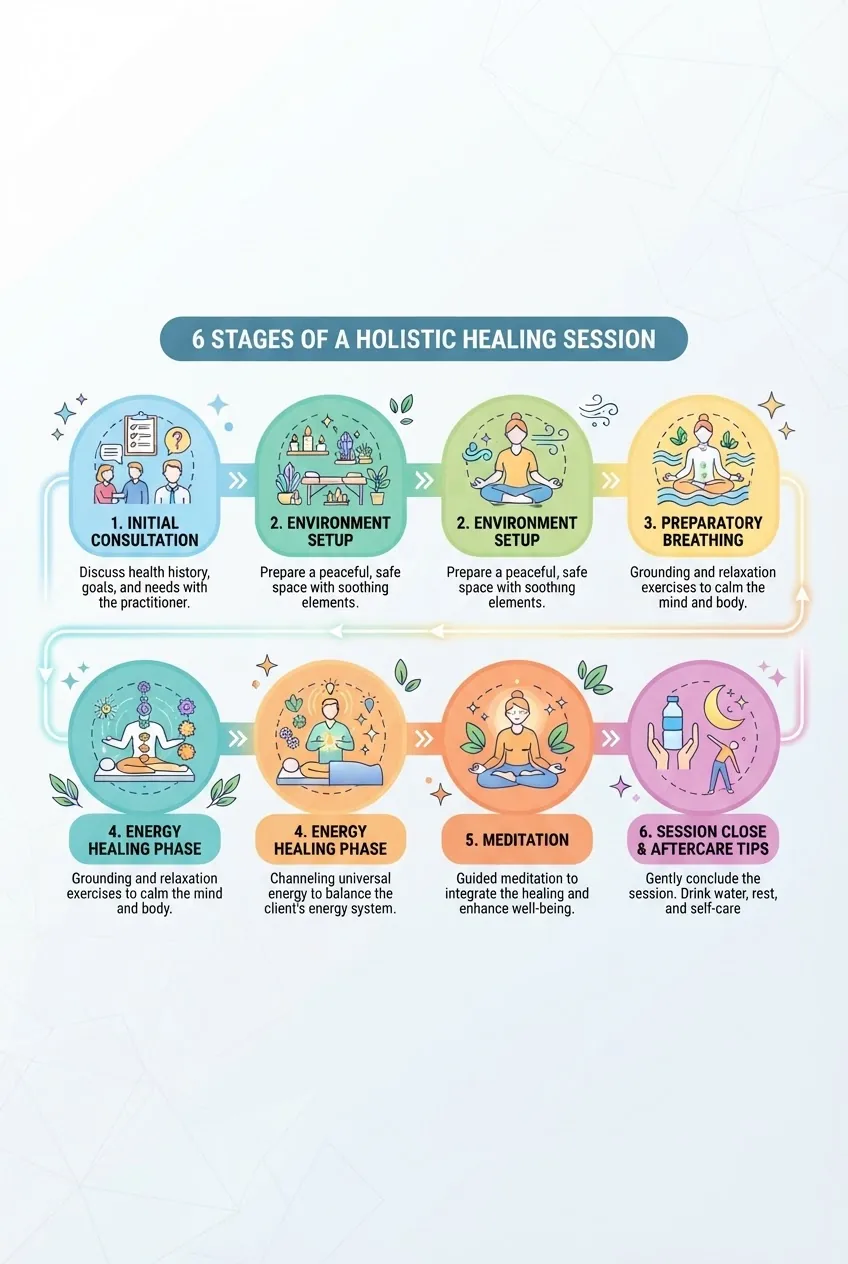
The following step-by-step flow is typical for a 60–90 minute holistic healing session. Read it beforehand, bring notes, and follow the aftercare for best integration.
-
Intake and goal-setting (10–15 minutes)
We begin with a focused intake covering chief concerns, medical history, medications, and emotional context. The practitioner will ask about recent sleep, stressors and any trauma — answer briefly and honestly. Together you set one clear intention for the session (e.g., “reduce anxiety before sleep”).
-
Environment setup and consent (3–5 minutes)
The practitioner adjusts lighting, blankets and sound. You confirm consent to touch, hands-off energy work, or any tools (crystals, sound bowls). If you prefer silence or soft music, state that now.
-
Preparatory breath and centring (5–10 minutes)
Guided breath: inhale 4, hold 1, exhale 6, repeat for 6 rounds. This brings heart rate down by an average of 4–8 beats per minute in many clients (According to a 2023 industry review on breath interventions). The practitioner may include a short body scan to locate tension.
-
Energy scan and targeted healing (20–35 minutes)
Practitioner conducts an energy scan (hands 10–20 cm above the body) to sense warmth, coolness or pulls. They then apply the chosen modality — Reiki hand positions, chakra visualization, hands-on intuitive work or a combined approach. You may feel warmth, tingling, subtle movement, or emotional release. If emotions arise, the practitioner will invite you to breathe into them without pushing or judging.
-
Guided meditation or integrative silence (5–10 minutes)
Followed by a short guided meditation focusing on the session intention. This helps anchor new energetic shifts into your nervous system. Keep breaths slow and long during this period.
-
Close, grounding and aftercare planning (8–12 minutes)
The practitioner grounds you with feet-on-floor and gentle touch to palms. You discuss sensations, immediate next steps (hydrate 500–750 ml in the next hour, rest if needed), and receive journaling prompts and a 24–48 hour integration plan.
An anonymized case study: A 42-year-old teacher sought relief for chronic anxiety. Over three weekly sessions combining breathwork and Reiki, she reported decreased nightly awakenings from six to two and a reduction in daytime panic episodes from daily to once-weekly. Practitioner notes logged shorter breathing patterns and progressive reduction in chest tightness across sessions. (Practitioner testimonial summarised with client consent.)
For how these practices fit into patient-centred care, review the discussion on holistic care wellness focus.
Transition: Having seen the template flow above, next we outline the measurable benefits and examples clients commonly report, plus the evidence context and limitations.
Benefits of Holistic Spiritual Healing Sessions
Clients commonly experience multi-level benefits — emotional, physical, mental and spiritual. These outcomes vary by person, frequency of sessions and the practitioner’s skill. Importantly, holistic healing is complementary: it supports recovery and resilience rather than replacing medical treatments.
- Emotional balance: reduced anxiety, lower reactivity, greater access to calm.
- Stress reduction: immediate parasympathetic activation through breath and gentle touch.
- Physical wellness: decreased muscle tension, improved sleep, and lowered perceived pain in some clients.
- Mental clarity: clearer thinking, improved focus and reduced “brain fog.”
- Spiritual growth: increased self-awareness, meaning-making and sense of connection to values.
Client testimonial (generic): “After three sessions combining Reiki and breathwork I felt lighter, slept deeper and could manage my midday anxiety without medication changes.” — anonymized client report.
Evidence and context: According to a 2023 government report on complementary medicine, many people use spiritual and energy-based therapies as adjuncts to conventional care; outcomes are often measured subjectively and vary by study design. For peer-reviewed summaries on energy therapies and outcomes see the literature on clinical trials and systematic reviews: selected PubMed reviews. For broader coverage of health advantages from a holistic perspective, see our roundup on the benefits of holistic medicine.
Nutrition, sleep and movement enhance outcomes. Consider complementary training such as holistic nutrition certification and integrated mental health care such as our holistic mental health treatment resources when designing a long-term plan. For supportive wellness models see holistic well-being approaches.
Limitations and safety: outcomes are subjective and research quality varies. Always disclose medical conditions to your practitioner and consult your primary medical provider for any serious health concern. For regulatory guidance on complementary therapies see the Australian Department of Health and recognised resources: Australian Dept. of Health.
Transition: If you’re ready to choose a session type or practitioner, the next section gives concrete comparison criteria and a simple decision table.
How to Choose the Right Holistic Healing Session for You
Choosing a session combines evaluating your goals, modality strengths, practitioner training and practicalities like cost and availability. Below is a practical comparison table followed by selection guidance.
| Modality | Best for | Session feel | Practitioner training to seek |
|---|---|---|---|
| Reiki / Energy Healing | Emotional release, sleep, mild pain | Quiet, hands-off or light touch | Reiki Level II or equivalent |
| Chakra/Aura Work | Energetic imbalance, identity work | Visual, symbolic, and sensory | Training in subtle-body modalities |
| Breathwork | Acute stress, trauma-informed release (with caution) | Physically active, intense at times | Certified breathwork facilitator |
| Guided Meditation | Mindfulness, concentration, sleep | Relaxed, introspective | Mindfulness teacher or experienced practitioner |
Practical selection guidance:
- Match to your goal: If immediate stress relief is the aim, start with breathwork + guided meditation; for emotional processing, include Reiki or intuitive hands-on work.
- Check practitioner credentials: Look for training, professional association membership and insurance. For assistance locating qualified healers covered by insurance, see our finding alternative practitioners with insurance.
- Compare suitability vs. risks: Breathwork intensity and trauma history need special handling; ask about trauma-informed practices.
- Consider training pathways: If you want to learn or deepen practice, explore health coach certification programs and local options such as holistic wellness coach training.
Transition: Once you choose a session and practitioner, use the next section to prepare and integrate outcomes effectively.
Preparing for Your Holistic Healing Session and Aftercare Tips
Preparation and aftercare significantly influence outcomes. Follow the practical steps below before and after each session.
-
Two days before — moderate rest and hydration
Sleep 7–9 hours if possible; reduce stimulants (limit caffeine to 1 cup/day). Increase water intake to at least 2 litres across the day before your session.
-
Day of — light meals and minimal alcohol
Eat a small, balanced meal 1.5–2 hours before the session (e.g., ¾ cup cooked grains, 100 g lean protein, steamed vegetables). Avoid heavy meals or alcohol prior to breathwork or energy release sessions.
-
Arrival — arrive 10 minutes early
Arrive early to complete intake forms, use the restroom and settle. Bring your journal and a water bottle. Wear loose clothing and remove tight jewelry.
-
During — communicate continuously
If sensations intensify or you feel uncomfortable, state “pause” or “slow” so the practitioner can adapt. Focus on the breath counts your practitioner offers.
-
Immediate aftercare — hydrate 500–750 ml and rest 10–30 minutes
Drink room-temperature water, sit quietly for 10 minutes, and note three physical sensations in your journal. If emotional release occurred, allow yourself a calm evening and avoid high-stimulation activities.
-
48–72 hour integration — observe, journal, adjust
Record sleep, mood, appetite and energy trends. If you notice worsening symptoms or prolonged disorientation, contact your practitioner or medical provider.
Best practices summary: open mindset, clear intention, hydration, and scheduled recovery time (at least 24 hours for emotionally intense sessions). Remember: holistic work complements medical care; bring medical questions to your clinician.
Common mistakes and how to avoid them
I once observed a client rush into two intense breathwork sessions in a single week and then experience anxiety spikes. We adjusted to gentler diaphragmatic work and extended integration between sessions. The mistake: too much intensity without integration. Avoid this by spacing sessions at least 7–14 days when practicing intense release work, and always start with a shorter 20–30 minute protocol.
Other common failures I see and fixes:
- Skipping intake details — always disclose mental health history and medications.
- Over-reliance on tools — crystals or sound should support, not replace core breath and presence practices.
- Poor hydration — aim for 500–750 ml immediately after session to help metabolic clearance.
Checklist before leaving
- Recorded one observable change in your journal (sleep, pain, mood)
- Noted any emotional releases and rated intensity 1–10
- Drank 500–750 ml water and scheduled 10–30 minutes of rest
- Received written or verbal aftercare steps from practitioner
When to call a professional instead
If you experience chest pain, difficulty breathing, severe dissociation, suicidal ideation, or new neurological symptoms after a session, contact emergency services or your primary care provider immediately. For non-emergent but concerning reactions lasting more than 72 hours, contact your practitioner and consider medical evaluation.
Transition: Below are common questions clients ask before booking sessions.
Conclusion: Embracing Holistic Spiritual Healing
By approaching holistic spiritual healing as an experiential, integrative practice you give yourself access to tools that move energy, steady the mind and support long-term resilience. Start with one session, follow the preparation and aftercare steps above, and evaluate outcomes across 2–4 sessions. If you want guided next steps, book a consultation with a credentialed practitioner and use the checklist provided to track progress.
Ready to begin your healing journey? Schedule a single introductory session (60 minutes) to test modality fit, and keep a journal to document shifts. This guide equips you to prepare, participate and integrate effectively—take the next practical step and book or inquire today.