

Evidence based complementary and alternative medicine (evidence based CAM) uses scientific methods—clinical trials, systematic reviews, and risk assessment—to evaluate CAM therapies for safety and effectiveness, then integrates proven modalities into patient care alongside conventional treatments to improve outcomes, symptom control, and patient-centred quality of life.
Introduction to Evidence Based Complementary and Alternative Medicine?
Answer: Evidence based CAM is the practice of applying rigorous scientific evaluation—controlled studies, meta-analyses, and safety monitoring—to complementary and alternative therapies so clinicians and patients can choose interventions supported by reproducible evidence.
Term: Complementary and alternative medicine (CAM) refers to medical systems, practices, and products not traditionally part of conventional Western medicine but used alongside (complementary) or instead of (alternative) standard treatments.
This introduction defines the scope and clarifies how an evidence-based approach reframes CAM from anecdote-driven care to data-driven options that can be evaluated, recommended, or rejected based on reproducible results and harm/benefit analysis. It emphasises that evidence based CAM is a methodology for assessing therapies such as acupuncture, herbal medicine, and mind-body interventions rather than a single unified system.
Why this matters clinically: evidence based CAM helps reduce unsafe practices, improves shared decision-making, and guides insurance and policy choices when outcomes are documented. According to a 2023 NCCIH report, research funding and clinical integration for CAM modalities increased as evidence grew for selected therapies; the trend underscores demand for rigorous evaluation. National Center for Complementary and Integrative Health (NCCIH).
alternative terms for western medical practices: CAM and integrative care
Image context: the following image conveys modern, evidence-minded CAM in a clinical setting.

Transition: Next, we unpack the principles of evidence-based medicine and how they apply specifically to CAM research and clinical practice.
Understanding the Principles of Evidence-Based Medicine in CAM?
Answer: Evidence-based medicine (EBM) in CAM applies the scientific method—hierarchies of evidence, controlled trials, systematic reviews, and clinical judgement—to evaluate whether a CAM practice produces reliable benefits that outweigh risks for defined patient populations.
Term: Evidence-based medicine (EBM) is a framework that integrates the best available research evidence, clinician expertise, and patient values to make health-care decisions.
EBM rests on three pillars: valid research evidence, clinical experience, and patient preferences; translating that model to CAM requires adapting study designs, setting relevant outcomes (e.g., pain reduction, function, quality of life), and assessing safety signals. Key EBM tools used in CAM include randomized controlled trials (RCTs), systematic reviews, meta-analyses, and pragmatic trials.
Define a common research term on first use:
Term: Randomized Controlled Trial (RCT) — a study in which participants are randomly assigned to the intervention or a control (placebo or usual care) to limit bias and isolate treatment effects.
Examples of principles applied to CAM:
- Pre-specifying outcomes: trials must define primary outcomes (e.g., 30% pain reduction at 12 weeks) to avoid selective reporting.
- Using validated measures: patient-reported outcome tools and objective biomarkers where possible.
- Transparency and registration: trial registration and data sharing to support reproducibility.
Evidence grading: Many CAM evaluations use recognised hierarchies such as the Oxford Levels of Evidence to rank study quality; high-quality meta-analyses of RCTs sit near the top while case series and expert opinion remain low-level evidence. External authority sources such as Cochrane Reviews often synthesise CAM trial data to produce actionable conclusions.
Example: An individual participant data meta-analysis of multiple high-quality acupuncture RCTs for chronic pain found small-to-moderate benefits versus sham acupuncture and larger benefits versus usual care—evidence typically judged at moderate quality by EBM standards (peer-reviewed meta-analyses).
Clinical translation: EBM does not demand identical study designs for all CAM practices; some modalities are best tested with pragmatic trials that mirror real-world practice settings, while mechanistic studies explore biological plausibility (e.g., herbs’ active compounds, acupuncture’s neurophysiological effects).
Transition: With principles set, the next section lists common CAM modalities that currently have supportive evidence and explains the nature of that evidence.
Common Complementary and Alternative Medicine Modalities with Evidence Support?
Answer: Several CAM modalities have varying levels of supportive evidence—acupuncture, some herbal medicines, mind-body practices, manual therapies, and certain nutraceuticals—each backed by RCTs, systematic reviews, or meta-analyses for specific indications.
Term: Systematic review — a structured summary of existing studies on a question, using explicit methods to reduce bias; a meta-analysis statistically combines data from multiple studies.
-
Acupuncture — Evidence highlights:
- Multiple RCTs and meta-analyses show acupuncture can reduce chronic low back pain, tension-type headache, and osteoarthritis knee pain compared with usual care; effects versus sham are smaller but often statistically significant (peer-reviewed meta-analyses).
- Mechanism research shows neurophysiological changes in pain processing, supporting biological plausibility.
-
Herbal medicine (phytotherapy) — Evidence highlights:
- Some herbs have high-quality RCT support for specific indications (e.g., St John’s wort for mild-to-moderate depression in multiple trials; peppermint oil for irritable bowel syndrome in controlled trials).
- Evidence strength varies widely by product standardisation, dose, and preparation; standardised extracts fare better in reproducible trials.
-
Mind-body interventions (mindfulness, CBT-based therapies, meditation, tai chi) — Evidence highlights:
- Mindfulness-based stress reduction (MBSR) and cognitive behavioural therapy (CBT)-informed mind-body programs have RCT evidence for anxiety, depression, chronic pain, and insomnia, often improving quality of life and function.
- Low risk profiles and reproducible protocols make these interventions attractive adjuncts to standard care.
-
Manual and physical therapies (massage, spinal manipulation, physiotherapy) — Evidence highlights:
- Massage therapy and physiotherapy have RCT evidence for short-term relief of musculoskeletal pain and function improvement; spinal manipulation has mixed results and should be applied by credentialed practitioners.
- Comparative effectiveness studies often show similar benefits to structured exercise programs for back pain.
-
Nutritional and supplement therapies — Evidence highlights:
- Omega-3 fatty acids have RCT support for reducing triglycerides and modest benefits for depressive symptoms; vitamin D has RCT evidence for bone health in deficient populations.
- Supplement quality is variable; trials using pharmaceutical-grade preparations show more reliable results.
-
Traditional systems (selected TCM, Ayurveda components) — Evidence highlights:
- Certain formulations and practices within Traditional Chinese Medicine (TCM) or Ayurveda have RCTs for narrow indications (e.g., herbal combinations for specific chronic conditions) but require standardisation and safety screening.
- WHO traditional medicine reports encourage quality research and regulatory systems to separate effective elements from unproven or harmful practices. World Health Organization (WHO).
-
Energy therapies and less-evidenced modalities (therapeutic touch, Reiki) — Evidence highlights:
- Clinical evidence is limited, often inconsistent, and frequently at risk of bias; current systematic reviews suggest insufficient high-quality evidence to recommend these modalities as stand-alone treatments.
- Where used, they function as low-risk adjuncts for patient comfort when providers are transparent about evidence limits.
Each modality’s evidence varies by condition, formulation, practitioner skill and trial quality; systematic reviews in journals like The Journal of Alternative and Complementary Medicine and Cochrane reviews synthesise this data for clinicians and patients.
Transition: Understanding types of evidence is necessary, but CAM research faces unique challenges; the following section explains study designs, bias sources, and reproducibility issues.
Research Methods and Challenges in Evaluating CAM Therapies?
Answer: CAM research uses standard biomedical methods—RCTs, cohort studies, and systematic reviews—but must overcome specific challenges: blinding difficulties, placebo effects, heterogeneity of interventions, small sample sizes, and limited funding, all of which complicate interpretation and reproducibility.
Term: Placebo effect — a measurable, observable improvement in health not attributable to the active components of an intervention but to expectations, context, and other non-specific factors.

Key research methodologies used in CAM:
- Randomized Controlled Trials (RCTs) — the gold standard for efficacy testing; challenges in CAM include creating convincing placebo/sham controls (e.g., sham acupuncture) and maintaining blinding for hands-on therapies.
- Pragmatic trials — test effectiveness in real-world settings, useful for complex, individualized CAM interventions but often trade internal validity for external validity.
- Mechanistic and pharmacology studies — explore biological activity of herbal compounds or neurophysiological effects of acupuncture to support plausibility.
- Systematic reviews and meta-analyses — aggregate trials; quality depends on primary trial standards and heterogeneity across studies.
Common challenges and strategies to mitigate them:
-
Blinding and placebo control
Problem: Hands-on or complex CAM interventions are hard to blind. Strategy: Use validated sham procedures (e.g., non-penetrating needles in acupuncture studies), objective secondary outcomes, and assessor blinding where possible.
-
Intervention heterogeneity
Problem: Individualised herbal formulas or tailored CAM sessions vary across practitioners. Strategy: Standardise core components for trials, document adjustments, and perform subgroup analyses to identify responsive profiles.
-
Small sample sizes and funding limits
Problem: Many CAM studies are underpowered, increasing false negatives or exaggerated effect sizes. Strategy: Multi-site collaboration and pre-registered trials improve statistical power and credibility; systematic reviews can pool smaller studies.
-
Publication and reporting bias
Problem: Positive small trials may be published more often than negative ones. Strategy: Trial registries, adherence to CONSORT guidelines for non-pharmacologic treatments, and open data are essential.
-
Placebo and expectancy effects
Problem: Expectation and therapeutic context can produce clinical benefits independent of the specific CAM modality. Strategy: Use expectancy measurement, include active comparator arms, and report contextual factors succinctly.
-
Reproducibility and product standardisation
Problem: Variable herbal preparations and unstandardised practitioner techniques hamper reproducibility. Strategy: Use chemically standardised extracts, document sourcing, and adopt Good Manufacturing Practice (GMP) standards for trials.
Example of a high-quality CAM trial: a multicentre RCT with pre-registration, validated sham control, blinded outcome assessors, and a pre-defined minimal clinically important difference demonstrates the type of design that produces robust, actionable evidence; readers interested in primary literature can consult journal complementary and alternative medicine resources and Cochrane reviews for detailed trial appraisals.
Barriers to CAM research acceptance include epistemological differences (traditional systems prioritise holistic outcomes), inconsistent funding, and regulatory gaps—overcoming these requires interdisciplinary teams, transparent methodology, and stakeholder engagement from patients to regulators.
Transition: After evaluating evidence, clinicians and regulators must weigh safety, practitioner training, and oversight—topics covered next.
Safety, Risks, and Regulatory Oversight of Evidence Based CAM?
Answer: Safety and regulatory assessment of evidence based CAM requires adverse-event monitoring, product quality assurance, practitioner credentialling, and integration with conventional care pathways to manage risks and ensure patient safety.
Term: Adverse effect — any undesired harmful outcome temporally associated with a healthcare intervention, ranging from mild side effects to serious events requiring medical attention.
Key safety considerations:
- Adverse event capture: Trials and clinics must record and publish adverse events; post-market surveillance for herbal products and supplements is essential because contaminants or interactions may cause harm.
- Drug–herb interactions: Many herbs interact with prescription medications (e.g., St John’s wort induces cytochrome P450 enzymes), so medication reconciliation is mandatory before starting herbal CAM.
- Infection control and procedural safety: For invasive CAM procedures like acupuncture, infection prevention, sterile technique, and practitioner credential verification reduce iatrogenic risk.
Regulatory frameworks and practitioner roles:
-
Product regulation
Herbal products and supplements are regulated differently across jurisdictions; look for products manufactured to GMP standards and independent quality testing reports (e.g., USP, TGA in Australia, FDA in the USA for dietary supplement reporting).
-
Practitioner certification and scope of practice
Many jurisdictions require licensure or certification for acupuncture, naturopathy, or chiropractic practice. Credential verification and continuing education help ensure competence; board-certified integrative medicine physicians often combine conventional training with validated CAM skills. See local registries and certification boards.
-
Clinical governance
Integrative clinics should use shared decision-making, document informed consent about evidence limits, and maintain referral pathways to conventional care when necessary.
-
Monitoring and reporting systems
Adverse events should be reported to national reporting systems and journals; clinical registries for CAM interventions strengthen post-approval safety data.
Example case: A hospital-based integrative program implemented standardised acupuncture protocols and a medication reconciliation process; over 12 months they reported reduced opioid prescriptions for musculoskeletal pain and documented no serious acupuncture-related adverse events in their registry (peer-reviewed case series and institutional quality reports).
Practical patient guidance:
- Always inform conventional clinicians about CAM use to identify interactions and contraindications.
- Seek practitioners who publish or reference evidence-based protocols, hold recognised credentials, and practice in regulated settings.
- Prioritise products with third-party testing and transparent ingredient sourcing.
Transition: With safety and regulation clarified, we explain how evidence based CAM is used in integrative medicine and how it compares with conventional care models.
Integrative Medicine: Combining CAM with Conventional Medicine?
Answer: Integrative medicine combines evidence-supported CAM modalities with conventional medical treatments in a coordinated, patient-centred care model to enhance outcomes, symptom control, and quality of life while maintaining safety and evidence standards.
Term: Integrative medicine — a coordinated approach that intentionally combines conventional medical treatments with complementary therapies that have demonstrated evidence of benefit and acceptable safety profiles.
How integrative care typically works:
- Multidisciplinary teams (physicians, CAM practitioners, pharmacists, allied health) collaborate on care plans.
- Shared decision-making aligns evidence, patient preferences, and clinical context.
- Integrative pathways focus on symptom management, rehabilitation, and chronic disease support, not replacing indicated conventional therapies.
| Feature | Integrative Care | Conventional Care |
|---|---|---|
| Treatment mix | Combines selected CAM modalities with standard medical treatments | Primarily pharmacological, surgical, and evidence-based procedures |
| Patient focus | Holistic, emphasizes lifestyle, symptom relief, and patient preferences | Disease-centred, focuses on diagnosis and evidence-guided interventions |
| Evidence standards | Uses EBM principles; integrates CAM with demonstrated benefit and safety | Strict EBM application with regulatory oversight |
| Regulation and training | Requires cross-disciplinary credential verification and clinical governance | Regulated professions with licensure and standard training |
| Care coordination | Emphasises coordinated plans across specialties and CAM providers | Referrals among specialists; less routine CAM coordination |
For readers who want a focused definition and care practice guide, see define integrative medicine and for a conventional medicine primer consult conventional medicine explained.
define integrative medicine — conventional medicine explained
Case study example: An integrative oncology clinic offered acupuncture, nutrition counselling, and mindfulness alongside chemotherapy to manage nausea and anxiety; controlled observational data from the clinic reported improved symptom scores and higher patient satisfaction, illustrating pragmatic integrative approaches described in peer-reviewed implementation studies.
Transition: Next, we summarise benefits and limitations so clinicians and patients can weigh decisions carefully.
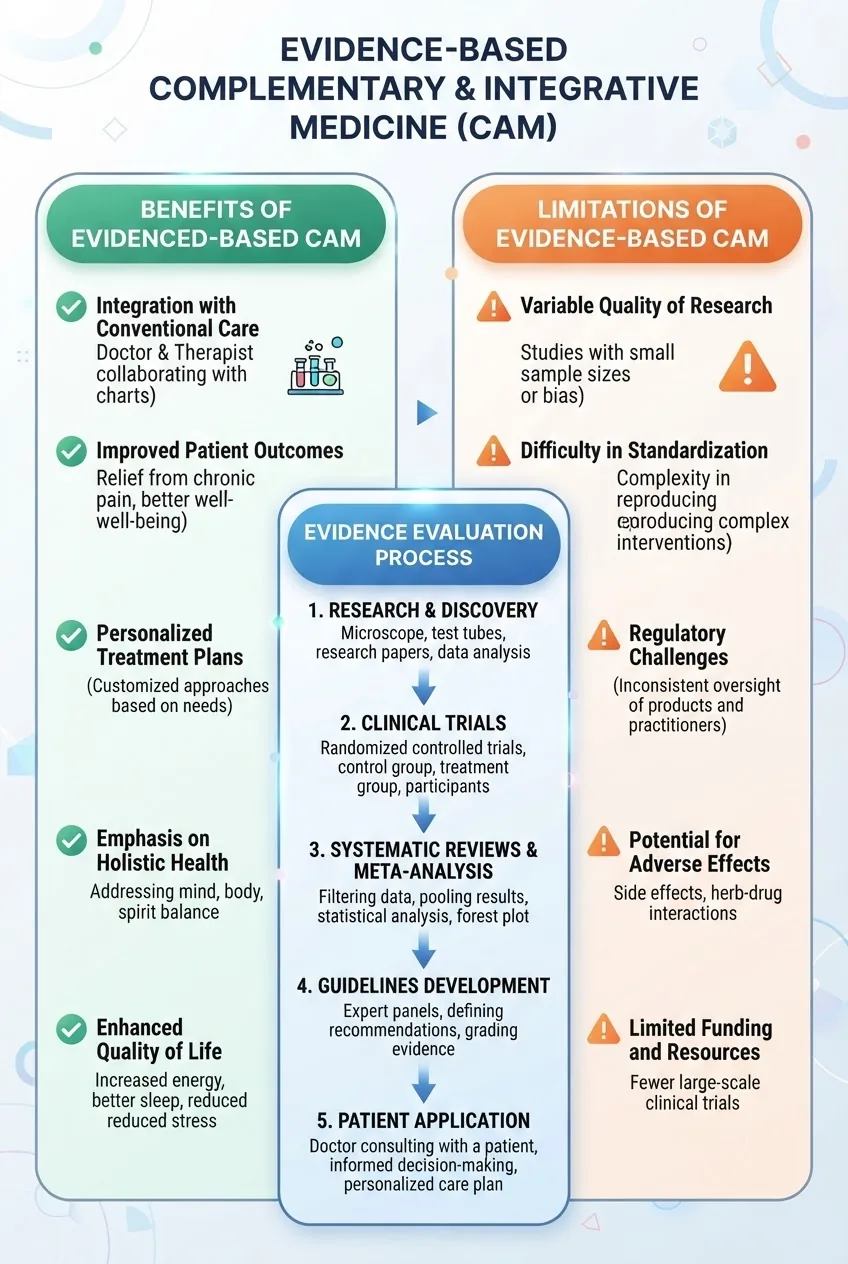
Benefits and Limitations of Evidence Based Complementary and Alternative Medicine?
Answer: Evidence based CAM can improve symptom control, patient satisfaction, and quality of life for certain conditions, but limitations include evidence gaps, product variability, regulatory inconsistency, and potential for interactions or delayed conventional care.
Balanced summary of pros and cons is essential for informed choices; below is a concise bulleted synthesis.
- Pros
- Improved symptom relief in select conditions (e.g., chronic pain, anxiety, insomnia) supported by RCTs and meta-analyses.
- Patient-centred options that respect preferences and holistic values, often increasing adherence.
- Lower adverse-effect profiles for many CAM modalities compared with pharmacologic alternatives when practised correctly.
- Potential to reduce medication burden (e.g., reduced opioid prescriptions) when integrated with conventional care.
- Supports lifestyle-based prevention and long-term wellness strategies.
- Cons
- Variable evidence quality—many therapies lack large, rigorous trials for specific indications.
- Product heterogeneity and contamination risks in unregulated supplements.
- Risk of interactions with conventional medicines and potential for delayed standard care if used inappropriately.
- Inconsistent practitioner training and regulatory oversight across jurisdictions.
- Placebo and expectation effects complicate interpretation of small trials and open-label studies.
Infographic: the following infographic presents a balanced visual summary of benefits, limitations, and the evidence evaluation process to help clinicians and patients quickly assess CAM options.
Transition: After weighing benefits and limitations, practical steps for accessing and evaluating evidence based CAM services are crucial for safe, effective care—detailed next.
How to Access and Evaluate Evidence Based CAM Services?
Answer: To access evidence based CAM, verify practitioner credentials, review primary research and systematic reviews, check product testing, consult conventional clinicians, and prefer clinics with integrated care pathways and clear safety policies.
Step-by-step practical guide:
- Define your clinical goal — identify whether you seek symptom relief, functional improvement, or wellness support; matched evidence varies by goal.
- Check practitioner credentials — verify licences, professional registration, and continuing education; ask about clinical experience and published protocols.
- Evaluate the evidence — look for RCTs, systematic reviews, or meta-analyses on your condition; reputable sources include NCCIH, Cochrane, and peer-reviewed journals.
- Assess safety and product quality — request product certificates, batch testing, and details on sourcing for herbal products or supplements.
- Integrate with your primary care — inform your GP or specialist about planned CAM use and request medication reconciliation to avoid interactions.
- Start with time-limited trials — agree on measurable outcomes and review points; discontinue if no benefit or if adverse effects occur.
- Use trustworthy directories and training resources — find practitioners through regulated professional bodies and university-affiliated integrative clinics.
For readers seeking facility-level services, practical benefits, or education pathways, consult resources on alternative health care center services and benefits and training information at alternative medicine degree programs online.
alternative health care center services and benefits • alternative medicine degree programs online
Transition: The final sections present quick takeaways and next steps for clinicians and patients contemplating evidence based CAM.
Conclusion — Key takeaways and call to action
Evidence based complementary and alternative medicine applies rigorous research standards to CAM modalities, identifying proven interventions and clarifying risks. Patients and clinicians should prioritise high-quality evidence, credentialled practitioners, and integrated care pathways. For clinical decisions, consult primary literature, authoritative sources like NCCIH and WHO reports, and discuss CAM options with your healthcare team. If you’re ready to explore options, start by verifying practitioner credentials and requesting evidence summaries for proposed treatments.