

By the end of this hands-on guide you will be able to perform basic self-administered sessions, select appropriate professional options, and design a 15–30 minute daily maintenance routine; this takes approximately 4–6 hours of reading and practice spread over a week and assumes a beginner to intermediate skill level.
Understanding Emotional Energy Healing
This guide explains what emotional energy healing is, how it operates in practical sessions and self-care, and why people choose it alongside other therapeutic routes. At its core, emotional energy healing refers to intentional practices that sense, shift, or balance subtle energy fields—including chakras, meridians and the aura—to release emotional blockages and restore flow between mind and body.
Practitioners describe emotional energy as patterns of felt charge and resonance in the body-mind system; when those patterns become dense or stuck—due to trauma, chronic stress, or unresolved grief—symptoms show as anxiety, low mood, recurring physical tension, or decision paralysis. The analogy I use with clients is simple: imagine a river with a log jam. Clearing the obstruction restores current, oxygenation and life downstream.
The key conceptual components you will see throughout this guide are:
- Energy fields: detectable patterns around and within the body (chakras, aura).
- Energy channels: systems like acupuncture meridians that convey subtle current.
- Emotional blockages: habitual patterns or trauma lodged in body-mind energy.
- Healing techniques: actionable modalities (EFT tapping, Reiki, breathwork).
Compared with talk-only approaches, emotional energy healing emphasises somatic and energetic processes alongside cognitive reframing. For a direct contrast, see the difference between holistic and traditional therapy.
Transition: Now that you understand the concepts and where blockages form, the next section walks through the practical techniques you can learn and apply immediately.
Common Emotional Energy Healing Techniques
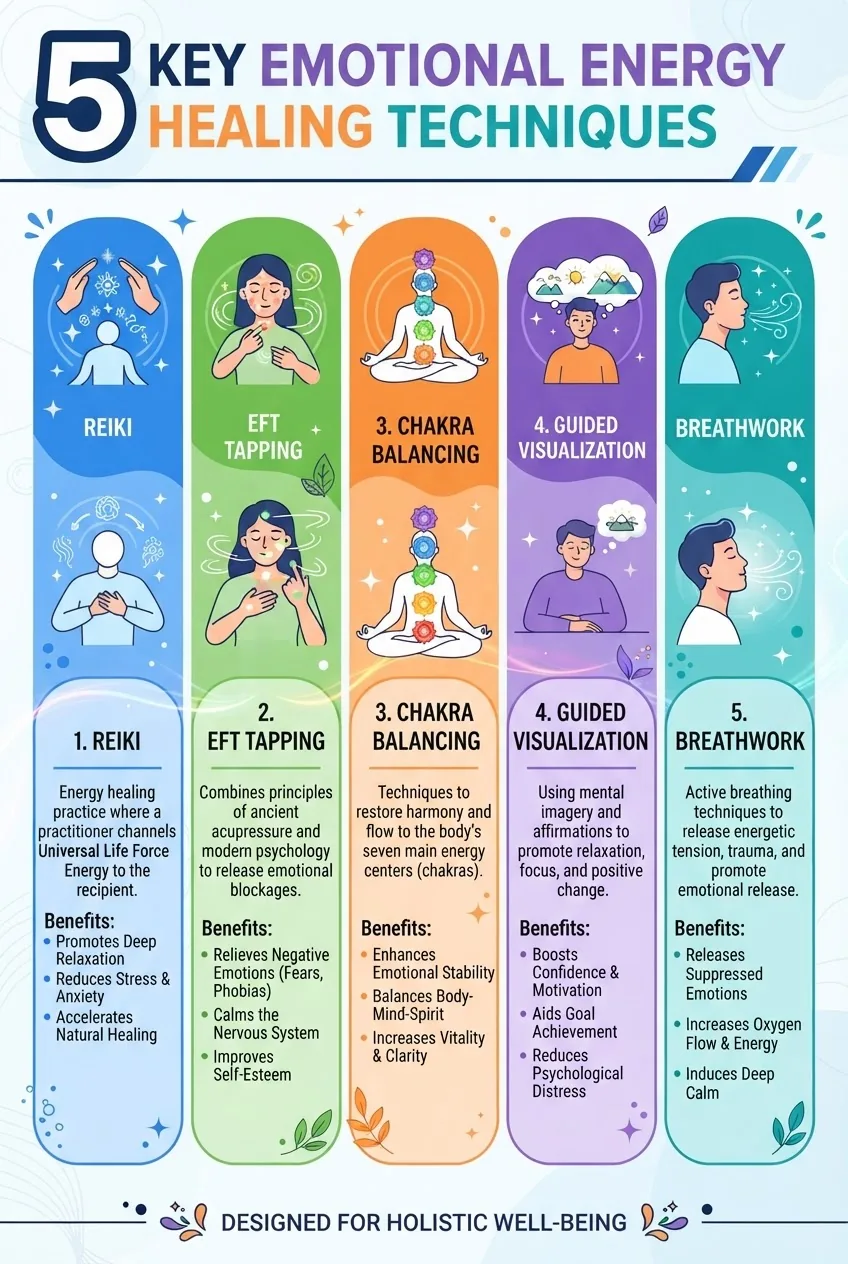
Below are the most widely used methods—each explained concisely with when to use it, core steps, and typical session timing. These techniques are frequently offered in integrative mental health settings and appear in reviews of mental health alternative treatments.

-
EFT tapping (Emotional Freedom Techniques) — Use when acute emotional charge appears (panic, flash of grief). EFT combines gentle fingertip tapping on acupuncture points with a verbal setup phrase. Typical session: 10–30 minutes.
- Start with a clear statement (setup): “Even though I feel X, I accept myself.”
- Tap 5–7 rounds on points (karate chop, eyebrow, side of eye, under eye, under nose, chin, collarbone, under arm, top of head) while repeating reminder phrases.
- Assess intensity on 0–10 scale; repeat until lowered by at least 3 points.
Case note: In clinic practice a client with performance anxiety dropped from SUDS 8 to 3 within three 15-minute rounds when combined with diaphragmatic breathing.
-
Reiki — Best for deep relaxation and ongoing emotional exhaustion. Reiki is an energy transmission technique where a practitioner places hands lightly over or on the body to channel restorative energy. Sessions typically last 45–60 minutes.
Anecdotal reports and practitioner registries (see professional bodies) show consistent improvements in self-reported stress and sleep quality when used weekly for 4–8 weeks.
-
Chakra balancing — Targeted when emotion is localised to a theme (e.g., throat chakra & communication issues). Techniques include guided visualization, sound (singing bowls), crystals and focused breath. A short protocol: 20 minutes per chakra or a 45–75 minute full session.
Typical practice: scan each chakra (root to crown), note sensations, use breath and visualization to clear and strengthen for 3–5 minutes per center.
-
Guided visualization — Effective for rehearsing new emotional responses and releasing stuck narratives. A core script lasts 10–20 minutes: body scan, safe place grounding, guided release (visualizing the blockage dissolving), and resource anchoring.
Use when memories are distressing but not retraumatizing; combine with grounding skills if dissociation risk is present.
-
Breathwork (diaphragmatic, coherent breathing, holotropic-style under supervision) — Use for regulation and rapid state change. Practice 4–10 minutes of coherent breathing (5–6 breaths per minute) to shift autonomic balance; supervised holotropic or connected-breath sessions can last 60–120 minutes and require trained facilitation.
Physiological note: coherent breathing increases heart rate variability, a marker of improved emotional regulation.
- Somatic experiencing / body-centered release — Focuses on felt sensations and impulse completion. Typical session 45–60 minutes; uses titration (small exposures) to release charge safely.
- Acupressure / Meridian techniques — Apply pressure to acupuncture points to move stuck emotional energy; 15–30 minute self-practice protocols or 45–90 minute professional sessions.
- Therapeutic touch and healing touch — Non-invasive hand proximity techniques used in clinical settings for calming and pain relief; usually 20–40 minutes.
- Energy psychology combinations — Protocols that pair cognitive restructuring with tapping or breathing (e.g., Thought Field Therapy variants). Sessions often last 30–60 minutes.
- Mindfulness-based energy practices — Integrate mindfulness meditation with subtle energy awareness; daily 10–20 minute practices recommended for maintenance.
Transition: Having reviewed the principal techniques, the next section explains what a typical treatment session looks like and the practitioner roles you will encounter.
Healing Treatment Practices and What to Expect
Sessions differ by modality and practitioner, but a reliable structure repeats across energy healing forms. Clinics and integrative centres often combine methods and coordinate care with medical providers.

Many clients access emotional energy work within broader programs at integrative centres; learn more about alternative health care center services that include energy modalities and allied supports.
Typical session structure (most common 60-minute energy-healing session):
- Intake (5–10 minutes) — Brief history, current symptoms, medications, and immediate safety checks (suicidality, severe dissociation).
- Grounding (3–5 minutes) — Breath or grounding exercise to stabilize the client.
- Assessment (5–10 minutes) — Gentle body scan, chakra/meridian check, or subjective units of distress (SUDS) rating.
- Intervention (20–35 minutes) — Technique-specific work (tapping rounds, Reiki placement, guided imagery).
- Integration (5–8 minutes) — Reflection, journaling guidance, and recommended at-home practices.
- Safety and follow-up (2–5 minutes) — Immediate aftercare instructions and scheduling next appointment if needed.
Practitioner roles you may meet:
- Energy healers (Reiki, Healing Touch practitioners) — Often credentialed by non-government associations; focus on hands-on or near-body energy flow.
- Energy psychologists / EFT practitioners — Trained to integrate tapping with cognitive and emotional processing.
- Somatic therapists — Licensed mental health professionals using body-based techniques.
- Integrative clinicians — Coordinate energy work alongside conventional medical care.
Session durations and recommended frequency: start with weekly 45–60 minute sessions for 4–8 weeks to assess effect; maintenance can shift to fortnightly or monthly. Self-care practices between sessions (10–20 minutes daily) speed consolidation.
Transition: Next we’ll compare self-led approaches to professional treatment to help you choose the right path.
Exploring Healing Methods: Self-Help vs Professional Treatment
Choosing between self-healing and professional treatment depends on symptom severity, trauma history, and safety needs. Below is a comparison to help decide.
| Option | Pros | Cons |
|---|---|---|
| Self-led techniques | Low cost, daily control, immediate access, good for mild‑moderate stress. | Limited for complex trauma, risk of reactivation without containment, slower progress. |
| Professional sessions | Skilled containment, faster resolution, clinical risk management, integrative care coordination. | Higher cost, scheduling required, variable credential standards. |
| Hybrid (self + professional) | Best of both: practice daily and use pros for reset and complex issues. | Requires discipline and clear communication between practitioner and client. |
For context on where energy healing sits among broader options, review this overview of alternative healthcare methods.
Transition: With choices clarified, let’s examine benefits and potential risks so you can weigh them responsibly.
Benefits and Potential Risks of Emotional Energy Healing
Practitioners and clients report a range of benefits: rapid emotional release, reduced anxiety, improved sleep, and better pain tolerance. Controlled studies and systematic reviews in energy psychology show positive outcomes for specific protocols (e.g., short-term reductions in anxiety after EFT sessions).
Measured benefits and evidence highlights:
- Reduced anxiety and PTSD symptoms in some trials after structured tapping protocols (according to a 2021 meta-analysis in energy psychology journals).
- Improved subjective sleep quality and relaxation following Reiki in several small randomized trials (according to peer-reviewed trial reports).
- Increased heart rate variability after coherent breathwork, a physiological marker of improved autonomic regulation (according to a 2020 physiology study).
Stat block:
According to a 2021 peer-reviewed meta-analysis in complementary and energy psychology journals, short-form EFT reduced anxiety scores by an average of 20–35% across studies; sample sizes and methodologies varied. According to a 2023 NIH overview, evidence is promising but not definitive for many energy modalities.
Potential risks and contraindications:
- Emotional retraumatization if exposure is too intense or unsupported—seek a trained clinician if you have complex PTSD.
- Physical discomfort during breathwork or intense somatic sessions—stop if you feel lightheaded, chest pain, or severe dissociation.
- Expectation and placebo effects—improvements may reflect contextual healing factors rather than specific energetic mechanisms.
Safety guidance is anchored in government and clinical overviews; for safety summaries see the National Center for Complementary and Integrative Health: NCCIH (NIH). For energy psychology literature see the Journal of Energy Psychology and professional Reiki bodies for practitioner standards: Journal of Energy Psychology and International Association of Reiki Professionals.
Emotional energy healing is also used adjunctively for pain relief; see research summaries in alternative therapies for pain management.
Transition: Next we’ll cover how to integrate these methods safely with other therapies and health care.
Integrating Emotional Energy Healing with Other Healing Therapies
Emotional energy healing works best as part of a coordinated care plan when needed—combined with psychotherapy, medication, physical therapy, or other complementary practices. Integration means shared goals, informed consent, and clear communication between providers.
Practical integration examples:
- Pair weekly EFT with cognitive behavioral therapy (CBT) to speed emotional regulation between sessions.
- Use Reiki or therapeutic touch immediately before physiotherapy to reduce muscle guarding and improve range of motion.
- Combine breathwork and mindfulness modules as adjuncts to medication for anxiety stabilization under medical supervision.
Emotional energy healing is commonly classified among complementary therapies that clinicians may recommend alongside mainstream care.
For broader terminology and how CAM and integrative care map to conventional medicine, see our pillar resource on alternative medicine practices.
Transition: With integration in mind, the next section helps you choose the right technique and practitioner with practical selection steps.
How to Choose the Right Emotional Energy Healing Technique and Practitioner
Use the following stepwise guidelines to make a safe, effective choice tailored to your goals and risk profile.
- Define your primary goal — symptom reduction, trauma resolution, emotional regulation, or maintenance. Write a one-sentence outcome (e.g., “Reduce nightly panic attacks to 1/month within 8 weeks”).
- Match technique to need — choose short, skills-based tools (EFT, breathwork) for acute regulation; choose ongoing energy work (Reiki, chakra balancing) for chronic exhaustion or low-level dysregulation.
- Check credentials and training length — ask about hours of supervised practice, certification bodies, and continuing education. For formal education paths, look into alternative medicine degree programs for practitioners seeking accredited training.
- Read client reviews and ask for a short consultation — request a 15-minute phone consult to assess rapport and safety practices (crisis planning, boundaries, referral networks).
- Confirm integration capabilities — ensure the practitioner will coordinate with your medical or mental health provider if needed, and maintains clear records.
- Trial a single session — book one 45–60 minute session, evaluate outcome at 24 and 72 hours using a simple SUDS scale and sleep quality measure.
- Assess cost and scheduling fit — plan for a 4–8 week initial block; if progress stalls, request outcome reassessment with measurable markers.
Practitioner qualifications to request:
- Training hours and supervision details (e.g., “200 hours with 50 supervised clinical sessions”).
- Membership in recognized associations (ask for body name and check their standards).
- Clear informed consent forms and safety procedures.
Transition: Now learn daily practices you can implement immediately to sustain gains between sessions.
Daily Healing Practices and Emotional Energy Maintenance
These simple, repeatable practices take 10–30 minutes per day and maintain energy balance, reduce reactivity and build resilience.
- Daily 6-minute coherent breathing — sit upright, inhale 5 counts, exhale 5 counts, for 6 minutes. Aim for morning and evening sessions.
- 3-minute EFT micro rounds — tap eyebrow-side-eye-under-eye for one mini round after stressful interactions; SUDS tracking recommended.
- Evening chakra check (10 minutes) — scan from root to crown, breathe into each center for 1 minute, imagine each chakra glowing and balanced.
- Weekly guided visualization (15–20 minutes) — use a recorded script focused on resource imagery and release.
- Movement and grounding (10–15 minutes) — walk barefoot when possible, or do grounding yoga sequences focusing on hip and pelvis release.
- Journaling and symptom tracking (5 minutes) — note triggers, SUDS score, and a one-line reflection after practice sessions.
Transition: The final sections share practitioner experience on common mistakes, offer a checklist, and explain when to call a professional.
Common mistakes and how to avoid them
I often see clients rush into intense practices without containment; they report flooding and dissociation. To avoid this, I always start with 3–5 minute grounding, keep SUDS checks, and slow the pace. Another frequent error is skipping documentation: I record baseline measures (sleep, SUDS, HRV if available) to evaluate change objectively.
I’ve also observed practitioners failing to coordinate with a client’s GP or mental health provider. That disconnect risks contraindications with medications or underlying medical conditions; always get signed consent to communicate with relevant providers.
Checklist: verify your work
- Baseline measures recorded: SUDS, sleep hours, mood rating (0–10).
- Performed a 6-minute coherent breathing practice daily for 7 days.
- Completed three 5–7 point EFT rounds on a targeted trigger and logged post-SUDS.
- Had at least one professional session (if symptoms are moderate to severe) and received aftercare instructions.
- Noted no severe adverse reactions (chest pain, fainting, suicidal ideation); if present, sought medical help.
When to call in a professional
Seek professional help if you experience suicidal thoughts, severe dissociation, worsening panic, persistent nightmares, or physical symptoms like chest pain. Also consult a clinician if self-practice does not reduce SUDS by at least 30% after a 4-week consistent regime.
Final practical note: keep a 24–48 hour integration window after intense sessions—rest, hydrate, gentle movement—and contact your practitioner if emotional distress intensifies.
Benefits and Potential Risks — quick recap
Emotional energy healing offers accessible tools for relief and maintenance, with evidence ranging from anecdotal to promising clinical trials. Expect faster subjective relief for anxiety and sleep at the population level, but recognise variability. Use professional oversight for complexity and consult public health guidance from NCCIH (NIH) for safety summaries.
Closing transition: apply the checklist, follow the daily routine, and escalate to professional care based on the symptom thresholds above.
How I use these methods in practice — short case study
Client A (mid-30s, chronic insomnia, high workplace stress): initial intake showed SUDS 7 nightly. Intervention plan: three weekly EFT sessions (15 minutes each) plus daily 6-minute coherent breathing. By week 4 SUDS decreased to 3; sleep improved from 4–5 hours to 6–7 hours. This illustrates how targeted technique + daily practice produces measurable change.
Closing summary and next steps: use the 7-step selection checklist above, begin the daily maintenance protocol for 14 days, and book a professional consultation if you score >6 on SUDS more than twice in one week.
Thank you for working through this hands-on guide. If you want step-by-step scripts or printable checklists, consider booking a consultation or enrolling in a supervised short course with accredited trainers.