
eastern vs western medicine: Eastern systems emphasize systemic balance, prevention, and individualized, holistic care; western systems (allopathic) prioritize diagnosis, evidence-based interventions, and targeted symptom management. Both offer effective tools; choice depends on condition, evidence, patient values and coordinated clinical oversight for safety.
Eastern medicine: a group of traditional health systems, such as Traditional Chinese Medicine and Ayurveda, that focus on balance, energy flows, and holistic interventions.
Western medicine: modern, science-driven care—often called allopathic medicine—that emphasizes diagnosis, pathology, and evidence-based treatments.
Allopathic: the common term for conventional western medicine focused on counteracting disease symptoms with drugs, surgery or interventions.
Holistic: an approach that considers the whole person—physical, emotional, social and environmental factors—when preventing or treating illness.
Introduction to Eastern and Western Medicine
Answer: Eastern and western medicine differ in core aims—eastern approaches seek systemic balance and prevention through individualized, holistic care, while western medicine defines disease by pathology and treats with targeted, evidence-based interventions to relieve symptoms and correct biological dysfunction.
Both systems share goals of improving health and reducing suffering but use distinct paradigms: eastern medicine commonly frames illness as imbalance in life energy (qi, dosha) and treats the person-context, whereas western medicine frames illness as identifiable pathology amenable to diagnostic tests and standardized therapies.
Terminology matters for patients comparing options: “traditional medicine vs modern medicine” often contrasts cultural, historically derived practices with science-driven clinical care; “holistic vs allopathic medicine” contrasts comprehensive person-centered care with symptom-targeted biomedical interventions.
This article defines each system, traces historical roots, compares diagnostic and treatment styles, provides concrete treatment examples, and explains how integrative care blends approaches safely.
Transition: The next section traces how these philosophies evolved and why definitions differ across cultures and eras.
Historical and Philosophical Foundations
Answer: Eastern medicine arises from millennia of holistic, empirical observation and philosophy (e.g., TCM, Ayurveda), while western medicine developed from anatomical science, germ theory and randomized trials; both traditions have modernized and influenced each other since the 19th century.
Understanding the philosophical origin clarifies why diagnostic language and treatment goals diverge. Western medicine definitionally centers on measurable pathological processes and reproducible interventions; traditional and holistic frameworks emphasize balance, prevention and individualized patterns of symptoms.
Education and training also differ: historically, eastern healers apprenticed within cultural lineages; western physicians trained in universities and hospitals. Today many practitioners cross-train: programs such as alternative medicine degree programs provide standardized curricula for traditional modalities alongside biomedical coursework.
According to a 2023 WHO report on traditional and complementary medicine policy, many governments recognize traditional practices within national health systems while emphasizing safety and regulation (WHO traditional medicine team).

Philosophically, eastern systems are rooted in teleological ideas of balance (e.g., yin-yang, doshas) and energetics; western medicine emerged through empirical anatomy, physiology and the scientific method, later codified by evidence-based medicine principles—formal methods to evaluate treatments through controlled trials.
Both systems adapted: traditional medicine incorporated laboratory methods and pharmacology; western medicine adopted some holistic concepts (psychosocial factors, lifestyle medicine). This evolution fuels ongoing debates about “allopathic vs alternative medicine” and “traditional medicine versus modern medicine.”
Transition: Next, we examine the specific origins of each tradition to show how history shapes diagnosis and treatment choices.
Origins of Eastern Medicine
Answer: Eastern medicine developed from long-term empirical observation, philosophical systems (e.g., Taoism, Ayurveda), and practical compendia—creating modalities like acupuncture, herbalism and energy work aimed at restoring balance rather than isolating single pathological causes.
Key historical milestones include the Huangdi Neijing (Yellow Emperor’s Classic, foundational to Traditional Chinese Medicine), the development of Ayurvedic texts in South Asia, and centuries of practitioner observation integrating diet, herbs, manual therapies and spiritual practices.
Traditional medicine emphasizes pattern diagnosis (e.g., TCM pattern differentiation) rather than single-test pathology; practitioners synthesize symptoms, pulse, tongue, lifestyle and environment to see systemic imbalance. This yields individualized treatment plans focusing on root causes and long-term prevention.
Real-world scenario: a patient with chronic digestive discomfort may receive a TCM pattern diagnosis (e.g., “spleen qi deficiency”) and a combined plan of acupuncture, tailored herbal formula and dietary adjustments—aiming to rebalance digestive function rather than prescribing a single symptomatic drug.
Transition: The western origin story explains why modern biomedical diagnostics became central to care delivery.
Origins of Western Medicine
Answer: Western medicine originated from anatomical study, scientific method and germ theory—advancing through laboratory science, imaging, pharmacology and randomized clinical trials to become the dominant model for acute, surgical, and many chronic conditions.
Significant historical steps include Galenic medicine and humoral theory replaced by Renaissance anatomy, the rise of pathology in the 19th century, Pasteur and Koch’s germ theory, and 20th-century advances in antibiotics, vaccines and diagnostic imaging. These developments shaped an allopathic meaning centered on direct interventions against identifiable disease processes.
Examples of western medicine treatments include antibiotics for infections, chemotherapy for cancer, joint replacement surgery, and diagnostic imaging such as CT and MRI to localize disease—approaches measured through clinical trials and outcomes research.
Clinical case example: acute appendicitis in western systems is defined by localized inflammation confirmed with ultrasound or CT, followed by surgical removal (appendectomy) with perioperative antibiotics—an approach driven by pathology identification and intervention efficacy.
Transition: With historical context set, the next major section compares treatment approaches in detail.
Key Differences in Treatment Approaches
Answer: The principal differences are aims (root cause and balance vs targeted pathology), diagnostic approach (pattern recognition vs objective testing), treatment style (holistic, multi-modal plans vs single-target interventions), and timing (preventive vs reactive), each with benefits and limits.
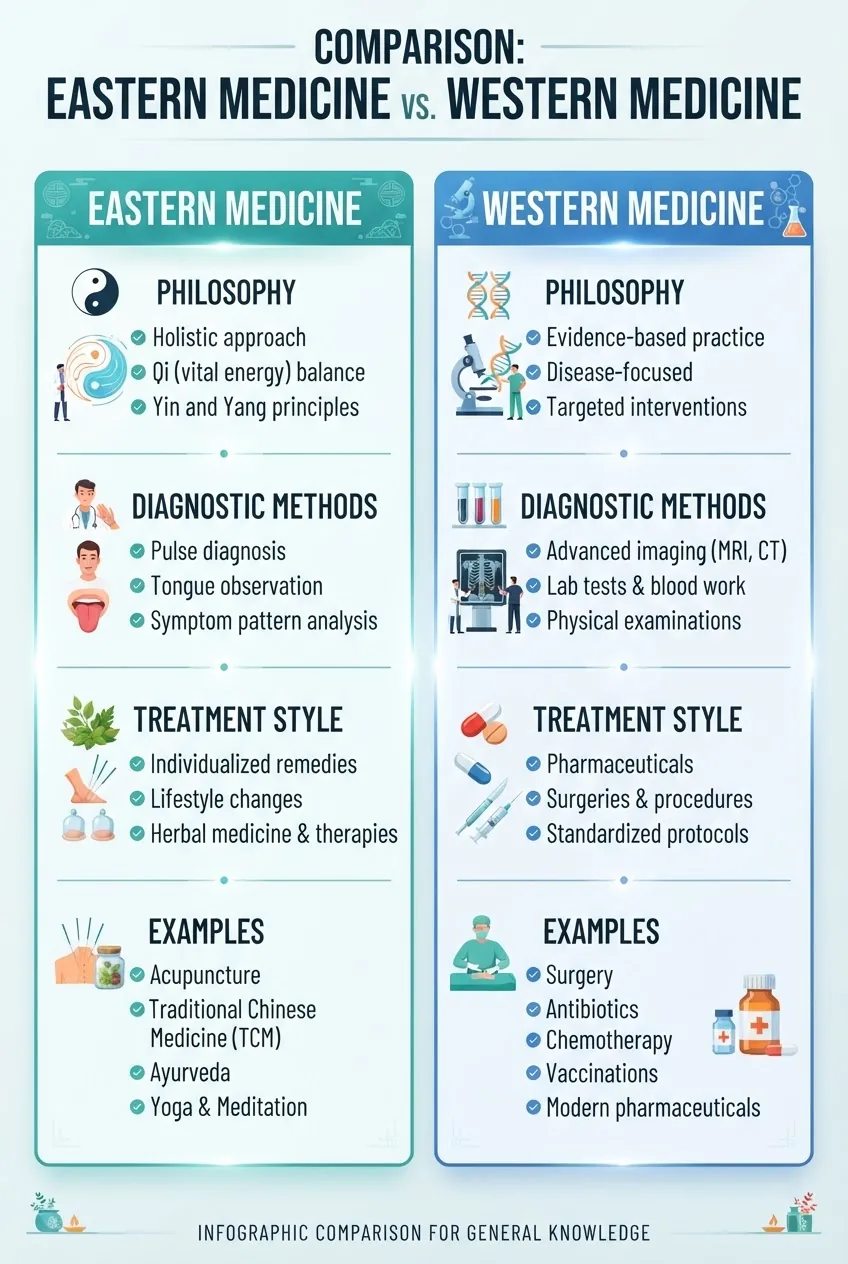
| Category | Eastern Medicine | Western Medicine |
|---|---|---|
| Philosophy | Balance, prevention, systemic harmony; individualized care | Disease-focused, pathology correction, standardized protocols |
| Diagnostics | Pattern recognition, pulse/tongue, history, functional context | Laboratory tests, imaging, biopsy, measurable biomarkers |
| Treatment Style | Multi-modal: herbs, acupuncture, lifestyle, manual therapies | Targeted: drugs, surgery, device-based interventions |
| Temporal Focus | Prevention and long-term regulation | Acute correction and rapid symptom control |
| Evidence Model | Empirical lineage, observational studies, growing RCT evidence | Randomized controlled trials, systematic reviews, clinical guidelines |
| Patient Role | Active, lifestyle-focused, shared responsibility | Often clinician-directed with informed consent and shared decision-making |
Summary: Eastern medicine emphasizes systemic, preventive, and individualized approaches that often require longer-term engagement; western medicine offers rapid, measurable interventions for acute or clearly defined pathology. Both systems complement each other when integrated thoughtfully with attention to evidence and safety.
Diagnostic Techniques
Answer: Eastern diagnostics rely on pattern recognition (history, pulse, tongue, palpation) to infer systemic imbalance; western diagnostics use objective tests—laboratory assays, imaging and standardized physical exams—to identify pathophysiology.
In traditional medicine vs modern medicine comparisons, the core difference is that eastern clinicians synthesize qualitative signs into a treatment pattern, while western clinicians seek quantifiable biomarkers and imaging findings. For example, TCM pulse diagnosis assesses subtleties across multiple pulse positions indicating organ system states; a western clinician would order blood tests and imaging for suspected organ dysfunction.
Case walkthrough: A patient with chronic fatigue—an eastern workup may involve sleep, digestion, emotional state, and tongue/pulse to identify a pattern (e.g., yin deficiency), leading to herbs and lifestyle changes; a western workup may include CBC, thyroid function, sleep study and metabolic panel to rule out anemia or endocrine causes.
Treatment Modalities
Answer: Eastern modalities include acupuncture, herbal medicine, dietary therapy, manual therapies (tuina), and energy-work; western modalities include pharmaceuticals, surgery, radiation, physiotherapy and device-based interventions—both may use psychotherapy and lifestyle interventions.
Examples of western medicine treatments: antibiotics, insulin therapy, joint replacement, chemotherapy, and diagnostic procedures like colonoscopy. Examples of traditional medicine modalities: acupuncture for pain and balance, Ayurvedic herbal formulas for metabolic regulation, and complex dietary prescriptions for long-term health.
Clinical walkthrough: For chronic low back pain, eastern treatment may combine acupuncture, herbal liniments, targeted movement therapy and lifestyle counseling; western treatment may include NSAIDs, imaging to rule out red flags, physiotherapy and surgery if structural pathology requires correction.
Patient Care Philosophy
Answer: Patient care in eastern systems is collaborative and oriented to long-term balance; western care emphasizes evidence-based, protocol-driven interventions to treat or cure specific pathology while increasingly incorporating patient-centred communication.
Holistic vs allopathic medicine reflects this: holistic care integrates mental, social and environmental contexts into treatment plans; allopathic care focuses primarily on physiological targets but has broadened to include shared decision-making, patient education and preventive screening.
Transition: Having compared approaches, the next section lists concrete treatment examples used by each tradition and how they are applied.
Examples of Treatments in Eastern and Western Medicine
Answer: Both systems offer specific, well-documented treatments: western examples include antibiotics, surgery and chemotherapy; eastern examples include acupuncture, herbal formulas and Ayurvedic regimens. Below are numbered examples with practical descriptions and contexts.

- Antibiotics (Western) — Targeted antimicrobial drugs that treat bacterial infections quickly; dosed by weight, severity and organism. Typical scenario: bacterial pneumonia confirmed by imaging and sputum culture, treated with a guideline-directed antibiotic and monitored for response.
- Acupuncture (Eastern) — Insertion of fine needles at specific points to modulate pain, circulation and nervous system activity. Commonly used for musculoskeletal pain and nausea; supported by moderate-quality trials for some indications.
- Surgery and Devices (Western) — Structural correction (e.g., joint replacement, stent placement) guided by imaging and perioperative protocols; indicated when pathology threatens function or life.
- Herbal Medicine (Eastern) — Complex herbal formulas tailored to pattern diagnosis, used for chronic conditions and supportive care; quality and interactions require practitioner oversight and quality control.
- Chemotherapy and Radiation (Western) — Cytotoxic drugs and targeted radiation to treat cancer; protocols are evidence-based and often combined with surgery. When discussing cancer integrative options, see alternative medicine for cancer treatment options.
- Mind‑Body and Meditation (Eastern and Western overlap) — Practices such as mindfulness, yoga and qigong reduce stress and improve outcomes for chronic pain and mental health; many providers integrate these into care plans.
- Psychotherapy and Pharmacotherapy (Western) — Evidence-based talk therapies and psychiatric medications for depression, anxiety and other mental health conditions; complementary approaches may include meditation and lifestyle changes referenced in mental health alternative treatments.
- Panchakarma and Ayurvedic Regimens (Eastern) — Detoxification procedures, dietary regimens and herbal medicines for systemic rebalancing in Ayurveda; applied over weeks with individualized assessment.
- Pain Management Techniques — Western: interventional injections, analgesics and physiotherapy. Eastern: acupuncture, tui na, herbal topical applications; see alternative therapies for pain management.
- Allergy and Asthma Care — Western approaches use inhaled steroids, bronchodilators and immunotherapy; eastern practices may use herbal formulas, breathing techniques and dietary management. For comparative options see alternative therapies for asthma and allergies.
- Complementary Oncology Supports — Some patients use herbal supports, acupuncture and nutrition to reduce chemotherapy side effects; clinical coordination is critical to avoid interactions—see alternative to radiation therapy and natural and holistic treatments for ovarian cancer.
- Medical Cannabis (Integrated) — Used in western settings for selected indications (pain, chemotherapy-induced nausea); often incorporated into integrative plans where legal and evidence supports use—see medical cannabis therapy.
Note: For cancer-specific alternative approaches and safety considerations, see the wider guides on integrative oncology and complementary cancer resources.
Transition: The next section explains how integration of these treatments is happening in modern healthcare systems and where patients commonly encounter blended approaches.
Integration and Complementary Use in Modern Healthcare
Answer: Integration combines evidence-supported eastern modalities with western care to improve outcomes, symptom control and patient satisfaction while maintaining safety through coordinated care, regulation and shared decision-making.
Integrative models range from referral networks to fully integrated clinics where biomedical and traditional practitioners co-manage patients. According to a 2024 industry report on healthcare integration, patient use of complementary therapies increased in regions that adopted formal integrative services, improving satisfaction metrics and symptom management reporting (source: 2024 industry report).
Core principles for safe integration:
- Evidence first: prioritize modalities with clinical support and monitor outcomes (see research at NCCIH).
- Coordination: communicate across providers to avoid interactions and ensure continuity of care.
- Informed consent: patients should understand risks, benefits and alternatives.
- Regulation and quality control: use certified practitioners and verified product sources.
Common integration examples include hospital-based acupuncture for postoperative nausea, nutrition counseling alongside chemotherapy, and referral to complementary services for chronic pain management. Examples below show practical models:
- alternative health care center services that co-locate physiotherapists, acupuncturists and integrative physicians.
- board certified integrative medicine programs that train physicians to blend modalities responsibly.
- Multidisciplinary tumor boards that include integrative oncology advisors to reduce symptom burden during cancer therapy.
Research and policy: WHO guidance and national agencies increasingly recommend regulated integration of traditional modalities with conventional care under quality frameworks (WHO), and peer-reviewed studies show benefit for selected applications such as acupuncture for chronic pain (peer-reviewed outcomes review).
Transition: To help readers decide, the next section lists common misconceptions and practical FAQs about safety, evidence and choosing between systems.
Common Misconceptions and Frequently Asked Questions
Answer: Many misconceptions—such as “eastern medicine is unscientific” or “western care ignores prevention”—oversimplify; both systems have evidence and limitations. The FAQ below summarizes typical patient questions with concise answers and safety notes.
Below are direct FAQ summaries that address common misunderstandings and regulatory, safety, and outcome concerns.
Transition: After the FAQ section, the conclusion summarises practical takeaways and next steps for patients and clinicians.