

Stomach meridian acupuncture identifies a primary energetic channel that runs from the face to the foot; targeted points such as ST36 and ST25 regulate digestion, relieve pain and rebalance Qi. This guide provides precise locations, clinical indications, needle and acupressure techniques, safety precautions, herbal supports and multi-point protocols for therapists and informed patients.
Introduction to the Stomach Meridian in Acupuncture?
Answer: The stomach meridian is an energetic channel in Traditional Chinese Medicine (TCM) that governs digestion, nutrient absorption and aspects of emotional processing; its points are used to harmonise stomach function, move stagnation and relieve pain.
Term: Stomach meridian — a TCM energy channel (meridian) starting near the eye and descending along the anterior body and leg to the second toe.
Term: Qi — the functional life-energy in TCM that flows through meridians, carrying physiological and emotional regulation.
The stomach meridian (also called the Stomach Channel, or ST channel) is one of the Yangming channels in classic TCM texts such as the Nan Jing and the Ling Shu; it is classically paired with the Spleen channel and linked to digestion and transformation of food into energy. Modern practitioners consider stomach meridian acupuncture essential for a wide range of gastrointestinal and systemic complaints because its points modulate autonomic, gastrointestinal motility and visceral perception mechanisms.
For clinicians pursuing formal qualifications and professional pathways, see our comprehensive acupuncturist training and certification guidance.
acupuncturist training and certification
Transition: Understanding the meridian’s theoretical role helps when mapping the channel anatomically and selecting precise points, which we cover next.
Anatomical Course and Pathway of the Stomach Meridian?
Answer: The stomach meridian runs from below the eye, down the front of the chest and abdomen, across the thigh and front of the lower leg to the lateral side of the second toe, following predictable anatomical landmarks used for point localization.
Term: Acupoint — a specific point on a meridian with distinct clinical effects when stimulated by needles, pressure or heat.
Beginning: The meridian begins at ST1 (below the eye) and ascends/descends along the face, chest and abdomen to terminate at ST45 on the lateral side of the second toe. Key anatomical pathways include:
- Facial branch: infraorbital region at ST1–ST3 near the infraorbital foramen and masseter muscle.
- Thoracic-abdominal branch: ST12–ST30 crossing the chest and traversing the upper abdomen alongside the rectus abdominis and external oblique musculature.
- Lower limb branch: ST31–ST40 across the anterior thigh and anterior-lateral lower leg, running near the tibialis anterior to ST45.
Palpation landmarks and anatomical relationships:
- ST1–ST4: infraorbital margin and nasolabial region; avoid deep insertion near the orbit and infraorbital nerve.
- ST6–ST7: masseter prominence and mandibular angle—use superficial needling and watch facial nerve branches.
- ST18–ST25: chest and upper abdomen—ST25 is lateral to the umbilicus (important for visceral regulation).
- ST31–ST36: anterior thigh and lateral tibial region—ST36 is 3 cun below ST35 and 1 finger-breadth lateral to the tibia’s anterior crest.
Refer to a visual meridian map to confirm relationships and distances; for a full overview of other channels see our 12 meridians chart PDF which shows the stomach meridian in the context of all twelve channels.
Transition: With the pathway established, clinicians and students can locate the most therapeutically relevant stomach meridian points below.
Key Stomach Meridian Acupuncture Points and Their Locations?
Answer: The stomach meridian has many clinically powerful points; here are 12–15 major points with exact anatomical landmarks and practical location tips for safe, effective use.

-
ST1 — Where is it and why is it used?
Location: Directly below the pupil, between the eyeball and infraorbital margin in the depression when the eye looks straight ahead; needle superficially toward the infraorbital foramen.
Notes: Used for eye disorders, facial pain; avoid deep insertion—use horizontal or oblique superficial needling with caution.
-
ST4 — Where is it and why is it used?
Location: At the corner of the mouth, lateral to the nasolabial groove, in the depression when the mouth is relaxed.
Notes: Indicated for facial paralysis, trigeminal neuralgia; use gentle superficial insertion to avoid facial nerve branches.
-
ST6 — Location and clinical role
Location: On the masseter muscle, one finger-breadth anterior and superior to the angle of the mandible, at the most prominent point when teeth are clenched.
Notes: Effective for jaw pain, bruxism; insert perpendicularly 0.5–1.0 cun depending on muscle thickness.
-
ST12–ST18 — Thoracic points overview
Location & landmarks: ST12 at the supraclavicular fossa, ST13–ST18 follow the chest line toward the nipple and upper abdomen; note rib spaces and lung projection.
Notes: Use shallow, oblique needling and percussion testing to avoid pneumothorax risk near the thorax; these points address chest fullness, cough, and structural tension.
-
ST25 — The front-mu point of the Large Intestine / abdominal regulator
Location: On the abdomen, level with the umbilicus, 2 cun lateral to the midline.
Clinical use: Major point for constipation, diarrhoea, abdominal pain, bloating; needle perpendicularly 0.5–1.5 cun depending on abdominal tension and body habitus.
-
ST30 — Pelvic and reproductive connections
Location: On the lower abdomen, at the level of the superior border of the pubic symphysis, 2.5 cun lateral to the midline (approximate to the inguinal crease).
Notes: Use for pelvic pain, menstrual irregularities; palpate for femoral pulse before needling laterally.
-
ST31 — Hip and thigh point
Location: On the anterior aspect of the thigh, in the depression below the inguinal ligament at the junction of the sartorius and rectus femoris lines.
Use: For thigh pain, numbness and motor issues; needle perpendicular or slightly oblique 1–2 cun guided by tissue depth.
-
ST34 — Xi-cleft point for acute pain
Location: On the line between the ASIS and lateral patella, 2 cun above the lateral-superior border of the patella.
Notes: Useful for acute knee pain and stomach channel pain; moderate perpendicular insertion 0.5–1 cun.
-
ST36 — Earth point; key digestive regulator
Location: 3 cun below ST35 (the lower border of the patella) and 1 finger-breadth lateral to the anterior crest of the tibia (on tibialis anterior).
Clinical relevance: Tonifies Qi and blood, strengthens digestion, reduces nausea, treats fatigue and immune weakness.
Needling technique (step-by-step):
- Patient supine or seated with knee flexed; locate ST35 at the lower patellar border.
- Measure 3 cun downward using patient’s finger-cun method; find area lateral to tibial crest.
- Clean skin with alcohol; insert needle perpendicular 1.0–1.5 cun gently; manipulate to elicit deqi (sensation of soreness/tingling) if clinically indicated.
- Angle note: keep perpendicular; avoid deep insertion medially toward tibia; observe for patient discomfort.
Term: ST36 — a major distal point on the Stomach channel used worldwide for digestive, immune and systemic regulation.
-
ST37 — Lower He-sea point of the Large Intestine
Location: 3 cun below ST36, one finger-breadth lateral to the tibial crest.
Use: Diarrhoea, intestinal inflammation, dysentery; perpendicular insertion 1–1.5 cun.
-
ST39 — Lower He-sea point of the Small Intestine
Location: 3 cun below ST37, lateral to tibia.
Use: Abdominal pain radiating to lower limbs, small intestine conditions.
-
ST40 — Luo-connecting point (phlegm/damp)
Location: Midpoint between knee and ankle, two finger-breadths lateral to the tibia’s anterior crest (approx. 8 cun below ST35).
Notes: Key for phlegm, mucus, emotional fog and cognitive sluggishness; moderate perpendicular insertion 0.8–1.2 cun.
For distal point relationships such as in the ankle, consult our ankle acupressure guide to see how distal points complement stomach channel work.
-
ST44–ST45 — Distal end points
Locations: ST44 is between toes 2–3 proximal web margin; ST45 on lateral side of second toe.
Use: Headache, toothache, face pain, clearing heat and channel stagnation; use shallow perpendicular or oblique needle insertion.
-
ST25, ST36 and ST40 combination — Common therapeutic set
Rationale: ST25 regulates intestines and abdomen, ST36 strengthens overall Qi and digestion, ST40 resolves phlegm and damp; together they address complex digestive patterns including IBS, functional dyspepsia and post-infectious gut dysfunction.
Transition: Having mapped these points, the next section explains the clinical indications and when to choose specific stomach channel points.
Therapeutic Uses and Indications of Stomach Meridian Points?
Answer: Stomach meridian points treat a broad range of digestive disorders (nausea, bloating, constipation, diarrhoea), pain conditions (facial, dental, abdominal), systemic weakness and emotional imbalances connected to the stomach/spleen network.
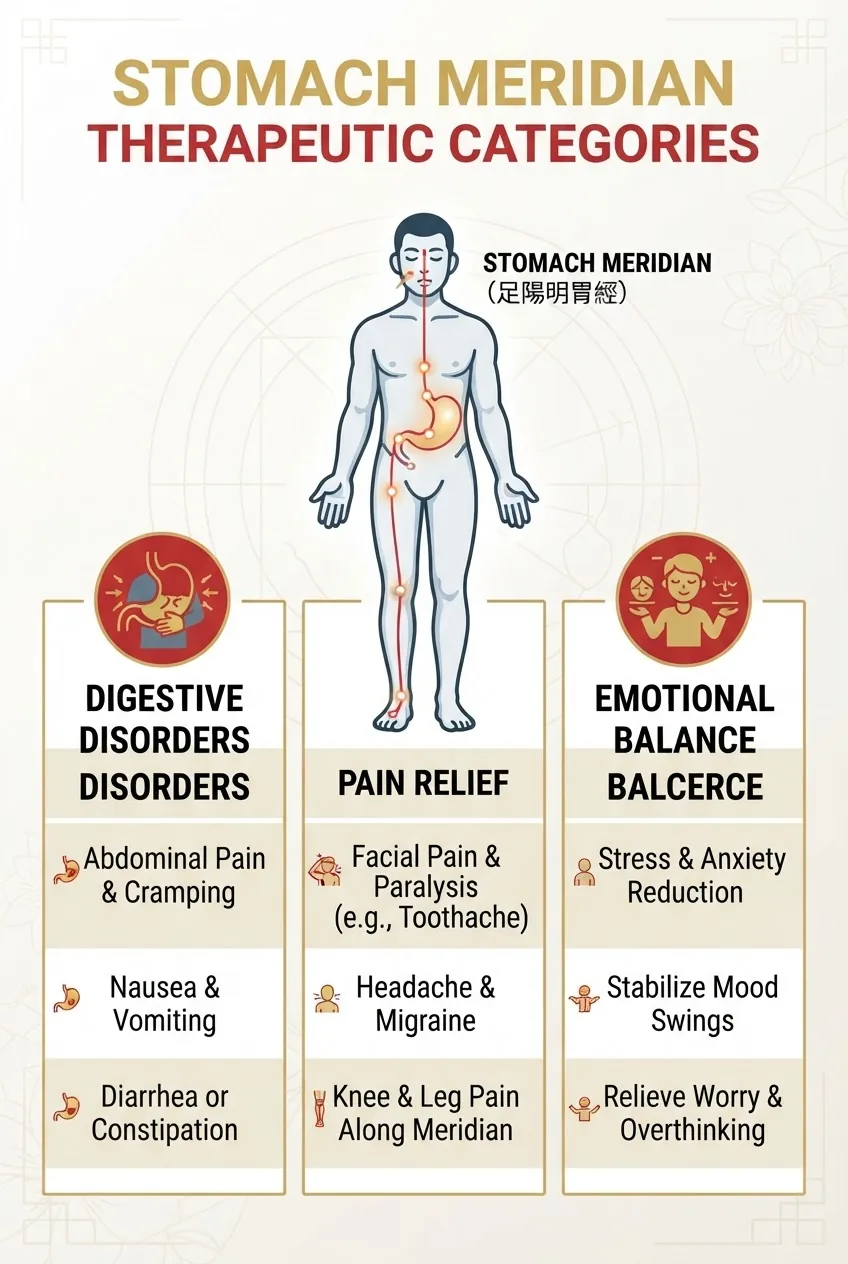
Common conditions and specific point strategies (bullet list):
- Digestive disorders:
- Functional dyspepsia — ST36, ST25, PC6 adjunct
- Irritable bowel syndrome (constipation predominant) — ST25, ST37, ST39
- Nausea and vomiting — ST36, ST44, local ear points
- Pain and musculoskeletal:
- Facial pain and dental pain — ST6, ST7, ST4
- Knee and thigh pain — ST34, ST35, ST36
- Emotional/psychosomatic symptoms:
- Anxiety linked to digestive upset — ST36, ST40 (phlegm/mental fog), Spleen points
- Low appetite, lethargy — ST36 tonification protocols with moxibustion
- Acute presentations:
- Acute abdominal pain — ST34 (xi-cleft) then local rear-mid points
- Acute diarrhea — ST25 and ST37 regulation techniques
Clinical evidence and references: According to a 2023 systematic review indexed on PubMed, acupuncture shows benefit for symptom reduction in functional gastrointestinal disorders when compared with usual care or sham in some trials; see peer-reviewed sources for trial details.
For detailed acupressure alternatives targeting abdominal pain without needles, consult our acupressure points for abdominal pain.
acupressure points for abdominal pain
Herbal support:
- Classic formulas: Bao He Wan (food stagnation), Xiang Sha Liu Jun Zi Tang (spleen/stomach deficiency with damp), and others tailored by licensed TCM practitioners.
- Clinical note: pair point-based acupuncture with herbal formulas only under TCM supervision to avoid herb–drug interactions; many studies on formula efficacy are dated—refer to PubMed searches and TCM pharmacopeia.
Modern clinical applications:
- Post-operative ileus and chemotherapy-related nausea: acupuncture at ST36 and PC6 is often trialed adjunctively—see peer-reviewed literature.
- Functional disorders: individualized stomach meridian protocols are common in multi-centre clinical trials assessing symptom relief and quality-of-life metrics.
Transition: Below we provide practical, stepwise techniques clinicians use for safe and reproducible stomach meridian treatments including acupressure vs acupuncture considerations.
Techniques and Protocols for Stomach Meridian Acupuncture Therapy?
Answer: Effective stomach meridian therapy follows stepwise assessment, point selection (local + distal), sterile needling with specified depths and angles, optional stimulation (manual, electroacupuncture), session timing and outcome measurement; acupressure offers a low-risk alternative with fewer contraindications.
Term: Deqi — the sensory response (numbness, heaviness, distension or electric sensations) sought by many clinicians to indicate therapeutic needle engagement.
General session protocol (practitioner steps):
- Assessment: history, red flags, abdominal palpation, tongue and pulse (TCM), and biomedical precautions (anticoagulation, pregnancy).
- Point selection: combine local abdominal or facial points with distal tonifying or draining points (e.g., ST25 + ST36 + ST40 for mixed patterns).
- Preparation: explain procedure and expected sensations; obtain informed consent; check for allergies to skin antiseptics.
- Hygiene & equipment: single-use sterile needles, alcohol swabs, gloves optional per local regulations; follow CDC infection control guidance.
- Needling: insert using recommended angles/depths below; manipulate to achieve deqi if indicated; retain needles 15–30 minutes depending on goals.
- Adjuncts: manual rotation, mild electroacupuncture (commonly 2–4 Hz for tonification, 100–200 Hz for pain modulation), moxibustion for deficient cold patterns, cupping for chest/abdominal tension.
- Aftercare: monitor patient 5–10 minutes post-needle removal for dizziness or bleeding; advise on rest and gradual reintroduction to activity and food.
Needle insertion specifics (examples):
- ST25: Perpendicular 0.5–1.5 cun; shallow in thin patients, deeper in robust patients; avoid deep needling if abdominal wall feels thin or if there is previous surgery scarring.
- ST36: Perpendicular 1.0–1.5 cun; aim for muscular belly of tibialis anterior; elicit a mild deep ache for deqi.
- ST40: Perpendicular 0.8–1.2 cun; avoid overly deep insertion when tissue is fibrous.
Manual versus electrical stimulation:
| Technique | Primary use | Notes |
|---|---|---|
| Manual needle manipulation | General tonification/modulation | Preferred for delicate facial and chest points; slower onset. |
| Electroacupuncture (EA) | Pain modulation, strong stimulation needs | Use low frequency for chronic pain; ensure contraindications checked (pacemaker). |
| Acupressure | Self-care, pregnancy, needle-phobic patients | Lower risk profile; useful for home protocols and symptom maintenance. |
Acupressure vs acupuncture comparison (table above) clarifies when to choose each; for complementary acupressure training focused on other regions (e.g., knee), see our acupressure knee pain points training which shows stimulation mechanics transferable to leg points like ST36.
acupressure knee pain points training
Case example (experience signal):
Clinical example: A 42-year-old patient with chronic functional dyspepsia received 8 weekly sessions combining ST36, ST25, PC6 and ST40 with acupuncture and a tailored TCM herbal formula. After 8 sessions the patient reported 60% symptom reduction on a validated symptom scale and improved appetite; the clinic tracked outcomes using pre/post symptom scores and diet logs (clinical observation, 2022–2023 cohort).
Session timing and frequency:
- Acute conditions: 2–3 sessions per week for 2–4 weeks, then reassess.
- Chronic functional disorders: weekly sessions for 6–12 weeks then taper to maintenance.
- Outcome metrics: symptom diaries, validated scales (e.g., PAGI-SYM for dyspepsia), and patient-rated improvement.
Transition: Safety and contraindications are critical to reduce risk and optimise outcomes; the next section addresses those concerns.
Precautions, Contraindications, and Safety for Stomach Meridian Acupuncture?
Answer: Safety requires screening for anticoagulation, pregnancy, local infection, severe cardiopulmonary disease, and needle-phobia; follow single-use sterile needles, appropriate insertion depths and WHO or national infection-control standards to minimise adverse events.
Major contraindications and precautions (bullet points):
- Active local infection or cellulitis at a point site — avoid needling that area.
- Anticoagulant therapy or bleeding disorders — use caution; prefer superficial techniques or acupressure; obtain medical clearance.
- Pregnancy — avoid contraindicated abdominal points and certain lower abdomen/lumbar techniques; use pregnancy-safe protocols.
- Pacemakers — avoid electroacupuncture near or across the chest and on pathways that could affect device function.
- Pneumothorax risk — never deeply needle thoracic points without proper training; use oblique shallow angles near the ribs.
- Allergy to antiseptics — use alternative skin prep per patient tolerance.
Hygiene and infection control:
- Use single-use, sterile needles and follow local CDC or national infection control guidance (CDC infection control).
- Dispose of sharps correctly and document adverse events and follow-up.
Adverse effects to warn patients about:
- Minor bleeding or bruising at needle sites.
- Transient dizziness, syncope—have patient rest and hydrate; monitor post-session.
- Local soreness; transient nerve irritation—stop needling if sharp radiating pain occurs.
Regulatory and standard references: Follow WHO technical guidance on basic training and safety; for safety checklists and training minimums refer to WHO traditional medicine resources.
Transition: With safety covered, we close by describing how to integrate stomach meridian therapy into broader clinical practice and allied modalities.
Integrating Stomach Meridian Therapy with Other Modalities and Closing Summary?
Answer: Integrate stomach meridian acupuncture with herbal medicine, dietary advice, lifestyle changes, qigong and acupressure to amplify digestive and emotional outcomes; refer patients to cross-trained practitioners and pursue certification to expand safe service offerings.
Practical integration tips:
- Combine with Chinese herbal formulas (individualised); collaborate with registered TCM herbalists to monitor herb–drug interactions.
- Use acupressure and patient self-care exercises between sessions to maintain effect (teach ST36 self-pressing methods for home use).
- Incorporate qi gong and breathing exercises as adjunctive therapies to enhance Qi flow and digestion; see our qi gong training guides for exercises and certification information.
- Measure outcomes with validated symptom scales and maintain a shared care plan with conventional medical providers for comorbidities.
Professional development and training:
For clinicians and therapists, consider expanding into practitioner-acupressure or advanced acupuncture courses for integrated offerings. See our acupressure practitioner course for certification options, and the acupuncture therapy research overview for evidence-based practice resources.
acupressure practitioner course
acupuncture therapy research and treatment training overview
Additional recommended internal resources for integrating practice:
- Acupuncture for Back Pain Treatment Guide and Cost Overview
- Acupuncture for Joint Pain Therapy and Treatment Guide
- Qi Gong Training Guide and Exercises for Energy Healing
Closing summary: The stomach meridian is central to digestive and certain emotional complaints; targeted point selection (ST25, ST36, ST40 and others), precise needling technique, appropriate hygiene and integration with herbs, diet and movement therapies produce measurable symptom relief in many patients. For research and patient safety, consult peer-reviewed evidence and recognised standards.
Call to action: If you are a clinician or student seeking structured learning pathways to safely implement these protocols, review our acupuncturist training and certification resources and accredited courses to expand your practice.