
By the end of this hands-on guide you will know the evidence-based benefits of meditation for mental health and overall wellness, how meditation affects the brain and body, and practical, timed steps to begin and sustain a daily practice. Expect to spend 15–30 minutes reading and 10–20 minutes daily practicing; this guide assumes a beginner-to-intermediate skill level.
What Is Meditation? Definition and Purpose
At its core, meditation is a set of practices that intentionally direct attention, awareness, and attitude to produce changes in cognition, emotion and physiology. The purpose ranges from cultivating focused attention (concentration meditation), noticing present-moment experience without judgment (mindfulness), to using imagery or mantra for relaxation and insight.
People ask “what is the point of meditation?” and “what is meditation good for?” Practically speaking, meditation trains mental habits—reducing rumination, increasing cognitive control, and improving emotional regulation. It is not merely relaxation; it is a skills-training process analogous to physical exercise for the body but targeted at attention and self-regulation systems.
Common forms include focused attention, open monitoring (mindfulness), loving-kindness (compassion) meditation, and movement-based practices like mindful yoga. Each has overlapping purposes: stress reduction, improved concentration, better sleep, and enhanced wellbeing. Later sections detail how these translate into measurable mental health benefits.
How Does Meditation Work? The Psychology and Science Behind It
Understanding how meditation works requires linking psychological mechanisms to neurobiology. Below, I explain the key pathways—attention training, emotion regulation, stress-response dampening—and point to specific neurobiological changes shown in randomized controlled trials (RCTs) and neuroimaging studies.

-
Strengthening attention and executive control
Practices that focus attention (e.g., breath-focused meditation) exercise the same frontal systems used for concentration and task-switching. Neuroimaging shows increased activation and cortical thickness in the dorsolateral and medial prefrontal cortex after sustained practice, improvements tied to better working memory and reduced distractibility.
A pivotal meta-analysis of meditation trials found consistent improvements in attention and cognitive control across multiple RCTs; the mechanism is often described as repeated top-down regulation: repeatedly noticing distraction, re-orienting attention, and thereby strengthening inhibitory control circuits.
-
Dampening the default mode network and reducing rumination
The default mode network (DMN)—a brain network active during mind-wandering and self-referential thought—tends to be hyperactive in anxiety and depression. Meditation reduces DMN activity during practice and, with long-term training, lowers baseline DMN connectivity, translating to less rumination and self-critical loops.
For readers who want to deepen technique work, see effective meditation techniques for practical ways to manage DMN engagement.
-
Emotion regulation via prefrontal-amygdala pathways
Meditation—especially mindfulness and loving-kindness practices—improves emotional regulation by enhancing prefrontal cortex control over the amygdala (the brain’s rapid threat detector). This is reflected in lower amygdala reactivity to emotional stimuli and quicker return-to-baseline after stressors.
Behaviorally this shows as reduced emotional reactivity and more constructive responses to stress. Psychological models describe this as improved “affect labeling” and reduced experiential avoidance—core mechanisms in cognitive therapies.
-
Stress-response and autonomic regulation
Meditation modulates the autonomic nervous system: increasing parasympathetic activity (rest-and-digest) and lowering sympathetic arousal (fight-or-flight). Physiological effects include reduced heart rate, lower blood pressure, and decreased cortisol responses to stress.
These effects are documented in laboratory stress tasks and real-world RCTs, supporting why people experience immediate calming and, with regular practice, sustained reductions in baseline physiological stress markers.
-
Neuroplasticity and structural brain changes
Meditation promotes neuroplastic changes—structural increases in hippocampal volume (memory and emotional regulation) and gray matter density in prefrontal regions, with decreases in brain regions associated with stress reactivity. These are measurable after weeks to months of consistent practice, often in longitudinal MRI studies.
Key methodologies include randomized controlled trials and longitudinal neuroimaging comparing meditation groups to active controls, enabling causal inferences about training-related brain changes.
-
Psychological learning: exposure, decentering and interoception
Meditation creates repeated low-intensity exposure to uncomfortable thoughts and sensations in a non-reactive context (a form of mental exposure), teaches decentering (viewing thoughts as passing events), and enhances interoceptive awareness (accurate sensing of internal states). These skills reduce avoidance and improve insight—core behavioral therapy targets.
For anxiety management specifically, meditation often integrates with broader mindfulness practices—see mindfulness exercises for anxiety which show complementary effects in clinical settings.
Scientific context: a rigorous meta-analysis published in JAMA Internal Medicine (2014) examined multiple RCTs and found meditation programs produced small to moderate reductions in anxiety and depression symptoms compared to controls (Goyal et al., 2014). A series of MRI studies (e.g., Hölzel et al., 2011) document structural changes tied to sustained practice (Hölzel et al., 2011). These sources use RCT and longitudinal designs essential for establishing causality.
Key Benefits of Meditation for Mental Health and Wellness
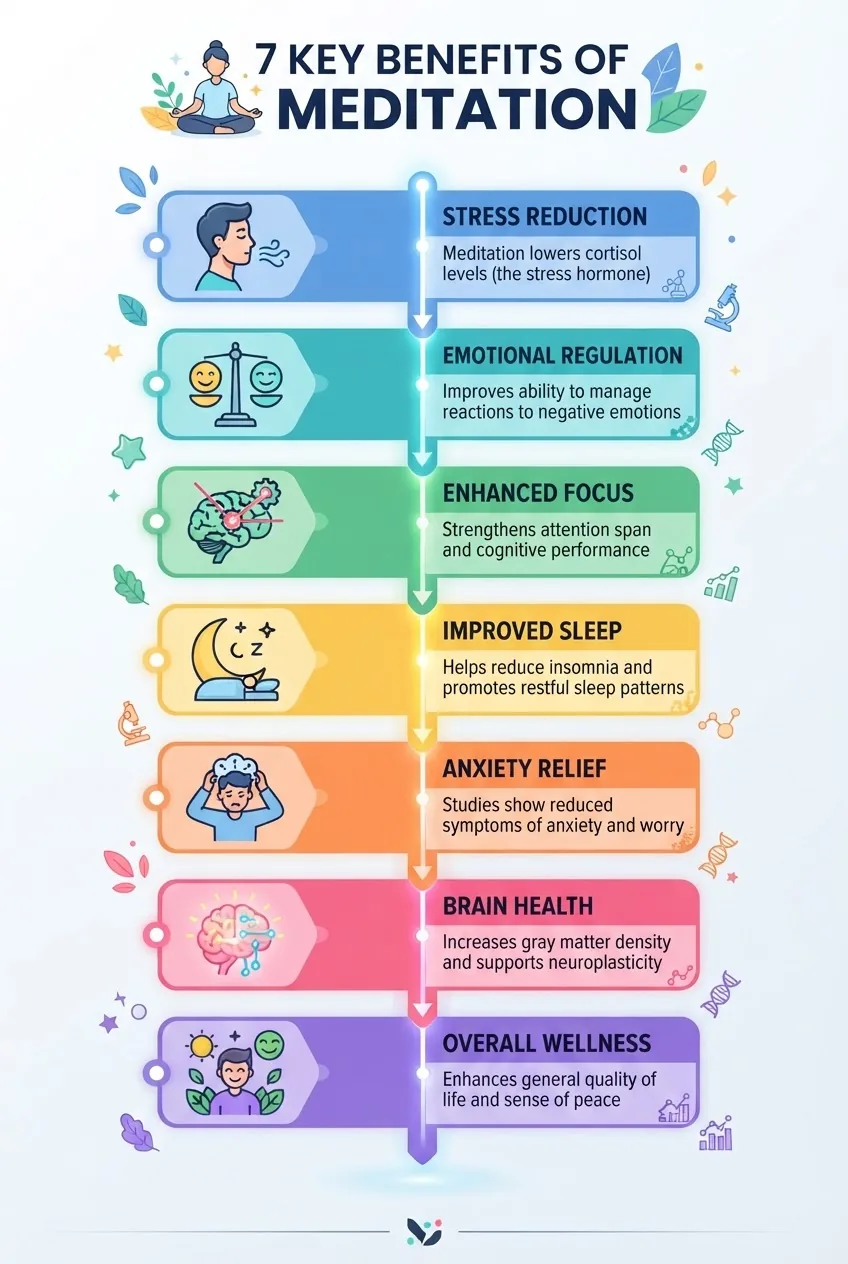
Below are the principal, evidence-backed advantages of meditation for mental health and wellbeing. Each point includes the mechanism, practical impact, and a concise citation or study type for verification.
-
Stress reduction and lowered physiological arousal
What it is: Regular meditation reduces baseline stress markers—salivary cortisol, resting heart rate and blood pressure—through enhanced parasympathetic tone.
Evidence: Multiple RCTs and experimental stress-task studies show significant reductions in cortisol and perceived stress after 8–12 week programs (Mindfulness-Based Stress Reduction or MBSR) (NCCIH overview—government health body summary).
Practical impact: People report faster recovery after stressful events and fewer stress-related physical complaints.
Complementary resources: advanced stress relief tools.
-
Anxiety symptom reduction
What it is: Mindfulness and focused-attention meditations reduce physiological reactivity and worry cycles, lowering generalized anxiety disorder and situational anxiety levels.
Evidence: A systematic review of meditation RCTs found small-to-moderate improvements in anxiety symptoms versus control groups (meta-analytic evidence, multiple RCTs; see Goyal et al., 2014).
Practical impact: Easier regulation of panic cues, decreased avoidance, and improved daily functioning.
-
Depression and mood enhancement
What it is: Meditation reduces depressive rumination and increases positive affect through decentering and behavioral activation.
Evidence: Meta-analyses and RCTs of mindfulness-based cognitive therapy (MBCT) show effectiveness in preventing relapse for recurrent depression and reducing depressive symptoms (Goyal et al., 2014).
Practical impact: Fewer depressive episodes and improved mood regulation over months when practiced consistently.
-
Improved attention, working memory and executive function
What it is: Regular attention-training enhances sustained attention, selective attention and working memory capacity.
Evidence: Controlled laboratory studies show measurable gains on standard attention tasks after 4–8 weeks of practice; neuroimaging shows strengthened prefrontal networks (RCTs and experimental designs).
Practical impact: Better focus at work, reduced mind-wandering, and improved task completion rates.
-
Better sleep and circadian regulation
What it is: Meditative practices reduce presleep hyperarousal and intrusive thoughts, improving sleep onset latency and sleep quality.
Evidence: RCTs of MBSR and mindfulness-based interventions report improved Pittsburgh Sleep Quality Index (PSQI) scores in clinical and community samples.
Practical impact: Reduced insomnia symptoms and fewer nighttime awakenings.
-
Emotion regulation and resilience
What it is: Increased capacity to notice emotional triggers, label feelings, and choose responses rather than react automatically.
Evidence: Neuroimaging and psychophysiological studies show reduced amygdala reactivity and improved prefrontal regulation following mindfulness training.
Practical impact: Higher tolerance for discomfort, faster recovery from setbacks, and more adaptive coping.
-
Brain health and neuroprotective effects
What it is: Structural and functional brain changes linked to memory, attention, and emotional control suggest meditation supports healthy aging and cognitive reserve.
Evidence: Longitudinal MRI studies show increased hippocampal volume and gray matter in prefrontal regions after months of regular practice (Hölzel et al., 2011—neuroimaging study).
Practical impact: Potential slowing of age-related cognitive decline when meditation is part of a broader brain-healthy lifestyle (exercise, sleep, social engagement).
-
Social and interpersonal benefits
What it is: Loving-kindness and compassion meditations increase prosocial emotions, empathy and relationship satisfaction.
Evidence: RCTs of compassion training report increases in positive affect and supportive behaviors toward others.
Practical impact: Improved conflict resolution, better listening and enhanced social connectedness.
Notes on variability: the magnitude of these benefits varies by practice type (mindfulness, compassion, focused attention), session length, consistency, and individual baseline levels of stress or pathology. High-quality RCTs and meta-analyses form the strongest evidence base; observational studies suggest additional, complementary benefits.
Benefits of Daily Meditation Practice: What Research Says
Daily practice compounds benefits. The research consistently shows a dose-response relationship: regular, brief sessions often outperform irregular, long sessions. Below is a compact research summary, followed by practical implications and longitudinal findings.
| Outcome | Evidence type | Typical timeframe |
|---|---|---|
| Reduced perceived stress | Multiple RCTs, MBSR programs | 4–8 weeks |
| Lower anxiety scores | Meta-analyses of RCTs | 6–12 weeks |
| Improved attention | Experimental studies, neuroimaging | 2–8 weeks |
| Sleep quality | RCTs with PSQI measures | 4–12 weeks |
| Structural brain changes | Longitudinal MRI studies | 8 weeks to months |
Research summary: Many studies use 8-week standardized programs (MBSR, MBCT) with 20–45 minute daily practice goals and weekly group sessions. According to a 2014 meta-analysis in JAMA Internal Medicine, meditation programs produced clinically meaningful reductions in anxiety and depression symptoms across multiple trials (Goyal et al., 2014).
Stat block (evidence snapshot):
- Small-to-moderate reduction in anxiety and depression symptoms across RCTs (systematic review/meta-analysis).
- Significant improvements in perceived stress after 8-week MBSR programs (multiple RCTs, government health summaries).
- Attention improvements measurable after as little as 2–4 weeks in lab-based studies (experimental designs).
Practical longitudinal advantages: Daily short practices (3–15 minutes) show reliable gains when done consistently; cumulative effects—reduced relapse in depression, sustained stress resilience, and incremental neuroplasticity—emerge after months. For evidence that short formats work when consistent, see short meditation practices for daily benefits.
Meditation Therapy and Its Role in Treating Mental Health Conditions
Meditation is widely used as a therapeutic adjunct and, in some cases, a first-line intervention for mild-to-moderate conditions. Below I describe clinical contexts, case examples, and how meditation integrates with psychotherapy and medication management.
Clinical applications: MBCT is recommended for relapse prevention in recurrent depression (clinical guidelines and RCTs). MBSR is commonly used for stress-related disorders, chronic pain, and general anxiety reduction. In cognitive-behavioural therapy (CBT) settings, mindfulness practices are adopted to address experiential avoidance and rumination.
Case example (anonymized): A 38-year-old client with recurrent depressive episodes and workplace stress began MBCT (8 weeks, 30 minutes/day). By week 6 she reported 40% fewer intrusive negative thoughts and maintained improved mood for 6 months post-program. This illustrates typical timelines where skills—decentering and behavioral activation—translate into measurable clinical gains.
Medication context: Meditation can be an adjunct to pharmacotherapy and psychotherapy. For readers comparing options, see anti anxiety medication options. Clinical teams often recommend combined approaches for moderate-to-severe conditions: medication for acute symptom control, meditation and therapy for skills and relapse prevention.
Guided formats: Guided meditation within therapy—either in-person or via validated digital interventions—helps adherence and structure. See guided meditation for mental health for practices commonly used in clinics.
Professional guidelines and evidence: National mental health organizations and clinical guidelines endorse mindfulness-based therapies for specific indications (relapse prevention in depression, stress reduction). According to a government health overview (NCCIH), meditation is a reasonable complementary approach for some conditions (NCCIH).
When to integrate meditation into therapy:
- As a primary intervention for mild-to-moderate stress, anxiety, and depressive symptoms.
- As adjunctive skills training during CBT or acceptance-based therapies.
- As a relapse-prevention strategy after symptom remission (MBCT model).
For clinical pathways beyond meditation, many practitioners combine meditation with counseling—see counseling and therapy options for anxiety.
Practical Ways Meditation Enhances Brain Health and Cognitive Function
This section translates neuroscience into hands-on implications: what to expect in brain function and how to design practice protocols that maximize cognitive gains.
-
Design short, consistent sessions to boost attention
Evidence shows 10–20 minutes daily of focused attention produces reliable attention gains within 2–8 weeks. Use a timed practice: 3-minute warm-up, 12-minute focused breath, 5-minute reflection. Track progress with simple attention tasks (e.g., a 5-minute concentration test twice weekly).
-
Combine mindfulness with cognitive exercises
Pairing meditation with goal-oriented cognitive tasks (working memory drills, controlled breathing during problem-solving) fosters transfer of training to executive function. Neuroplasticity is activity-dependent: intentional challenge plus regulation yields stronger frontal changes.
-
Use movement-based mindfulness to support embodied cognition
Integrating gentle yoga or walking meditation improves interoception and motor-cognitive coordination. For combined benefits, consider combining meditation with the 30 day yoga challenge for stress reduction to improve both brain and body resilience.
-
Practice loving-kindness to enhance social cognition
Compassion meditations increase activation in neural circuits linked to empathy and prosociality, improving perspective-taking and social memory—skills that support cognitive health through enriched social engagement.
-
Track and adapt practice using objective markers
Measure sleep quality (PSQI), perceived stress (PSS), and simple attention tests monthly. If improvements plateau after 8–12 weeks, increase practice duration by 5–10 minutes or add an additional session per day to sustain neuroplastic gains.
Why Is Meditation Important for Overall Wellness? Beyond Mental Health
Meditation impacts physical health, lifestyle behaviours and social wellbeing, making it a core element of holistic wellness. Below are concrete lifestyle integration tips and cross-benefits.
Physical health perks: lowered blood pressure, improved heart rate variability, and reduced inflammation markers in some studies—benefits that reduce cardiovascular risk when combined with diet and exercise.
Behavioural benefits: improved impulse control supports healthier eating, better sleep hygiene, and regular exercise adherence. Emotion regulation reduces stress-driven behaviours like smoking or binge eating.
Social and occupational benefits: improved focus and emotional stability enhance interpersonal functioning and workplace performance. Programs that combine meditation with workplace practices report improvements in presenteeism and reduced burnout indicators.
Complementary practices: Meditation pairs well with physical practices. For those exploring integrated approaches, see benefits of yoga for anxiety relief and the 30 day yoga challenge for stress reduction for combined protocols that boost overall wellness.
Integration tips (practical):
- Start with 5–10 minutes daily for two weeks, then increase to 15–20 minutes by week three.
- Practice at consistent times—morning sessions improve mood and focus; evening sessions aid sleep.
- Use reminders and micro-habits: tie meditation to a routine (after brushing teeth) and keep a simple log.
Common Questions: Does Meditation Work and How to Maximize Its Benefits
Below are concise, practical Q&A items summarizing evidence and best practices. For short practice starters, see quick mindfulness meditation scripts and breathing supports like breathing meditation exercises.
-
Does meditation actually work?
Yes — RCTs and meta-analyses show meditation reduces symptoms of anxiety and depression and improves stress resilience. Effect sizes vary; structured programs (8-week MBSR/MBCT) have the strongest evidence base (meta-analysis, 2014).
-
How long before I see benefits?
Short-term gains (immediate calming, reduced reactivity) can appear in single sessions; clinically meaningful reductions in anxiety or stress usually emerge after 4–8 weeks of consistent practice (20–30 minutes/day or equivalent).
-
Is guided meditation better than self-guided?
Guided practice often improves adherence for beginners and is equally effective for many outcomes. Over time, combining guided sessions with self-practice yields the best adherence and deeper skill consolidation—see structured guides for implementation.
-
How do I maximize benefits?
Make practice daily, start short (5–10 minutes), gradually increase to 20–30 minutes, pair with group classes or guided courses for accountability, and track objective markers (sleep, stress scales). Add movement-based mindfulness for embodied regulation.
Hands-On Step-by-Step Practice Protocol (Core Steps)
The steps below are an actionable, evidence-informed daily routine to realize the main benefits described earlier. Each step includes timing, settings and measurable thresholds.
Before you start
- Quiet space or cushion/chair for sitting (3×3 metre clear area recommended).
- Timer or smartphone timer app set to 5, 10, 15 or 20 minutes.
- Journal or tracking sheet to record session length and notes (simple two-column: date / notes).
- Optional guided audio (5–20 minutes) for early adherence.
-
Set a clear, measurable goal (3 minutes)
Decide frequency and duration: start with 5 minutes daily for days 1–7, then 10 minutes daily for days 8–21, then 15–20 minutes daily from week 4 onward. Logging must be daily; target at least 22 out of 28 days to establish habit threshold.
-
Create a consistent environment (5 minutes)
Choose a consistent time and quiet spot. If mornings, sit within 30 minutes of waking. If evenings, choose 30–60 minutes before intended sleep time. Minimise interruptions: phone on airplane mode and a visible timer only.
-
Position and posture check (1–2 minutes)
Sit upright with spine neutral: hips slightly higher than knees if on a cushion, feet flat if on a chair. Hands on knees or lap. Eyes can be closed or softly focused. This posture supports alert relaxation and minimizes drowsiness.
-
Anchor attention (core practice: 5–15 minutes)
Focus on the breath or a chosen anchor. When distraction occurs, note it quickly (“thinking”) and gently return attention. Use timed cycles: 3 minutes anchor + 7 minutes stable focus + 5 minutes open awareness for a 15-minute session. Count breaths only if attention wavers often.
-
Open monitoring and affect labeling (3–7 minutes)
Shift to noticing bodily sensations, emotions and thoughts without reacting. Label experiences briefly (e.g., “anger,” “warmth”) and return to present sensations. This builds decentering and emotion regulation skills over weeks.
-
Compassion/loving-kindness practice (optional, 5 minutes)
Recite short phrases to self and others: “May I be safe. May I be well.” Progress to loved ones and neutral people. Use 3–5 minutes after core practice to build social-emotional benefits.
-
Brief journaling and objective tracking (2–3 minutes)
Immediately after practice, note session length, perceived focus (1–5 scale), and one observation (e.g., “less reactivity at lunch”). Track weekly averages and aim for incremental improvements (e.g., focus score +0.5 over 4 weeks).
Common mistakes and how to avoid them
I’ve observed these failures in real clients and students. I describe each in first person and how I corrected course.
- Skipping consistency for intensity: I used to increase session length before building habit; this led to burnout. Fix: start 5 minutes daily and only increase after 3 weeks of consistent practice (≥20 days practiced).
- Expecting immediate emotional transformation: I once assumed a single session would erase anxiety; when it didn’t, motivation dropped. Fix: track small changes (sleep, reactivity) and celebrate incremental wins at 2–8 week marks.
- Poor posture leading to sleepiness: I often fell asleep in evening sessions. Fix: sit with upright posture or switch to morning practice, and use walking meditation if drowsy persists.
- Using meditation to avoid therapy: I advised a client to meditate when they needed trauma-focused therapy; this delayed appropriate care. Fix: use meditation as complementary; seek professional support when symptoms are severe.
Checklist: Verify your practice
- Have you practiced at least 5–10 minutes daily for 21 consecutive days?
- Do you log session length and a brief note after each session?
- Are you showing measurable improvements: sleep or stress scales improved after 4–8 weeks?
- Do you combine guided practice with self-practice at least 3 times weekly?
- Have you consulted a clinician if symptoms are moderate-to-severe or suicidal ideation exists?
When to call in a professional
If you experience worsening symptoms, intrusive trauma memories, panic attacks, suicidal ideation, or functional decline despite regular practice, consult a mental health professional immediately. Meditation is a powerful adjunct, but severe clinical conditions often require psychotherapy, medication, or specialist interventions.