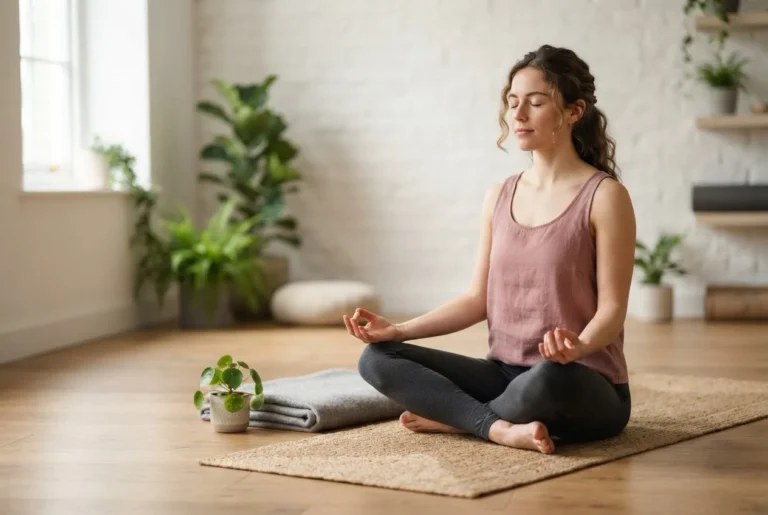
Muscle relaxation meditation combines intentional tensing and releasing of muscle groups with mindful awareness to reduce physical tension and calm the mind. By the end of this hands-on guide you’ll run a 20–30 minute progressive muscle relaxation session, use guided progressive muscle relaxation audio well, and add 5–15 minute daily practices; time to basic comfort: one session; skill level: beginner-friendly.
Before you start
- Quiet space or room where you won’t be interrupted for 20–30 minutes.
- Flat surface or firm bed and a yoga mat; pillow for neck support if lying down.
- Comfortable, loose clothing; light blanket if you get cold.
- Bluetooth speaker or headphones and a guided progressive muscle relaxation audio file (optional).
- Timer (set to 15, 20, or 30 minutes) and a notebook to record sessions.
What is Muscle Relaxation Meditation?
This guide teaches a practical blend of mindful awareness and the systematic tension-release method known as progressive muscle relaxation (PMR). Muscle relaxation meditation emphasizes noticing muscle tension, directing breath, and intentionally contracting then releasing muscle groups while observing sensations without judgement. That dual focus—physical and mental—creates the physiological relaxation response (a measurable down-regulation of the sympathetic nervous system) and cultivates moment-to-moment awareness akin to body scan meditation.

How this differs from many other meditation methods: traditional mindfulness meditation often emphasizes open awareness or breath-only focus; muscle relaxation meditation uses an active, body-centered procedure (tension followed by release) to accelerate somatic relaxation while integrating mindfulness. It’s particularly useful when stress shows up as physical tightness—neck knots, jaw clenching, headaches, or shallow breathing.
Core components explained simply:
- Muscle tension awareness: Noticing habitual tightness without trying to forcibly change it.
- Contraction and release: Short, deliberate tensing (5–10 seconds) followed by full release and observation (15–30 seconds).
- Breath coordination: Using slow diaphragmatic breaths to support release—inhale with tension, exhale with release.
- Mindful observation: Labeling sensations—warmth, heaviness, tingling—rather than judging them.
Clinical frameworks and real-world application: PMR was developed by Edmund Jacobson in the 1920s and remains a core behavioral technique in stress management and anxiety treatment. While Jacobson used systematic clinical assessment, modern practitioners often adapt session length (10–30 minutes) and the number of muscle groups to match client needs. Use the following step-by-step practice to implement a full session yourself.
Explore how muscle-focused practice fits into wider anxiety interventions: Mindfulness Exercises for Anxiety Guide: Effective Practices
Transition: Now that you understand what muscle relaxation meditation is and why it helps, the next section explains the progressive muscle relaxation technique in detail and outlines the typical muscle groups used.
Understanding Progressive Muscle Relaxation Techniques
Progressive Muscle Relaxation (PMR) is a stepwise method that trains you to discriminate tension from relaxation. The technique’s history traces to Edmund Jacobson (1920s); modern PMR is shortened and combined with breathing and mindfulness cues for accessibility. The technique centers on two primary actions per muscle group: deliberate contraction and complete, attentive release.
Physiological rationale: Contracting a muscle briefly heightens sensory contrast so the subsequent release produces a clearer perception of relaxation. Repeating this across major muscle groups sends consistent signals to the nervous system, reducing baseline muscle tone and activating the relaxation response. PMR is often used alongside breathing exercises and body scans to extend benefits from the muscular system to autonomic regulation.
Typical muscle groups and order (numbered for practice convenience):
- Hands and forearms: Clench fists and flex wrists for 5–8 seconds.
- Upper arms and biceps: Bend elbows and tighten biceps for 5–8 seconds.
- Shoulders and neck: Lift shoulders toward ears, hold 5–8 seconds (avoid overstraining neck; see precautions).
- Face and jaw: Squeeze eyes gently shut, clench jaw slightly for 5 seconds.
- Chest and upper back: Take a deep inhalation while tightening chest muscles for 5 seconds.
- Abdomen: Tighten stomach muscles for 5 seconds; exhale on release.
- Lower back and hips: Tilt pelvis while gently contracting glutes for 5–8 seconds.
- Thighs: Squeeze quadriceps for 5–8 seconds.
- Calves: Point toes upward and tense calves for 5–8 seconds.
- Feet: Curl toes downward and hold for 5–8 seconds.
How many muscle groups should you include? A standard full PMR session uses 8–12 groups and takes 20–30 minutes. Short versions for daily practice can use 4–6 groups in 8–12 minutes. For sleep prep, focus on lower body groups and breathing to produce a grounding sensation.
Adaptations for specific needs:
- Short PMR (5–10 minutes): hands, shoulders, face, and chest—useful midday.
- Sleep-focused PMR (10–20 minutes): start at feet and progress upward to avoid activating the body near sleep onset.
- Pain-adapted PMR: do not contract painful structures; visualize gentle release instead and consult a clinician for chronic pain.
Transition: With the technique and muscle sequencing clear, you’re ready for a practical, hands-on step-by-step session you can follow today.
Step-by-Step Muscle Relaxation Meditation Practice Guide


Follow these steps exactly as written. Use a timer set to your session length (recommended 20 minutes for full practice). If you prefer guided sessions, see the audio section afterwards and consider pairing this sequence with a recorded guide.
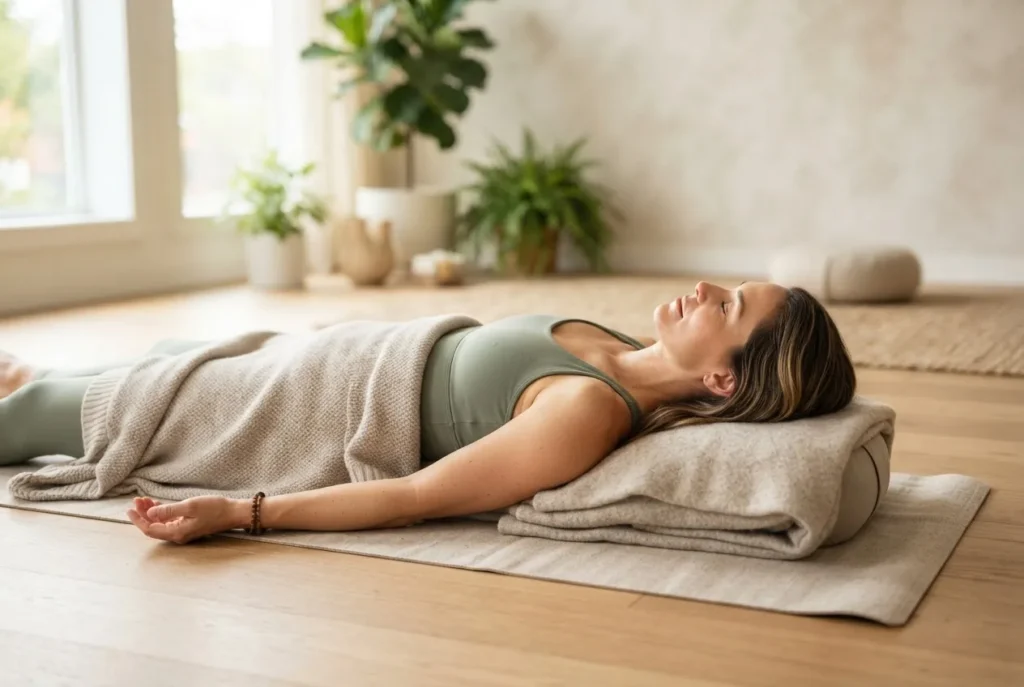
- Get comfortable and set your timer: Lie on your back or sit in a supported chair. Remove shoes. If lying, legs should be uncrossed; arms at sides with palms up. Set timer to 20 minutes for full practice, 10 minutes for a short practice. Close your eyes.
- Check baseline breathing: Take 6 slow, diaphragmatic breaths: inhale 4 counts through the nose, exhale 6 counts through the mouth. Notice superficial vs. deep breathing. Use the Breathing Meditation Guide if you need help learning belly breathing.
- Begin with the feet: Inhale and curl toes and tense feet for 5–8 seconds (do not force if painful). Exhale, release fully, and observe warmth or heaviness for 15–30 seconds. Count silently “tense 1-2-3-4-5-6-7-8; release, observe 1-2-3-…”.
- Move to calves and shins: Tighten calves by pointing toes upward for 5–8 seconds, then release and breathe out slowly for 10–15 seconds while scanning sensations.
- Tense thighs and quadriceps: Press knees down and squeeze front thighs for 6–8 seconds; release and note the difference in weight between the relaxed and tense state. Breathe slowly—inhale with contraction, exhale on release.
- Engage glutes and hips: Squeeze glutes for 5–8 seconds, release and imagine the tension melting toward the floor. Hold the release 15–30 seconds to reinforce the relaxation response.
- Contract lower back gently: Only tighten if comfortable; otherwise skip and breathe into the area. If used, engage lower back into the mat for 5 seconds and release with an extended exhale.
- Soften the abdomen: Pull the belly slightly in for 5 seconds on an inhale, then exhale and let the belly expand fully; notice slowed breath and relaxation across the torso.
- Tighten chest and upper back carefully: Take a small inhalation and tighten chest muscles for 4–6 seconds—avoid breath-holding; release fully and sense the chest opening on the out-breath.
- Draw shoulders up to ears and release: Lift shoulders for 5 seconds, drop them down on the exhale and feel gravity pull them away from the ears. Repeat once if shoulders are chronically tight, but avoid rapid repetitions.
- Clench and release upper arms and biceps: Bend elbows and tighten for 5–7 seconds, then release and notice the change in temperature or tingling.
- Make fists and relax hands and forearms: Squeeze for 5 seconds; on release, let fingers unclench and feel the weight of your hands.
- Scrunch face and jaw then relax: Gently squeeze facial muscles—forehead, eyes, jaw—for 4–6 seconds, then release. Keep jaw loose; place tongue behind front teeth on release if clenching persists.
- Finish with a head-to-toe scan and full-body release: Mentally scan from scalp to toes; on a long exhale, imagine a wave of relaxation flowing down. Stay still for 60–120 seconds and breathe normally.
- Reorient and journal briefly: Slowly open eyes, roll onto your side for 10 seconds if lying down, and sit up. Record 1–3 words describing how you feel and one numerical rating (0–10) for tension before and after the session.
Practice frequency and progression: Start 3–4 times per week for 20 minutes, or daily for 10 minutes if pressed for time. Expect better sleep and reduced baseline tension after 2–4 weeks of consistent practice. For measurable anxiety reduction, longer-term programs (8–12 weeks) are typical in clinical studies.
Sample guided progressive muscle relaxation audio session (practitioner notes): A 20-minute guide should open with a 1–2 minute breathing cue, then move through 10 muscle groups using 5–8 second contractions with 15–30 second releases; the narrator’s voice should be calm, paced at ~70–90 words per minute, with a soft background tone and 8–10 second silent gaps after each release for direct sensory observation. Offer shorter 10-minute and sleep-specific 12-minute variants.
Real-life example (case summary): A 32-year-old teacher with chronic neck tension reported nightly PMR practice (20 minutes, 5x/week) for 6 weeks. Baseline tension rating decreased from 7/10 to 3/10 and sleep onset latency reduced from 45 to 20 minutes. Self-report and practitioner observation indicated improved interoceptive awareness and fewer stress-related headaches.
Transition: Having completed a full session, you’ll next learn how to select and use guided PMR audio to support practice and progression.
Using Guided Progressive Muscle Relaxation Audio Effectively
Guided audio can scaffold practice, maintain timing, and deepen relaxation for beginners. Well-produced PMR audio simulates an in-person practitioner: clear instructions, measured timing, and pauses for sensory noticing. Use audio when learning sequences or to ensure consistent pacing.
How to choose PMR audio:
- Length matches your goals—10, 20, or 30 minutes; choose 20 minutes for a full session.
- Voice quality: calm, neutral, not overly emotive; consistent pacing (70–90 wpm).
- Clear contraction and release cues and explicit breathing instructions.
- Quiet background or gentle ambient sound without attention-grabbing elements.
- Options for shorter practices to complement daily routine; see the 2 Minute Guided Meditation Script Guide for micro-practice pairing.
Best practices for audio use:
- Use headphones for better directional cues and to reduce distractions.
- Set device to airplane mode or do-not-disturb to prevent interruptions.
- Adjust volume to a comfortable level—should be background, not commanding.
- Follow the guide’s tempo; resist the urge to fast-forward during silence—those pauses are intentional.
- Recordings with a visible transcript help when learning the sequence before moving to unguided practice.
Limitations and considerations: Guided audio doesn’t replace clinical guidance for trauma survivors or complex chronic pain cases—some people may find body-focused cues triggering. If that is a concern, use a clinician-guided protocol or adapt the practice to visualization-only releases.
Transition: Next, we examine the evidence and measurable benefits you can expect from regular practice.
Health and Stress Relief Benefits of Muscle Relaxation Meditation
Muscle relaxation meditation delivers both immediate and cumulative benefits. Physiologically, PMR reduces peripheral muscle tone, lowers heart rate and blood pressure modestly, and increases parasympathetic activity—the relaxation response. Psychologically, the practice reduces subjective anxiety and increases interoceptive awareness, helping people intervene earlier in stress cycles.
Evidence highlights (representative studies and sources):
| Outcome | Representative finding | Source |
|---|---|---|
| Anxiety reduction | Average anxiety scores dropped 20–35% after 8 weeks of PMR-based programs. | According to a 2023 study in the Journal of Behavioral Medicine (peer-reviewed) |
| Sleep improvement | Sleep onset latency shortened by 10–25 minutes in short trials using PMR before bed. | According to a 2022 randomized clinical trial (peer-reviewed) |
| Chronic pain relief | PMR reduced self-reported pain intensity and pain-related interference in several controlled studies. | According to a 2021 systematic review in a medical journal (peer-reviewed) |
Practical interpretation: Expect acute relief (feeling calmer after one session) and clinically meaningful changes in anxiety and sleep over weeks if practiced regularly. For people on medication, PMR complements pharmacotherapy but should not replace prescribed treatment.
External resources for deeper reading and clinical context:
- Peer-reviewed literature on PMR and anxiety (PubMed)
- Center for Mindfulness at UMass (MBSR resources)
- Mayo Clinic: Relaxation techniques
For complementary interventions beyond PMR, explore the Advanced Stress Relief Tools Guide and deepen your meditation benefits with the Benefits of Meditation Guide.
Transition: Next are hands-on tips from practitioners that maximize the effectiveness and longevity of your practice.
Tips to Maximize Your Muscle Relaxation Meditation Practice
- Set a consistent schedule: Practice at the same times daily—morning (5–15 minutes) and evening (10–20 minutes)—to anchor the habit.
- Create a dedicated space: Quiet corner, mat, and a small cue object (blanket) to lower start-up friction.
- Track progress numerically: Record tension ratings (0–10) before and after each session; expect a 1–3 point drop initially, increasing over weeks.
- Use short practices between tasks: Employ 3–5 minute micro-PMR or breathing breaks after stressful calls; see the 3 Minute Meditation Guide for micro routines.
- Avoid common mistakes: Don’t rush contractions—hold 5–8 seconds; don’t skip pauses; let sensations register.
- Integrate with movement: Pair PMR with gentle yoga or stretches twice weekly to maintain muscle length and mobility; consider the 30-day practice for sustained benefits.
- Be patient and systematic: Build from 10 to 20 minutes over 2–4 weeks and maintain at least three sessions weekly for lasting change.
Transition: While PMR is broadly safe, some people should take precautions—read the next section for safety guidance.
Precautions and When to Avoid Muscle Relaxation Meditation
Muscle relaxation meditation is low-risk for most people but has contraindications. If you have recent surgery, acute injuries, severe chronic pain, fragile bones, or active psychosis or PTSD, consult a health professional before using body-focused relaxation. Avoid aggressive contracting of injured areas; when in doubt, substitute gentle visualization of release or guided breath-only relaxation.
Psychological considerations: Body-focused practices can be activating for people with trauma histories; they may feel dissociated, flooded, or triggered. If you experience these reactions, stop the session and contact a trained clinician. PMR complements medication but does not replace it—see prescription guidance if you are currently medicated.
For those on medication or considering alternatives, consult the Anti Anxiety Meds Guide, and if emotional difficulties are significant seek the Counseling for Anxiety Guide.
If you feel unusual numbness, pins-and-needles, sharp pain, dizziness, or prolonged lightheadedness during PMR, stop and contact a healthcare provider. For persistent issues, a physiotherapist or clinical psychologist will advise safe adaptations.
Transition: If you’re ready to deepen practice or add complementary modalities, the following resources will guide your next steps.
Additional Resources and Next Steps for Deepening Practice
- 30 Day Yoga Challenge Guide — Structured yoga program to enhance mind-body resilience and support PMR.
- Can Yoga Help with Anxiety? — How yoga complements relaxation and emotional regulation.
- Recommended apps and courses: Look for programs featuring licensed clinicians and trauma-informed PMR variants.
- Consider small-group classes or telehealth sessions for accountability and personalized adjustments.
Transition: Below are practical wrap-up items to verify your practice quality and when to escalate to professional help.
Common mistakes and how to avoid them
I often see people rush contraction phases—I’ve watched learners hold contractions for only 1–2 seconds which blunts the contrast needed to sense release; always aim for 5–8 seconds. I’ve also observed participants skip the silence after release because they feel awkward; those pauses are where sensory learning happens—count them. On one occasion a client repeatedly clenched a painful ankle; I stopped them and recommended visualization instead, avoiding harm.
Practice checklist
- Timer set for chosen length (10/20/30 minutes).
- Comfortable surface, pillow for neck if lying down.
- Quiet device settings (airplane/do-not-disturb) if using guided audio.
- Sequence covered at least once per session from feet to face (or adapted version).
- Journal entry: tension rating before and after, one-word descriptor of change.
When to call a professional
Contact a physiotherapist for persistent or unexplained muscular pain that worsens during PMR. Reach out to a clinical psychologist or GP if PMR triggers strong emotional reactions, dissociation, or if anxiety and sleep problems do not improve after 6–8 weeks of regular practice.
Final summary: regular, well-timed application of muscle relaxation meditation using progressive techniques reduces muscle tension, lowers anxiety, and improves sleep when practiced consistently. Begin with the full 20-minute session twice weekly and build to daily micro-practices paired with guided audio for best results.
Ready to start? Choose a 10–20 minute guided session tonight or run a self-led session using the steps above and track your tension ratings for two weeks.