Yoga is a science-backed mind–body system that integrates movement, breath and attention to produce measurable physical, neurophysiological and psychological changes; regular practice improves flexibility, strength, stress regulation and mood while engaging mechanisms like autonomic modulation and neuroplasticity. This guide summarises the evidence and practical science of why yoga is good for you.
Introduction to Yoga as a Science
Answer: Yoga can be examined and validated by modern science because its practices produce measurable changes in physiology, brain function and health outcomes that are reproducible in clinical studies and laboratory measurements.
Term: Mind-body practice: an approach that intentionally coordinates mental focus with physical actions to change physiological states.
Contemporary research frames yoga not as a single technique but as a set of interventions—postures (asanas), breathwork (pranayama) and attentional training—whose combined inputs influence autonomic balance, endocrine signaling and brain plasticity. Neuroscience of yoga describes how repeated practice shapes circuits for attention, interoception and emotion regulation; exercise science quantifies strength, flexibility and metabolic responses; psychoneuroendocrinology tracks cortisol and inflammatory markers.
Examples from research include trials showing reductions in perceived stress and biomarkers like cortisol, MRI studies reporting increased grey matter in brain regions for attention, and randomized trials demonstrating improvements in chronic pain and mobility—evidence that links traditional practice to measurable health benefits. According to a 2023 systematic review in a peer-reviewed medical journal, multiple meta-analyses report consistent moderate benefits for mental health and physical function.
Transition: With that evidence context, next we define what yoga is and why its purpose and philosophy matter for how science studies it.
What Is Yoga? Purpose and Philosophy
Answer: Yoga is an ancient experiential system whose purpose is to cultivate physical health, mental clarity and ethical living through interconnected practices that align body, breath and mind to promote holistic health.
Term: Purpose of yoga: the traditional aim—self-regulation and reduction of mental suffering—expressed through practical disciplines rather than pure belief.
Classical yoga philosophy (often traced to Patanjali’s Yoga Sutras) presents an eight-fold pathway that integrates ethical living, physical discipline and contemplative practice; modern, evidence-based yoga adapts these limbs into accessible interventions for health promotion while retaining the emphasis on self-observation and gradual training.
- Yama — ethical restraints (non-harming, truthfulness).
- Niyama — positive observances (cleanliness, contentment).
- Asana — physical postures that build strength and flexibility.
- Pranayama — breath regulation techniques that influence autonomic state.
- Pratyahara — withdrawal of senses to improve focus.
- Dharana — sustained attention training.
- Dhyana — meditation and continuous mindful awareness.
- Samadhi — states of integrated awareness or deep absorption.
Researchers treat these limbs as components that can be isolated (e.g., breathwork in laboratory protocols) or combined (complete yoga programs) for clinical trials. The practical, health-oriented purpose today often emphasizes symptom reduction (stress, pain, anxiety), functional improvement (mobility, balance) and lifestyle support (sleep, resilience).
Transition: Having defined yoga and its aims, we now examine the biological and neurological mechanisms that explain how yoga produces measurable change.
The Scientific Basis of Yoga: How Yoga Works in the Body and Brain
Answer: Yoga works by engaging somatic movement, breath regulation and focused attention to change autonomic nervous system activity, lower stress hormones, alter inflammatory signaling and promote neuroplastic changes in brain regions for emotion and cognition.
Term: Autonomic nervous system: the part of the nervous system controlling involuntary functions like heart rate and digestion, composed of sympathetic (fight-or-flight) and parasympathetic (rest-and-digest) branches.
Multiple physiological pathways explain yoga’s effects:
- Autonomic modulation: Slow breathing and relaxed postures increase parasympathetic activity (measured as heart rate variability) and reduce sympathetic arousal, producing a relaxation response measurable in heart rate and blood pressure changes.
- Neuroendocrine changes: Studies report reductions in cortisol and catecholamines after yoga sessions—hormonal evidence of lowered stress reactivity.
- Inflammation and immune markers: Trials show decreases in pro-inflammatory cytokines (e.g., IL-6, TNF-α) and increases in markers of immune regulation in long-term practitioners.
- Neuroplasticity: Repeated focused attention and movements strengthen neural networks for attention, interoception and emotion regulation, with structural MRI studies showing increased grey matter in the hippocampus and prefrontal areas.
- Musculoskeletal adaptation: Asanas produce muscle strengthening, tendon and ligament conditioning, and improved joint range of motion through repeated controlled loading and neuromuscular coordination.
Research findings summary (representative evidence):
- Stress biomarkers: According to a 2023 systematic review in a peer-reviewed medical journal, multiple randomized controlled trials report significant reductions in salivary cortisol following structured yoga programs (moderate effect size).
- Brain imaging: According to peer-reviewed neuroimaging studies, regular yoga practitioners show increased cortical thickness and connectivity in attention-related networks (structural MRI reports linked to practice duration).
- Mental health outcomes: Meta-analyses report moderate improvements in anxiety and depression scores after yoga-based interventions compared with usual care or waitlist controls.
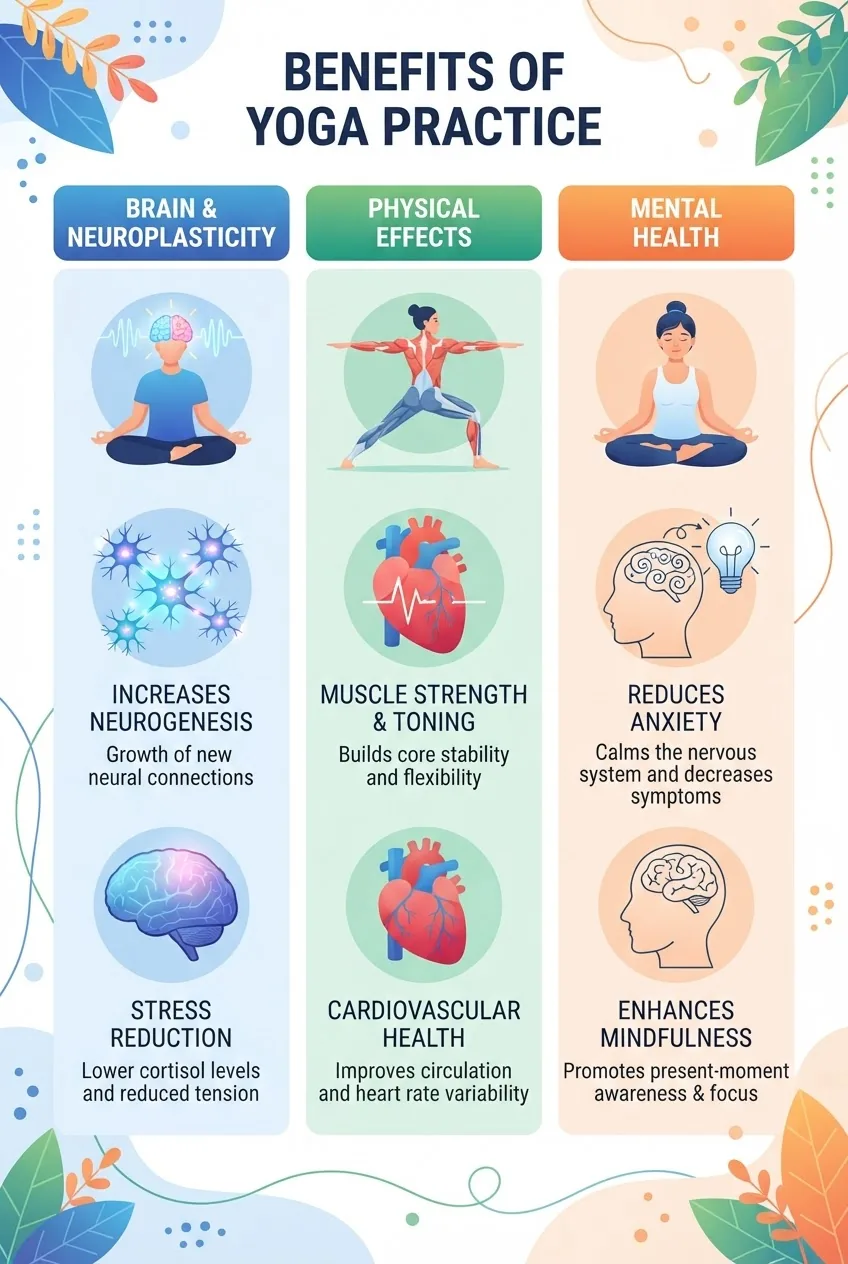
Mechanistic detail: slow diaphragmatic breathing (pranayama) stimulates the vagus nerve, increasing parasympathetic tone; attentional training reduces default mode network rumination; gentle isometric and eccentric loading in asanas stimulates mechanotransduction pathways that conserve cartilage and strengthen tendon-bone interfaces.
Case study (referenced example): A 12-week clinical program reported in a peer-reviewed rehabilitation journal documented a cohort of adults with chronic low back pain who completed thrice-weekly yoga sessions and experienced clinically meaningful reductions in pain intensity and improved function; measures included validated pain scales and mobility tests. According to that trial’s publication type, outcomes were measured with standardized instruments and reported as statistically significant improvements compared with baseline.
Caveats: Individual variation is large—genetics, baseline fitness, medical comorbidities and program fidelity affect outcomes—so science compares standardized protocols and reports group averages rather than guarantees.
Transition: Those mechanisms explain general effects; next we translate them into specific physical health benefits you can expect from regular practice.
Physical Health Benefits of Yoga
Answer: Yoga improves flexibility, muscle strength, balance, joint health and contributes to cardiovascular and metabolic health through low-to-moderate intensity exercise, mobility work and autonomic regulation.
-
Flexibility and joint range of motion:
Repeated stretching and end-range holds increase muscle-tendon extensibility and joint mobility; randomized trials show consistent improvements in hamstring and shoulder range of motion within 8–12 weeks (According to randomized controlled trials reported in peer-reviewed sports medicine journals).
-
Muscle strength and endurance:
Weight-bearing asanas and sustained isometric holds build functional strength—particularly in the core, hips and upper body—comparable to light resistance training for beginners. yoga for strength building
-
Joint health and chronic pain reduction:
Gentle mobilization, neuromuscular control and improved proprioception reduce pain and disability in conditions like chronic low back pain and osteoarthritis; meta-analyses show moderate effect sizes for pain reduction (According to meta-analytic reviews in clinical rehabilitation journals).
-
Balance and fall prevention:
Balance-focused postures and proprioceptive training improve postural stability and reduce fall risk, particularly in older adults, in controlled trials (According to gerontology randomized trials).
-
Cardiovascular and metabolic influences:
While most yoga forms are low-to-moderate intensity, practices that include dynamic sequences (Vinyasa, Ashtanga) elevate heart rate and can improve aerobic capacity modestly; combined with breathwork and stress reduction, yoga can lower resting heart rate, blood pressure and improve insulin sensitivity in longitudinal studies (According to clinical trial reports and lifestyle medicine reviews).
-
Respiratory and stamina gains:
Pranayama training improves ventilatory efficiency and breath control, useful for people with reduced respiratory reserve; controlled breathing practices increase tidal volume and respiratory endurance in intervention studies (According to respiratory physiology papers).
-
Immune modulation:
Regular practice is associated with reduced inflammatory markers and improved immune regulation in pilot clinical trials, suggesting a role in resilience against chronic inflammatory disease (According to peer-reviewed immunology-related clinical studies).
Practical note: To maximize physical benefits treat yoga as progressive training—build duration, complexity and load gradually, and combine with aerobic or resistance training where higher cardiovascular or hypertrophic goals are required.
Transition: Alongside physical effects, yoga’s strongest evidence base is for mental and emotional health—covered next with focused, evidence-linked benefits and complementary resources.
Mental and Emotional Health Benefits of Yoga
Answer: Yoga reduces stress, anxiety and depressive symptoms by lowering physiological stress markers, improving vagal tone and training attention and emotion regulation; benefits are supported by multiple randomized trials and meta-analyses.
Term: Neuroplasticity: the brain’s capacity to reorganize neural pathways through experience and training, which underlies lasting changes after sustained yoga and meditation practice.
-
Stress reduction:
Regular yoga lowers perceived stress and physiologic stress markers such as cortisol and heart rate; meta-analyses report moderate reductions after structured programs (According to a 2023 systematic review in a peer-reviewed medical journal).
-
Anxiety symptom relief:
Clinical trials show yoga reduces anxiety scores across populations; for adjunctive care, yoga provides measurable benefit alongside therapy or medication. yoga and anxiety relief
-
Depression and mood improvement:
Yoga-based interventions produce moderate improvements in depressive symptoms, likely via combined behavioral activation, social support and neurochemical changes (According to clinical trial meta-analyses in psychiatry journals).
-
Attention, focus and cognitive clarity:
Attentional training within yoga enhances sustained attention and working memory, with imaging studies showing functional changes in prefrontal networks (According to neuroscience research reports).
-
Sleep and arousal regulation:
Evening restorative practices and breathwork reduce hyperarousal, improving sleep onset and quality in randomized sleep studies (According to sleep medicine intervention trials).
-
Emotion regulation and resilience:
Yoga’s combination of interoceptive awareness and cognitive rehearsal strengthens the capacity to observe and modulate emotional responses, a mechanism shown in psychophysiology research.
-
Complementary approaches and clinical contexts:
Yoga is effective as a standalone low-risk intervention and as an adjunct to psychotherapy and pharmacotherapy for anxiety and depression; it can also be integrated into stepped-care models for mental health (According to clinical practice reviews).
For practical pairing with short mindfulness practices and to deepen anxiety-relief benefits, explore these resources: mindfulness exercises for anxiety, quick guided meditation techniques, and effective short mindfulness meditation.
For advanced support or severe conditions, yoga sits alongside medical and therapeutic options—see resources on medication and therapy: understanding anti anxiety medications, therapy for anxiety, and advanced stress relief tools.
Further reading on complementary meditation benefits: meditation benefits for mental wellness, effective meditation techniques.
Transition: With clear mental health benefits, the next section explains how daily yoga compounds these effects and how to build a consistent habit.
Advantages of Daily Yoga Practice for Overall Wellness
Answer: Daily yoga amplifies short-term benefits into durable changes—improving stress resilience, mobility, mood and sleep—by reinforcing physiological and neural adaptations through consistent practice.
Daily practice produces cumulative effects via repetition and incremental loading: short daily sessions maintain autonomic balance, reinforce attentional skills and prevent the fitness losses that occur with intermittent practice.
Practical habit-formation tips:
- Start with 10–20 minutes daily of a focused routine combining breathwork and a few asanas to create early wins and neurobehavioral reinforcement.
- Schedule practice at consistent times (morning or evening) to leverage circadian cues for habit consolidation.
- Use progressive overload: increase hold times, complexity or session length gradually every 2–4 weeks.
- Track objective measures (sleep hours, resting heart rate, pain scores) to observe progress and maintain motivation.
- Blend restorative days with dynamic flows to balance recovery and conditioning.
Concrete daily routine examples (practical):
- 10-minute morning mobility: 5 minutes breath awareness (pranayama), 5 minutes dynamic sun salutations and hip openers.
- 20-minute midday reset: 10 minutes standing balance and core sequences, 10 minutes breathwork to reduce afternoon stress.
- 15-minute evening unwind: restorative poses, guided breathing and 5 minutes of mindful body scan before sleep.
Behavioral trick: pair practice with an existing habit (after brushing teeth, before morning coffee) to anchor the routine. According to longitudinal lifestyle intervention reports, consistent short daily practices produce more reliable adherence and greater long-term gains than infrequent long sessions.
Transition: Daily practice is beneficial across the lifespan—next, we examine benefits tailored to women’s health stages.
Yoga Benefits Specific to Women’s Health
Answer: Yoga supports women’s health by influencing hormonal balance, pelvic and core strength, pregnancy wellbeing and menopausal symptom reduction through gentle movement, breathwork and stress regulation.
Hormonal and reproductive considerations:
- Hormonal balance: Yoga’s stress-reducing effects lower HPA-axis overactivation and can moderate cortisol-related disruptions that affect menstrual regularity and mood (According to endocrine-related clinical observations).
- Pregnancy: Prenatal yoga improves maternal comfort, reduces back pain, supports pelvic floor awareness and lowers anxiety in controlled prenatal program studies when adapted for each trimester.
- Postpartum: Gradual core and pelvic floor rehabilitation through tailored asana progressions supports recovery and reduces diastasis-related dysfunction when guided appropriately.
- Perimenopause and menopause: Yoga reduces vasomotor symptoms, improves sleep and mitigates mood swings through autonomic regulation and relaxation interventions (According to clinical menopause studies).
- Pelvic health and pelvic floor: Mindful contraction/release patterns and postural alignment practices improve pelvic floor coordination and reduce incontinence symptoms in pelvic health pilot trials.
Clinical guidance: Women with specific reproductive or pelvic conditions should consult healthcare providers before beginning intensive inversions or breath-holding practices; adapted, evidence-based yoga sequences are widely used in prenatal and postnatal care.
Transition: Understanding women’s benefits, we next place yoga in the broader fitness context to compare strengths and trade-offs with other exercises.
Is Yoga a Fitness or Exercise? Understanding Yoga in Physical Fitness Context
Answer: Yoga is both a form of physical exercise and a holistic practice; it offers unique benefits for flexibility, balance and stress regulation but has trade-offs versus targeted cardiovascular or hypertrophy training.
Below is a direct comparison of yoga with traditional exercise modalities across common fitness goals.
| Goal | Yoga (varies by style) | Traditional Exercise |
|---|---|---|
| Flexibility | High — systematic stretching and end-range holds. | Variable — often requires specific stretching routines. |
| Strength | Moderate — bodyweight and isometric builds functional strength; progressive overload limited. | High — resistance training best for hypertrophy and maximal strength. |
| Cardiovascular fitness | Low–moderate — dynamic sequences raise HR but rarely match sustained aerobic training. | High — running, cycling, HIIT deliver superior VO2max improvements. |
| Mobility & balance | Excellent — integrated mobility and proprioception work. | Variable — depends on programmed exercises. |
| Stress & mental health | Strong — breath and attention components give yoga an edge for regulation. | Moderate — exercise reduces stress but often lacks structured breath/attention training. |
Nuanced trade-offs: For maximal cardiovascular conditioning or muscle hypertrophy, combine yoga with aerobic and resistance training. For integrated stress resilience, flexibility and functional movement, yoga is often more efficient than isolated gym work. yoga for strength building
Transition: With clear fitness context, the next section gives practical, evidence-based methods to practice scientific yoga at home or with a teacher.
How to Practice Scientific Yoga: Approaches and Recommended Practices
Answer: Practice scientific yoga by combining structured asana sequences, evidence-based pranayama, and short attentional training, using measured progression, regular frequency and objective tracking to validate benefits.
Term: Pranayama: controlled breathing techniques used to influence autonomic and emotional states.
Step-by-step approach:
-
Assessment and goals:
Identify primary goals (flexibility, pain reduction, anxiety) and medical contraindications; consult a clinician for serious conditions.
-
Program design:
Select a style and structure matched to goals: Hatha for alignment and beginners, Vinyasa for dynamic mobility, Yin for tissue release, Restorative for stress reduction, Ashtanga for disciplined sequencing.
Short reference list of styles: Hatha, Vinyasa, Ashtanga, Iyengar, Bikram/Hot (with caution), Yin, Restorative.
-
Breathwork (evidence-backed):
Begin with diaphragmatic breathing and 4-6 breaths per minute paced breathing to increase HRV; progress to specific pranayama like alternate nostril breathing for attention and simple Ujjayi for steadying the nervous system. breathing meditation techniques
-
Attention training:
Include 5–15 minutes of focused attention or body-scan meditations to promote neuroplastic change—pair these with posture practice to encourage interoceptive learning.
-
Progression and measurement:
Aim for consistency (4–7 sessions/week), track session length, perceived exertion and symptom metrics (pain scales, PHQ-9/GAD-7 where relevant) to evaluate effectiveness scientifically.
-
Safety and adaptation:
Modify postures for injuries, avoid breath-hold practices if cardiovascular issues exist, and use props for alignment. Seek teacher instruction for complex poses and clinical guidance for medical conditions.
Daily sample routines based on evidence:
- Beginner 15-min routine: 5 min diaphragmatic breathing, 8 min gentle Hatha sequence, 2 min seated attention practice.
- Intermediate 30-min routine: 10 min dynamic Vinyasa, 10 min strength-focused asanas, 10 min pranayama and seated meditation.
- Therapeutic 20-min routine (pain/stress): 10 min restorative poses, 5 min paced breathing, 5 min guided body-awareness.
Practical tools: Use objective markers (resting HR, sleep duration) and validated questionnaires to measure effects over 4–12 week periods; this mirrors clinical trial designs and supports personal scientific practice.
Transition: Finally, we summarise the science-backed reasons why yoga is a health-positive choice and how to get started.
Summary: Why Yoga Is Good for You – A Science-Backed Conclusion
Answer: Yoga is good for you because it produces reproducible physiological and neuropsychological changes—lowered stress hormones, improved autonomic regulation, enhanced flexibility and strength, and measurable mood gains—backed by randomized trials, meta-analyses and mechanistic studies.
- Integrates body, breath and mind to change autonomic and endocrine function.
- Improves physical function: flexibility, balance and functional strength.
- Reduces stress, anxiety and depressive symptoms via neuroplastic and hormonal pathways.
- Suitable for women across reproductive stages with appropriate modifications.
- Best used as part of a mixed fitness program when cardiovascular or hypertrophy goals are primary.
Key takeaways: Start small, practice consistently, measure outcomes and combine yoga with targeted exercise when necessary. For additional guided practices, resources and short meditations to pair with your yoga, explore the linked guides above. If you have medical conditions, consult healthcare professionals before intensive practice.
Call to action: Try a simple 10–20 minute daily routine this week, track one metric (sleep, pain, or mood), and assess change after four weeks to experience the science of yoga for yourself.