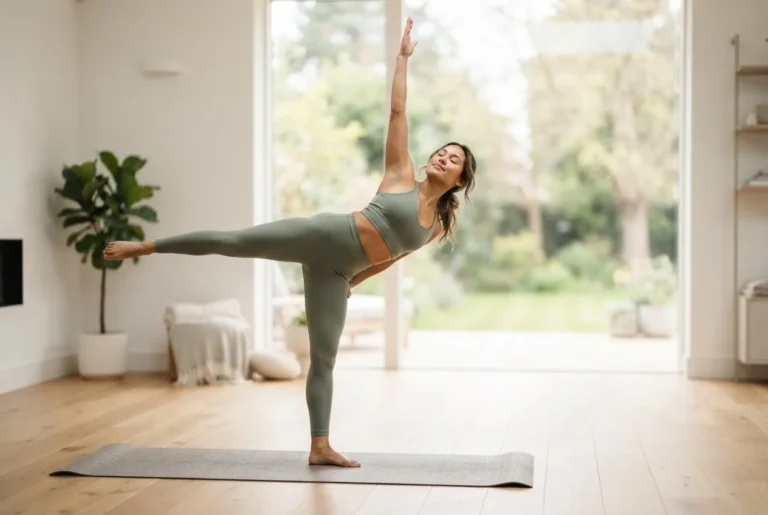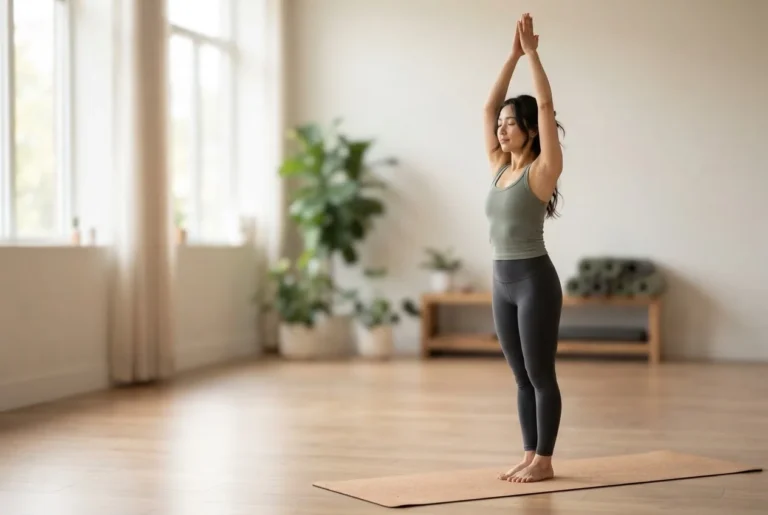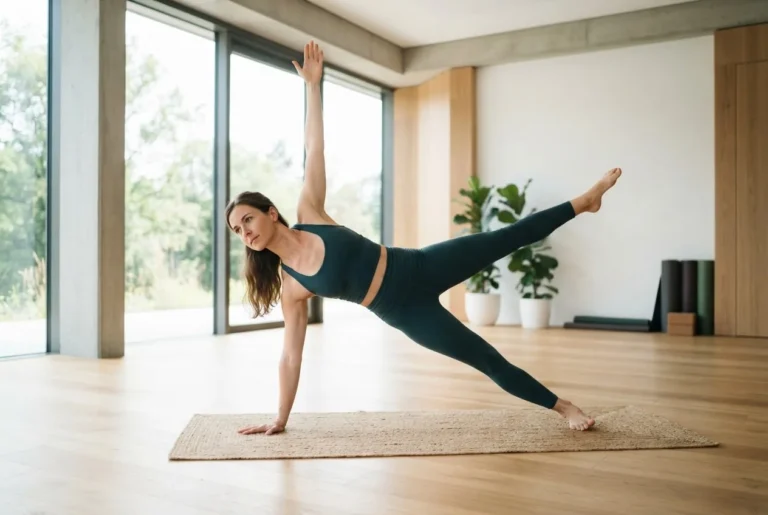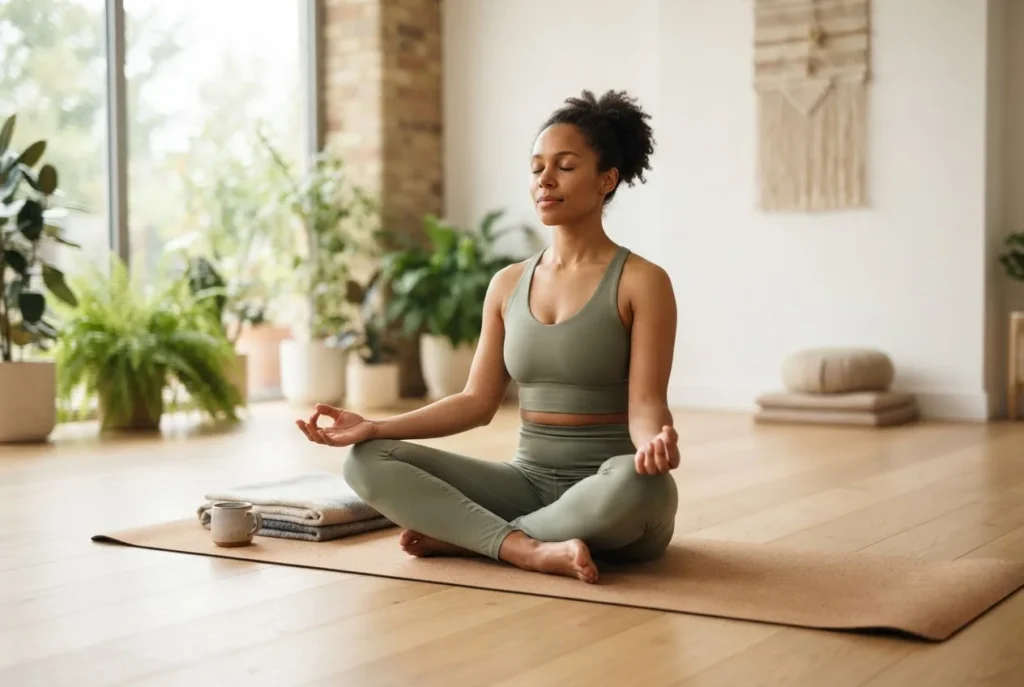
Yoga vs meditation: both cultivate calm and focus, but yoga is a system combining physical postures, breath control and ethical practice while meditation is primarily a mental training for attention and awareness; each can reduce stress and improve wellbeing, and many people integrate them for complementary benefits.
Introduction to Yoga and Meditation
Answer: Yoga and meditation are related but distinct traditions that share a mind-body connection and aim for mental clarity and relaxation; yoga combines movement, breath and philosophy while meditation focuses on attention and inner awareness. The overview below frames origins, shared aims and practical context.
Yoga: an ancient holistic practice combining physical postures, breath regulation, ethical guidelines and contemplative methods originating in South Asia.
Meditation: a set of practices that train attention and awareness to cultivate mental stillness, clarity and emotional regulation.
Both developed within long-standing traditions and now appear across health and wellness contexts; they address stress reduction, mental clarity and the mind-body connection through different primary routes—movement-plus-breath versus primarily mental focus.
Transition: Next we examine yoga as a physical and mental discipline to see what the practice includes and why it’s often grouped with meditation.
Defining Yoga: Physical and Mental Discipline
Answer: Yoga is a multi-limbed discipline that integrates physical postures (asanas), breath control (pranayama), concentration and ethical precepts to cultivate strength, flexibility, breath awareness and a contemplative mind. It is both a physical and mental training system with spiritual roots in classical texts.
Asana: a physical posture or seat used in yoga practice to develop strength, balance and alignment.
Pranayama: breath control techniques in yoga designed to regulate life-energy (prana) and support concentration and relaxation.
- Core components
- Asanas — physical postures to build flexibility, strength and proprioception.
- Pranayama — regulated breathing practices that influence autonomic state and attention.
- Dharana and Dhyana — concentration and meditative absorption described in yoga philosophy.
- Yamas and Niyamas — ethical guidelines for lifestyle and mental habits in classical yoga.
- Relaxation/Restorative practices — guided relaxation like savasana to integrate practice.
- Typical session structure (example)
- 5–10 minutes: centring and breath awareness (pranayama).
- 20–40 minutes: dynamic or static asanas (movement, alignment).
- 5–10 minutes: cooling poses and restorative holds.
- 5–15 minutes: guided relaxation or short meditation (dhyana).
- Philosophical context
Classical sources such as Patanjali’s Yoga Sutras describe an eight-limbed path where meditation is embedded as a later limb; physical practices prepare the body and mind for sustained attention and contemplative states.
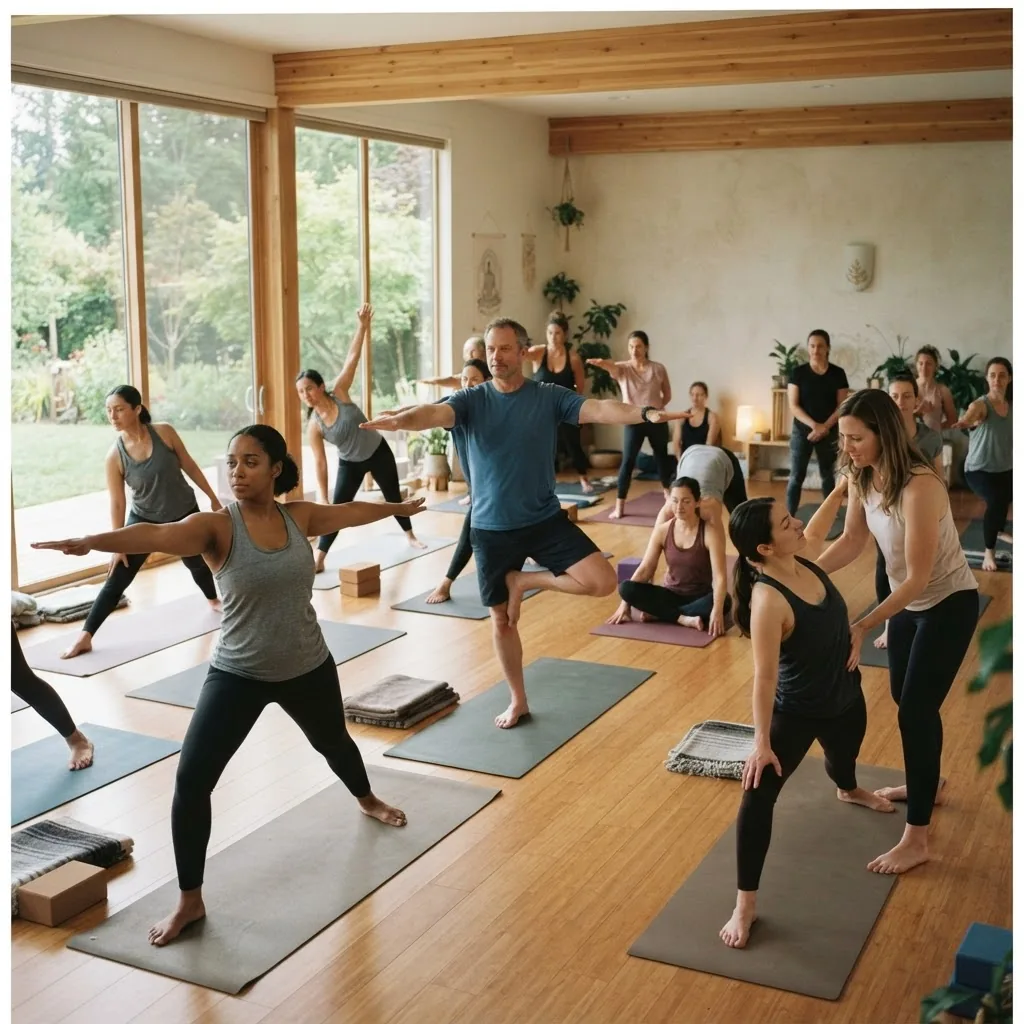
Practical scenario: a 45-minute Hatha class combines movement and breath with the explicit aim of calming the nervous system and preparing the student for inward attention; many practitioners then sit for a short meditation to deepen concentration.
Transition: After exploring yoga’s physical and philosophical framework, we next define meditation more narrowly as focused mental training and outline common techniques.
Defining Meditation: Focused Mental Practice
Answer: Meditation is a set of practices that train attention, awareness and the quality of mind—common forms include focused attention, open monitoring and loving-kindness; meditation can be seated, walking, or integrated into activities and is primarily a mental discipline rather than a physical exercise.
Meditation: systematic mental training to cultivate attention, awareness and emotional regulation.
Mindfulness meditation: a practice maintaining nonjudgmental, present-moment awareness of sensations, thoughts and emotions.
- Common meditation methods
- Focused attention — sustain attention on a single object (breath, mantra, image).
- Open monitoring — observe thoughts, sensations and feelings without attachment.
- Loving-kindness (metta) — intentionally cultivate benevolent feelings toward self and others.
- Breath awareness — simple, accessible anchor for stabilizing attention.
- Movement-based meditation — walking meditation, mindful movement (may overlap with yoga).
- Typical session structure (example)
- 1–2 minutes: posture and body-scan to settle.
- 10–20 minutes: chosen technique (focused attention or open monitoring).
- 2–5 minutes: soft closing, noting the state of mind before resuming activity.
- Technique reference
For deeper practical methods see effective meditation techniques.
Transition: With both practices defined, the next section compares them side-by-side—practice type, goals, settings and how they each shape the mind and body.
How Is Yoga Different from Meditation?
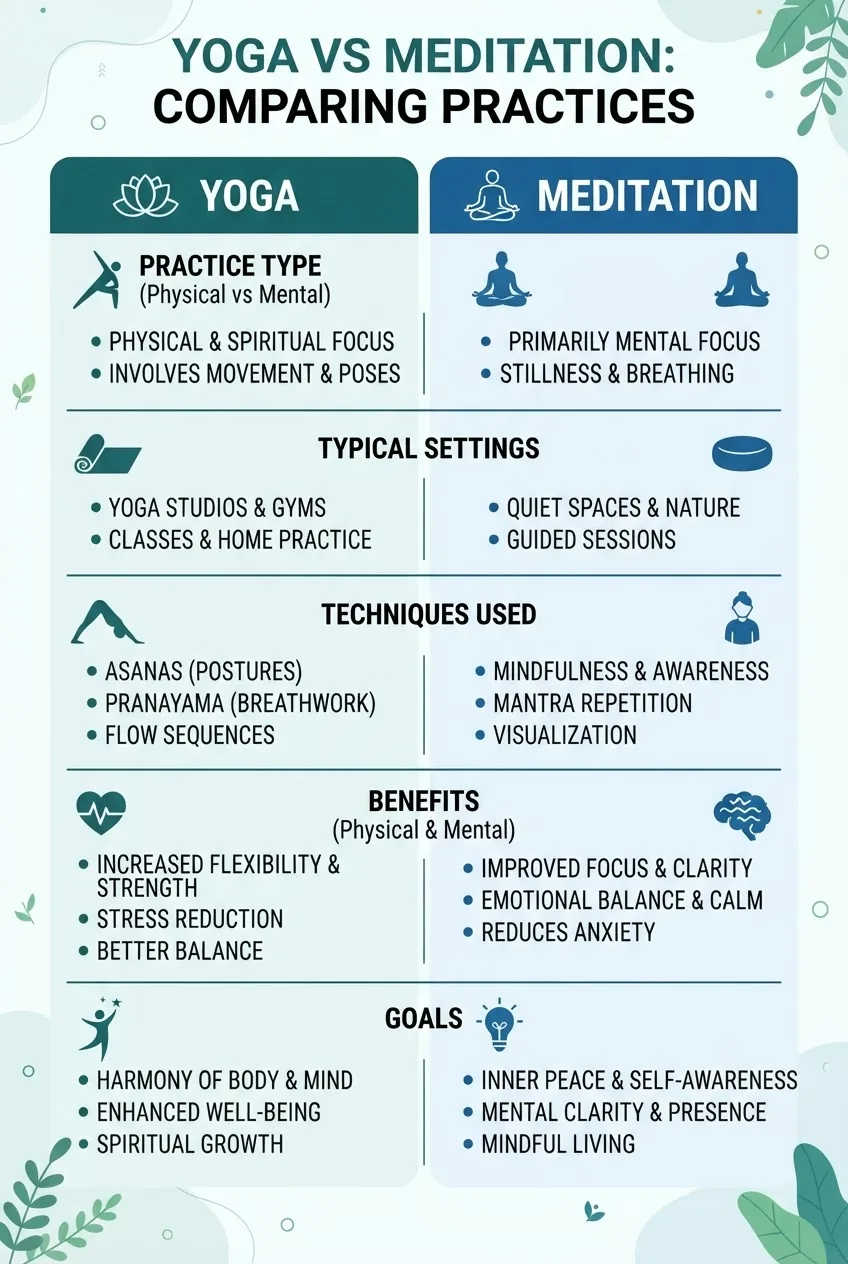
Answer: Yoga emphasizes integrated physical and breath practices that prepare body and mind, while meditation emphasizes sustained mental training; differences show in activity level, technique, immediate effects and long-term goals, though the practices overlap and reinforce each other.
| Category | Yoga | Meditation |
|---|---|---|
| Practice type | Movement + breath + philosophy (embodied practice) | Primarily mental training (attention and awareness) |
| Typical setting | Studio, gym, home mat | Quiet seat, cushion, chair, or walking space |
| Primary techniques | Asanas, pranayama, bandhas, rest | Focused attention, open monitoring, loving-kindness |
| Physical effect | Improves strength, flexibility, balance | Minimal physical demands; posture matters |
| Mental/Emotional effect | Regulates arousal via movement and breath; supports mindfulness | Directly trains attention, reduces ruminative thinking |
| Session length | Often 30–90 minutes | Often 5–60 minutes |
| Long-term goal | Integrated health: body, breath, ethics, contemplation | Stable attention, clear awareness, emotional regulation |
Elaboration: The active vs passive framing helps: yoga tends to be active and embodied, using asanas and pranayama to influence physiology; meditation is comparatively passive in terms of movement but active in directing attention and noticing mental events.
Scientific context: physiological effects differ—movement and breath practices in yoga elicit parasympathetic engagement and musculoskeletal benefits, while focused meditation alters attentional networks and emotional reactivity; see a major review on meditation effects for evidence-based context.
Evidence: According to a 2014 meta-analysis in JAMA Internal Medicine on meditation programs, mindfulness-based interventions produced moderate reductions in anxiety and small-to-moderate reductions in depression (peer-reviewed study).
Caveats: individual response varies by baseline health, practice dose, and instruction quality; some people find movement-based entry through yoga easier, while others prefer seated practices. Transition: Given overlap, the next section asks directly whether yoga can be considered meditation and where they intersect.
Is Yoga Meditation? Exploring Overlaps and Differences
Answer: Yoga can include meditation—classical yoga explicitly contains contemplative limbs—but not every yoga session is meditation; elements such as sustained attention to breath, repeated movement with mindful awareness, or seated dhyana qualify portions of yoga as meditative.
Historical note: classical sources (e.g., Patanjali’s Yoga Sutras) present meditation (dhyana) as an essential limb of yoga, meaning that meditation is embedded within the broader yoga path rather than being identical to all yoga activity. See a translation of the Yoga Sutras for classical context: Patanjali’s Yoga Sutras.
Examples clarifying overlap:
- Asana with meditative focus — holding a posture while tracking breath and sensation cultivates sustained attention like focused attention meditation.
- Pranayama as a meditation — certain breath practices are used as direct objects for meditation and can induce meditative states.
- Class ending meditation — many yoga classes close with a seated or supine meditation (dhyana), which is explicitly meditation in form and intention.
Clarifying point: a vigorous Vinyasa class that emphasizes athletic sequencing may produce mental calm as a secondary effect, but unless attention is intentionally trained (for example, observing breath and thought), that class is not the same as formal meditation training.
Role of breath: breath awareness and pranayama are a significant bridge—breath-focused techniques function as meditation anchors in both traditions; for detailed breath-based methods see breathing meditation techniques.
Transition: Knowing how each practice can stand alone or blend informs practical thinking about benefits; the next section compares the health advantages of yoga versus meditation.
Benefits of Yoga Compared to Meditation
Answer: Both yoga and meditation reduce stress and support mental health, but yoga adds measurable physical benefits—strength, flexibility, balance and cardiorespiratory improvements—while meditation gives a focused pathway to attention control and emotional regulation; combined practice often yields complementary gains.
-
Stress reduction and anxiety relief
Both practices reduce subjective stress and physiological arousal through parasympathetic activation; meditation trains appraisal and thought patterns, while yoga reduces muscle tension and breath irregularity.
Evidence: According to a 2014 meta-analysis in JAMA Internal Medicine, mindfulness programs decreased anxiety and depression symptoms in diverse populations (peer-reviewed study).
-
Mental health benefits and mood regulation
Meditation provides direct training of attention and reduces rumination, often producing measurable improvements in mood and resilience; yoga contributes via movement, breath and embodied self-regulation.
-
Physical strength, balance and flexibility
Yoga delivers clear musculoskeletal benefits—improved strength, balance and flexibility from regular practice—advantages meditation does not directly provide.
-
Cardiorespiratory and autonomic benefits
Certain pranayama and active yoga sequences can improve breathing efficiency and influence heart rate variability, supporting stress resilience in ways distinct from seated meditation.
-
Cognitive function and attention
Meditation shows reliable improvements in attention, working memory and executive control through repeated attention training; yoga contributes cognitive benefits indirectly via improved sleep, mood and physical fitness.
-
Accessibility and contraindications
Meditation is accessible to most people without physical limitations, while some yoga postures need adaptation; consult instructors and healthcare professionals for contraindications, especially after injury or with specific medical conditions.
-
Long-term integration
Yoga’s philosophical elements (yamas/niyamas) encourage lifestyle change that can support lasting wellbeing; meditation’s skill of attention underpins sustained emotional self-regulation.
Clinical and public-health context: mental health organizations emphasize multi-modal care; complementary approaches like yoga and meditation can be used alongside therapy or medication when appropriate. For broader mental-health framing see the WHO fact sheet (WHO: mental disorders).
Transition: After comparing benefits, we’ll outline how to combine both approaches into a practical stress-reduction sequence and how that integrates with other supports.
Combining Yoga and Meditation for Stress Reduction
Answer: Combine yoga and meditation by sequencing gentle movement and breath (10–30 minutes) to reduce bodily tension, then follow with a focused attention or open-monitoring meditation (5–20 minutes); this integrated approach leverages embodied regulation to make meditation more accessible and effective.
Sample combined sequence (30 minutes)
- 5 minutes: gentle centring and pranayama (slow diaphragmatic breaths).
- 15 minutes: slow asana flow or restorative holds to release muscle tension and increase interoceptive awareness.
- 5–8 minutes: seated breath-focused meditation (focused attention).
- 2–5 minutes: brief metta or body-scan and soft transition back to activity.
Practice tips and integration context:
- Start with breath awareness during movement to translate embodied calm into a seated meditation.
- Use guided recordings to scaffold practice until independent concentration arises.
- Combine with other evidence-based supports when anxiety is severe—see anxiety counseling and therapeutic options or advanced tools advanced anxiety management tools.
- For practical daily strategies and step-by-step exercises see mindfulness exercises for anxiety, which shows routines suitable for integration with yoga.
- Reinforce practice with sleep hygiene, therapy, or medication when clinically advised (see medication and therapy guides linked above).
Case example: a client with workplace anxiety reported reduced reactivity after six weeks of combined short yoga sessions plus a daily 10-minute meditation; this mirrors findings in trials showing multimodal approaches often outperform single interventions for complex stress patterns (source: peer-reviewed literature and clinical program reports).
Transition: For readers ready to begin, the next section lists concrete starter tips to build separate and combined routines safely and sustainably.
Practical Tips to Start Yoga and Meditation Separately and Together
Answer: Begin with short, consistent sessions—5–15 minutes for meditation and 15–30 minutes for yoga—use comfortable settings, focus on breath and simple postures, and progressively increase duration; combine them by adding a short seated practice after yoga to deepen calm.
-
Set realistic duration
Start small: for meditation try 3–5 minutes (see short meditation sessions), for yoga try 15–20 minutes with gentle asanas.
-
Establish setting and consistency
Create a low-distraction corner, comfortable seat or mat, and pick a regular time—morning or evening boosts habit formation.
-
Choose accessible content
Begin with guided classes or recordings; for quick scripts see quick mindfulness practices and short meditations short meditation sessions.
-
Learn foundational postures safely
Follow beginner guidance—see beginner yoga routines—and modify poses to avoid strain.
-
Prioritise breath and attention
Use simple breath anchors (inhale-exhale counts) during movement to link body and mind; this makes subsequent seated meditation more stable.
-
Track progress and adapt
Note subjective changes—sleep, mood, reactivity—and adjust session length accordingly; seek qualified teachers for technique corrections or medical advice if needed.
Transition: Finally, we summarise how to choose the right practice based on goals and preferences and invite readers to act.
Conclusion: Choosing the Right Practice for You
Answer: Choose yoga when you want embodied benefits—strength, flexibility and breath-based regulation—and choose meditation when the priority is training attention and emotional regulation; many people benefit most from an integrated approach that pairs short meditations with regular yoga practice for holistic mental wellness.
Key takeaways:
- Yoga and meditation overlap but are not identical; yoga often contains meditative elements.
- Meditation trains attention directly; yoga adds physical and autonomic regulation through asanas and pranayama.
- Both reduce stress—evidence supports mindfulness-based programs and yoga interventions for anxiety and mood improvements (peer-reviewed meta-analysis).
- Integrate practices progressively, adapt to physical limitations, and use therapy or medication when appropriate (see related guides linked above).
CTA: If you’re unsure where to start, try a short combined routine today—10 minutes of gentle yoga followed by 5 minutes of breath-focused meditation—and explore our linked guides for quick scripts, beginner sequences and structured challenges to build a sustainable practice.